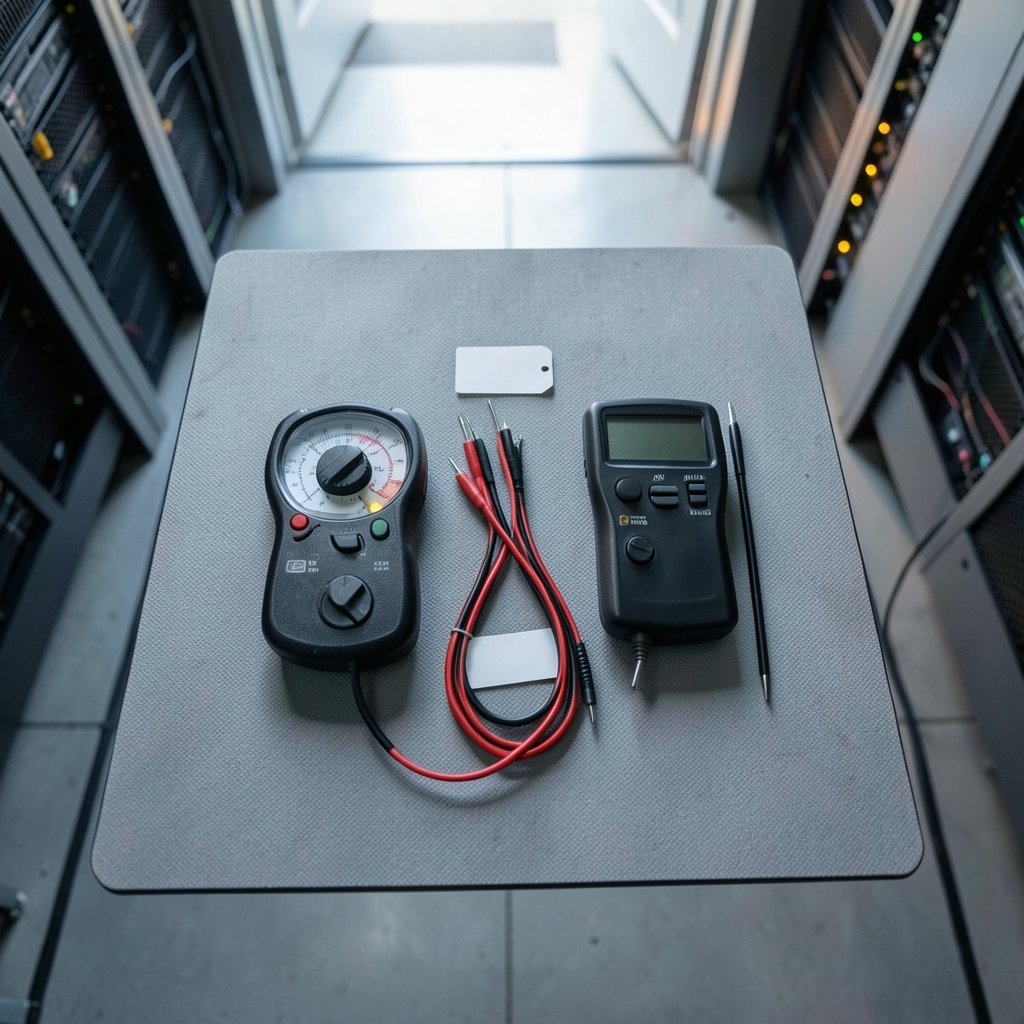
Quick Answer: Are expensive digital multimeters worth it?
It depends. For anyone working on mains wiring, industrial panels, or equipment that must be calibrated and documented, an expensive meter is worth it because you are paying for verified safety ratings, better input protection, and traceable calibration rather than bragging rights.
For hobbyists, students, and low-voltage tinkerers, a solid entry-level meter covers most everyday tasks at a fraction of the price. The gap shows up in stability over temperature, long-term drift, and how the meter behaves when something goes badly wrong.
Before buying, compare the full CAT rating with its voltage, true-RMS capability, input protection and fusing, calibration options, basic accuracy, and build quality. Price alone tells you very little.
Why do two multimeters that both claim “CAT III” and “±0.5% accuracy” sell for $30 and $300? On paper they look like twins. In the hand, and especially inside the case, they are not. The interesting part is figuring out which differences actually matter for the work you do, and which ones are just marketing polish.
The spec sheet hides the real differences

Cheap and mid-priced meters love to advertise basic DC accuracy, and honestly, many of them are decent at it. Plenty of sub-$50 models claim ±0.5% DC accuracy, which lands close to what mid-range meters promise. If accuracy on a fresh bench test were the whole story, the expensive meter would be a tough sell.
The problem is that a spec sheet is a snapshot, not a movie. What it rarely shows is how the reading drifts as the meter warms up, how it behaves after a year in a hot van, and whether anyone can prove the number was ever correct. Those qualities cost money to engineer and to certify, and they are exactly what you pay for at the higher end.
There is also a quieter issue: marketing copy. A meter can print “CAT III” on the front in bold letters, but the rating only means something when it is paired with a voltage and backed by actual testing. “CAT III” alone says very little. “CAT III 600 V” or “CAT III 1000 V” is the full claim, and that distinction trips up a lot of buyers.
Safety ratings are the strongest reason to pay more
This is the part worth slowing down for. IEC 61010-1 defines the measurement categories, usually called CAT II, CAT III, and CAT IV, along with the transient overvoltages a meter must survive in each one. The standard was first published in 1992, and the current edition is IEC 61010-1:2010+A1:2016.
Here is the practical translation. A CAT III 1000 V rating means the meter has been tested against much higher transient overvoltages than a CAT II 600 V rating. Those transients are the invisible spikes that ride on mains power and industrial circuits, and they are what turns a careless measurement into a firecracker.
Cheap meters often print “CAT III” without independent testing behind it. That does not automatically make them bombs, but it does mean the label is a claim rather than a verified fact. When a meter is going anywhere near a distribution panel or a three-phase motor drive, that difference is the whole ballgame.
Input protection is where the money quietly goes
Open up a cheap meter and an expensive one side by side and the cost gap starts to make sense. Real protection costs real money: fused current inputs, high-energy resistors, and MOVs or varistors all add to the bill of materials. Teardown comparisons of budget versus branded meters commonly show missing or undersized protection parts.
You will not see any of that on the box. You only notice it on the day you accidentally leave the probes in the current jacks and touch a live circuit. Good protection is insurance you buy once and hopefully never test.
True-RMS matters more than most people realize
Inexpensive meters frequently use averaging, also called mean-responding, AC measurement. On a clean sine wave from a wall outlet, that is fine. On distorted waveforms, it reads low, sometimes badly low.
Where does this bite? Variable-frequency drives, dimmers, and modern electronics with switching power supplies all produce non-sinusoidal waveforms. A true-RMS meter handles those correctly. True-RMS meters are specified for crest factors, typically up to 3:1 at full scale, which is the technical way of saying they stay honest when the waveform gets spiky.
If your work is automotive, HVAC, industrial controls, or anything involving drives and inverters, true-RMS is not a luxury. It is the difference between a reading and a guess. For basic household checks, an averaging meter will usually get you close enough.
Calibration and traceability: the invisible premium
A meter with a documented calibration certificate traceable to a national metrology institute supports regulated or quality-controlled work. In the US that traceability runs back to NIST; in the UK, to NPL. Traceability is the chain of comparisons that lets you say, with evidence, that your meter reads what it says it reads.
That chain costs money, and it is a big part of why professional meters carry professional prices. It also explains why calibration services exist as a business: instruments need periodic checking, and a certificate is often a requirement rather than a nicety.
For a hobbyist, this is mostly irrelevant. For anyone in manufacturing, medical equipment, aerospace, or anywhere a quality system audits the tools, an uncalibrated bargain meter is a paperwork problem waiting to happen. If you are weighing similar cost-of-ownership questions elsewhere in your toolkit, the same logic shows up in software subscriptions, as this breakdown of whether ChatGPT Plus is worth it in 2026 makes clear.
What you actually get at each price tier
Approximate price bands help frame the decision, though treat them as rough guides and check current prices before buying.
| Tier | Typical price | What you usually get | Best for |
|---|---|---|---|
| Entry-level | $20–60 | Basic accuracy, averaging AC, limited or unclear protection, “CAT III” claims without documentation | Hobbyists, students, low-voltage bench work |
| Mid-range | $100–300 | True-RMS, documented CAT ratings, fused inputs, better build and stability | Serious DIY, electronics techs, field service |
| Professional/industrial | $300–1000+ | Verified CAT III/IV ratings, robust input protection, calibration support, long-term stability | Electricians, industrial maintenance, regulated work |
The jump from entry-level to mid-range buys the most meaningful upgrade for most people. The jump from mid-range to professional buys assurance, durability, and documentation, which only pay off if your work demands them.
The regulatory layer nobody reads
Multimeters sold in the EU must meet the Low Voltage Directive and the EMC Directive. Here is the catch that surprises people: CE marking is a self-declaration. A manufacturer can apply it without an independent lab verifying the CAT rating. So a CE mark is not proof of independent CAT testing, no matter how official it looks on the back of the case.
That does not mean every CE-marked budget meter is suspect. It means the mark tells you less than most buyers assume. The same “read the fine print” instinct applies to plenty of consumer purchases, whether you are judging Xbox Game Pass costs in 2025 and whether they are worth it or deciding if a collectible coin is genuinely valuable.
Common mistakes buyers make
A few patterns come up again and again, and avoiding them saves both money and grief.
- Buying the label, not the rating. “CAT III” without a voltage is marketing. Always look for the full “CAT III 600 V” style claim.
- Assuming higher price means higher accuracy. Basic accuracy is often similar across tiers. Stability, protection, and traceability are the real dividers.
- Skipping true-RMS to save $40. Fine for outlets, wrong for drives and inverters.
- Ignoring the probes. Cheap probes with thin insulation undercut a good meter. The probe is part of the safety system.
- Never checking calibration. Even a great meter drifts. If your work is regulated, build calibration into the budget from day one.
What actually works in practice
Match the meter to the job, not to the shelf appeal. For low-voltage bench work, breadboards, Arduino projects, and checking batteries, an entry-level meter does the job and does it well. Spend the savings on decent probes and a second meter so you can watch voltage and current at the same time.
For anything touching mains wiring, panel work, or motor controls, step up to a meter with a documented CAT III rating at the right voltage and true-RMS measurement. This is the tier where the price premium earns its keep, and it is also the tier where a mistake is most expensive.
For regulated or industrial environments, buy the professional tier and treat calibration as a recurring cost, not an afterthought. The certificate is often the point.
One honest caveat: there is no verified, dated study comparing failure rates or safety incidents between cheap and expensive meters. The claim that cheap meters are “dangerous” gets repeated constantly, but hard primary data is hard to find. Treat it as a sensible caution rather than a proven statistic. The evidence-backed case for spending more rests on verified safety ratings and traceability, not on scare stories.
Where the money goes if you skip the premium tier
If a professional meter is not in the cards, the next best move is spending a little on the parts that matter. Good silicone test leads with proper ratings, a spare fuse, and a known-good reference source for sanity checks go a long way. Many people who tinker with electronics also find that free or low-cost tools stretch a budget further than expected, much like the picks in this roundup of free AI tools worth your time.
The principle is the same across hobbies: put money where failure is costly, and save it where failure is merely annoying. A blown $30 meter on a breadboard is a bad afternoon. A blown $30 meter inside a live panel is a different category of problem entirely.
Conclusion
Expensive digital multimeters are worth it when the work demands verified safety, traceable accuracy, and durability under real conditions. They are not worth it when a basic meter covers everything you do. The smartest buyers ignore the price tag and read the rating: full CAT category with its voltage, true-RMS where waveforms are dirty, real input protection, and calibration support if anyone will ever audit the results.
Buy for the job in front of you, not the fantasy of the job you might have someday. A mid-range meter with honest specifications beats a bargain with impressive-looking claims, and it beats an overpriced professional model gathering dust on a shelf. Spend where failure hurts, save where it does not, and always read the label past the bold letters.
FAQ
Is a $30 multimeter safe for household electrical work?
It can be, if it carries a full CAT rating with a voltage, such as CAT III 600 V, and has fused inputs. The risk is that budget meters often print “CAT III” without independent testing behind it. For occasional outlet checks it is usually fine, but for panel work, spend more.
Do I really need true-RMS?
Only if you measure non-sinusoidal waveforms, such as variable-frequency drives, dimmers, or switching power supplies. On those, averaging meters read low. For basic household and low-voltage DC work, an averaging meter is usually adequate.
How often should a multimeter be calibrated?
It depends on your quality system and how critical the measurements are. Many regulated environments calibrate annually. For hobby use, calibration is rarely necessary, though occasional checks against a known reference are a sensible habit.
Can a cheap meter damage the circuit I am testing?
Possibly. Meters with poor input protection and low-quality probes can cause shorts or arcs if something goes wrong, especially on mains circuits. Good fusing and proper probe ratings reduce that risk considerably.
What is the difference between CAT III and CAT IV?
CAT IV covers measurements at the origin of the installation, such as service entrances, where transient energy is highest. CAT III covers distribution circuits and panel-level work. CAT IV demands more protection, and both ratings only mean something when paired with a voltage.
Is an expensive meter more accurate than a cheap one?
Not necessarily in basic accuracy terms. Many budget meters claim ±0.5% DC accuracy, close to mid-range models. The real differences show up in stability over temperature, long-term drift, input protection, and calibration traceability.