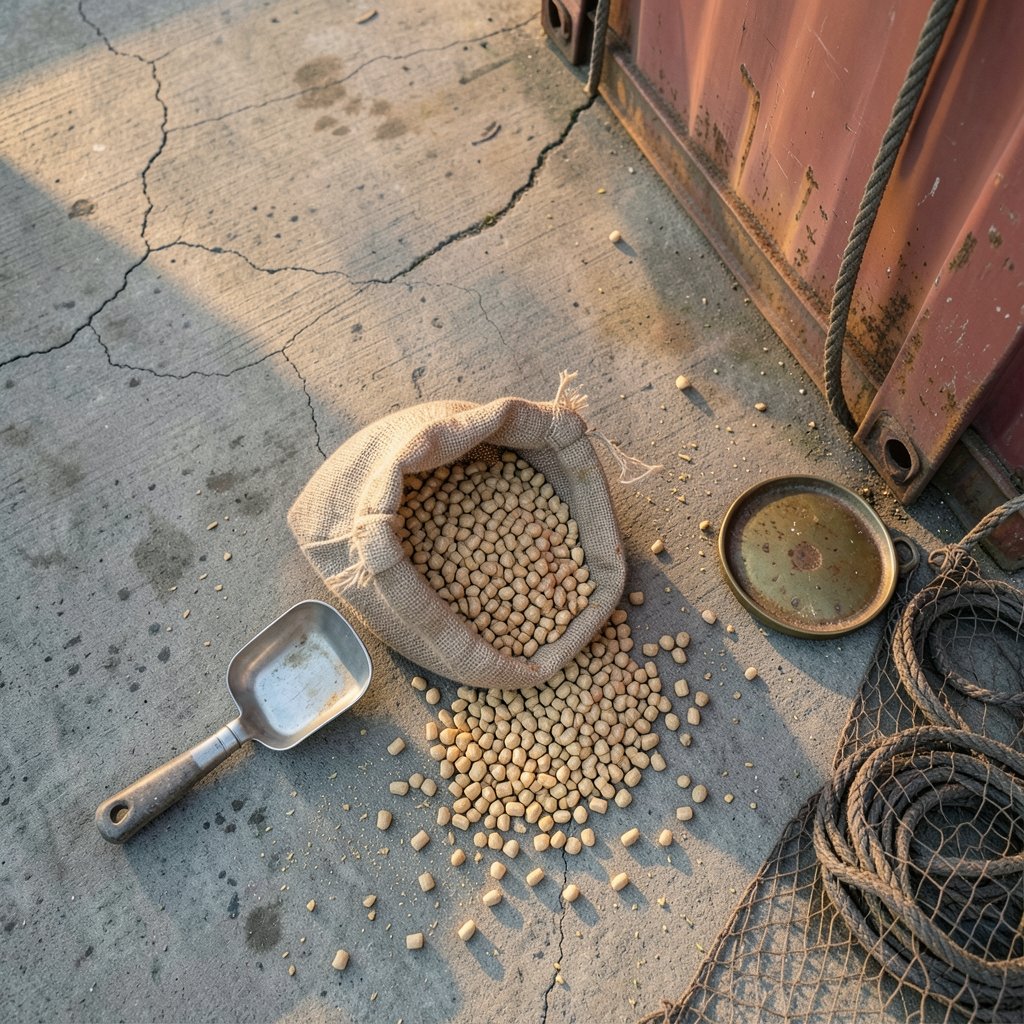
What if the fuel that keeps a factory boiler running travels 5,000 kilometres before it burns? That is exactly what happens when India imports biomass pellets, and the numbers behind those shipments are more interesting than most buyers expect. India has become a major destination for biomass pellet imports, with hundreds of shipments arriving in a single year. The trade is shaped by a 5% basic customs duty, a small social welfare surcharge, a handful of dominant supplier countries, and a domestic supply chain that still cannot keep up with demand from power plants and industrial boilers.
This article walks through what actually lands at an Indian port, what it costs to clear, where it comes from, and the mistakes that catch first-time importers off guard.
What counts as a biomass pellet at Indian customs?
Not every compressed lump of organic matter gets the same treatment at the border. The classification depends on what the pellet is made of and how it is described on the invoice.
Wood pellets sit under HS code 4401.31, formally “sawdust and wood waste and scrap, agglomerated in logs, briquettes, pellets or similar forms.” The eight-digit Indian tariff item is 44013100. This is the code most importers of wood-based fuel pellets use.
A related code, 44012200, covers non-coniferous agglomerated pellets and briquettes. It carries the same headline rates but applies to a different product description, so the two are not interchangeable on a bill of entry.
Agricultural residue pellets, made from rice husk, mustard stalk or bagasse, can be classified differently depending on composition and end use. That matters because the duty treatment and the paperwork both shift with the code.
The practical lesson: get the classification right before the container ships. A wrong code at the port means demurrage, amended bills of entry and sometimes a penalty. Customs brokers who handle wood products regularly will flag the difference between 44013100 and 44012200 in minutes. New importers often do not.
How much duty does India charge on imported wood pellets?

The core numbers are simple enough to memorise.
| Charge | Rate | Notes |
|---|---|---|
| Basic customs duty (MFN) | 5% | Applies to HS 4401.31 |
| Social Welfare Surcharge | 10% of basic duty | Works out to 0.5% of assessable value |
| IGST | 5% | Under Schedule I of the integrated tax rate notification |
| Total effective incidence | About 11.06% | On a CIF assessable value of ₹100 |
The Social Welfare Surcharge is the line item that surprises people. It is not 10% of the cargo value. It is 10% of the basic customs duty, which is 5%, so the surcharge adds half a percentage point. Small, but it shows up on every bill of entry.
The IGST is creditable for registered businesses, so the true cost to a GST-registered importer is closer to the duty plus surcharge, with the IGST flowing back as input tax credit. For unregistered buyers, the full 11.06% is a real cost.
Rates change. Preferential agreements, anti-dumping actions and product-specific notifications can all move the effective number. Anyone budgeting a large shipment should confirm the current rate with a customs broker or the official tariff schedule rather than relying on a figure from an older purchase order.
Which countries supply India’s biomass pellets?
Trade records point to a short list of origins. Nepal, Indonesia, China and the Netherlands appear repeatedly in shipment data, with Nepal standing out as the largest supplier by import value over the most recent twelve-month window tracked in tariff databases.
The Nepal trade makes geographic sense. Land border, short freight, and a steady supply of sawmill residue from Himalayan timber operations. Cargo moves by road through border crossings in Bihar and Uttar Pradesh rather than by sea.
Indonesia and China bring volume by sea, typically in containers of wood pellets for industrial buyers. The Netherlands appears in the data as a trading hub as much as a producer, with material consolidated and re-exported.
One pattern worth noting: shipment records show cargo sizes ranging from small consignments of a few tonnes to full container loads in the tens of tonnes. A single bill of lading in mid-2025 recorded roughly 84 metric tonnes of biomass wood pellets from Indonesia, while a Nepal consignment the same month ran to 19 tonnes. The trade is not dominated by one scale of buyer.
Is India’s import demand growing?
The shipment counts tell a striking story. Import data covering October 2023 to September 2024 recorded 450 biomass pellet shipments into India, supplied by 16 foreign exporters to 17 Indian buyers, a growth rate of 650% compared with the preceding twelve months.
Treat that figure with care. A 650% jump from a small base is easier to achieve than it sounds, and monthly shipment counts can be lumpy. But the direction is clear: Indian buyers are sourcing more pellets from abroad.
Why? Domestic pellet manufacturing has expanded, yet industrial demand from co-firing in thermal power plants, brick kilns, distilleries and food processing boilers has grown faster. When domestic supply tightens or prices spike, importers fill the gap.
The broader economics of Indian trade and currency movement also shape landed costs. A weaker rupee makes dollar-denominated cargo more expensive, which can flip a deal from viable to marginal overnight. Buyers who track the rupee alongside pellet prices tend to negotiate better, a point that comes up whenever the India money rupee UPI digital cash really work question surfaces in trade circles.
What does a shipment actually cost to land?
Landed cost is where theory meets the invoice. A simple worked example helps.
Assume a CIF value of ₹100 per unit of cargo. Basic customs duty takes ₹5. Social welfare surcharge adds ₹0.50. IGST at 5% applies to the sum of assessable value plus duty, adding roughly ₹5.28. Total outlay before credits: about ₹110.78. For a GST-registered buyer, the IGST portion returns as credit, leaving an effective cost of about ₹105.50.
Then add the costs that never appear in the tariff schedule:
- Freight and insurance beyond the CIF quote, if the terms are FOB.
- Port handling and terminal charges, which vary widely between Nhava Sheva, Chennai and Kolkata.
- Customs broker fees, typically a flat fee per bill of entry.
- Inland transport from port to plant, often the largest single add-on for interior locations.
- Moisture and quality claims, which can quietly erode value if the specification is loose.
A common mistake is comparing an imported pellet price per tonne directly with a domestic quote. The domestic price already includes delivery. The import quote usually does not. Once freight, duty, port costs and inland haulage are stacked on, the gap narrows sharply, and sometimes reverses.
What quality and specification issues trip up importers?
Pellets are not a uniform commodity. Two cargoes at the same price per tonne can behave very differently in a boiler.
The specification items that matter most:
- Moisture content, usually targeted below 10%. Wet pellets lose calorific value and can swell in storage.
- Ash content, critical for boilers with tight tolerance. High-ash cargo from mixed feedstock can slag furnace grates.
- Calorific value, quoted in kcal/kg or MJ/kg, which determines how much fuel a plant actually needs.
- Fines, the dust fraction created by handling, which reduces usable mass and creates fire risk in silos.
- Durability index, a measure of how well pellets survive transport without crumbling.
First-time buyers frequently accept a supplier’s certificate of analysis without arranging independent inspection at loading. That is the single most common error. A pre-shipment inspection by a recognised surveyor costs a fraction of a rejected container, and it gives the buyer leverage if the cargo arrives out of spec.
Another frequent mistake: ordering a full container of an unfamiliar grade to test. Better to buy a small trial consignment, run it through the actual boiler, and measure ash and heat output before committing to volume.
Storage deserves planning too. Pellets absorb moisture, and monsoon-season arrival at an open yard can ruin a cargo before it is used. Covered, ventilated storage is not optional in most of India.
How does domestic supply compare with imports?
India’s pellet market is developing quickly, with grades split between standard, utility and premium pellets, and applications spanning power plants, commercial heating, combined heat and power and even animal bedding. Domestic mills cluster near sawmill and agro-residue belts.
Imports fill three gaps: volume when domestic mills are stretched, specific grades that domestic producers do not make in quantity, and price arbitrage when landed import costs undercut local quotes.
The balance shifts with season, harvest cycles and power plant procurement tenders. Buyers who maintain relationships with both domestic mills and overseas suppliers ride out the swings better than those locked into a single source.
There is also a technology angle. As India’s digital and industrial infrastructure expands, logistics costs fall and supply chains tighten. The same forces reshaping connectivity, discussed in pieces like Jio vs starlink india satellite internet really costs 2026, eventually reach rural feedstock collection and warehouse tracking, which is where pellet supply chains are weakest.
What should a first-time importer do differently?
Practical steps that separate smooth shipments from expensive lessons:
- Verify the HS code in writing with a customs broker before booking cargo. Confirm whether the product is 44013100 or falls elsewhere.
- Ask for a pre-shipment inspection and specify the test parameters in the contract.
- Price the full landed cost, not the FOB or CIF number, before comparing with domestic quotes.
- Check the supplier’s export history. Trade data platforms list shipment records, buyer names and volumes, which is a fast way to spot a trader posing as a producer.
- Start small. A trial container through the full clearance process reveals broker quality, port delays and inland logistics issues at low risk.
- Budget for currency movement. A 3% rupee swing can wipe out a thin margin on a large cargo.
For importers weighing multiple cross-border opportunities at once, the discipline is the same as in any trade relationship: verify the counterparty, model the full cost, and keep a domestic fallback. The dynamics described in India vs south africa cricket rivalry trade ties really apply just as well to pellet sourcing, where relationships and reliability matter as much as headline price.
Conclusion
Biomass pellet imports into India are a small but fast-moving corner of the energy trade. A 5% basic duty, a 0.5% social welfare surcharge and 5% IGST set the baseline, and the total effective incidence lands near 11% before credits. Nepal leads the supplier list, with Indonesia, China and the Netherlands filling out the roster. Shipment volumes have grown sharply from a modest base, driven by industrial demand that domestic mills cannot fully meet.
The importers who succeed are not the ones who chase the cheapest quote per tonne. They are the ones who classify correctly, inspect before loading, model the full landed cost, and keep a domestic option open. Pellets are a fuel, and fuel buyers who treat quality and logistics as seriously as price are the ones whose boilers keep running through the monsoon.
FAQ
What is the import duty on biomass pellets in India?
Wood pellets under HS code 4401.31 attract a 5% basic customs duty, plus a Social Welfare Surcharge of 10% of that duty, which equals 0.5% of the assessable value. IGST at 5% also applies under Schedule I. The total effective incidence is about 11.06% on a CIF value of ₹100, though registered businesses can claim the IGST as input tax credit.
Which country is the largest supplier of biomass pellets to India?
Nepal is the largest supplier by import value over the most recent twelve-month period tracked in tariff databases. Indonesia, China and the Netherlands also appear as significant origins in shipment records, with sea freight containers arriving from Southeast Asia and consolidated cargo moving through European trading hubs.
Is a licence required to import biomass pellets into India?
Importers need a valid Importer Exporter Code from the Directorate General of Foreign Trade, GST registration, and standard customs documentation including the bill of entry, commercial invoice, packing list and bill of lading. Wood products may also require plant quarantine clearance depending on origin and treatment. Confirm current requirements with a customs broker, since phytosanitary rules vary by source country.
How long does customs clearance take for a pellet shipment?
Sea cargo typically clears in three to seven working days if documents are complete and the HS code is correct. Land border cargo from Nepal can move faster. Delays usually stem from classification disputes, missing certificates or valuation queries rather than the physical inspection itself.
Can agricultural residue pellets be imported under the same code as wood pellets?
Not always. HS 4401.31 specifically covers wood-based pellets. Agricultural residue pellets may fall under a different classification depending on feedstock and end use, which changes the duty and documentation requirements. Importers should confirm the correct code for their specific product before shipment rather than assuming the wood pellet code applies.
What is the biggest mistake new importers make?
Accepting a supplier’s own quality certificate without independent pre-shipment inspection. Moisture, ash content and fines can vary widely between cargoes, and a rejected container is expensive to return or dispose of. A surveyor’s report at loading costs little and protects the entire shipment value.