
How Can AI Help Me Generate More Sales? Artificial intelligence can help businesses increase revenue by identifying high-intent leads, personalizing customer outreach, automating follow-ups, and improving sales decisions. By reducing repetitive tasks and highlighting valuable opportunities, AI allows sales teams to spend more time connecting with potential customers and closing deals.
Whether you run a lean solo operation or manage an established revenue team, understanding how to apply AI across your sales cycle can turn missed opportunities into predictable growth. Below is a clear, practical breakdown of how AI drives revenue, which tools fit different stages of the funnel, and how to implement them without losing the human touch.
How Can AI Help Me Generate More Sales with AI-Powered Strategies?

In a sales context, artificial intelligence refers to software systems that analyze historical customer data, recognize buying patterns, generate tailored communication, and automate routine workflows. Rather than relying on static rules such as sending the exact same email sequence to every subscriber AI adapts based on real-time behavior, engagement signals, and deal context.
Most revenue-generating AI falls into three functional categories:
- Predictive AI: Evaluates historical CRM records, website behavior, and company data to forecast deal outcomes, score leads, and flag churn risks.
- Generative AI: Drafts personalized outreach emails, summarizes discovery calls, builds proposal templates, and creates tailored responses to buyer objections.
- Conversational AI: Powers intelligent website chat assistants and voice agents that answer product questions, qualify inbound visitors, and book calendar meetings around the clock.
7 Practical Ways AI Helps You Generate More Sales

Implementing AI does not require an enterprise budget or a complete overhaul of your tech stack. Focusing on high-friction bottlenecks typically delivers the fastest return on effort.
1. Prioritizing High-Intent Leads with Predictive Scoring
Chasing every inbound inquiry equally drains time and lowers morale. AI lead scoring analyzes thousands of data points including company size, industry, email opens, pricing page visits, and past purchase patterns to rank prospects by their likelihood to convert.
AI-powered lead scoring can also evaluate customer fit and engagement using historical CRM data, as explained in HubSpot’s guide to building lead scores with AI.
When your team starts every morning calling the top tier of scored leads first, response times drop and conversion rates rise. You stop guessing who is ready to buy and focus energy where intent is strongest.
2. Accelerating Account and Prospect Research
Thorough pre-call preparation builds trust, yet manually reading company updates, announcements, and public profiles for every prospect takes hours. AI research assistants scan public company news, leadership changes, hiring trends, and recent milestones in seconds, compiling a concise briefing before you pick up the phone.
Having relevant context at your fingertips allows you to open conversations with genuine insight rather than generic pitch lines.
3. Personalizing Outreach Without Sacrificing Volume
Buyers quickly ignore templated mass emails. Generative AI helps bridge the gap between scale and relevance by tailoring messaging to a prospect’s specific role, industry challenges, and recent triggers. Businesses can also explore different AI email marketing tools to improve campaign creation, audience segmentation, and email personalization.
Instead of asking AI to write an entire cold email from scratch which often sounds stiff feed it your core value proposition alongside specific details about the prospect. Use the output as a strong first draft, edit it to match your natural voice, and send messages that feel individually researched.
4. Capturing and Qualifying Inbound Leads 24/7
Interest cools rapidly when a potential buyer fills out a form or asks a question on your website and waits hours for a reply. Modern conversational AI assistants engage visitors immediately, answer routine questions using your approved product information, ask qualifying questions, and schedule meetings directly onto your calendar.
For e-commerce and self-serve businesses, AI recommendation engines also suggest relevant add-ons and complementary products based on browsing behavior and cart contents, increasing average order value automatically.
5. Eliminating Post-Call Administrative Bottlenecks
Manual data entry is one of the biggest hidden drains on sales productivity.
You can also use AI to automate tasks, such as updating CRM records, sorting incoming inquiries, and preparing routine follow-ups. Conversation intelligence tools record, transcribe, and summarize sales calls automatically extracting action items, buyer objections, budget details, and next steps straight into your CRM.
With accurate notes logged automatically, follow-up emails go out faster and nothing falls through the cracks between discovery and closing.
6. Identifying Deal Risks and Coaching Opportunities
Deals rarely stall overnight; warning signs usually appear days or weeks earlier in subtle shifts in buyer engagement. AI pipeline tools monitor communication frequency, sentiment changes, competitor mentions, and multi-stakeholder involvement to flag at-risk opportunities before they slip away.
Sales managers can also review AI-surfaced call highlights to see which messaging resonates best with top performers and coach reps on handling recurring objections effectively.
7. Improving Forecasting and Dynamic Pricing
Accurate revenue forecasting helps you allocate marketing budgets, plan inventory, and set realistic targets. AI forecasting models evaluate historical win rates, deal velocity, and seasonal demand to project revenue far more reliably than manual spreadsheet estimates.
In retail, travel, and high-volume consumer sectors, dynamic pricing algorithms also adjust offers in real time based on demand fluctuations, inventory levels, and customer segments protecting profit margins while staying competitive.
Matching AI Capabilities to Your Sales Stage

Choosing the right starting point depends on where your pipeline currently loses momentum.
| Sales Funnel Stage | Common Bottleneck | Practical AI Solution | Primary Outcome |
| Prospecting & Lead Gen | Hours spent researching accounts and building lists | AI prospect enrichment and intent-signal alerts | Faster list building and better-timed outreach |
| Inbound Qualification | Slow response times to website visitors and forms | 24/7 conversational AI chat and automated calendar booking | Higher lead capture and shorter speed-to-lead |
| Discovery & Demos | Forgotten follow-ups and messy CRM records | Automated call transcription, summaries, and CRM sync | More selling hours and consistent follow-through |
| Proposal & Closing | Time-consuming proposals, quotes, and stalled negotiations | AI proposal drafting and deal-risk monitoring | Faster quote turnaround and proactive deal saves |
| Retention & Expansion | Missed upsell windows and unexpected customer churn | Predictive churn alerts and personalized product recommendations | Higher customer lifetime value and repeat orders |
Practical Considerations Before Choosing AI Sales Tools
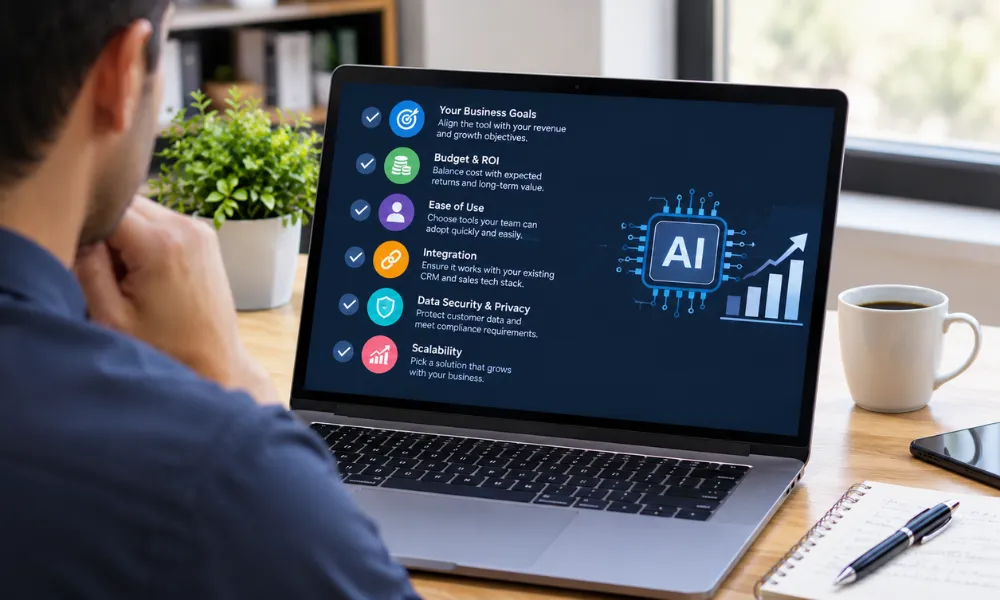
Adding more software does not automatically create more revenue. Before investing in new tools, evaluate three core factors:
- Data Quality: AI models rely on your CRM and customer records. Duplicate contacts, missing deal stages, and outdated notes lead to unreliable predictions. Clean up your core data fields first.
- Workflow Integration: The best AI features live inside the CRM, inbox, and calendar tools your team already uses daily. You can also explore these AI productivity tools to identify solutions that simplify daily tasks, improve team efficiency, and reduce repetitive work.
Standalone platforms that require constant tab-switching often go unused. - Human Oversight: Keep a human in the loop for external communication, pricing approvals, and nuanced negotiations. Use AI to draft, analyze, and recommend while people review and build trust.
Common Mistakes to Avoid When Using AI in Sales
Even strong tools can backfire when deployed carelessly. Watch out for these frequent pitfalls:
- Automating Bad Messaging at Scale: Sending thousands of generic, unedited AI emails damages your sender reputation and alienates prospects. Quality and relevance always outperform sheer volume.
- Buying Overlapping Tools: Many modern CRMs already include built-in AI features for email drafting, lead scoring, and call summaries. Audit your existing software before paying for separate subscriptions.
- Ignoring Buyer Privacy and Compliance: Ensure any tool recording calls or processing customer data complies with regional privacy laws, consent rules, and your company’s security policies.
- Expecting Instant Autopilot: AI improves steadily as it learns from your specific sales cycle, win-loss history, and feedback. Treat implementation as an iterative process rather than a one-click fix. For a more structured approach, learn about using AI at work productively and how to introduce AI into everyday business workflows while maintaining quality and human oversight.
Frequently Asked Questions
Can AI completely replace human salespeople?
No. While AI excels at data analysis, scheduling, research, and repetitive follow-ups, buyers still rely on human judgment, empathy, and trust especially for complex, high-value, or consultative purchases. AI works best as a co-pilot that handles busywork so salespeople can focus on real conversations.
Is AI useful for small businesses and solo founders, or only large enterprises?
Small businesses and solo founders often see the biggest immediate impact because AI acts like a force multiplier. Affordable AI assistants can handle website inquiries after hours, draft proposals in minutes, and keep contact records organized without requiring additional headcount.
How quickly can AI improve sales results?
Time-saving benefits such as automated call summaries, meeting scheduling, and email drafting show up within days of setup. Revenue improvements from predictive lead scoring and forecasting typically take a few weeks to a few months as the system gathers enough historical data to spot reliable patterns.
What is the easiest way to start using AI in my sales process?
Start with one high-friction daily task. Using an AI meeting assistant to transcribe calls and draft follow-up emails, or enabling built-in AI lead scoring inside your existing CRM, requires minimal setup and delivers immediate, measurable time savings.
Will AI-generated sales emails hurt my response rates?
Unedited, generic AI emails can lower response rates because buyers easily recognize robotic phrasing. However, when you use AI to gather prospect insights and structure a personalized draft that you refine in your own voice, response rates typically improve because your outreach is faster and more relevant.
How much do AI sales tools cost?
Costs vary widely depending on team size and features. Many core CRMs include basic generative and scoring tools in standard plans, standalone AI writing and meeting assistants often start at modest monthly per-user fees, and enterprise conversation intelligence or forecasting suites require custom annual contracts.
Final Thoughts
Generating more sales with AI comes down to removing friction between you and your buyers. By letting intelligent tools handle prospect research, lead prioritization, call notes, and timely follow-ups, you free up the time and mental bandwidth required to listen closely, solve customer problems, and close more deals. Start small, keep your customer data clean, and pair smart automation with authentic human conversation.
Disclaimer: This content is for informational purposes only and reflects our personal opinions and experiences. We just love to write and share what we know and research.