The best smart scales in 2027 are the ones that give you consistent, useful readings and an app you will actually open. A good smart scale should weigh accurately, sync without a fuss, and present body composition trends in plain language rather than a wall of unexplained numbers.
The short answer is that most people should buy a Wi-Fi scale from an established health brand, step on it at the same time each day, and judge progress over weeks, not single readings. Body composition figures from any home scale are estimates, so trends matter far more than any one morning’s percentage.
Key takeaways
- Buy for consistency, not precision: a scale that reads the same way every day is more useful than one chasing decimal-point accuracy.
- Wi-Fi syncing beats Bluetooth-only for most households, because readings upload even when your phone is in another room.
- Body fat, muscle mass and similar figures are estimates made by bioelectrical impedance, not direct measurements.
- Weigh at the same time, in the same conditions, and look at four-week trends.
- Check app costs before you buy: some scales keep their best features behind a subscription.
How a smart scale actually measures body composition
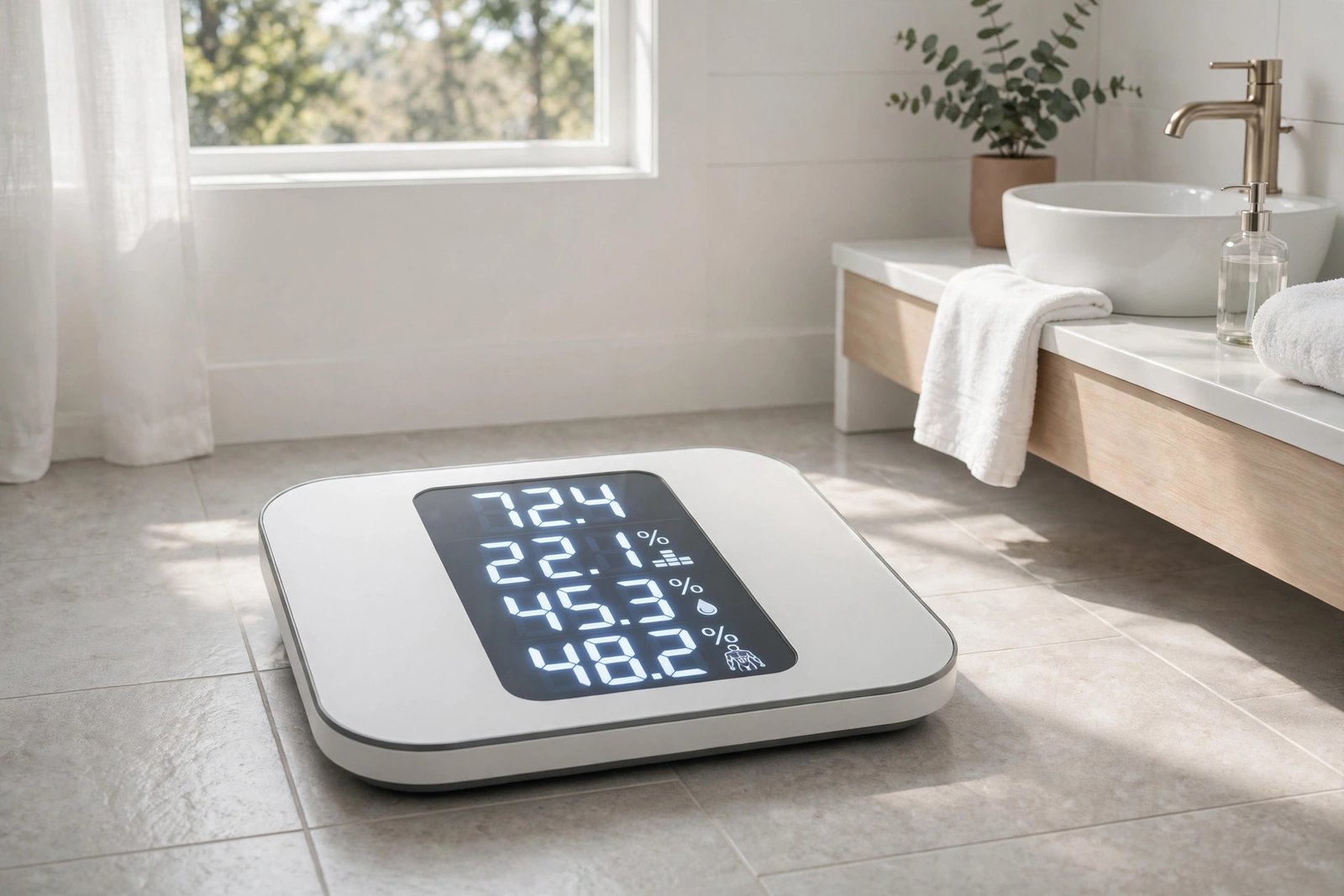
A smart scale weighs you with load cells, much like an ordinary bathroom scale, and then estimates body composition with bioelectrical impedance analysis. It sends a tiny, painless electrical current up one leg and down the other, measures the resistance, and combines that with your height, age and sex to estimate fat, muscle, water and bone mass.
That method has real limits. The current only travels through your lower body, so the upper body is largely inferred. Hydration, a recent meal, exercise and even warm feet can shift the readings. Two scales can therefore give different body fat percentages for the same person on the same morning, and both can still be useful if each one is consistent with itself.
The best smart scales compared
The table below compares the scales most people should shortlist, on the factors that affect daily use: connectivity, the breadth of metrics, power source and whether the headline features need a subscription.
| Scale | Connectivity | Body composition metrics | Power | Subscription needed? |
|---|---|---|---|---|
| Withings Body Scan | Wi-Fi and Bluetooth | Weight, body fat, muscle, visceral fat, vascular age, nerve health | Rechargeable battery, about a year per charge | No for core metrics; optional Withings+ adds coaching |
| Withings Body Smart | Wi-Fi and Bluetooth | Weight, body fat, muscle, visceral fat, heart rate | AAA batteries, about 15 months | No for core metrics |
| Garmin Index S2 | Wi-Fi and Bluetooth | Weight, body fat, muscle, bone, body water | AAA batteries, about 9 months | No |
| Fitbit Aria Air | Bluetooth only | Weight and body fat percentage | AAA batteries, about 6 months | No, syncs with the free Fitbit app |
| Eufy Smart Scale P2 Pro | Wi-Fi and Bluetooth | Weight, body fat, muscle, visceral fat, heart rate | Rechargeable battery, about 3 months | No |
Caption: The leading smart scales compared on connectivity, metrics, battery life and subscriptions. Battery figures are manufacturer-stated and vary with use.
The best smart scales in 2027
Withings Body Scan
Best for: people who want the most detailed health picture a home scale can offer.
The Body Scan is Withings’ flagship, and it shows. It measures segmental body composition, estimating fat and muscle separately in your torso, arms and legs, and it adds vascular age and a nerve-health assessment that no rival scale offers. The large colour display shows your weight, a trend graph and the weather as you step off, which means you rarely need to open the app.
It is the most expensive scale here, and its size suits a permanent spot on the bathroom floor rather than a cupboard. Check the current price before buying, as it often varies between retailers. The Withings app remains one of the clearest health apps available, and it syncs with Apple Health and Google Fit.
Withings Body Smart
Best for: most buyers who want Withings quality without the flagship price.
The Body Smart is the sensible pick in the range. It keeps Wi-Fi syncing, a clear colour display, visceral fat and heart-rate readings, and multi-user recognition for up to eight people, while dropping the segmental analysis and nerve-health checks that most people will not miss. It runs on AAA batteries for well over a year, so there is nothing to charge.
Garmin Index S2
Best for: Garmin watch owners and serious athletes.
The Index S2 exists to complete a Garmin ecosystem. Step on it and your weight flows into Garmin Connect alongside your runs, rides and sleep, feeding training readiness and calorie estimates that a standalone scale cannot offer. It is less impressive outside Garmin’s world, but if you already train with a Garmin watch, no other scale fits your data so neatly. Pair it with one of the best sleep trackers to see how weight, sleep and recovery interact.
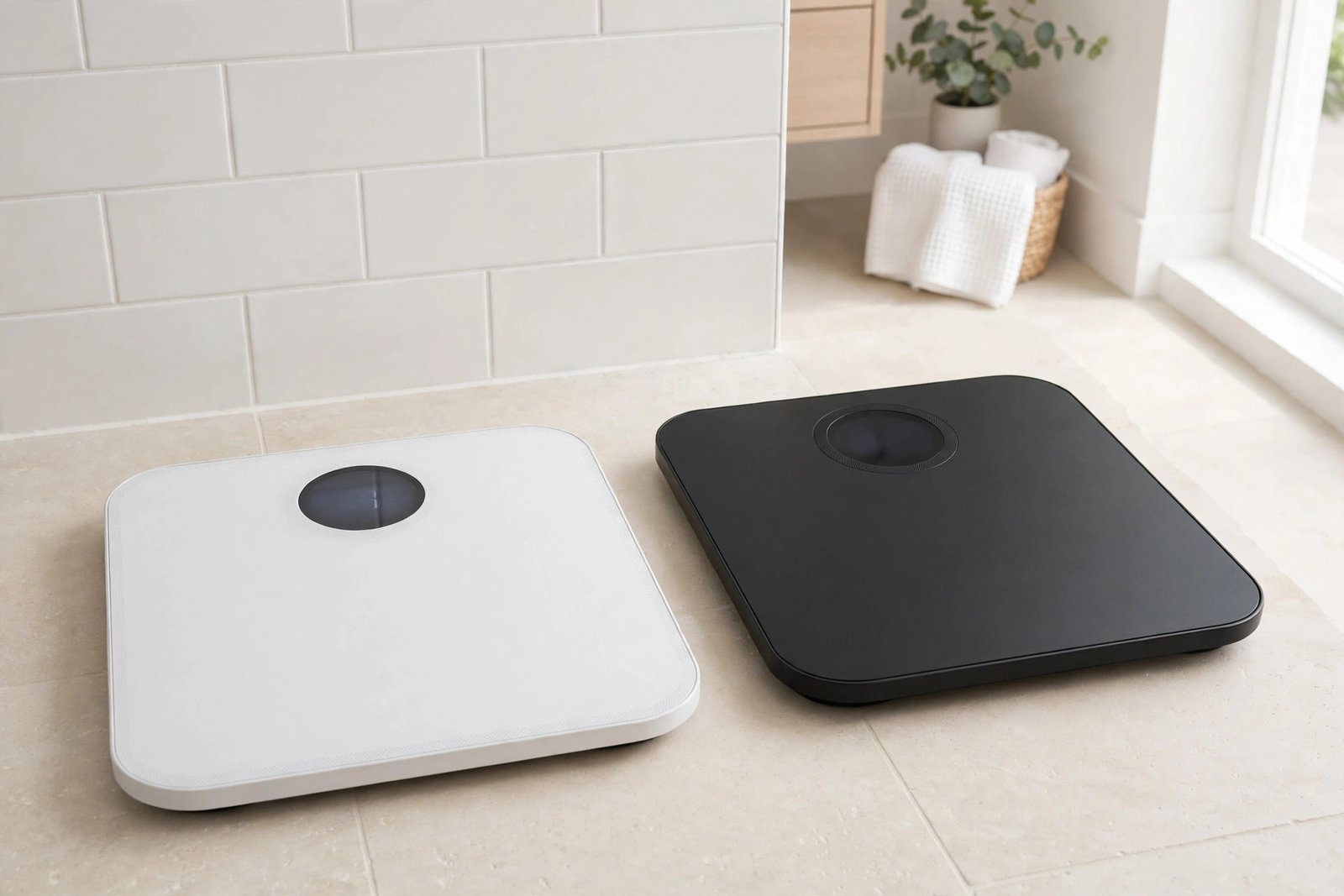
Fitbit Aria Air
Best for: Fitbit users who want the cheapest way into smart weighing.
The Aria Air is a simple, inexpensive Bluetooth scale that does two things well: it weighs you accurately and it sends the result to the Fitbit app, where it sits next to your steps, sleep and heart rate. It estimates body fat percentage but skips the deeper metrics, which is fine if you mainly want weight trends in an app you already use.
Its limits are real. Bluetooth-only syncing means your phone must be nearby, and there is no Wi-Fi, so it cannot update while your phone charges downstairs.
Eufy Smart Scale P2 Pro
Best for: families who want detailed metrics at a mid-range price.
Eufy’s P2 Pro measures sixteen metrics, including body fat, muscle mass, visceral fat and heart rate, and displays them on a bright screen with a small 3D avatar model that shows where the numbers come from. It supports unlimited user profiles through the EufyLife app, syncs over Wi-Fi and Bluetooth, and works with Apple Health, Google Fit and Fitbit.
The rechargeable battery lasts around three months, shorter than its AAA-powered rivals, and the app is busier than Withings’ or Garmin’s. On value, though, it is the strongest scale here: detailed metrics, a good display and no subscription.
How to choose: a quick decision framework
Work through these five questions before you buy, and the right scale usually picks itself.
- What ecosystem are you in? Garmin watch owners should buy the Index S2; Fitbit users should look at the Aria Air; everyone else should start with Withings or Eufy.
- Do you need Wi-Fi? Choose Wi-Fi if the scale lives far from your phone, or if several people use it. Bluetooth-only is fine for a single user who keeps their phone nearby.
- Which metrics will you actually use? Weight and body fat cover most goals. Visceral fat is worth having if you are tracking metabolic health; segmental analysis and vascular age are bonuses, not essentials.
- Is there a subscription? Check what sits behind a paywall. The scales here keep core metrics free, but coaching, advanced reports and some health scores may cost extra.
- Who else steps on it? Look for automatic user recognition and enough profiles for the household. A scale that mixes up two people’s data is worse than a basic one.
How to get readings you can trust
Accuracy starts with routine. Weigh yourself first thing in the morning, after using the bathroom and before eating or drinking, wearing the same amount of clothing each time. Place the scale on a hard, flat floor: carpet throws off both weight and impedance readings, and most scales include feet or a mode for carpet, but hard flooring is always better.
Stand still, with bare, dry feet centred on the electrodes, and wait for the reading to finish before stepping off. Do not compare readings taken at different times of day: you can gain a kilogram or more between morning and evening from food and water alone. That is normal, and it is why a single reading tells you almost nothing.
A note on what the numbers cannot do: a smart scale is not a medical device. Its body fat estimate can be several percentage points away from a clinical DEXA scan, and it cannot diagnose anything. If you are managing a medical condition, tracking rapid weight change, or the numbers are causing you distress, talk to a clinician rather than adjusting your diet to chase a percentage. For broader context on tracking your health at home, see our guide to the best fitness trackers for seniors, which covers simple, low-fuss health tracking.
Frequently asked questions
Are smart scales accurate for body fat?
They are reasonably accurate for tracking change, but not for absolute values. Bioelectrical impedance estimates body fat from electrical resistance, and the result can vary with hydration, meals and exercise. Treat the percentage as an estimate and follow the trend over four weeks or more.
Is a smart scale safe to use with a pacemaker?
Most manufacturers advise against using the impedance feature if you have a pacemaker or another implanted electronic device, because the scale passes a small current through the body. Some scales offer a weight-only mode. Check the manufacturer’s guidance and ask your clinician if you are unsure.
Do I need Wi-Fi on a smart scale?
Not always, but it helps. Wi-Fi scales sync automatically without your phone nearby and suit shared households. Bluetooth scales are cheaper and fine if you weigh yourself with your phone in the room and open the app afterwards.
How often should I weigh myself?
Daily weighing at the same time gives the smoothest trend line, and research generally finds it helps people who are managing weight. If daily weighing affects your mood, once a week at the same time still shows progress. Either way, judge the trend, not one reading.
Can several people use one smart scale?
Yes, most smart scales recognise different users by weight and keep separate profiles. The Withings scales support up to eight people and Eufy supports unlimited profiles, while cheaper scales may support fewer. Check the limit before buying for a family.
Do smart scales need a subscription?
The scales in this guide do not: weight, body fat and the other core metrics are free. Optional subscriptions add coaching, detailed reports and extra health scores. Check what is included before you buy so the price you see is the price you keep paying.
The bottom line
The best smart scale in 2027 for most people is the Withings Body Smart: accurate, easy to live with, free of subscriptions for its core metrics, and backed by the clearest app in this group. Garmin owners should buy the Index S2, Fitbit users the Aria Air, and anyone who wants the deepest health picture the Body Scan. Whichever you choose, the habit matters more than the hardware: same time, same conditions, and a four-week view of the trend. That is what turns a bathroom gadget into a genuinely useful health tool.
If you track your weight to support better sleep and recovery, our guide to what local AI is and how to run AI offline on your computer is a useful read on keeping personal health data private. Then pick your scale, set a reminder for the same time each morning, and give the trend a month before you judge it.