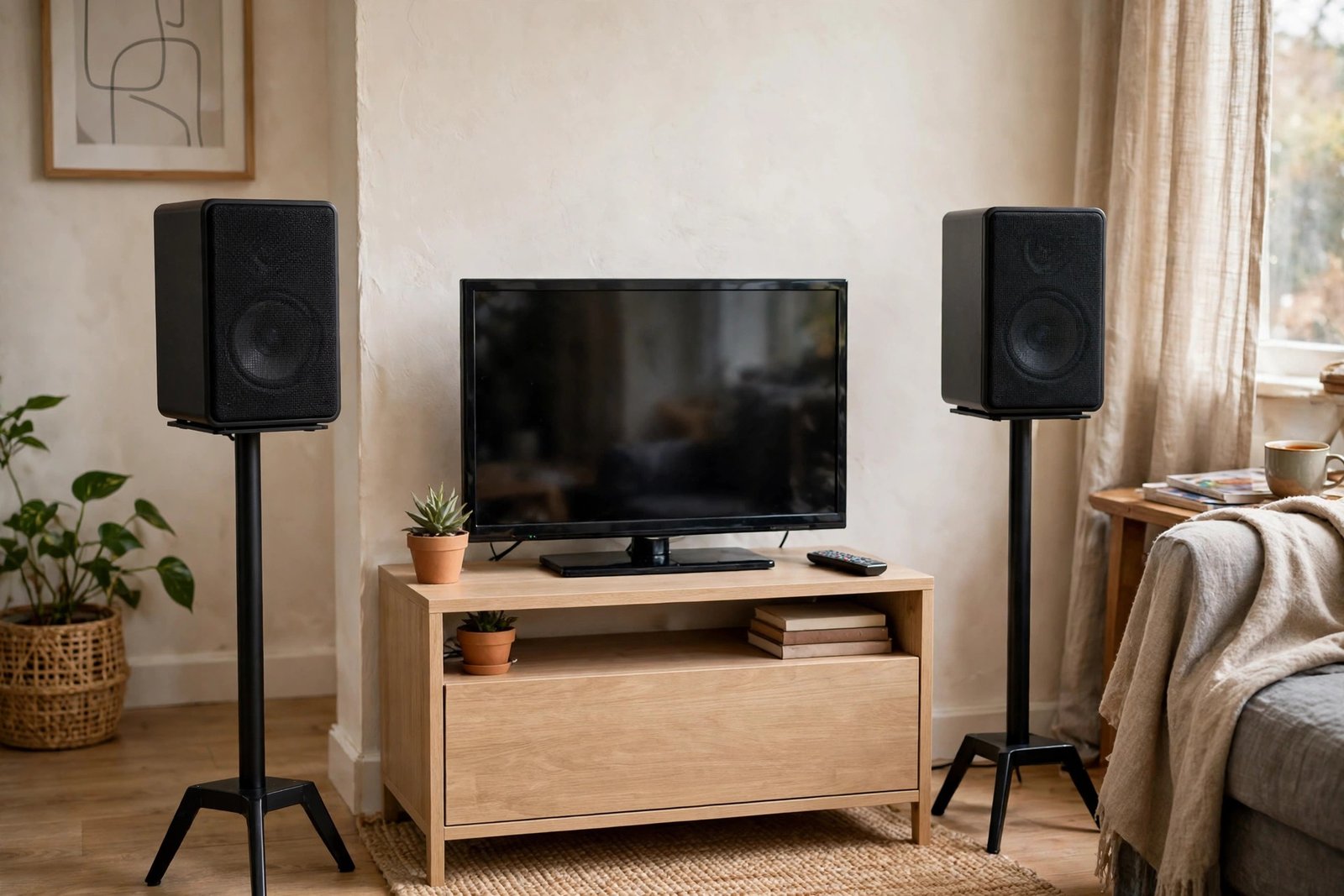
The best home theatre speakers for small rooms are the ones that fit the space you actually have, not the system you wish you had. A pair of large floor-standing speakers will crowd a small living room and overwhelm it with bass, while a well-chosen pair of bookshelf speakers can fill the same room with clear dialogue and a wide, convincing soundstage.
So which set should you buy? For most people, the Edifier R1280DBs are the simplest answer: powered speakers with Bluetooth, optical input and a subwoofer output, with no receiver to buy. If you already own a receiver, or you plan to build a surround system over time, the Klipsch R-50M are the stronger long-term choice.
Key takeaways
- In a small room, cabinet size matters as much as sound quality: measure your shelf or stand before you order.
- Powered speakers need only a power socket and a source; passive speakers need an amplifier or receiver as well.
- A 4 to 5.25-inch woofer is usually enough for a small room, and a subwoofer can be added later if you want deeper bass.
- Rear-ported speakers need space behind them, so keep them a few inches from the wall.
- Sensitivity matters: a low-sensitivity speaker needs more amplifier power to reach the same volume.
Why small rooms need a different shortlist
A small room changes the physics of home theatre. Sound reflects off nearby walls, bass builds up in corners, and the listening position is often only two or three metres from the speakers. A modest speaker can sound full and detailed, while a powerful one can sound boomy and tiring.
There are two main routes into a small-room system. Powered speakers have the amplifier built in, so you connect them straight to a TV, a computer or a turntable. Passive speakers need a separate amplifier or AV receiver, which costs more and takes up more space, but lets you add a centre, rear speakers and a subwoofer later.
A 2.0 pair suits music and TV in a small room, a 2.1 system adds a subwoofer for deeper bass, and a 5.1 system adds a centre and rear speakers — but it needs five speakers, a receiver and careful placement.
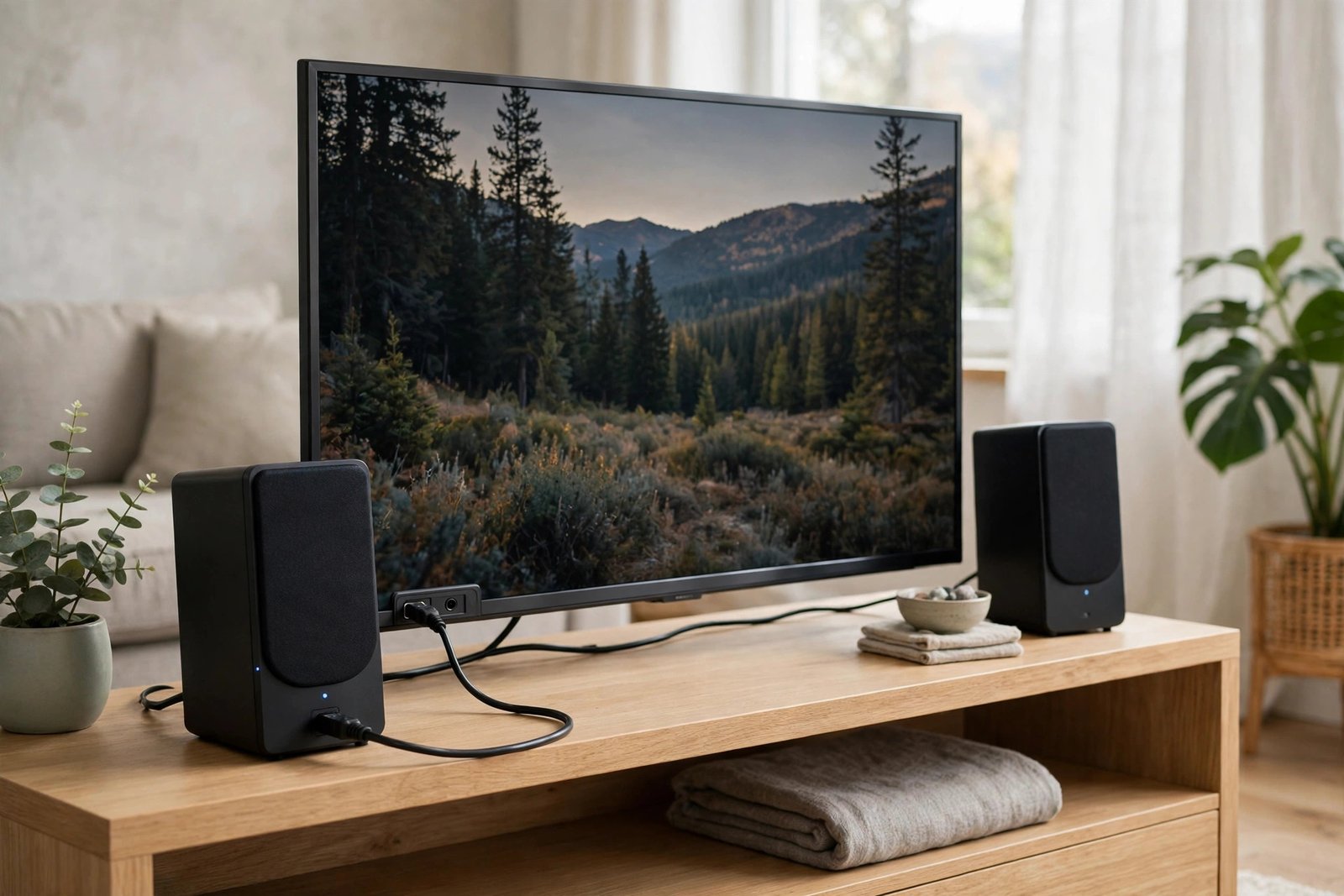
The best home theatre speakers for small rooms
1. Edifier R1280DBs
Best for: the simplest small-room set-up, with no receiver needed.
The Edifier R1280DBs are powered bookshelf speakers: the amplifier is built into one cabinet and the second speaker connects to it with a cable. They deliver 42W RMS in total, with a 4-inch woofer and a 13mm silk dome tweeter in each speaker. The cabinets are compact at 146 by 234 by 196mm.
Connections cover Bluetooth 5.0, optical and coaxial inputs, two RCA inputs and a subwoofer output, so you can connect a TV, a computer and a phone. A remote is included, and the response is 51Hz to 20kHz. Check the current price before you buy.
2. Klipsch R-50M
Best for: a receiver-based system you can grow into surround sound.
The Klipsch R-50M are passive bookshelf speakers, so they need an amplifier or AV receiver. Each speaker pairs a 5.25-inch spun-copper TCP woofer with a 1-inch aluminium LTS tweeter in a 90 by 90 degree Tractrix horn. Klipsch rates the response at 58Hz to 21kHz, with 92dB sensitivity and 75W continuous / 300W peak power handling, at 8 ohms.
That high sensitivity is a real advantage: the R-50M play louder from a given amplifier than most rivals, so a modest receiver is enough. The cabinets are 13.9 inches high and 9 inches deep, but the rear port needs space behind it. Check the current price before you buy.
3. Polk Monitor XT15
Best for: a flexible pair that works as fronts or surrounds.
The Polk Monitor XT15 are compact passive bookshelf speakers, designed to work as fronts or surrounds. Each speaker has a 5.25-inch bi-laminate paper woofer and a 1-inch Terylene dome tweeter, with a frequency response of 48Hz to 40kHz and 86dB sensitivity. Polk recommends 30 to 150W per channel.
At 10.6 inches high and 7.2 inches deep, the XT15 are genuinely bookshelf-sized, with a keyhole hanger for wall mounting. They are Hi-Res Audio certified and compatible with Dolby Atmos and DTS:X systems. Check the current price before you buy.
4. JBL Stage 240B
Best for: a dedicated home theatre pair with wall-mount brackets included.
The JBL Stage 240B are the smallest bookshelf speakers in JBL’s Stage series, built for home theatre use in a small room. Each speaker has a 4.5-inch polycellulose woofer and a 1-inch anodised aluminium tweeter in JBL’s High-Definition Imaging waveguide. JBL rates the response at 53Hz to 25kHz, with 85dB sensitivity, 6 ohms impedance, and 20 to 125W of amplifier power.
Wall brackets are included, along with anti-slip pads and foam port plugs, and the cabinets measure 10.7 by 6.9 by 8.5 inches. They work as fronts or surrounds, so a second pair can complete a small surround system later. Check the current price before you buy.
5. Micca RB42
Best for: the smallest shelf or desk where a compact speaker must still sound full.
The Micca RB42 are compact passive bookshelf speakers, and the smallest on this list at 8.7 inches high and 4.9 inches wide. Each speaker has a 4-inch coated paper woofer and a 0.75-inch silk dome tweeter, with a frequency response of 50Hz to 20kHz in a typical room. Power handling is 15 to 100W per speaker, at 4 to 8 ohms.
The RB42 need a capable amplifier, because their sensitivity is 83dB, lower than the other passive speakers here. In return, they deliver a warm, full sound from a cabinet that fits where larger speakers cannot. Check the current price before you buy.
6. Klipsch R-50PM
Best for: a powered pair that also works with a turntable and a TV.
The Klipsch R-50PM are powered bookshelf speakers, and the most versatile pair on this list. Each speaker has a 5.25-inch spun-copper TCP woofer and a 1-inch aluminium LTS tweeter in a Tractrix horn, with a built-in amplifier rated at 60W per channel RMS. The response is 55Hz to 20kHz, and the 14-inch cabinets need a stand or a deep shelf.
Connections cover Bluetooth 5.0, optical and USB inputs, a 3.5mm input, and an RCA input that switches between line level and phono, so a turntable can connect directly. There is no HDMI ARC input, so connect the TV through optical. Check the current price before you buy.
Comparison table
| Speaker | Type | Woofer | Sensitivity | Best for |
|---|---|---|---|---|
| Edifier R1280DBs | Powered | 4-inch | Not stated | Simplest set-up |
| Klipsch R-50M | Passive | 5.25-inch | 92dB | Growing into surround |
| Polk Monitor XT15 | Passive | 5.25-inch | 86dB | Fronts or surrounds |
| JBL Stage 240B | Passive | 4.5-inch | 85dB | Dedicated home theatre |
| Micca RB42 | Passive | 4-inch | 83dB | Smallest shelves |
| Klipsch R-50PM | Powered | 5.25-inch | Not stated | Turntable and TV |
The six best home theatre speakers for small rooms compared on type, woofer size and sensitivity. Passive speakers need an amplifier or receiver; powered speakers have one built in.
Sensitivity is the column to watch for a passive speaker. The Klipsch R-50M at 92dB will play noticeably louder than the Micca RB42 at 83dB from the same amplifier.
How to choose: a five-minute decision framework
Work through these questions before you spend anything. They prevent the most common mistake in a small room: buying speakers for a larger room, then placing them where they cannot work properly.
- Powered or passive? For the fewest boxes, choose powered speakers. If you want to add a centre and rear speakers later, choose passive speakers and a receiver.
- Measure the space first. Check the height, width and depth of the shelf or stand, and leave a few inches behind rear-ported speakers.
- How far will you sit? Two to three metres away, a 4 to 5.25-inch woofer is enough. A larger driver can make bass harder to control.
- What will you connect? A TV needs optical or HDMI ARC; a turntable needs a phono input; a computer needs USB or Bluetooth. List your sources before you choose.
- Do you need a subwoofer now? Most small rooms sound good without one at first, and every powered pair here has a subwoofer output for later. Buy the speakers first, then decide.
If you would rather keep the set-up to a single bar, our guide to the best soundbars under $150 covers that option. For music in other rooms, see the best smart speakers and displays, and for sound outside, see the best portable speakers for camping.
Placement that makes a small room sound bigger
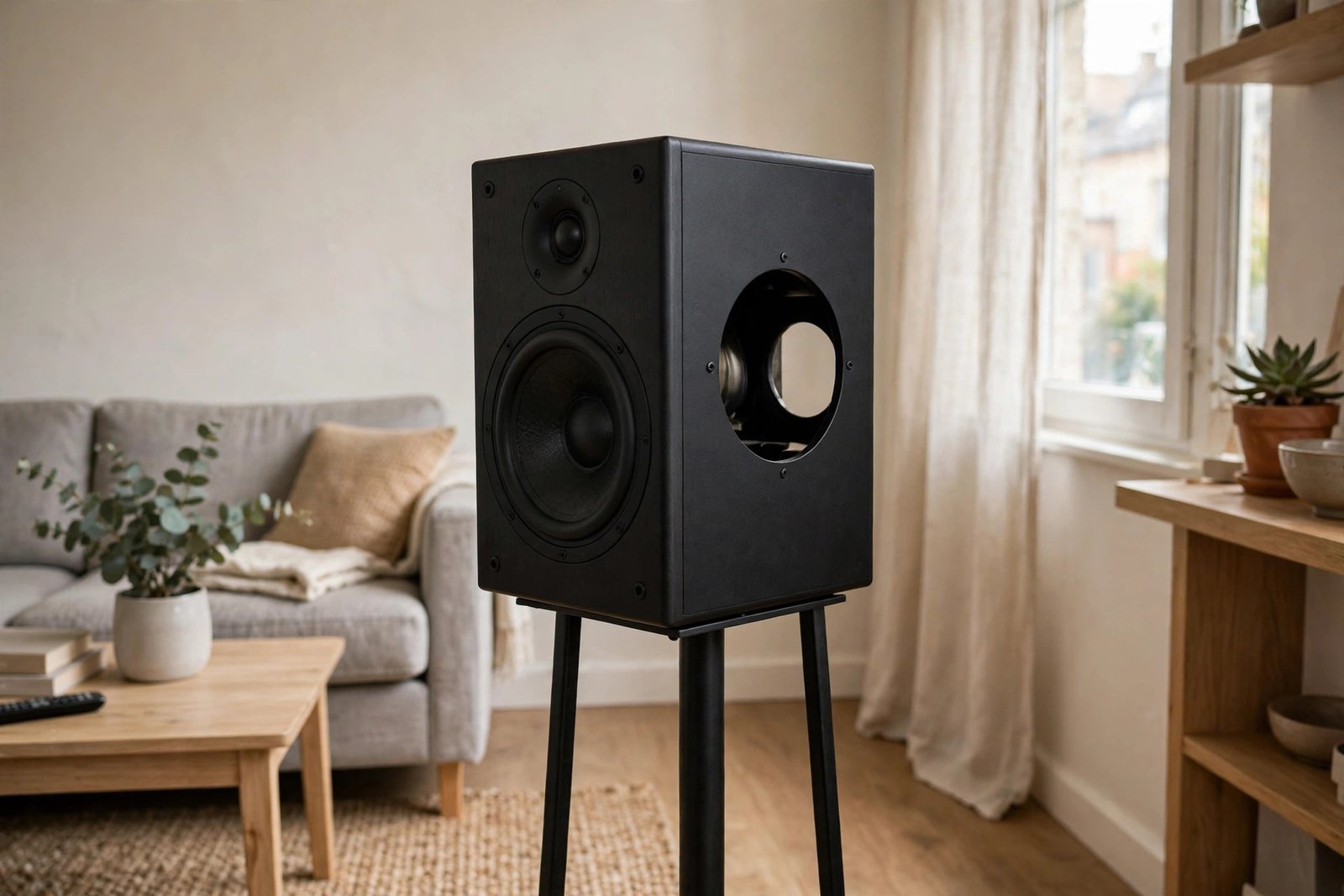
Place the speakers at ear height when seated, with the tweeters pointing towards your ears — usually stands of 24 to 28 inches for a sofa. Keep the pair the same distance from your seat and angle them slightly towards you. Give rear-ported speakers a gap of 10 to 15cm behind the cabinet.
Frequently asked questions
Do I need a subwoofer in a small room?
Not always. A good pair of bookshelf speakers can cover most films and music in a small room, and a subwoofer can make bass harder to control in a tight space. If you add one later, a small powered subwoofer is easier to balance than a large one.
Are bookshelf speakers good enough for home theatre?
Yes, in a small room they are often the best choice. They reproduce dialogue clearly, fit on a shelf or stand, and can serve as front or surround speakers in a 5.1 system. A centre speaker helps dialogue further, but a good stereo pair is a strong starting point.
What is the difference between powered and passive speakers?
Powered speakers have an amplifier built in, so you connect them directly to a TV, computer or turntable. Passive speakers need a separate amplifier or receiver, which adds cost and space but lets you build a full surround system over time.
How far from the wall should speakers sit?
Rear-ported speakers should sit at least 10 to 15cm from the wall behind them, so the port can work properly.
Can I use bookshelf speakers as surround speakers?
Yes. Models such as the Polk Monitor XT15 and JBL Stage 240B are designed to work as front or surround speakers, and the Klipsch R-50M can move to surround duty if you upgrade the fronts later. Match the brand and series where you can.
How much amplifier power do I need?
It depends on the speaker’s sensitivity and the size of the room. A high-sensitivity speaker such as the Klipsch R-50M needs less power than a low-sensitivity one such as the Micca RB42. In a small room, 30 to 75W per channel is usually enough.
The bottom line
The best home theatre speakers for small rooms are not the biggest or the most powerful. They are the pair that fits your shelf, matches your sources and leaves room to add a subwoofer or a centre speaker later.
For most people, that means the Edifier R1280DBs: powered, compact and ready to connect to a TV, a computer and a phone. If you already own a receiver, or you want a system that can grow into surround sound, the Klipsch R-50M are the stronger investment.
Your next step is simple: measure the shelf or stand, list the sources you will connect, and decide whether you want the simplicity of powered speakers or the upgrade path of passive ones. Then pick the pair that matches those answers.