Tamil is spoken by more than 80 million people, yet for years it sat near the bottom of the priority list for language-learning apps. That has changed fast. In 2027, the best AI tools for learning Tamil combine speech recognition tuned for Tamil sounds, adaptive spaced repetition, and conversational chatbots that correct your grammar in real time, turning a language that once demanded a classroom and a textbook into something you can practise on a phone during a commute.
The change matters because Tamil is genuinely hard for English speakers. It has its own script with 247 letters, sounds that do not exist in English, and a split between the formal written language and the everyday spoken language. Generic language apps that treat every language the same way tend to fail here. The tools that work best for Tamil are the ones that handle the script properly, teach spoken Tamil rather than only literary Tamil, and give you feedback on pronunciation instead of just multiple-choice drills.
We tested the leading AI-powered options against five criteria: quality of Tamil content, speech recognition and pronunciation feedback, script teaching, personalisation, and value for money. The eight tools below are the ones that earned a place, led by Duolingo for beginners, Ling for speaking practice, and ChatGPT as the most flexible conversation partner you can get for the price of a coffee.
Key takeaways
- Duolingo is the best overall starting point for Tamil in 2027, with a free tier, a full Tamil course, and solid gamification that keeps beginners coming back.
- Ling is the best for speaking, with AI pronunciation scoring and conversations built around everyday Tamil phrases.
- ChatGPT is the best flexible tutor, able to explain Tamil grammar, role-play conversations, and correct your written Tamil on demand.
- Most learners should combine one structured app with one AI conversation tool rather than paying for several apps at once.
- Free tiers cover the basics well, but serious learners should budget for a paid plan, which typically costs between 7 and 15 dollars a month.
At a glance: the shortlist
| Product | Best for | Starting price | Standout limit |
|---|---|---|---|
| Duolingo | Beginners, daily habit | Free; Super from around $7/month | Spoken Tamil coverage is thin |
| Ling | Speaking and pronunciation | Free; Pro from around $9/month | Smaller Tamil lesson library |
| Mondly | Structured courses | Free; Premium from around $10/month | Script teaching is light |
| Drops | Vocabulary building | Free; Premium from around $10/month | Five-minute daily cap on free tier |
| Memrise | Memory and real phrases | Free; Pro from around $9/month | Less Tamil content than big languages |
| ChatGPT | Conversation and grammar help | Free; Plus from $20/month | No structured curriculum |
| Talkpal AI | AI speaking practice | Free; Premium from around $13/month | Newer, smaller community |
| Preply | Live human tutors | From around $8 per lesson | Quality varies by tutor |
Duolingo — Best overall
Duolingo remains the easiest place to start learning Tamil in 2027, and it is the tool we recommend first to almost everyone. Its Tamil course covers the script, core vocabulary, and basic sentence patterns in short, game-like lessons that take five to ten minutes each.
The app’s AI features have improved noticeably. Duolingo now adapts lesson difficulty to your error patterns, offers AI-generated explanations when you get an answer wrong, and includes conversation practice that simulates simple exchanges like ordering food or introducing yourself. Speech recognition checks your pronunciation of Tamil words and sentences, though it is more forgiving than a human tutor would be, so do not treat a passing score as proof your accent is perfect.
Where Duolingo falls short is depth. The Tamil course is shorter than the Spanish or French courses, and it leans towards formal, written Tamil rather than the colloquial Tamil people actually speak in Chennai or Toronto. Once you finish the course, you will be able to read signs, handle simple exchanges, and understand basic sentences, but you will not be conversational. Think of it as a strong foundation, not a complete education. Readers exploring other languages in the same series can see how the same approach works for a different script in our guide to the best AI tools for learning Sinhala.
Pros: Free tier is genuinely useful; excellent habit-building design; Tamil script taught step by step; available on every platform.
Cons: Limited spoken Tamil; course is shorter than major languages; pronunciation scoring is lenient.
Ling — Best for speaking
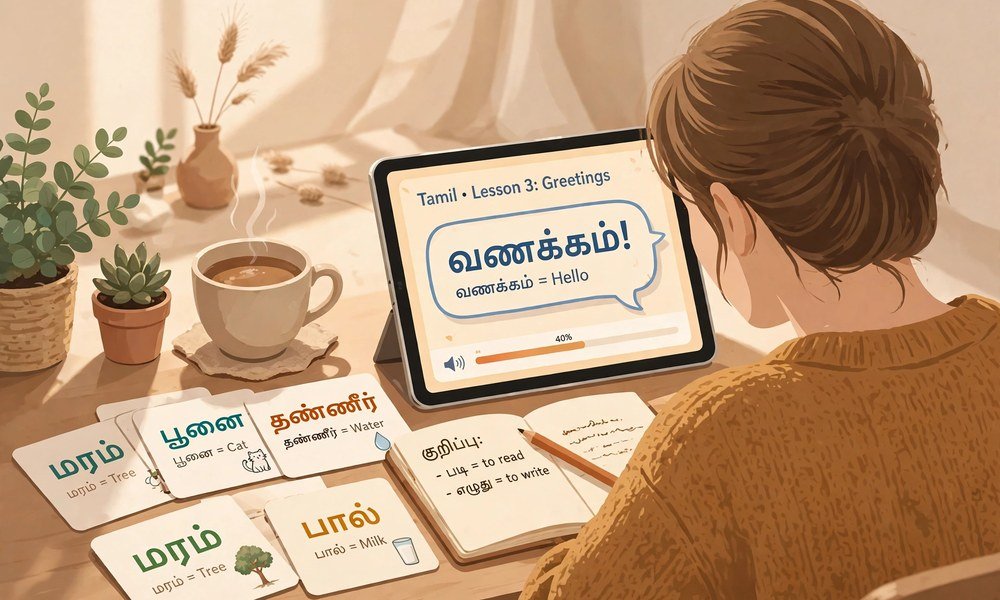
Ling is built around one idea: you learn a language by speaking it, not by staring at flashcards. Its Tamil course opens with everyday phrases, greetings, numbers, and food vocabulary, and every lesson includes audio from native speakers and a speaking exercise where the app scores your pronunciation. For Tamil, where the difference between similar sounds can change a word’s meaning entirely, that instant feedback is worth more than another hundred vocabulary drills.
The app’s AI chatbot lets you practise short conversations without the pressure of talking to a real person. You can repeat a dialogue as many times as you like, slow the audio down, and see a side-by-side comparison of the Tamil script, transliteration, and English translation. Ling also tracks your weak sounds and pushes extra practice on the ones you keep missing.
The main drawback is scale. Ling’s Tamil content library is smaller than its library for European languages, so intermediate learners may run out of fresh lessons sooner than they would like. The free tier is also limited. Still, for the first three to six months of speaking practice, Ling is the strongest dedicated option we found, and it pairs well with a broader course app for grammar and reading.
Pros: Strong pronunciation scoring; native-speaker audio; AI chatbot conversations; script, transliteration, and translation shown together.
Cons: Smaller Tamil library than major languages; limited free tier; less grammar depth than a full course.
Mondly — Best structured course
Mondly takes a more traditional, course-like approach to Tamil, with lessons organised into clear topics such as travel, family, food, and business. Each lesson mixes vocabulary, sentence building, listening, and speaking, and the app’s speech recognition gives you a score on every spoken answer. The structure suits learners who like to know exactly where they are in a course and what comes next, rather than wandering through gamified levels.
Its standout feature is the AI conversation simulator, which places you in realistic scenarios, such as checking into a hotel or asking for directions, and responds to what you say rather than following a fixed script. For Tamil learners, this is a useful bridge between memorised phrases and real conversation, because it forces you to produce sentences on the spot.
Mondly’s weakness for Tamil is the script. It teaches Tamil words mostly in transliteration at first, and its script lessons are lighter than Duolingo’s or Ling’s. If your goal is to read Tamil, you will need a supplementary resource for the alphabet. Pricing is also worth watching: Mondly frequently discounts its lifetime plan, which can be good value, but the monthly price is on the higher side for what you get in Tamil specifically.
Pros: Clear course structure; realistic AI conversation scenarios; good listening exercises; regular discounts on lifetime access.
Cons: Script teaching is light; monthly price is relatively high; Tamil content is thinner than major languages.
Drops — Best for vocabulary
Drops does one thing and does it well: it teaches vocabulary fast. Its Tamil word lists are organised into practical topics, and each five-minute session uses images, quick matching games, and spaced repetition to lock words into memory.
The app’s AI adjusts which words it shows you based on what you have already mastered and what you keep forgetting, so your review sessions focus on your weak spots instead of cycling through words you already know. Drops also handles the Tamil script cleanly, showing each word in Tamil letters alongside transliteration and audio, which makes it a good companion for learning to read while you build vocabulary.
The limits are obvious: Drops teaches words, not sentences. You will not learn Tamil grammar here, and you will not practise conversation. The free tier caps sessions at five minutes a day, which is fine for a daily top-up but frustrating if you want longer study sessions. Used as a supplement to a full course app, however, Drops is one of the most efficient vocabulary tools available for Tamil, and the premium plan removes the time cap.
Pros: Very fast vocabulary learning; clean Tamil script display; smart spaced repetition; beautiful, simple interface.
Cons: No grammar or conversation; five-minute daily cap on free tier; best as a supplement, not a standalone tool.
Memrise — Best for memory and real phrases
Memrise combines spaced repetition with video clips of native speakers using Tamil in real-life situations, which is a combination few other apps offer.
The app’s AI features include a conversation mode where you practise responding to prompts in Tamil and receive feedback on your answers, plus a review system that schedules words for revision at the point you are about to forget them. Memrise’s phrasebooks are practical, covering situations such as meeting people, eating out, and travelling, and the Tamil content includes both script and transliteration so you can learn to read as you go.
Memrise is not the most structured option. Its Tamil course is less linear than Mondly’s, and learners who want a clear curriculum may find it meandering. The amount of Tamil content is also smaller than for languages like Spanish or Japanese. But for building durable vocabulary and getting used to real spoken Tamil, Memrise earns its place, especially for learners who already have the basics and want to expand what they can understand and say.
Pros: Real native-speaker video; strong spaced repetition; AI conversation practice; practical phrasebooks.
Cons: Less structured than rivals; smaller Tamil catalogue; free tier has limits.
ChatGPT — Best flexible tutor
ChatGPT is not a language course, and that is exactly why it belongs on this list. As an AI tutor for Tamil, it can do things no course app can: explain a grammar rule in plain English, generate practice sentences using only the vocabulary you already know, role-play a conversation at a shop in Madurai, correct a paragraph you wrote in Tamil, and translate a song lyric while explaining the cultural references. The voice mode turns it into a conversation partner you can talk to at any hour.
The key is prompting it well. Ask it to act as a patient Tamil teacher, to correct your mistakes gently, to use spoken Tamil rather than formal literary Tamil, and to keep its replies short enough for you to follow. For learners who already use a structured app, ChatGPT fills the gaps that apps leave: explanation, conversation, and personalised feedback.
There are limits to be honest about. ChatGPT sometimes makes mistakes in Tamil, particularly with complex grammar and formal versus colloquial usage, so do not treat it as an authority on every point. It has no curriculum, so undisciplined learners can drift. And the best voice features sit behind the paid Plus plan. But as a flexible, always-available tutor, nothing else on this list matches it, and the free tier is enough to get real value from it.
Pros: Unlimited conversation topics; explains grammar on demand; corrects written Tamil; voice mode for speaking practice.
Cons: Occasional errors in Tamil; no structured curriculum; best features need the paid plan.
Talkpal AI — Best AI speaking practice
Talkpal AI is a dedicated AI language tutor built around conversation. You choose a scenario, such as ordering at a restaurant or chatting with a new colleague, and talk with an AI partner that responds in Tamil, corrects your mistakes, and adapts to your level. The experience feels closer to a real conversation than the scripted dialogues in most apps, because the AI follows what you actually say rather than steering you back to a fixed script.
For Tamil, Talkpal’s strengths are its patience and its feedback. It will slow down, repeat itself, explain a word you did not understand, and keep the conversation going when you run out of things to say.
Talkpal is a newer product than Duolingo or Mondly, and that shows in a smaller community and fewer supplementary features. It is not a full course, so you will still need another tool for the script and core vocabulary. But as a dedicated speaking partner, especially for learners who feel nervous talking to real people, it is one of the most effective AI tools available for Tamil in 2027.
Pros: Natural, adaptive conversations; detailed feedback on mistakes; progress tracking; low-pressure speaking practice.
Cons: Newer and smaller than rivals; not a complete course; premium plan needed for full features.
Preply — Best for live human tutors
AI tools are powerful, but a human tutor still catches things no algorithm does, and Preply is the simplest way to find one for Tamil. The platform lists tutors from Tamil Nadu, Sri Lanka, and the Tamil diaspora, with profiles showing their experience, specialities, reviews, and hourly rates. You can filter for tutors who teach spoken Tamil, exam preparation, or Tamil for heritage learners, and most offer a trial lesson before you commit.
Live lessons complement AI tools well. A tutor can correct your pronunciation in ways speech recognition cannot, explain the difference between formal and spoken Tamil with real examples, and design lessons around your goals, whether that is talking to family, travelling, or reading Tamil literature.
The obvious trade-off is cost and variability. Lessons typically start around 8 dollars an hour and rise with the tutor’s experience, so regular lessons add up. Tutor quality also varies, so read reviews and use the trial lesson before booking a package. Preply’s own AI features, such as lesson summaries and vocabulary tracking, are useful but secondary; the real product here is the person on the other end of the call.
Pros: Real human feedback; tutors for every level and goal; flexible scheduling; trial lessons available.
Cons: Costs add up with regular lessons; quality varies by tutor; no free tier.
How to choose
Start with your goal. If you want to learn Tamil from zero, begin with Duolingo for the script and basics, add Ling for speaking, and use ChatGPT as your on-demand tutor. That combination costs little or nothing to start and covers reading, vocabulary, speaking, and explanation. If you already know the basics and want to become conversational, shift the balance towards Talkpal AI or Preply, where real speaking practice matters more than another round of vocabulary drills.
Next, be honest about how much time you have. Five minutes a day is enough for Drops or a Duolingo streak, but it will not make you conversational. Aim for at least twenty minutes a day across two tools: one structured app for new material, and one conversation tool for using it. Consistency beats intensity, so choose tools you actually enjoy opening. The same logic applies across languages; our roundup of the best AI tools for learning Turkmen follows the same two-tool approach for a very different language.
Finally, watch the pricing. Most of these tools offer a free tier that is genuinely useful, and paid plans usually cost between 7 and 15 dollars a month. Before paying, use the free trial, check whether the Tamil content is as deep as the marketing suggests, and look for annual or lifetime discounts, which can cut the monthly cost substantially. One paid app plus one free AI tutor is enough for most learners; paying for four apps at once is a sign you are collecting subscriptions, not learning Tamil.
Checklist: before you pay
- Try the free tier first and confirm the Tamil course is substantial, not a token offering.
- Check that the app teaches the Tamil script, not just transliteration.
- Test the speech recognition with a few Tamil words before subscribing.
- Compare the monthly price with the annual or lifetime plan, which is often far cheaper.
- Confirm you can cancel easily and that your progress and vocabulary lists are exportable.
- Plan your routine: one structured app plus one conversation tool, at least twenty minutes a day.
Frequently asked questions
Can I learn Tamil with AI tools alone?
Yes, up to a point. AI tools can take you from zero to a solid intermediate level in Tamil, covering the script, core vocabulary, basic grammar, and simple conversation. To become genuinely fluent, you will eventually need real conversations with native speakers, whether through a tutor on Preply or by speaking with Tamil-speaking friends and family.
Which AI tool is best for learning the Tamil script?
Duolingo teaches the Tamil script most thoroughly of the apps on this list, introducing letters gradually and reinforcing them through reading exercises. Drops and Ling also display Tamil script clearly alongside transliteration. If reading is your priority, start with Duolingo and add Drops for vocabulary.
Is spoken Tamil very different from written Tamil?
Yes. Tamil has a well-known split between formal written Tamil and everyday spoken Tamil, with different verb endings, pronouns, and even vocabulary. Good AI tools teach spoken forms alongside written ones. When using ChatGPT, ask it explicitly for spoken Tamil if you want to sound natural in conversation. Similar challenges appear in other languages with formal and colloquial registers, as covered in our guide to the best AI tools for learning Mongolian.
How long does it take to learn Tamil with these tools?
With twenty to thirty minutes of daily practice, most learners can read the Tamil script and handle simple conversations within six to twelve months. Reaching comfortable conversational fluency usually takes one to two years of consistent study, including speaking practice. There is no shortcut, but AI feedback and daily habits shorten the journey considerably.
Are free AI tools enough for Tamil?
For the first few months, yes. The free tiers of Duolingo, Ling, Drops, and ChatGPT cover the script, core vocabulary, and basic conversation practice. Paid plans become worthwhile once you want unlimited practice, deeper content, and advanced AI features such as voice conversation and detailed feedback.
Do these tools work for Tamil heritage learners?
Yes, and heritage learners often progress fastest, because they already understand spoken Tamil even if they cannot read or write it. Tools like Drops and Memrise help rebuild vocabulary quickly, while a tutor on Preply can focus on literacy and formal grammar rather than starting from zero.
The bottom line
For most learners, the best combination in 2027 is Duolingo for the script and foundations, Ling for speaking practice, and ChatGPT as a flexible tutor. That trio covers everything a beginner needs, and two of the three cost nothing to start. Add Talkpal AI or a Preply tutor when you are ready to speak more, and use Drops or Memrise when your vocabulary needs a boost.
Tamil is a challenging language, but it has never been easier to learn. The AI tools above handle the script, the sounds, and the conversation practice that once required a classroom, and they do it for the price of a streaming subscription or less. Pick one structured app, pick one conversation tool, and practise every day. In a year, you will be glad you started now.
Note: Prices and plans change. Check the product’s current plan details before buying — no link is provided here by design, all links in this article go to other occcy.com guides.