Urdu is spoken by more than 230 million people, yet it has long been one of the hardest major languages to learn with an app. For years the big platforms skipped Urdu entirely or offered a thin course with no speaking practice, leaving learners to rely on textbooks, videos and private tutors. That has changed: a new wave of AI tools now teaches Urdu with speech recognition, adaptive review and conversational chatbots, and the quality gap between the best and the rest is wide.
The tools in this guide were chosen for one reason: they actually support Urdu in 2027, with real lessons rather than a translated word list. We looked at how each tool handles the Urdu script, whether it teaches the Nastaliq alphabet properly, how good its speech recognition is for Urdu sounds, what it costs after the free trial, and whether it builds toward real conversation instead of endless matching games. Some tools are best for complete beginners, others for heritage speakers who can understand Urdu but cannot read or write it.
Our shortlist covers eight tools, from structured courses to AI conversation partners and live tutoring marketplaces. Mondly takes the top spot for its full Urdu course and speech practice, while the Ling app is the strongest choice for beginners who want to master the script first. If you only want one tool, start there. If you want to speak fluently, pair an app with a live tutor and an AI chat partner for daily conversation.
Key takeaways
- Mondly is the best overall AI tool for learning Urdu in 2027, with a complete course, speech recognition and daily lessons that cover reading, writing, listening and speaking.
- The Ling app is the best choice for beginners because it teaches the Urdu alphabet and Nastaliq script step by step before moving into words and phrases.
- Drops is the best free way to build Urdu vocabulary fast, with five-minute visual sessions that work well alongside a main course.
- Live tutoring on italki is the fastest route to confident speaking, with one-to-one Urdu lessons from qualified tutors at prices far below traditional language schools.
- No single app makes you fluent on its own; the learners who progress fastest combine a structured course, daily AI conversation practice and regular speaking with a real person.
At a glance: the shortlist
| Product | Best for | Starting price | Standout limit |
|---|---|---|---|
| Mondly | Best overall | Free plan; premium from about $9.99 a month | Some advanced lessons feel short |
| Ling | Beginners and the Urdu script | Free plan; premium from about $8.99 a month | Smaller lesson library than Mondly |
| Drops | Vocabulary building | Free with limits; premium from about $9.99 a month | Free sessions capped at five minutes |
| Memrise | Memorising phrases | Free plan; premium from about $8.99 a month | Urdu content is partly community-made |
| Mango Languages | Structured, library-backed learning | Often free through libraries; from about $7.99 a month | Interface feels dated next to rivals |
| Pimsleur | Speaking and listening | From about $14.95 a month | Almost no reading or script practice |
| italki | Live one-to-one tutoring | Lessons from about $5 per hour | Quality varies by tutor |
| ChatGPT | AI conversation practice | Free plan; Plus from about $20 a month | No structured curriculum |
Mondly — Best overall
Mondly is the most complete AI tool for learning Urdu, and it wins this roundup because it does everything a beginner needs in one place. The course starts with the Urdu alphabet and basic greetings, then builds through everyday topics such as family, food, travel, work and shopping. The speech recognition listens to your Urdu pronunciation and scores it, which matters more in Urdu than in many languages because small sound differences change meaning entirely.
The app’s chatbot conversations are the standout feature. You practise realistic dialogues, ordering food, asking for directions, introducing yourself, with an AI partner that responds to what you actually say rather than forcing you down a fixed script.
Pricing is straightforward. There is a free plan with daily lessons, and the premium subscription unlocks the full Urdu course, all languages and offline mode. The main weakness is that advanced lessons can feel short for learners who have already reached an intermediate level, and the grammar explanations are lighter than a textbook would give. A similar roundup of language-learning AI tools for other languages shows the same pattern, and the guide to the best AI tools for learning Turkmen is a useful comparison if you are learning more than one language.
Pros: Complete Urdu course from alphabet to conversation; strong speech recognition; realistic AI chatbot dialogues; daily lessons with spaced repetition.
Cons: Advanced lessons feel short; grammar explanations are light; premium needed for the full course.
Ling — Best for beginners and the Urdu script
Ling is the best tool for anyone starting Urdu from zero, because it takes the script seriously. Urdu is written right to left in the Nastaliq style, and many apps gloss over this with romanised transliteration that leaves learners unable to read a menu, a message or a street sign. Ling teaches the alphabet letter by letter, showing how each character changes shape at the start, middle and end of a word, and it drills the sounds with native-speaker audio before asking you to read whole words.
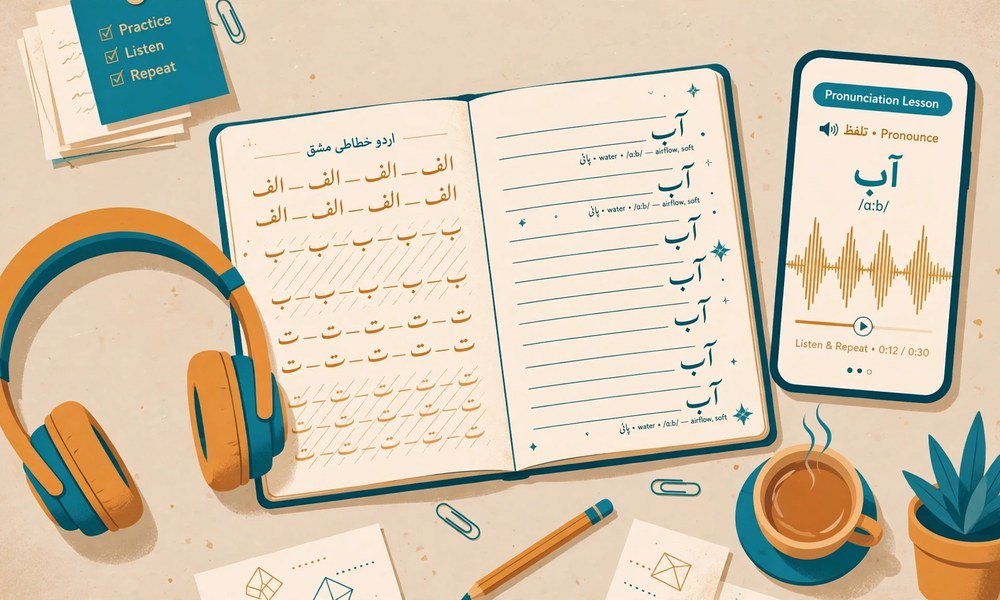
Beyond the alphabet, Ling’s lessons are short, game-like and focused on useful phrases rather than obscure vocabulary. You learn how to greet people properly, ask how someone is, talk about your family and handle everyday situations such as shopping and travelling. The interface is clean and friendly, and the lesson structure makes it easy to do ten minutes a day without feeling overwhelmed.
Ling offers a free plan with a limited number of lessons and a premium plan that unlocks the full course. The trade-off is that the lesson library is smaller than Mondly’s, so advanced learners will outgrow it sooner. That is fine, because Ling’s job is to get you reading and speaking basic Urdu confidently, and it does that job better than any other app in this guide.
Pros: Excellent Urdu alphabet and script teaching; native-speaker audio; short beginner-friendly lessons; good value on annual plans.
Cons: Smaller lesson library than rivals; advanced content is limited; chatbot conversations are simple.
Drops — Best for vocabulary building
Drops takes a different approach from every other tool here: it does almost nothing except teach vocabulary, and it does that one thing extremely well. Each session lasts five minutes and uses beautiful illustrations, quick swiping games and native-speaker audio to teach Urdu words in themed sets such as food, travel, numbers, colours and everyday objects. Drops is the tool you open when you have five spare minutes and want to add twenty new words to your Urdu vocabulary without thinking too hard about it.
The visual approach works particularly well for Urdu because the script is part of what you are learning. Drops shows the Urdu word in its proper script alongside the illustration and audio, so you start recognising written words naturally even if you are not formally studying the alphabet yet.
The free plan limits you to one five-minute session every ten hours, which is enough to test the app but frustrating if you want to study properly. Drops will not teach you to hold a conversation on its own, and it does not teach grammar, so treat it as a supplement rather than a complete course. As a supplement, though, it is the most enjoyable vocabulary tool available for Urdu, and the five-minute format means there is genuinely no excuse to skip a day.
Pros: Fast, visual vocabulary learning; excellent Urdu script exposure; five-minute sessions fit any schedule; strong spaced repetition.
Cons: No grammar or conversation practice; free plan is heavily time-limited; not a standalone course.
Memrise — Best for memorising phrases
Memrise has been helping people learn languages for more than a decade, and its strength is memorisation. The app uses spaced repetition, mnemonics and video clips of native speakers to help Urdu phrases stick in long-term memory, and it is particularly good for the kind of practical phrases travellers and heritage learners need first: greetings, polite requests, directions, numbers and common expressions.
The video clips are Memrise’s best feature. Hearing real people speak Urdu in natural settings, rather than a single studio voice, trains your ear for different accents, speeds and speaking styles.
The main caveat is the community content. Some user-made Urdu courses are excellent and some are patchy, with inconsistent transliteration or outdated vocabulary, so stick to the official courses and the highest-rated community sets. Memrise is not the best first app for a complete beginner who needs to learn the alphabet, but it is one of the best second apps for anyone who already knows the basics and wants to lock in phrases they can actually use.
Pros: Excellent spaced repetition and memorisation; native-speaker video clips; large amount of Urdu content including community courses; offline mode.
Cons: Community content quality varies; script teaching is weaker than Ling; premium needed for AI conversation features.
Mango Languages — Best structured, library-backed learning
Mango Languages is the quiet achiever of this list. It does not advertise as loudly as its rivals, but its Urdu course is one of the most carefully structured available, and many learners can use it entirely free through their public library.
Mango teaches the Urdu script alongside the spoken language, with writing practice that shows the correct stroke order for each letter. The cultural notes are genuinely useful, explaining when to use formal and informal forms of address, how greetings differ by setting, and what to expect in social situations in Pakistan and among Urdu-speaking communities elsewhere.
The interface looks dated next to Mondly and Ling, and the app feels slower to navigate, but the teaching is solid and the price is hard to beat. Paid subscriptions start from around $7.99 a month. Mango is best for learners who like structure and explanation, and who want to understand why Urdu works the way it does rather than just memorising phrases.
Pros: Well-structured conversation-based course; good grammar and cultural explanations; often free through libraries; teaches the script properly.
Cons: Dated interface; slower navigation than rivals; fewer gamified features to keep you motivated.
Pimsleur — Best for speaking and listening
Pimsleur is the oldest method in this guide and still one of the most effective for speaking. Each lesson is a thirty-minute audio session built around a conversation: you listen, repeat, answer prompts and build sentences out loud, with almost no screen time at all. For Urdu, where pronunciation and listening comprehension are the hardest parts, this audio-first approach makes a real difference.
The Urdu course covers five levels, taking learners from complete beginner to a solid intermediate standard in speaking and listening.
Pimsleur is the most expensive option here, starting from about $14.95 a month, and it teaches almost no reading or writing, so you will need another tool for the script. Even with those limits, Pimsleur is the best choice for anyone whose main goal is to speak and understand Urdu, particularly heritage learners who want to talk with older relatives. Pair it with Ling for reading and you have a complete system.
Pros: Best audio method for speaking confidence; hands-free lessons fit any routine; proven graduated recall system; five full levels of Urdu.
Cons: Most expensive option here; almost no reading or script practice; slow pace for learners who already know some Urdu.
italki — Best for live one-to-one tutoring
No app can replace a real conversation, which is why italki earns a place in this guide. It is a marketplace where you book one-to-one video lessons with Urdu tutors, choosing from professional teachers with formal qualifications and community tutors who offer cheaper conversation practice. Lesson prices start from around $5 per hour, and most tutors offer a discounted trial lesson, so you can try two or three teachers before committing to one.
The real value, though, is the human feedback: a tutor hears your pronunciation, corrects your mistakes gently, explains the cultural context behind a phrase, and pushes you to speak in full sentences instead of single words. Learners who combine an app with one italki lesson a week progress noticeably faster than learners who only use apps, because speaking to a real person forces your brain to retrieve words under pressure.
Tutor quality varies, as it does on any marketplace, so read reviews, watch the introduction videos and take trial lessons with more than one teacher. Used well, italki is the single fastest way to go from understanding Urdu to speaking it, and it is the tool we recommend most strongly as a complement to any app in this guide.
Pros: Real conversation with a native speaker; lessons tailored to your goals; very affordable from about $5 an hour; AI summaries and vocabulary from lessons.
Cons: Quality varies between tutors; scheduling takes effort; no structured curriculum unless your tutor provides one.
ChatGPT — Best for AI conversation practice
ChatGPT is the most flexible tool in this guide and the only one that can do almost anything you ask it to. It can act as an Urdu conversation partner at any hour, correct your sentences and explain your mistakes, generate dialogues on any topic, quiz you on vocabulary, translate with explanations rather than just answers, and role-play situations such as a job interview, a doctor’s visit or a family dinner.
The best way to use ChatGPT for Urdu is with specific prompts. Ask it to play a shopkeeper while you buy vegetables, to correct a paragraph you wrote and explain each correction, or to tell a short story in simple Urdu and then ask you questions about it. The free plan is enough to start,.
ChatGPT has real limits. It is not a structured course, so it will not tell you what to study next or track your progress properly. Used as a daily practice partner alongside a structured course, though, ChatGPT is one of the most powerful learning tools available, and it costs nothing to try.
Pros: Unlimited flexible conversation practice; explains mistakes clearly; voice mode for speaking practice; free plan is genuinely useful.
Cons: No structured curriculum or progress tracking; occasional Urdu errors; Plus plan is pricey for a single tool.
How to choose
Start with your goal, not with the app store ratings. If you cannot read the Urdu script yet, your first priority is an app that teaches it properly, which means Ling or Mango Languages, because everything else becomes harder without the alphabet. If you can already read a little and want a complete course, Mondly is the best all-rounder. If your main problem is vocabulary, add Drops for five minutes a day. And if you can already understand Urdu but cannot speak it, skip the apps and book a tutor on italki, because only real conversation will close that gap.
Budget matters, but less than consistency. Most of these tools cost less than a takeaway meal per month on an annual plan, and Mango Languages is often free through a library, so price should rarely be the deciding factor. What matters is whether you will actually open the app every day. Try the free plans of two or three tools for a week before paying for anything, and pick the one whose lessons you look forward to rather than the one with the longest feature list. A tool you use daily beats a better tool you abandon after a fortnight; the best AI tools guide compares the wider landscape before you commit.
Finally, plan for the long term. Learning Urdu to a conversational level takes most learners between six months and two years of regular study, depending on how much time they give it and whether they already speak a related language such as Hindi or Punjabi. A good plan is a structured course for the first three months, daily AI conversation practice from month two, and weekly tutoring from month three onwards.
Checklist: before you pay
- Try the free plan for at least a week and confirm the Urdu course is complete, not a demo with a handful of lessons.
- Check that the tool teaches the Urdu script properly, with Nastaliq letters and right-to-left reading, not romanised transliteration alone.
- Test the speech recognition with Urdu sounds and confirm it gives useful feedback on your pronunciation.
- Compare monthly and annual prices, and check whether your library offers Mango Languages free before subscribing to anything.
- Confirm you can cancel easily, export your vocabulary or notes, and keep access until the end of the billing period.
- Decide how you will practise speaking with a real person, whether that is a tutor, a language exchange partner or a family member.
Frequently asked questions
Can I learn Urdu with AI tools alone?
You can learn a great deal with AI tools alone: the alphabet, several thousand words, basic grammar and simple conversations. But fluency needs real speaking practice, because apps cannot replicate the pressure and unpredictability of a live conversation. Use an app for the foundations and add a tutor or language exchange partner as soon as you can hold a basic conversation.
How long does it take to learn Urdu with an app?
With thirty minutes of daily study, most learners can read the script and hold simple conversations within three to six months. Reaching a comfortable intermediate level, where you can discuss everyday topics without constantly searching for words, usually takes nine to eighteen months.
Does Duolingo teach Urdu?
No, Duolingo does not offer an Urdu course, which is why it does not appear in this guide. Urdu learners need alternatives, and Mondly, Ling and Mango Languages are the strongest options among the major platforms.
Which AI tool is best for learning to read and write Urdu?
Ling is the best choice for reading and writing, because it teaches the alphabet and the Nastaliq script systematically before moving into vocabulary and phrases. Mango Languages is a strong second choice, with stroke-order writing practice and detailed explanations of how Urdu sentences are built.
Are there free AI tools for learning Urdu?
Yes. Drops, Ling, Memrise, Mondly and ChatGPT all offer free plans with real Urdu content, and Mango Languages is free through many public libraries. A related roundup of the best AI tools for learning Sinhala covers the same free-versus-paid trade-offs for another language with a non-Latin script.
Is it better to learn Urdu with an app or a tutor?
Both, in that order. An app is better for the early stages, when you need to learn the script, build vocabulary and practise pronunciation without pressure. Start with an app, add weekly tutoring after two or three months, and keep using the app for daily review between lessons.
The bottom line
Mondly is the best overall AI tool for learning Urdu in 2027, with the most complete course and the strongest mix of speaking, listening, reading and writing practice. Ling is the best choice for beginners who need to master the script first, Drops is the best vocabulary supplement, and italki is the best way to turn app knowledge into real speaking ability.
Whatever you choose, the tool matters less than the habit. Fifteen minutes a day, every day, will take you further than occasional long sessions, and combining a structured course with AI conversation practice and real speaking is the fastest reliable route to fluency.
Note: Prices and plans change. Check the product’s current plan details before buying — no link is provided here by design, all links in this article go to other occcy.com guides.