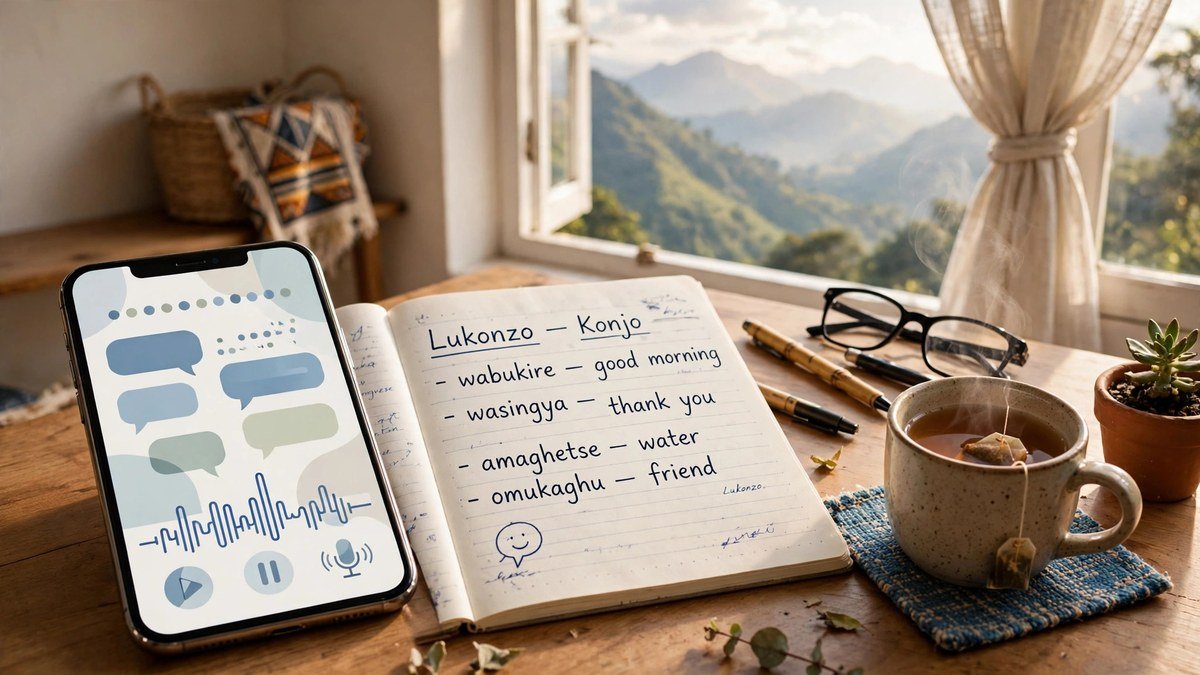
Didinga, also spelled Diding’a, is a distinct Surmic language spoken in South Sudan, and it deserves to be learned on its own terms. It is not a dialect of another language, not a variant of a better-known neighbour, and not interchangeable with any of the other Surmic languages covered in this series. If you want to learn Didinga, you need tools and habits that work for a low-resource language with a small speaker community, limited published course material, and almost no ready-made app course. That is a different challenge from picking up a language with millions of learners and a full Duolingo tree, and the tools below are judged on exactly that challenge.
Didinga belongs to the Surmic family, but it is a language in its own right, different from the other Surmic guides published so far in this series: Kwegu, Me’en, Suri, Mursi, Tirma, Chai, and Baale. It is also different from every other language guide published so far, including the Omotic guides for Gofa, Gamo, Konta, Malo, Oyda, Zayse, Dawro, Wolaytta, Yemsa, Kafa, Bench, Sheko, Basketo, Dime, Chara, Anfillo, Bambassi, Melo, Mocha, Dizy, Nayi, and She, the isolate guide for Shabo, and the Eastern Nilotic guides for Tennet, Lopit, Lotuko, Bari, Kakwa, Pojulu, Mondari, Nyangatom, Toposa, Turkana, and Karimojong. Learning Didinga means learning Didinga sounds, Didinga words, and Didinga sentence patterns, and borrowing vocabulary or grammar from those neighbours will only slow you down. The good news is that the same eight tools can still help, provided you use them as workbenches for your own material rather than as ready-made courses.
None of the eight tools in this guide offers a complete, ready-made Didinga course, and any tool that claimed to would deserve scepticism. What they do offer is spaced repetition, pronunciation practice, listening input, sentence building, and a daily habit, and those are the ingredients a Didinga learner needs most. This guide tests each tool against the reality of a low-resource language: can you add your own words, can you record or import audio, can you practise speaking, and can you keep going when there is no pre-built path to follow? The best tool for learning Didinga in 2027 is the one that lets you build your own course inside it, and the rankings below reflect that test. For a sense of how a closely related Surmic guide approaches the same problem, the Suri guide is a useful comparison, because Suri learners face the same shortage of ready-made material.
Key takeaways
- Duolingo is the best overall starting point for daily habit and motivation, but you must add your own Didinga words and sentences because it has no Didinga course.
- Memrise and LingQ are the strongest tools for building a personal Didinga vocabulary and reading collection from material you collect yourself.
- Pimsleur is the best option for speaking and listening practice, because its audio-first method suits a language you will mostly hear before you read it.
- uTalk is the most practical tool for learning useful spoken phrases quickly, with native-speaker audio as the model for your pronunciation.
- No single tool covers Didinga fully, so combine one habit app, one vocabulary tool, and one speaking tool, and review your own word list every day.

At a glance: the shortlist
| Product | Best for | Starting price | Standout limit |
|---|---|---|---|
| Duolingo | Daily habit and motivation | Free; paid plan from about $7 per month | No Didinga course built in |
| Babbel | Structured grammar lessons | Paid, from about $14 per month | No Didinga course built in |
| Rosetta Stone | Immersive picture-based learning | Paid, from about $12 per month | No Didinga course built in |
| Memrise | Custom vocabulary decks | Free; paid plan from about $9 per month | Quality depends on your own decks |
| Mondly | Quick daily phrases | Free; paid plan from about $10 per month | No Didinga course built in |
| Pimsleur | Speaking and listening | Paid, from about $15 per month | Audio lessons need your own phrases |
| LingQ | Reading and listening input | Free; paid plan from about $13 per month | Needs Didinga texts you supply |
| uTalk | Spoken phrases fast | Paid, from about $10 per month | Phrase range is limited |
Duolingo — Best overall
Duolingo is the best overall tool for a Didinga learner, not because it teaches Didinga, but because it teaches the habit of learning every day. It has no Didinga course, and that matters, so be clear about what you are buying: a streak, a daily reminder, short lessons, and a friendly structure that keeps you coming back. For a low-resource language, that habit is worth more than a clever feature you use twice and abandon. Use Duolingo in a nearby language, such as English or another language you already know, to keep your study routine warm, and run your real Didinga work alongside it in a notebook or a flashcard deck. The danger is mistaking a Duolingo streak for Didinga progress, so measure yourself by Didinga words you can actually say, not by gems earned.
Pros: Free to start, excellent daily habit design, short lessons, listening and speaking exercises, works on phone and desktop.
Cons: No Didinga course, no Didinga audio, streaks can become the goal instead of real learning, ads on the free plan.
Babbel — Best for structured grammar
Babbel is the best choice in this list for a learner who wants clear, structured grammar explanations, and that is a genuine need when you are learning Didinga. Didinga sentence structure will not match English, and guessing from word lists alone leads to sentences that sound wrong even when every word is right. Babbel explains how sentences are built in the languages it does teach, and a Didinga learner can borrow that discipline: study a Babbel lesson on verb forms or word order, then sit down with a Didinga speaker or a Didinga word list and work out how the same idea is expressed in Didinga. It is indirect, and it requires effort, but it is far better than memorising phrases without understanding how they fit together.
Pros: Clear grammar explanations, practical conversation lessons, good review system, dialogue practice, polished lessons.
Cons: No Didinga course, paid only after the trial, less game-like than Duolingo, limited value if you already know grammar.
Rosetta Stone — Best for immersive learning
Rosetta Stone is the best tool here for immersive, picture-based learning, and its method has a real advantage for Didinga. It teaches without translation, matching pictures to sounds and sentences, so you learn to think in the target language instead of translating everything through English. For Didinga, where English translations can be misleading and where many words have no neat English equivalent, that picture-first approach is genuinely helpful. You can copy the method yourself: collect pictures of everyday things, ask a Didinga speaker to name them, record the answers, and build your own picture deck. Rosetta Stone shows you how that kind of learning should feel, even though it cannot supply the Didinga pictures and sounds itself.
Pros: Immersive picture-based method, strong speech recognition, no translation crutch, calm and focused lessons, good pronunciation feedback.
Cons: No Didinga course, higher price, slower for urgent phrases, method can feel repetitive over time.
Memrise — Best for custom vocabulary
Memrise is the strongest vocabulary tool in this guide for a Didinga learner, because it lets you build your own decks from the words you actually need. That is the whole game for a low-resource language: nobody will hand you a finished Didinga deck, so you must make one, and Memrise makes that process fast and pleasant. Add a word, add its meaning, add a memory hook, and let spaced repetition bring it back just before you would forget it. Start with the words of daily life: greetings, family, food, water, home, work, numbers, and the verbs you use most. A deck of two hundred well-chosen words, reviewed daily, will take you further than a thousand words you never review.
Pros: Easy custom decks, strong spaced repetition, free plan is useful, audio can be added, good for daily review.
Cons: No ready-made Didinga deck, quality depends entirely on your own material, community content varies, some features need the paid plan.
Mondly — Best for quick daily phrases
Mondly is the best tool here for quick daily phrases, and speed matters when you are starting Didinga from nothing. Its lessons are short, its chatbot gives you a safe place to practise replies, and its augmented-reality features make vocabulary feel concrete rather than abstract. For a Didinga learner, the value is in the routine: five minutes a day, every day, learning to say something useful rather than studying about the language. Copy its pattern into your Didinga work by choosing one situation each week, such as greeting someone, buying food, or asking for directions, and learning the five sentences that situation needs. That is how a phrase tool earns its place, and Mondly’s design is a good model for it.
Pros: Very short lessons, chatbot conversation practice, speech recognition, varied exercise types, good daily routine.
Cons: No Didinga course, free plan is limited, lessons can feel shallow, paid plan needed for full access.
Pimsleur — Best for speaking and listening
Pimsleur is the best tool in this guide for speaking and listening, and for Didinga that may be the most important skill of all. Didinga is a language you will mostly hear before you read it, and Pimsleur’s audio-first method matches that reality. Its lessons ask you to listen, repeat, and answer, building sentences piece by piece until you can say them without thinking. That is exactly how a Didinga learner should practise: hear a phrase, say it back, change one word, say it again. There is no Didinga Pimsleur course, so you cannot simply press play and learn Didinga, but you can use its method with your own phrases, recording a speaker and practising in the same listen-and-respond pattern.
Pros: Audio-first speaking method, excellent for listening, forces you to speak aloud, careful spaced review, hands-free lessons.
Cons: No Didinga course, higher price, slow for reading and writing, needs your own Didinga phrases to be useful.
LingQ — Best for reading and listening input
LingQ is the best tool here for reading and listening input, and input is what turns a word list into a language. It lets you import texts and audio, click on unknown words, save them, and review them later, which is a perfect fit for a Didinga learner who has collected stories, songs, or recorded conversations. There is no Didinga library waiting inside LingQ, so you must supply the material, but that is also its strength: your Didinga reading will be real Didinga, spoken and written by real people, not a textbook approximation. Start with short texts, even a few sentences, and read them until every word is familiar before moving on.
Pros: Import your own Didinga texts and audio, click-to-save vocabulary, tracks known words, listen-while-reading, good progress picture.
Cons: No Didinga library built in, free plan limits saved words, needs material you collect yourself, hard texts can discourage beginners.
uTalk — Best for spoken phrases fast
uTalk is the most practical tool in this guide for learning useful spoken phrases quickly, and that matters when you want to speak Didinga rather than study it. It teaches through native-speaker audio, games, and short phrase lists, and its focus is on saying things correctly rather than on grammar rules. For a Didinga learner, the method is the lesson: learn a phrase, hear a native speaker say it, repeat it until it sounds right, and use it the same day. uTalk has no Didinga course, so you cannot learn Didinga phrases directly from it, but you can use its phrase lists as a template, working through greetings, introductions, food, travel, and numbers with a Didinga speaker and recording each one.
Pros: Native-speaker audio, record-and-compare speaking practice, practical phrase lists, quick to start, good for confidence.
Cons: No Didinga course, limited phrase range, price is per language, less depth on grammar and reading.
How to choose
Choose your tools by the job you need done, not by the brand you like best. Every Didinga learner needs three jobs covered: a daily habit, a vocabulary store, and speaking practice. Pick one tool for each job and ignore the rest until those three are working. Duolingo or Mondly can carry the daily habit, because both make it easy to show up for five minutes. Memrise or LingQ can carry the vocabulary store, because both let you build and review your own Didinga material. Pimsleur or uTalk can carry the speaking practice, because both make you say things aloud and listen carefully. That three-tool stack is enough, and adding a fourth tool before the first three are habits will only split your attention.
Budget matters too, so start free wherever you can. Duolingo, Memrise, and LingQ all have useful free plans, and a free plan used daily beats a paid plan used weekly. Pay only when a tool has proved its value to you: when you have used Memrise for a month and hit its limits, or when Pimsleur’s audio method has clearly improved your speaking. Check the current price before you subscribe, because prices and plans change, and cancel anything you have not opened in two weeks. A tool you do not use is not a bargain at any price. The Kwegu guide follows the same three-job approach for another Surmic language, and its reasoning applies directly to Didinga.
Finally, judge every tool by one test: does it let you add your own Didinga material? If the answer is no, it can still help as a warm-up or a model, but it cannot be your main Didinga tool. If the answer is yes, it can grow with you from your first ten words to your first conversation. Ask a Didinga speaker for help early, even for an hour a week, because a speaker can correct your pronunciation, supply the words you actually need, and tell you when a sentence sounds natural. No app replaces that, but the right three apps will make that hour far more productive.
Checklist: before you pay
- Try the free plan for at least two weeks and confirm you actually open the app daily.
- Check that the tool lets you add your own Didinga words, phrases, or texts.
- Confirm the price, the billing period, and how to cancel before subscribing.
- Make sure you can export or at least review your saved words outside the app.
- Test the audio and speech features on your phone, not just on a desktop.
- Pick one habit app, one vocabulary tool, and one speaking tool, and ignore the rest.
Frequently asked questions
Is Didinga the same language as Suri or Me’en?
No. Didinga is a distinct Surmic language, different from Suri, Me’en, Kwegu, Mursi, Tirma, Chai, and Baale, and different from all the other languages in this guide series, including the Omotic languages Gofa, Gamo, Konta, Malo, Oyda, Zayse, Dawro, Wolaytta, Yemsa, Kafa, Bench, Sheko, Basketo, Dime, Chara, Anfillo, Bambassi, Melo, Mocha, Dizy, Nayi, and She, the isolate Shabo, and the Eastern Nilotic languages Tennet, Lopit, Lotuko, Bari, Kakwa, Pojulu, Mondari, Nyangatom, Toposa, Turkana, and Karimojong. These languages are related in some cases, but related does not mean the same, and learning one will not teach you another.
Can I learn Didinga with Duolingo alone?
No, because Duolingo has no Didinga course. You can use Duolingo to build a daily study habit and to practise listening and speaking in another language, but your Didinga words, sentences, and audio must come from your own material, a speaker, or a vocabulary tool such as Memrise or LingQ. Treat Duolingo as the warm-up, not the course.
Which tool is best for Didinga pronunciation?
Pimsleur and uTalk are the best choices for pronunciation, because both are built around listening and speaking. Pimsleur’s listen-and-respond lessons train you to produce sentences, while uTalk’s record-and-compare feature lets you hear the gap between your voice and a native speaker’s. Record a Didinga speaker whenever you can, and practise with that recording daily.
How many Didinga words should I learn first?
Aim for about two hundred well-chosen words in your first months, covering greetings, family, food, water, home, work, numbers, and common verbs. Two hundred words you can say confidently in real sentences are worth far more than a thousand words you only recognise on a screen. Add new words slowly, and review old ones every day.
Do I need to pay for any of these tools?
Not at first. Duolingo, Memrise, and LingQ all have free plans that are useful for a Didinga learner, and you should use them for at least two weeks before paying for anything. Pay only when a tool has proved its value and you have hit a real limit, such as needing offline access or more saved words. Check current pricing before subscribing, because prices change.
What is the fastest way to start speaking Didinga?
Learn fifty useful phrases and use them with a real speaker as soon as you can. Greetings, introductions, thanks, food, and numbers will carry you into real conversations faster than grammar study alone. Use uTalk’s phrase method or Pimsleur’s speaking drills as your model, practise aloud every day, and do not wait until you feel ready, because speaking is what makes you ready. The guide to the best AI tools for students has more general advice on building a daily study routine that works alongside a language project like this one.
The bottom line
The best AI tools for learning Didinga in 2027 are Duolingo for daily habit, Memrise for your own vocabulary deck, and Pimsleur for speaking and listening, with LingQ and uTalk close behind for reading input and fast phrases. No single tool teaches Didinga, because no ready-made Didinga course exists in these apps, but together they give you the habit, the words, and the speaking practice that a low-resource language demands. Start free, build your own material with a speaker’s help, and review a little every day.
What matters most is not the app you choose but the routine you keep. Fifteen minutes a day, every day, with real Didinga words and real speaking practice, will take you further in a year than any expensive course used once a week. Pick your three tools, make your first deck of fifty words, find a speaker to practise with, and begin. Didinga is a distinct language with its own sounds and sentences, and it rewards learners who respect that and learn it on its own terms.
Note: Prices and plans change. Check the product’s current plan details before buying — no link is provided here by design, all links in this article go to other occcy.com guides.