
You may recognize a new English word on a page and still be unable to use it when you need it. That gap can make conversations feel harder than reading, even when you already know many words.
A steady routine can help unfamiliar terms become easier to recall and use. You will meet a word, make sense of it, try to recall it, and use it in a real sentence.
Paper cards, a notebook, or digital tools can all support the same cycle. Classroom examples can also work for independent study when you adapt the prompts to your own needs.
Study time can fit around work, school, or family life. You do not need a perfect plan or a long list to begin; you need a few useful words and a clear next step.
A short, repeatable practice session is more useful than waiting for a perfect study plan.
Key Takeaways
- Choose a few words you expect to meet or use again.
- Understand each word before trying to recall it.
- Check your answer and correct errors promptly.
- Review words over time, not only in one long session.
- Use new words in speech or writing to test them in context.
- Keep the daily routine small enough to repeat.
Why does active recall help words stick?
A word becomes easier to produce when you practice retrieving it, not just rereading its meaning. Retrieval practice means trying to recall learned material before checking the answer, then using feedback to correct or strengthen recall.
Try to recall a word after you understand it, then check the answer and correct mistakes. Looking at a definition can make a word feel familiar, but familiarity is not the same as being able to say it.

Recognition happens when you see or hear a word and know it. Recall asks you to produce the word without seeing it first, which is closer to speaking or writing.
A low-pressure attempt shows what you can already retrieve and what still needs work. If your answer is wrong, a clear correction helps you connect the word to its meaning again.
Understand the word before testing yourself, and give each attempt clear feedback.
Retrieval works best after learners have processed the material and can answer successfully most of the time. A 2026 language-teaching article describes a typical success range of 60-80%, with prompt, clear feedback after errors.
A study of retrieval practice found better retention and application after repeated recall than after restudy. Its experiments tested complex research concepts, not English vocabulary words.
That distinction matters: a practice session should not feel like a string of impossible guesses. Use an example that makes the meaning clear before asking yourself to produce the word.
If most attempts feel like guesses, return to a clearer example before testing yourself again.
How do you choose words worth learning?
Start with words that will help you understand or say something you expect to encounter again. Useful words often appear in your reading, listening, work, classes, or daily conversations.
Give priority to words that recur or connect to a real topic in your life. A vocabulary list can include new words, familiar words, and half-known words you recognize but cannot yet use.
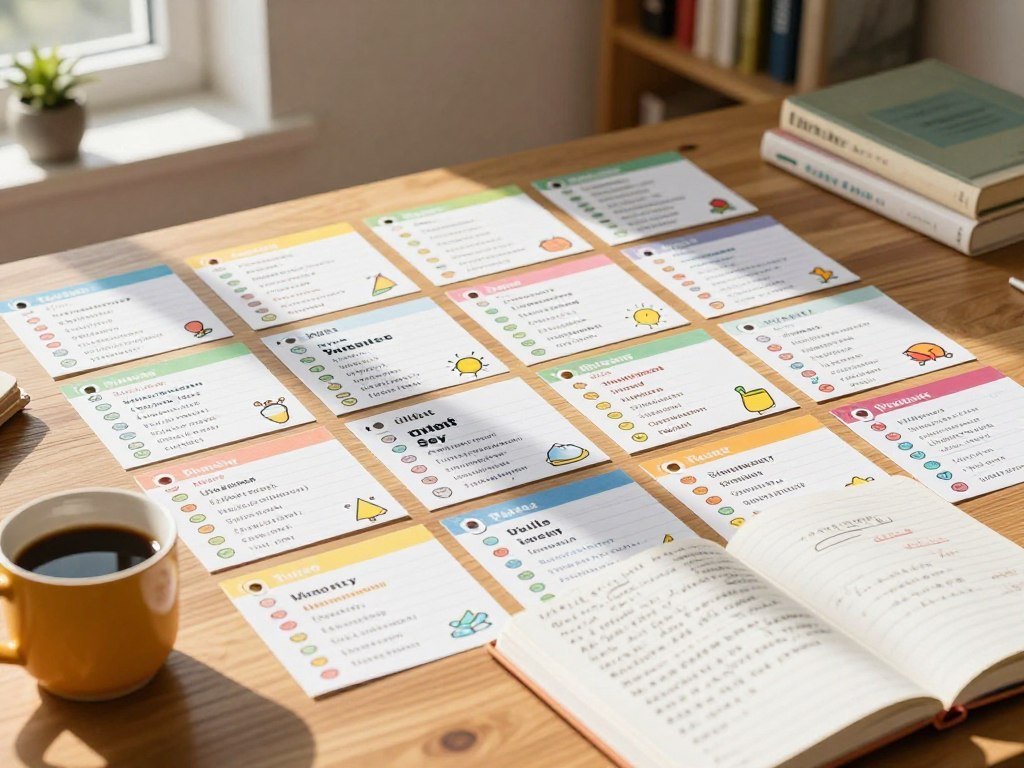
This mix makes a list less intimidating and gives you a starting point. A half-known word may need a stronger example or more practice, while a familiar entry may need only a quick check.
Vocabulary learning strategies can help you spot useful entries. A 2023 survey of 94 adult English learners in Jyväskylä, Finland, found that learners used regular review, repetition, context clues, movies, television, and synonyms in conversation.
Many strategies learners viewed as useful involved studying words outside their original context. That can include a brief definition, a written prompt, or a synonym you can compare with the target word.
Choose more than object names. Verbs help you describe actions, while small functional words can show time, cause, contrast, or direction.
For example, knowing a verb can help you explain what happened at work, not just name the tools in the room. A connector such as “although” can help you show that two ideas differ.
Do not try to save every unfamiliar word from a page or video. A shorter list gives you more room to understand and recall each entry.
Leave an obscure word off the list unless it matters to a current reading, conversation, or goal.
How should you introduce a new word?
Give a new word a clear meaning and example before expecting a learner to produce it. Meaning comes first, so the learner has something useful to connect with the word.
Do not ask for recall before the learner has heard or read a definition and example. A reading lesson may preview 10-12 words, including two or three words learners already know.

That preview count serves one reading lesson. The VALE framework instead recommends intensive teaching of 6-12 high-value words per week, with varied review activities.
Teach the word in a meaningful context
The VALE-K introduction routine takes 10-12 minutes. Learners say the word, clap its syllables, hear a student-friendly definition, and listen to example sentences.
They then discuss an image, answer an example-or-non-example quiz, and finish a sentence frame. These steps help learners connect sound, meaning, and use.
The table shows a simpler sequence you can use with one word. Each quick check helps you decide whether to continue or spend more time.
| Stage | Learner action | Quick check |
|---|---|---|
| Input | Hear or read the word and definition | Point to the matching image |
| Processing | Compare examples and nonexamples | Explain why one example fits |
| Rehearsal | Say the word in a sentence frame | Complete the frame with meaning intact |
| Retrieval | Recall the word from a meaning cue | Produce the word without looking |
Process its meaning before testing recall
A definition alone may be too thin to guide use. Add an example that shows what the word does in a sentence, then ask the learner to explain that example.
The National Center on Improving Literacy and The Reading League Journal recommend student-friendly definitions, examples, nonexamples, and questions that check understanding. Their explicit vocabulary instruction guidance also supports teaching words before, during, and after reading.
If a learner cannot explain the example in their own words, spend more time processing the meaning before moving to recall.
What belongs on a useful vocabulary card?
A useful vocabulary card should make you retrieve one clear meaning in one clear context. Keep it focused, so one prompt tests one useful connection instead of a page of notes.
Use four parts: the target word, a brief meaning cue, a natural sentence, and a recall prompt. You can write them on a paper card, in a notebook, or in a digital set.
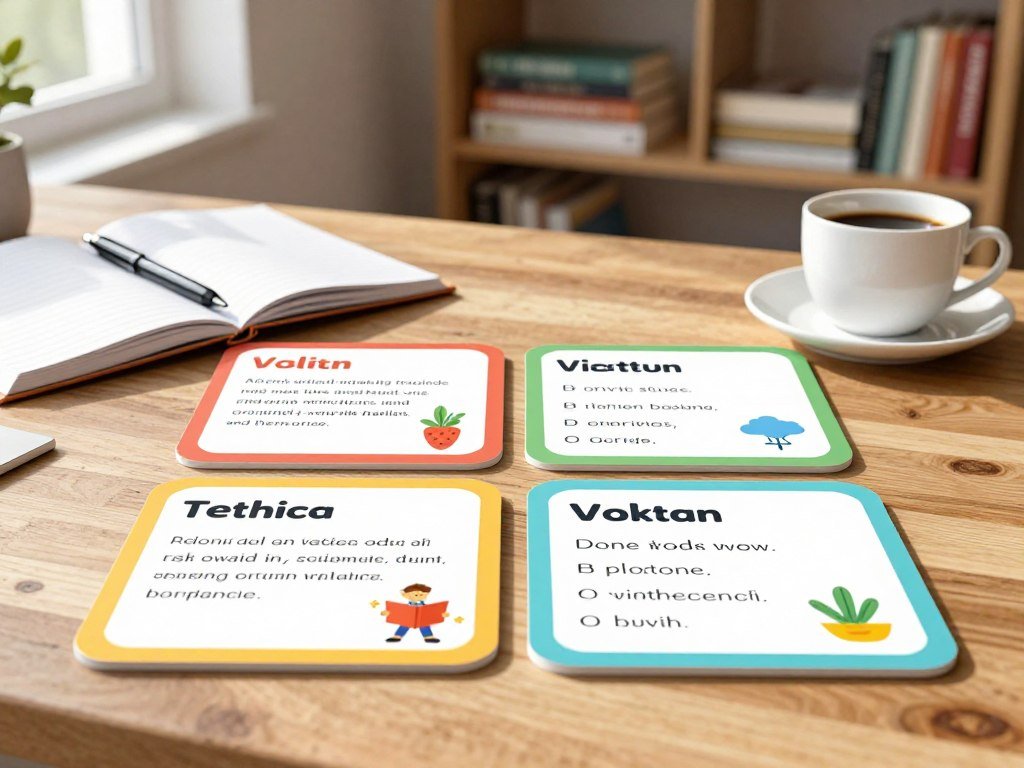
Include these four items on each basic card:
- The target word, with pronunciation support when you need it.
- A brief definition or bilingual cue.
- One natural sentence that shows how the word is used.
- One recall prompt on the back or next line.
A bilingual sentence can give you an entry point when an English definition feels unclear. Read the sentence, cover the answer, and try to produce the target word before checking its meaning.
A paper card can work as well as a digital one. A research synthesis of 32 empirical studies reviewed paper and digital cards, ready-made and self-made cards, and different study conditions.
The word-card research synthesis found that more reviewed studies reported larger effects for paper than digital cards. Those comparisons do not mean paper will work better for every learner.
For a difficult word, expand the card with the Frayer Model. It sorts information into a definition, characteristics, examples, and nonexamples.
You do not need all four Frayer parts for every entry. A simple word may need only one cue and one good sentence.
Copying several dictionary meanings onto one card makes quick review harder. Choose the meaning that fits your current example, then add another card if you need a second meaning later.
Keep a card short enough that you can attempt the answer before your attention drifts.
How can you test yourself without guessing blindly?
Try to produce the word from a cue that gives enough information to make a fair attempt. A fair cue points toward the meaning without showing the answer itself.
Check each answer promptly, and adjust the next cue if recall fails. A useful sequence keeps the learner working, but avoids turning practice into random guessing.
Start with a fair recall cue
Use this four-step routine for a card or notebook prompt:
- Read the prompt and notice what kind of answer it asks for.
- Pause, then attempt the word without looking at the answer.
- Check the answer and correct any error right away.
- Retry later with a slightly harder cue.
For example, suppose the target word is “borrow.” Start with a first-letter clue, such as “b,” if the meaning is still new.
Next, remove that letter and give a meaning cue: “Use something that belongs to someone else, then return it.” A sentence prompt can make the final attempt harder: “Can I ___ your pen?”
Add help gradually, then give feedback
This change from more help to less help is called diminishing-cues retrieval. Each step asks you to recall more of the word on your own.
A 2026 study compared diminishing-cues retrieval, standard retrieval, and restudy with 20 difficult English-Chinese word pairs. Both retrieval groups did better than restudy, and diminishing cues did better than standard retrieval.
The study involved native Chinese-speaking university students and difficult word pairs. Its result supports trying this method, but it cannot promise the same outcome for every learner or word.
When you miss an answer, look at the correct word and meaning together. Then choose an easier cue for the next attempt instead of repeating the same failed prompt.
A strong prompt gives enough information to begin, then lets you do the work of finding the word. The clue should support recall, not replace it.
When a recall attempt fails, correct it promptly and make the next attempt easier before gradually removing the help.
How often should you review vocabulary?
Review a new word on Day 1, Day 2, Day 4, Day 8, Day 15, and Day 30, then adjust based on recall. Space reviews out as the word gets easier to retrieve.
After a successful recall, move the next review farther out; after a failed recall, bring it closer. You can track the dates on paper without using an app.
The schedule below groups the six days into four checkpoints. Choose a prompt that asks you to produce the word rather than simply recognize it.
| Review day(s) | Recall prompt | If recall fails |
|---|---|---|
| Day 1 and Day 2 | Meaning cue and short sentence | Check the meaning and retry sooner |
| Day 4 and Day 8 | Meaning cue without a sentence | Return to a clearer cue the next day |
| Day 15 | Use the word in a new sentence | Review again within a few days |
| Day 30 | Recall from a brief topic cue | Move the next review closer |
A manual active-recall schedule gives the Day 1, Day 2, Day 4, Day 8, Day 15, and Day 30 sequence. Treat it as a starting pattern, not a test you must pass perfectly.
Successful retrieval can stretch the time before your next review. A failed attempt signals that the word needs attention sooner, while the meaning is still fresh.
Missing a review does not mean you should double the next session or restart the entire list. Continue with the next useful review and bring only the difficult words forward.
Marking a missed date can help you see what happened, but it does not need to become extra homework. Keep the system simple enough to use.
If a word is still difficult, bring its next review forward instead of adding a large catch-up session.
How does reading build vocabulary that flashcards cannot?
Reading and listening show how a word behaves around other words, while a card can check whether you can recall it quickly. Both kinds of practice add useful knowledge.
Use cards for fast recall and understandable reading for context. Context includes nearby sentences, common word pairings, tone, and changes in meaning.
Use repeated encounters to learn from context
An article, book, show, or video can reveal a word through the sentences around it. Later encounters may add a new example or show how people use it in everyday speech.
Repeated reading also helps you notice collocations, which are words that often appear together. You may learn that people “make a decision,” for example, rather than “do a decision.”
Context can also show register, or how formal or casual a word sounds. A word may shift in meaning across sentences, even when its spelling stays the same.
For topic vocabulary, the VALE framework describes choosing about 16 core words. Each selected informational text is read aloud at least twice, followed by discussion and review with a visual poster.
Keep flashcards for quick recall
A card can ask whether you remember a definition or can produce a word from a cue. Reading supplies a wider view of how the word works in real language.
Spaced repetition can help consolidate high-frequency words, while extensive reading builds contextual knowledge. They serve different needs, so you do not have to choose one method.
Do not save every unfamiliar word from a reading. A long list can distract you from the text and leave little time to review any entry well.
Save a word from a text only when its meaning or use matters enough to revisit.
How can speaking and writing improve English vocabulary?
Choose one target word and use it to say something true about your own day. Meaningful use helps you test whether you can fit the word into a real message.
English vocabulary and speaking skills improve together when you retrieve and use new words in an exchange. Repeating a definition alone does not show whether the word fits your idea.
Try one of these four options with a target word:
- Explain an idea aloud using the target word.
- Write a sentence about a real event.
- Turn a sentence into a question for a partner.
- Replace a familiar word with a precise synonym, then check the meaning.
For example, you might use “reschedule” to explain why you moved an appointment. A partner can then ask when you plan to meet instead.
A 2023 survey of adult English learners in Finland found that learners who rated their English ability more highly used some context-based vocabulary strategies more often. The survey shows a connection, not proof that one level caused the other.
Try the word in one spoken sentence and one written sentence before relying on it in conversation. The written version gives you time to notice whether the word says what you intend.
If you practice alone, record a short voice note or read your sentence aloud. Then listen for places where the sentence sounds unclear or incomplete.
A real exchange can be brief: ask a partner a question, answer it, and use the word again if it fits. The point is to communicate, not to force a word into every reply.
If a new word sounds unnatural in your sentence, check a real example before trying it again.
Which of the Best Ways to Learn Vocabulary Fit Your Routine?
For customizable flashcards, start by comparing Anki and Quizlet; for contextual reading and listening, compare WordUp and LingQ. The right format depends on how you want to practice.
Choose a tool that fits your study format and lets you attempt recall before checking. The table compares five options and their listed features and prices.
Listed prices were checked in October 2026 and can change. Anki is free on desktop, web, and Android; AnkiMobile for iOS costs $24.99 as a one-time purchase.
| App | Study format | Useful feature | Listed price |
|---|---|---|---|
| Anki | Custom digital flashcards | Spaced review across devices | Free desktop, web, Android; iOS $24.99 once |
| Quizlet | Flashcards and study modes | Sets and practice activities | Free; Plus $35.99/year; Plus Unlimited $44.99/year |
| WordUp | Personalized word learning | Real examples and contextual practice | $9.49-$149.99/year |
| LingQ | Reading and listening | Learn from saved content | $14.99/month; $119.99/year; $215.76/24 months |
| Memrise | Vocabulary and language courses | Practice with video content | $24.99/month; $61.99/year |
Choose an app by its study format
Anki suits learners who want to build and manage their own flashcards. AnkiMobile on iOS costs more than the free desktop, web, and Android versions.
Quizlet offers a free plan, with paid plans for more features. Compare its set-based format with Anki before moving a large vocabulary list.
WordUp combines personalized recommendations, real-world examples, spaced repetition, and contextual practice. LingQ focuses on learning through reading and listening, with plans priced by month or longer terms.
Memrise offers monthly and annual plans. Its course format may suit you if you want guided language practice alongside word review.
For a wider comparison of ways to study Spanish, see these Spanish-learning app options. Choose tools by the kind of practice they support, not by a long feature list.
How to study vocabulary words online
Magoosh Vocabulary App is free and focuses on GRE, SAT, TOEFL, and academic vocabulary. Drops uses short illustrated practice, and its free tier allows five minutes every 10 hours.
TubeVocab helps you save words from YouTube transcripts. Its free tier includes 110 credits, and its annual Pro plan costs about $3.67 per month.
Wordela offers a Free Forever plan and a VIP plan for $4 per month. It supports custom lists and adaptive review.
Vocabulary.com offers adaptive questions and progress tracking. Its listed prices are $12.99 per month, $39.99 for six months, or $59.99 per year.
Brighterly provides live, one-to-one reading tutoring for grades 1-10. Its 12-month subscription is listed at $17.70 per lesson, including a 20% discount.
Online practice works best when the format matches your goal and you try to recall each answer before checking. Picking an app only because it has the most features can leave you with a poor fit.
Before committing to a paid plan, test whether you can complete a real review session in the app’s free option or trial.
Which vocabulary activities make review more engaging?
A review game becomes useful when learners have to explain why an answer fits. Engagement matters, but a quick answer alone does not show whether a word makes sense.
Ask learners to explain the clue or meaning after they choose an answer. This works in a classroom, with a study partner, or during independent practice.
Use drawing, word maps, and movement
Make a word map that connects a target word to examples, related words, and parts of speech. A learner can point to the connection and explain how it helps show meaning.
A Frayer-style organizer can sort a word into a definition, characteristics, examples, and nonexamples. Learners can also draw a definition or act out a word, then describe what their picture or movement means.
That explanation turns an image into a check of understanding. If a drawing is unclear, ask what detail would help another learner identify the word.
Try digital and team-based practice
Quizizz offers self-paced classic mode, picture-based questions and answers, and spreadsheet import for quizzes. Visuwords shows related words, examples, parts of speech, and links between terms in an interactive word map.
Quizlet Live uses teams and prompts students to say terms aloud and share meanings. The three formats offer different ways to review: solo questions, visual links, and team discussion.
Classroom results can offer helpful examples, but they do not predict the same outcome for every learner. In a VALE-K study, just under 200 kindergarten students in 13 classes had mean PPVT-4 standard scores rise from 98.29 in fall to 107.38 in spring.
The change was statistically significant and had a medium effect size, d = 0.66. In the final year of VALE-DI, six second-grade dual-immersion classes saw Gates-MacGinitie Vocabulary Subtest Normal Curve Equivalent scores rise from 43 to 53.
Those results describe the named programs and groups, not every vocabulary activity. A game that rewards speed without asking students to explain an answer can miss whether they understand it.
Let learners rehearse a clue with a partner before asking them to explain a word in front of the whole group.
How should you adapt practice to your level and goal?
Choose practice based on what the learner needs to say or understand next, not age alone. Real tasks give vocabulary a clear purpose.
Adults and students benefit from words tied to their actual work, study, or daily communication. The best prompt depends on the task the learner expects to face.
Adults learning for work or conversation
For work or conversation, focus on language you need for an email, meeting, appointment, or daily request. Practice producing a useful word in a sentence that fits that task.
If you need to explain a delay, for instance, practice a sentence about the real event. A sentence tied to your own situation is easier to judge for meaning and tone.
Students learning for school or exams
Students can connect target words to current reading, lessons, and assessments. Pictures, sentence frames, and short examples can help make a school term easier to understand.
Students preparing for an exam may need test-specific words alongside everyday language. Exam terms should add to useful conversation vocabulary, not replace it completely.
A 2023 study of adult English learners in Jyväskylä found some variation in strategy choices by study reason and self-assessed proficiency. Age had no significant relationship with learners’ strategy choices in that study.
That finding is a reason to ask about a learner’s goals and current comfort with English, rather than assigning one method to everyone in an age group. A working adult may study for an exam, and a student may need language for a part-time job.
Revisit the goal whenever a study list fills with words the learner has no reason to use.
What daily routine helps vocabulary stick without burnout?
A reliable daily routine can take 15 minutes and still include context, recall, and active use. Short sessions can give each part of practice a clear place.
Try five minutes with a word in context, five minutes of recall, and five minutes of active use. You can follow the routine with paper, a phone, or a book.
A short routine you can repeat
Use this 15-minute plan as a practical starting point:
- Spend five minutes meeting a word in a sentence or short reading.
- Spend five minutes attempting to recall recently studied words.
- Spend five minutes using one or two words aloud or in writing.
Keep the activity small enough to finish. One well-chosen word can give you a useful sentence, while a longer list may leave no time to use anything.
How to learn vocabulary fast without adding pressure
One intensive personal method, dated September 23, 2026, uses mixed sets of 50-80 words. It keeps two or three sets active and reviews them two or three times a day for 20 minutes.
Those quantities describe one demanding approach, not a requirement. You do not need to copy its word count or review time to make steady progress.
Fixed daily word quotas can create a backlog when you miss a day or need more time with a difficult word. Focus instead on completing a manageable review and using some words well.
When words are not sticking, reduce the number of difficult prompts and make the cue clearer. Return to the word sooner instead of making every session longer.
If you miss a day, restart with a small set and a clear cue rather than trying to repay every missed session at once.
Choose a word that matters to your next conversation or reading, then keep its next attempt easy enough to begin. A calm restart leaves room for practice tomorrow.
Conclusion
A small practice loop can turn a word you noticed today into one you can try using tomorrow. A word is more likely to become usable when you understand it, retrieve it, and meet it again in a meaningful setting.
Keep your next step simple. Choose one useful word from something you read or heard today, write a short example, and set a reminder for your first recall attempt tomorrow.
That example gives the word a place in your own language, not just on a page. You can build from there with a few minutes of practice at a time.
Choose one useful word today, write a sentence with it, and set a reminder to recall it tomorrow.
FAQ
How many new words should I learn each day?
There is no daily word count that suits every learner, so keep your personal study load manageable. For focused classroom instruction, the VALE framework recommends teaching 6-12 high-value words per week. You might work with one or two words in a study session, then add more when recall feels steady. A smaller set you can use beats a large backlog.
How long should I study vocabulary each day?
A 15-minute session is a practical starting point, not a proven minimum or a rule for everyone. Spend five minutes meeting a word in a sentence or short reading, five minutes trying to recall recent words, and five minutes using one or two aloud or in writing. Shorten or extend the routine to fit your schedule and focus.
Should I learn vocabulary from a list or in sentences?
Use both: a vocabulary list organizes prompts, while sentences show how words work in context. Read or hear a definition and example before you test yourself. Then cover the word and try to recall it from a meaning cue. A list can keep review clear, but a sentence helps you see how the word fits a real idea.
Are flashcards better than reading for vocabulary?
Flashcards and reading build different kinds of vocabulary knowledge, so combine them when you can. Cards help you check whether you can recall a word quickly from a cue. Reading shows how words connect, which phrases sound natural, and how meaning can shift across sentences. Use a card to test recall, then look for the word in understandable reading.
Can watching movies or TV help me learn new words?
Yes, movies and TV can help when you use subtitles or surrounding dialogue to work out a word’s meaning. Listen for how the line fits the scene, then check whether the word appears again. Save only recurring or useful words for later recall. A short clip with clear speech can be easier to study than a fast scene full of unfamiliar phrases.
What should I do when I keep forgetting the same word?
After a failed attempt, check the answer, correct the meaning, and make your next cue easier. Review the word sooner rather than adding a large catch-up session. You might move from a sentence prompt to a clearer meaning cue, then remove help as recall improves. If the meaning still feels unclear, revisit a good example before testing yourself again.



