
Idaho ranks No. 1 overall in the 2026 livability ranking, but the best fit for you depends on what you value most. The best states to live in can look different to a young worker, a parent, or a retiree. A livability metric is a measurable indicator used to compare states on a specific condition, such as housing affordability or crime.
Use the ranking as a starting point, not a verdict on where you should live. Affordability, jobs, education, health, safety, and quality of life each tell a different part of the story. Check income growth and local costs, too, since statewide averages cannot describe every town or household.
One state may offer more room in your budget, while another may suit your work or school needs. The place you move to should support daily life, not just look good on a chart. Treat a state ranking as a shortlist, then check whether its costs and daily-life tradeoffs fit your household.
Key Takeaways
- Idaho leads the 2026 livability ranking.
- Five equally weighted dimensions shape the overall comparison.
- Housing affordability differs from total cost of living.
- Family, safety, and happiness rankings measure separate concerns.
- Your budget and work options matter at the local level.
- Use rankings to build a shortlist, then compare real costs.
Best States to Live In in 2026: Top 10 Overall
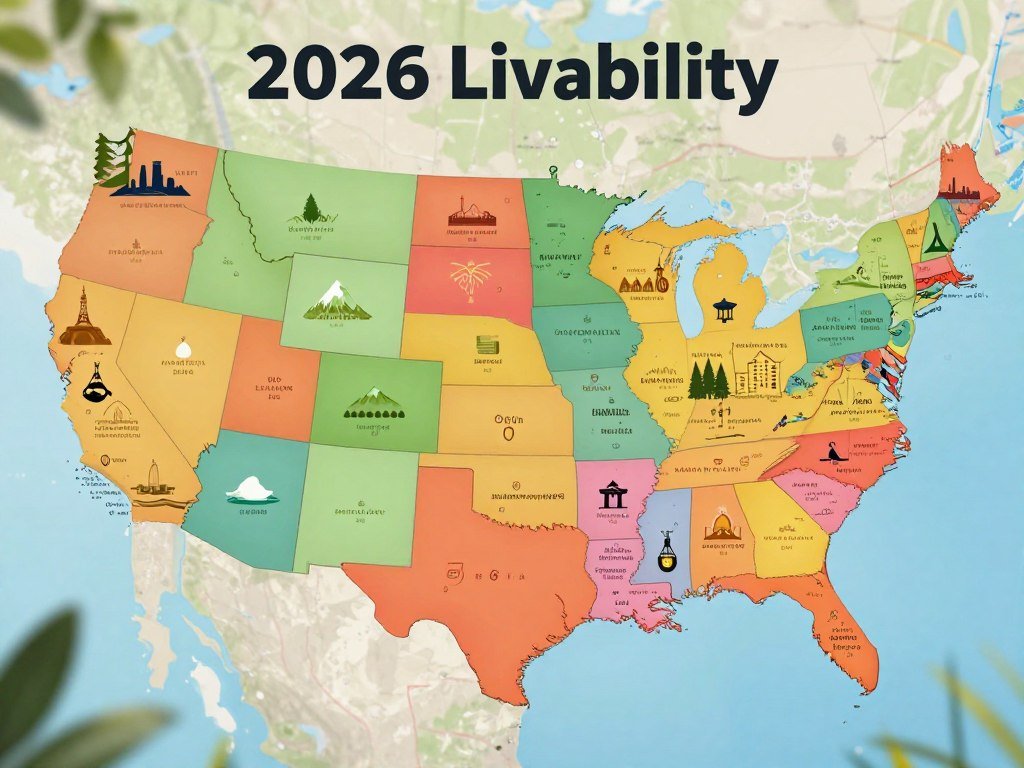
Idaho leads the 2026 overall ranking with a score of 60.15, narrowly ahead of New Jersey at 59.41. Wisconsin, Massachusetts, and New Hampshire complete the top five, though each state’s strengths may suit different households.
The total score combines five dimensions, each worth 20 points. A high result in one area can lift a state, but it cannot tell you whether the state fits your own plans.
The five highest-ranked states
The leading states offer a useful first look at the best states live in across the country. New Jersey and Massachusetts placed near the top, while Wisconsin also earned a strong score. These results show how close several states came in the 2026 comparison.
| State | Overall rank | Total score |
|---|---|---|
| Idaho | 1 | 60.15 |
| New Jersey | 2 | 59.41 |
| Wisconsin | 3 | 59.32 |
| Massachusetts | 4 | 59.28 |
| New Hampshire | 5 | 58.89 |
Wyoming ranks sixth with 58.71, followed by Utah at 58.63. Minnesota takes eighth at 57.94, Pennsylvania ranks ninth at 57.71, and Florida rounds out the ten at 57.48.
How the overall score is built
All 50 states were compared across five dimensions using 51 livability indicators. Each indicator received a score on a 100-point scale, then the five dimensions contributed equally to the total.
The dimensions are affordability, economy, education and health, quality of life, and safety. The mix gives you a broad view of state conditions, rather than a single measure such as income or school access. These metrics can also hide local differences, since cities and rural areas may offer distinct choices.
A strong score in one dimension does not guarantee a personal fit.
For example, a state may score well on economic measures but still feel out of reach if local housing costs strain your budget. Another may have strong education and health results, yet offer fewer job options in your field. The numbers help you narrow the field; your needs decide which candidates stay.
Compare the state’s quality and services with what you need day to day. A ranking can point you toward a best state to consider, but it cannot weigh your commute, family ties, or preferred climate. Use the overall order to identify candidates, not as a substitute for checking the factors that matter most to you.
Which States Offer the Lowest Housing Costs?
Iowa ranks first for housing costs, followed by North Dakota, West Virginia, South Dakota, and Kansas. That ranking focuses on housing, not every cost a household pays.
Low housing costs alone do not establish the lowest total cost of living. Housing affordability compares home prices and rents with household income, while cost of living is a separate factor.
Five states with the lowest housing costs
The 2026 housing-cost ranking gives you a place to start if affordability is a priority. The table pairs each state’s housing position with its overall rank, showing that a low housing-cost result does not automatically mean a high overall result.
| State | 2026 housing-cost rank | Overall rank |
|---|---|---|
| Iowa | 1 | 11 |
| North Dakota | 2 | 16 |
| West Virginia | 3 | 43 |
| South Dakota | 4 | 17 |
| Kansas | 5 | 24 |
Housing cost burden offers another way to judge affordability. In 2024, 32.0% of U.S. households spent at least 30% of household income on housing, based on America’s Health Rankings housing cost burden data.
Look beyond the housing-cost rank
Home prices and rents are only part of a household’s housing costs. Taxes, income, and the share of pay left after bills can change how affordable a home feels.
Idaho illustrates why housing measures can tell different stories. Its median real estate tax rate is 0.5%, and it has the eighth-highest homeownership rate. Those facts describe property taxes and ownership, not the full cost of buying or renting.
A home may have a low price but still take up a large share of local income. The reverse can happen where pay is higher, even if home prices are also higher. Compare housing payments with local income, since a low housing-cost rank alone does not show how much room a household has in its budget.
Which States Rank Highest for Raising a Family?
Massachusetts leads the family ranking, with Minnesota, North Dakota, Wisconsin, and Nebraska completing the top five. Family needs add context that a general state score cannot capture.
Housing, child care, schools, and health coverage can affect a family budget in different ways. Compare each measure with your own household’s needs, including the cost of care when parents work.
The five leading states for families
The 2026 family ranking places Massachusetts first, Minnesota second, North Dakota third, Wisconsin fourth, and Nebraska fifth. Its housing-affordability positions differ from the separate low-housing-cost ranking. In the family ranking, North Dakota placed second for affordable housing, Kansas third, Nebraska fourth, and South Dakota fifth.
Child-care costs also vary sharply as a share of family income. In North Dakota, care cost 9% of median income for a family with two working parents. In Hawaii, it cost 18% of median income for the same family type.
Child care cost 9% of median income in North Dakota for a family with two working parents, compared with 18% in Hawaii. A gap like this can matter when two parents need care to stay at work.

Compare housing, child care, and schools
Wisconsin shows how school and health measures can add useful detail. It ranked sixth for public school quality and had a high school graduation rate above 96%. Health insurance coverage reached 94.8%, and unemployment ranked seventh-lowest.
Nebraska recorded 8.7 drug deaths per 100,000 people in 2023, another measure families may want to weigh. No single figure covers every school, clinic, or community, so statewide data work best as an early screen.
- School quality in the districts you may consider.
- Housing payments compared with household income.
- Child-care costs for your family’s work schedule.
- Health coverage options and local access to care.
A statewide school rank can point you toward places to research, but school access depends on the district. Families should check school options at the district level before treating a statewide education rank as a decision.
Where Do Safety and Happiness Rankings Point?
Vermont leads the 2026 safety ranking, while Hawaii leads the happiness ranking. These categories measure different things, so one result cannot stand in for the other.
A safety rank and a crime rate are not interchangeable measures. The safety rank combines a broader category, while a crime rate reports offenses against a population.
States with the strongest safety ranks
Vermont ranks first among the safest states in 2026, followed by Massachusetts, Maine, New Hampshire, and Connecticut. New Hampshire had the lowest crime rate in the 2026 best-states comparison. Idaho, Rhode Island, Maine, and Connecticut followed it.
The distinction matters because a composite safety rank can include more than reported offenses. New Hampshire recorded 110 violent-crime offenses per 100,000 residents in 2024. Virginia recorded 218 violent-crime incidents per 100,000 residents that year.
USAFacts’ crime-rate comparison explains how FBI crime data can differ by state and region. Crime rates also depend on the offense type being counted, so check whether a number covers violent crime or property crime.

Happiness and life satisfaction leaders
Hawaii ranks first among the happiest states in 2026, followed by New Jersey, Utah, Idaho, and Maryland. Hawaii’s residents had the nation’s highest reported life satisfaction.
That result speaks to reported well-being, not every part of a move. A high happiness position does not settle questions about cost, climate, or job fit. A state that suits one household’s pace and work may not match another’s.
Look at the safety measure behind a rank, then compare it with the concerns you care about. Some households may focus on violent offenses, while others may pay more attention to property crime or broader safety conditions. Check which safety measure matters to your household, because a composite safety rank and a crime rate are not the same measure.
How Can You Choose a State That Fits Your Priorities?
A state’s overall rank is a useful filter, but your shortlist should reflect the costs and opportunities you will actually face. Your own priorities come first, whether you are starting a career, raising a family, or seeking a change.
Compare the specific places you might live, not only the statewide rank. The 2026 ranking’s underlying data were current as of July 13, 2026.
The remaining positions complete the 50-state ranking. Ranks 11 through 30 are Iowa, New York, Virginia, Montana, Maine, North Dakota, South Dakota, Illinois, Vermont, Nebraska, Colorado, Connecticut, Rhode Island, Kansas, Indiana, North Carolina, Georgia, Ohio, Michigan, and Missouri.
Ranks 31 through 45 are California, Delaware, Washington, Arizona, Maryland, Texas, Hawaii, South Carolina, Alabama, Tennessee, Kentucky, Oregon, West Virginia, Oklahoma, and Nevada. The last five are Arkansas at 46, Alaska at 47, Mississippi at 48, Louisiana at 49, and New Mexico at 50.
Young adults should compare entry-level job options, housing payments, commute needs, and access to education or health services.
There is no single state that suits every age group. A young adult may care most about entry-level work and a manageable commute. A family may put more weight on schools, while access to health services can matter at any age.
- Rank your personal priorities, such as work, budget, and services.
- Choose candidate states that fit those needs.
- Compare likely monthly budgets in each city or town.
- Verify job openings and commute options in those places.
Before making a move, compare expected take-home income with housing and transportation costs in the specific place you would live.
Conclusion
Idaho is the overall leader, but the right choice is the state that fits your own priorities and budget. No single national ranking captures every household’s preferred balance of affordability, health, safety, and quality of life.
A state’s score can help you start, while a local budget shows what daily expenses may mean for your household. Compare likely income with housing, transportation, and the costs that shape your routine.
Choose three candidate states and set up a monthly budget comparison for each. Put three finalist states into a monthly budget worksheet before deciding where to visit or move.
FAQ
What is the #1 best state to live in?
Idaho ranked No. 1 overall in the 2026 comparison, with a total score of 60.15. Its lead reflects performance across five equally weighted dimensions, not a promise that every household will find it ideal. If housing cost, schools, or safety matters most to you, a category ranking may point toward another state. Compare the measures that shape your daily life.
What is the #1 state to move to?
Idaho leads the 2026 overall ranking, but that rank is not a personalized moving recommendation. Your best choice depends on your budget, work options, and daily needs. Compare the cities or towns where you could realistically live, since local costs and services can differ within one state. A high statewide score is a useful first filter, not a final answer.
What are the top 3 safest states to live in?
Vermont, Massachusetts, and Maine ranked first, second, and third for safety in 2026. A safety rank reflects a broader category, while a crime rate counts reported offenses per population. Those measures can offer different views of safety. Check the types of offenses and the local areas that matter to you, rather than relying on one statewide position alone.
What is the #1 cheapest state to live in?
Iowa ranked first for housing costs in 2026, but that does not prove it has the lowest total cost of living. The housing-cost rank compares housing affordability, while other expenses shape the full household budget. Local income also matters: a payment that looks low statewide may still take a large share of your pay. Compare housing costs with income where you may live.
Are the best states the same for young adults and families?
No, young adults and families do not automatically need the same state. Young adults may focus on entry-level jobs, housing payments, commutes, and access to education or health services. Families may give more weight to schools, child care, and health coverage. Compare those needs with your own budget and plans, then judge each likely city or town rather than relying only on statewide results.



