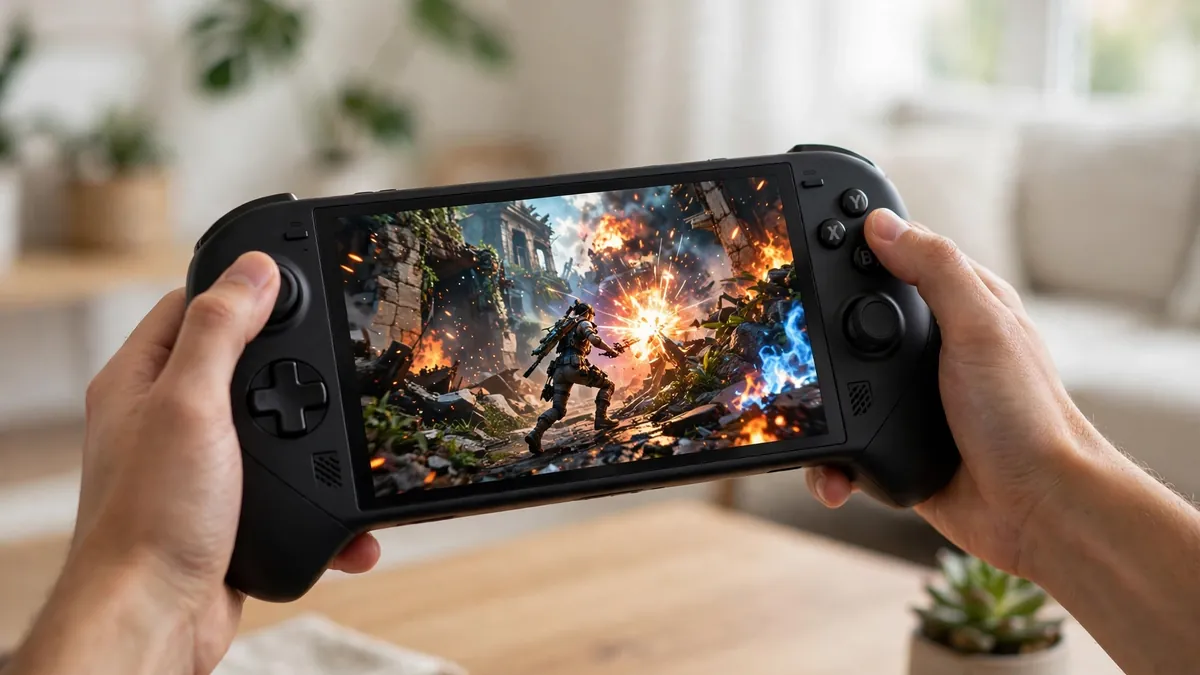
The Acer Predator Atlas 8 review starts with a simple question: how much performance can you get from a handheld gaming PC without paying the top price in the category? Engadget published its review of the Acer Predator Atlas 8 on 25 November 2026, giving the device a score of 8.2 out of 10, and the verdict is that Acer has built a serious rival to the best Windows handhelds by matching its closest competitor on the chip that matters most while charging about $350 less.
The Acer Predator Atlas 8 is a Windows handheld gaming PC, not a laptop, built around an 8-inch display and full controller grips on either side. Its headline feature is the Intel Arc G3 Extreme processor, the same chip found in the MSI Claw 8 EX AI+, which is currently the performance benchmark in this class of device. Acer pairs that chip with 24GB of shared memory and 512GB of storage in the North American model, which costs $1,300, and the review finds that the performance gap between the two machines is far smaller than the price gap.
That combination matters because handheld gaming PCs have moved from a niche curiosity to a genuine alternative to a desktop or console for many players. The Atlas 8 arrives at a moment when the price of memory is rising and several rivals cost far more, so a device that delivers nearly the same frame rates for hundreds of dollars less deserves a close look at where it matches the best, where it falls short, and who should actually buy it.
Key takeaways
- Engadget scored the Acer Predator Atlas 8 at 8.2 out of 10 in its review published on 25 November 2026.
- The Atlas 8 uses the same Intel Arc G3 Extreme chip as the MSI Claw 8 EX AI+ but costs about $350 less, at $1,300 in North America.
- In Cyberpunk 2077 at 35 watts, the Atlas 8 reached 88 frames per second, close to the Claw at 95 frames per second.
- It has an 8-inch 120Hz display with 500-nit brightness, an 80Wh battery, dual USB-C ports with Thunderbolt 4, and a fingerprint reader in the power button.
- The main drawbacks are its high price, speakers that distort at high volume, no USB-A port, and a weak D-pad noted by a second reviewer.
What happened
Engadget reviewer Sam Rutherford tested the Acer Predator Atlas 8 as a daily gaming handheld, running demanding PC games, checking battery life, and comparing it directly with the MSI Claw 8 EX AI+, the handheld that has set the pace for high-end Windows portables. The review describes a device that follows the familiar handheld template: a large screen in the middle, controller grips on both sides, and all of the ports along the top edge.
Inside, the Intel Arc G3 Extreme processor is the star of the show. It is the same chip used in the MSI Claw 8 EX AI+, and it carries an integrated Arc B390 graphics unit with support for XeSS frame generation, which can lift frame rates in supported games. The North American Atlas 8 pairs that chip with 24GB of LPDDR5X memory and 512GB of internal storage, while the Claw offers 32GB of memory and 1TB of storage.
The performance numbers in the review are striking. In Cyberpunk 2077 at 35 watts, with the game running at full HD resolution on medium graphics settings and XeSS set to performance mode, the Atlas 8 hit 88 frames per second. The Claw managed 95 frames per second in the same test, a gap of barely more than five percent. When the power limit was dropped to 15 watts, the kind of setting a player might choose when running on battery alone, the two devices were effectively tied in Returnal at full HD on medium settings, with 60 frames per second for the Acer against 59 for the MSI.
Battery life comes from an 80Wh battery, which is large for a handheld of this size. In Engadget testing, the Atlas 8 played World of Warcraft: Forever at full HD on medium settings for an hour and 45 minutes on a single charge while keeping frame rates consistently above 90. Less demanding games last longer, and the second review found that manually lowering the power limit could extend play to roughly four and a half hours in GTA 5 Enhanced and more than five hours in Horizon Chase Turbo.
The port selection is modern and practical, with one notable omission. Along the top edge sit dual USB-C jacks with Thunderbolt 4 support, a microSD card reader for expandable storage, a 3.5mm audio jack, and a power button with a built-in fingerprint reader. There is no USB-A port, so older accessories need an adapter or a USB-C cable. The device weighs 861 grams, or about 1.9 pounds, which is heavy for a handheld but well balanced, according to both reviews, thanks to rounded grips that flare at the bottom and a lightly grippy front surface.
Like other high-end Windows handhelds, the Atlas 8 runs Microsoft Xbox experience software on top of Windows, which gives it access to a huge library of PC games through stores such as Steam and the Xbox app. That openness is one of the main reasons handheld PCs have grown so quickly: the same device can play a new release, an older classic, and a cloud-streamed game without being locked to a single store.
Why it matters
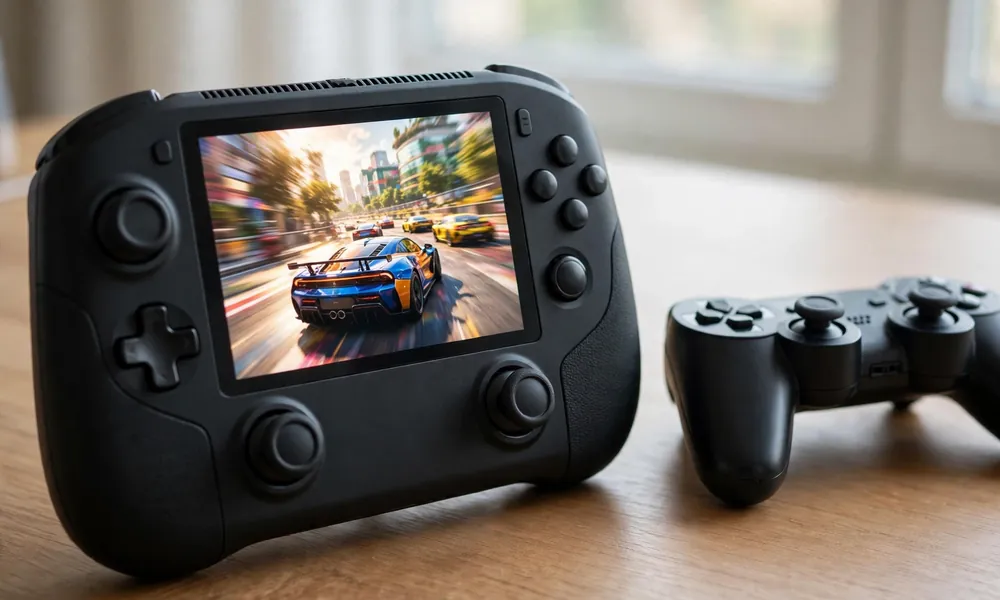
The Atlas 8 matters because it changes the value calculation at the top of the handheld market. Until now, the fastest Windows handheld has also been one of the most expensive, and buyers who wanted the best frame rates had little choice but to pay for it. Acer has shown that the same silicon can be sold for $350 less, and that the performance cost of that saving is only a few percent in most games. That is the kind of gap that forces rivals to respond, either by cutting prices or by offering something clearly better in another area.
There are trade-offs that buyers should not ignore. Engadget found that the speakers sound distorted at high volumes, so headphones are the better choice for serious play. The weak D-pad is a bigger concern: the second review found that at least half of tested special-move inputs in fighting games were missed, and about a quarter of diagonal inputs in a platform game went in a cardinal direction instead. That flaw will matter most to players who love fighting games and retro platformers, and it could be a deal-breaker for them even though the rest of the hardware is strong.
What is next
The immediate question is availability and pricing in each market. The Atlas 8 is out now, and buyers should be able to find it directly from Acer or from retailers in their area. In the United Kingdom there are four variants, with the base models using the standard Intel Arc G3 chip and the pricier models using the Arc G3 Extreme, while the United States only gets the Extreme versions. Prices vary by configuration, so it is worth checking the exact memory and storage of the model on sale before buying, because the $1,300 North American model is the 24GB and 512GB version.
Competition will not stand still either. The smaller Atlas 7 is already on the way, and other makers are preparing their own devices with the same Intel chips. The MSI Claw remains the performance reference, and its larger memory and storage give it a reason to exist at a higher price, but Acer has narrowed the gap so far that MSI may need to sharpen its own pricing or add features to justify the difference. Buyers who can wait a few months may see better deals on both devices, especially around major sales events.
At a glance
| Detail | What is known |
|---|---|
| Review score | 8.2 out of 10 from Engadget, published 25 November 2026 |
| Price | $1,300 in North America, about $350 less than the MSI Claw 8 EX AI+ |
| Processor | Intel Arc G3 Extreme with integrated Arc B390 graphics |
| Memory and storage | 24GB of shared memory and 512GB of storage in the tested model |
| Display | 8-inch LCD, 1920 by 1200, 120Hz refresh rate, 500-nit brightness |
| Battery | 80Wh, about 1 hour 45 minutes of demanding play at full power |
| Ports | Dual USB-C with Thunderbolt 4, microSD reader, 3.5mm audio, fingerprint power button |
| Weight | 861 grams, about 1.9 pounds |
Checklist: judging this review honestly
- Check the exact model on sale, because memory and storage vary by region and configuration.
- Compare the $350 saving with the cost of a larger microSD card if 512GB is not enough.
- Test the D-pad yourself if you play fighting games or retro platformers regularly.
- Try the 15-watt mode on battery, where the Atlas 8 matches its rival most closely.
- Use headphones, since the built-in speakers distort at high volume.
- Weigh battery life against performance, and keep a charger handy for demanding games.
Frequently asked questions
Is the Acer Predator Atlas 8 a laptop?
No. The Acer Predator Atlas 8 is a handheld gaming PC with an 8-inch screen and built-in controller grips. It runs Windows and plays PC games, but it is held in both hands like a portable console rather than used on a desk like a laptop.
How much does the Acer Predator Atlas 8 cost?
The North American model costs $1,300. That is about $350 less than the MSI Claw 8 EX AI+, its closest rival, which uses the same Intel Arc G3 Extreme chip but offers more memory and storage.
How fast is the Atlas 8 in real games?
In Engadget testing, it reached 88 frames per second in Cyberpunk 2077 at 35 watts on medium settings, against 95 for the Claw. At 15 watts in Returnal, the two were effectively tied at 60 and 59 frames per second.
How long does the battery last?
The 80Wh battery lasted an hour and 45 minutes in a demanding game at full power in Engadget testing. Less demanding games last longer, and manually lowering the power limit can extend play to several hours.
What are the main drawbacks?
The review lists its high price, speakers that distort at high volume, and the lack of a USB-A port. A second review also found a weak D-pad that missed many inputs in fighting and platform games.
Should I buy the Atlas 8 or the MSI Claw 8 EX AI+?
Choose the Atlas 8 if you want nearly the same performance for about $350 less and can live with 512GB of storage. Choose the Claw if you need 32GB of memory and 1TB of storage and are willing to pay more for them.
The bottom line
The Acer Predator Atlas 8 earns its 8.2 out of 10 by doing the thing that matters most in a handheld: delivering the performance buyers expect at a price that is easier to accept. The same Intel Arc G3 Extreme chip, the bright 120Hz screen, and the large battery add up to a device that plays demanding games well, and the few-percent gap to its more expensive rival is small enough that most players will never feel it.
If you want a premium handheld without paying the premium price, the Atlas 8 is the most convincing option yet, and it sets a new standard for value at the top of the market. Check the exact model, test the controls if you can, and make sure 512GB is enough for your library. If those checks pass, this is a handheld that delivers potent performance at a slightly better price, exactly as the review promises.