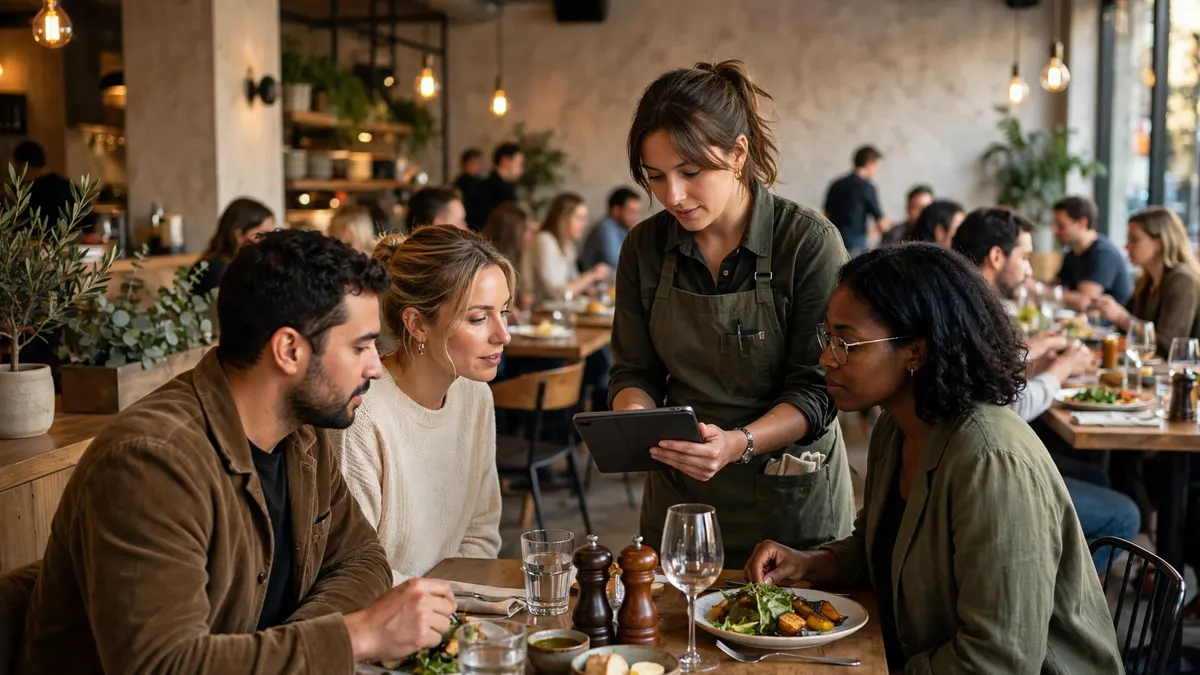
Running a restaurant in 2027 means juggling online orders, reservations, delivery apps, staff rotas, food costs, reviews, and a phone that never stops ringing. The best of them use AI for the repetitive work — predicting demand, answering the phone, spotting waste, and turning one-time guests into regulars. This list is for owners and managers of full-service restaurants who want software that earns its keep on a Friday night, not just in a demo.
We looked for tools that solve a real restaurant problem first and use AI to do it better — proven POS and reservation platforms with genuinely useful automation, plus newer specialists for voice ordering, inventory, and guest marketing. Price matters too: a tool that costs more per month than a slow Tuesday takes is not a bargain.
The shortlist covers front and back of house — ordering, payments, tables, phone answering, inventory, and marketing — so you can fix your biggest pain point first, or build a small stack that covers the lot.
Key takeaways
- Toast is the best overall pick for full-service restaurants wanting one system for orders, payments, and reporting.
- Square for Restaurants is the best budget starting point, with a free tier for small dining rooms.
- SevenRooms is the best choice for guest experience and repeat visits, with strong CRM tools.
- Voice AI such as Slang.ai now answers the phone reliably, freeing staff during the dinner rush.
- Check renewal pricing, contract length, and data export before you sign — switching POS systems is painful.
At a glance: the shortlist
| Tool | Best for | Starting price | Standout limit |
|---|---|---|---|
| Toast | Full-service restaurants | From $69 per month | Hardware and add-ons add up |
| Square for Restaurants | Small restaurants on a budget | Free starter plan | Advanced features cost extra |
| SevenRooms | Guest experience and loyalty | Custom pricing | Priced for larger venues |
| OpenTable | Reservations and discovery | From $249 per month | Per-cover fees on top |
| Choco | Ordering and supplier management | Free starter plan | Supplier coverage varies by city |
| MarketMan | Inventory and food-cost control | From $199 per month | Needs disciplined stock counts |
| Slang.ai | Answering phones with AI | From $199 per month | Needs careful menu setup |
Toast — Best overall
Toast is the closest thing to a complete operating system for a full-service restaurant, covering point of sale, handheld ordering, online ordering, payments, payroll, and reporting in one place. Its AI focuses on what matters: sales forecasting, suggested prep levels, and alerts when a dish starts costing too much. During service, servers fire orders from the table and split bills in a couple of taps.
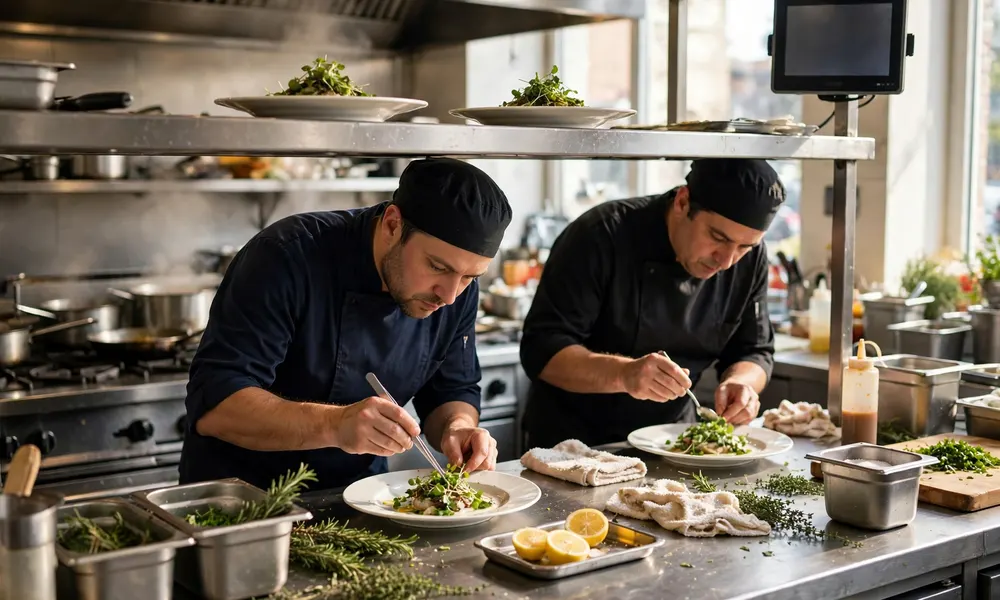
Reporting shows which items sell, which hours are dead, and which servers turn tables fastest, without exporting spreadsheets. It integrates with many reservation, delivery, and accounting tools. Check current pricing before buying — hardware and add-ons add to the monthly fee.
Pros: Deep all-in-one feature set; strong reporting and forecasting; wide integration list; handheld ordering built for busy floors.
Cons: Costs climb with hardware and add-ons; contracts can be long; setup takes time.
Square for Restaurants — Best for small restaurants
Square is the easiest way for a small restaurant to get a proper system without a big upfront bill. The free starter plan covers table management, menus, and payments, and paid tiers add floor plans, coursing, and deeper reporting. Its AI is practical: summaries flagging your best and worst sellers, and suggestions for menus and staffing.
Square also handles payments, delivery, and gift cards, so a small venue can run most of its operation on one account. Many of the same ideas appear in our guide to AI tools for coffee shops, where low cost and fast setup matter just as much. The trade-off is depth: large multi-site restaurants will outgrow it sooner.
Pros: Free starter plan; fast setup; simple interface staff learn quickly; payments built in.
Cons: Advanced features cost extra; reporting is lighter than Toast; less suited to large operations.
SevenRooms — Best for guest experience
SevenRooms is built around one idea: the guest, not the table, matters most. It combines reservations, waitlists, table management, and a guest database that remembers allergies, anniversaries, favourite tables, and spend. Its AI segments your guest list automatically and suggests who should get a win-back offer, a birthday note, or a tasting-night invite — marketing that feels personal because it rests on real visit history.
For restaurants living on regulars and special occasions, that memory beats a booking widget. It also handles chef tables and ticketed events. Pricing is custom and aimed at larger venues, so small cafes should look elsewhere.
Pros: Excellent guest profiles and CRM; smart segmentation and automated marketing; handles ticketed events and experiences; strong table management.
Cons: Custom pricing for larger venues; needs clean guest data; learning curve for staff.
OpenTable — Best for reservations and discovery
OpenTable remains the biggest reservation network, and that reach is its main selling point: diners search it first, so a listing puts you in front of people already deciding where to eat tonight. Beyond bookings it offers table management, guest notes, and AI features that flag likely no-shows.
The downside is cost: a monthly fee plus per-cover charges means a busy restaurant pays more when it is busiest. Some owners use OpenTable for discovery and shift regulars to direct booking over time. If your dining room depends on walk-ins and locals, a cheaper tool may do the same job.
Pros: Largest diner discovery network; reliable booking and table tools; no-show prediction fills empty seats.
Cons: Monthly fee plus per-cover charges; costs rise with volume.
Choco — Best for ordering and suppliers
Choco tackles the least glamorous part of running a restaurant — ordering from suppliers. Instead of phone calls and paper invoices, orders go through one app, suppliers confirm digitally, and invoices are matched automatically. Its AI reads invoices, flags price changes, and spots when two suppliers charge different prices for the same ingredient — a leak that quietly eats margin.
For kitchens ordering from several suppliers a week, the time saving is significant — and the price-tracking is the real prize. The catch is coverage: Choco works best where your suppliers are already on the platform, so check your key vendors are supported before you commit.
Pros: One app for supplier orders; automatic invoice matching; flags price rises; free starter plan.
Cons: Supplier coverage varies by city; some vendors still prefer phone orders.
MarketMan — Best for inventory and food costs
MarketMan is the tool for owners who suspect food cost is drifting but cannot prove where. It tracks inventory from delivery to plate, costs recipes in real time, and alerts you when a dish margin drops below target. Its forecasting looks at past sales and suggests order quantities, cutting both waste and the Friday-night panic when a key ingredient runs out.
The catch is discipline: it only works if someone counts stock regularly and keeps recipes accurate. Restaurants that commit usually find the savings quickly — a few points of food cost pays for the subscription many times over. It integrates with major POS systems, including Toast and Square.
Pros: Real-time recipe and margin costing; demand forecasting cuts waste; integrates with major POS systems.
Cons: Needs regular stock counts; from $199 a month; staff training takes effort.
Slang.ai — Best for answering the phone
The phone is a restaurant’s worst bottleneck: during the rush nobody can answer it, and every missed call is a lost booking. Slang.ai answers with a natural-sounding voice, takes reservations, answers questions about hours and menus, and routes the calls that need a human. It books directly into your reservation system, so a Saturday 7pm caller gets a table instead of a voicemail.
Setup is the make-or-break step: the AI needs your menu, hours, policies, and booking rules loaded correctly, and you should test it with awkward questions before it goes live. Once running, owners report far fewer missed calls and calmer front-of-house staff.
Pros: Answers every call, even at peak; books into your reservation system; fewer interruptions.
Cons: Needs careful setup; from $199 a month; complex requests still need a human.
How to choose
Start with your biggest leak: empty tables while the phone rings unanswered means fix the phone first; creeping food cost means fix inventory; drifting regulars means fix the guest experience. Buy an all-in-one system only when your POS is the bottleneck — otherwise add one specialist and measure the result first.
Check three things before you sign: whether the tool integrates with your POS and reservation system, the total monthly cost including processing and per-cover fees, and how you get your data out if you leave. A tool that holds your guest list hostage is a bad deal at any price. Budget a week for rollout, not a day — the best software fails if the team is not trained. For the people side, our guide to scheduling software for hospitality teams covers rota tools that pair well with the systems above. Check current pricing on every product before buying, since plans and fees change often.
Checklist: before you pay
- Run a free trial or pilot during a real service, not just a quiet weekday.
- Confirm the total monthly cost, including payment processing and per-cover fees.
- Check the contract length, renewal price, and cancellation terms in writing.
- Confirm the tool integrates with your POS, reservations, and accounting software.
- Ask how to export your guest list, menus, and sales history if you leave.
- Check support hours — a Friday-night outage needs Friday-night help.
Frequently asked questions
What is the best AI tool for a small restaurant?
Square for Restaurants is the best starting point for most small restaurants: the free starter plan covers tables, menus, and payments. If your dining room is larger or you need deeper reporting and forecasting, Toast is the stronger all-in-one choice.
Can AI really answer a restaurant phone properly?
Yes, for most of the volume: reservations, hours, directions, dietary questions, and takeaway orders. Tools such as Slang.ai handle these reliably once set up correctly. Complaints, large parties, and special requests still need a human, and a good setup routes those through quickly.
Do these tools replace staff?
No. They replace repetitive tasks — taking phone orders, counting stock, sending reminders — so staff can focus on guests. Restaurants using them still need servers, cooks, and managers; the tools just mean fewer staff stuck at a terminal or on the phone.
How much should a restaurant budget for AI tools?
A small restaurant can start with free or low-cost tools and spend under $100 a month. A busy full-service venue running a POS, reservations, and one or two specialists should expect $300 to $800 a month all in. Measure the return one tool at a time — one saved booking or a point of food cost usually covers the bill.
Will AI tools work with my existing POS?
Most specialists on this list integrate with Toast, Square, and other major POS systems. Check the exact integration before you buy, not after, and confirm whether sales, inventory, and guest data sync both ways. If a tool only exports a spreadsheet once a day, it will not keep up during service.
What about food trucks and other mobile food businesses?
Mobile operators face different problems — changing locations, limited space, and short service windows — so their tool stack looks different. Our guide to AI tools for food truck owners covers options built for that way of working.
The bottom line
For most full-service restaurants, Toast is the best overall pick: it covers ordering, payments, and reporting in one system, and its forecasting helps owners decide with numbers instead of gut feel. If budget is the main constraint, start with Square for Restaurants and add a specialist later. If your dining room lives on regulars, SevenRooms is most likely to bring them back; if the phone is your bottleneck, Slang.ai pays for itself in recovered bookings.
Whatever you choose, pilot it during a real service and judge it on one number: does it save more than it costs? AI tools for restaurants are improving fast, but the 2027 winners will still be the restaurants that use them to serve guests better, not the ones with the longest feature list.