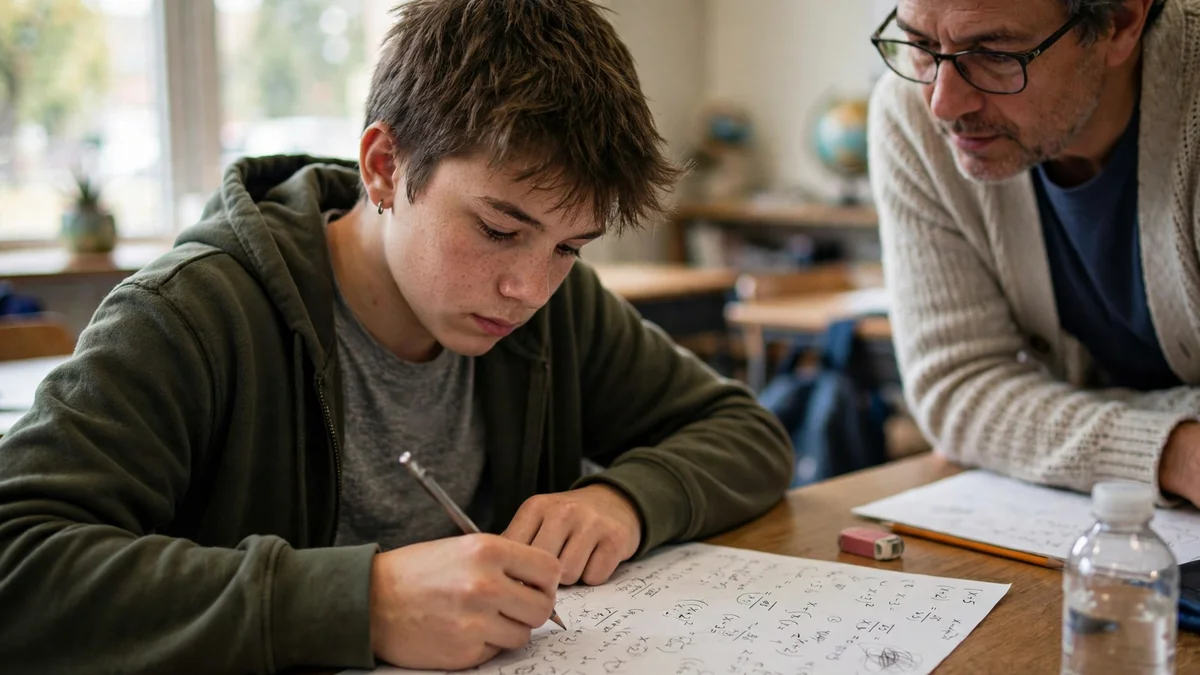
Artificial intelligence tutors can keep a student working hard on a difficult maths problem, but a human teacher in the room still does the job better. That is the headline finding of a small experiment from the University of Cambridge, reported by the BBC on 29 November 2026 under the headline “Cambridge University study finds AI no match for maths teachers”. Students supported by a teacher found the work easier, attempted more questions and ended the session less stressed than students supported by an AI tutor or by an internet search engine.
The study matters because it asked a different question from most research on AI in schools. Instead of testing whether an AI tutor raises test scores, the Cambridge researchers asked how students cope when the work gets hard: how difficult it feels, how much effort it takes, how many questions they attempt, and how stressed they feel at the end. Those are the moments where learning is won or lost, and they are the moments where a teacher’s presence seems to make the biggest difference.
The experiment was small and deliberately narrow, and the researchers say so themselves. It involved 149 students aged 16 to 18 from a single large sixth-form college in England, a single 90-minute session, and one AI tutor, Khanmigo Lite from Khan Academy. The findings are best read as careful evidence about how students experience hard work with different kinds of support, not as a verdict on every AI tutor, every subject or every classroom. This article reports what the study did, what it found, where its limits lie, and what it means for schools deciding how to use AI tutors.
Key takeaways
- In a randomised experiment with 149 students aged 16 to 18, those with a human maths tutor reported the lowest difficulty, made the most attempts and felt the least stressed.
- Students using the AI tutor Khanmigo Lite reported significantly more effort than those with a teacher, and rated the work as significantly harder in the second round.
- At the end of the session, 5.8 per cent of the human-tutored group reported feeling stressed, against 19.2 per cent with the AI tutor and 32 per cent using web search.
- Students left alone with an internet search engine fared worst on stress, calm and attempts, making unguided searching the weakest form of support tested.
- The study did not measure whether answers were correct or whether anyone learned more, and its findings are exploratory, so it cannot say which kind of support produces better grades.
| Group | Support received | Felt stressed at the end | Felt calm at the end |
|---|---|---|---|
| Human teacher | A maths tutor in the room, guiding without giving answers | 5.8% | 55.8% |
| AI tutor | Khanmigo Lite, Khan Academy’s Tutor Me tool, guiding with hints | 19.2% | 51.9% |
| Internet search | DuckDuckGo with its AI features switched off, plus any public website | 32.0% | 22.0% |
How the Cambridge experiment was designed
The study was carried out by Megan Ennion, a doctoral researcher at the University of Cambridge’s Faculty of Education, and Professor Ros McLellan, and was published in the British Journal of Educational Technology on 13 November 2026. It took place in a large sixth-form college of around 3,000 students that already had experience of custom-built AI tutors. A total of 160 students volunteered, and 149 gave usable data, all aged between 16 and 18.
Each student was randomly given one form of help for a single 90-minute session: a human maths tutor in the room who guided without giving answers, Khanmigo Lite, the Khan Academy Tutor Me tool, which guides with questions and hints, or the DuckDuckGo search engine with its AI features switched off. Everyone tackled the same work: two 20-minute sections of four problems each, then a choice of six more problems from tiers of difficulty.
The problems were deliberately demanding. The college’s heads of mathematics and psychology confirmed that they went beyond the A-level curriculum, so nobody could coast. All three groups were told the same thing: use the support for guidance, not for answers.
What the students reported

The human tutor group came out ahead on almost every measure. Those students reported the lowest perceived difficulty in both sections, and they made the most attempts at questions in both sections. In the second section, when students had to go back into hard work after a bruising first round, the gap widened, and the human group showed the biggest drop in perceived difficulty, from 2.06 to 1.67 on a five-point scale.
The BBC’s account says the teacher-supported students solved more of the difficult questions, and the study’s lead researcher, Megan Ennion, told the BBC: “We need to start judging AI based on how far it supports the whole learning process, not just where students end up.” That framing points to a tension: a detailed write-up of the paper stresses the researchers measured attempts and reported difficulty, not whether answers were right, so “solved more” should be read as the BBC’s summary rather than a measured gain in learning.
The stress figures are striking, although the authors report them descriptively and did not test them statistically. At the end of the experiment, just 5.8 per cent of the human-tutored group reported feeling stressed, against 19.2 per cent using the AI tutor and 32 per cent working with web search. The calm figures run the same way: 55.8 per cent, 51.9 per cent and only 22 per cent.
Why the AI tutor made the work feel harder
The most interesting finding is not that the AI tutor lost, but how it lost. Students using Khanmigo Lite reported significantly more effort than those with a teacher, yet they found the work harder and attempted fewer questions. Higher effort can mean a student is persisting, or it can mean the difficulty never got resolved and they were pushing harder against a wall.
Ennion offered an explanation rooted in what a teacher can read and a chatbot cannot. A chatbot is less able to read a student’s response to a challenge, or to recognise confusion, frustration and disengagement. Teachers, the researchers said, are better at scaffolding: giving tailored help when a student struggled, then gradually withdrawing it as confidence grew.
That distinction is the heart of the paper. The AI tutor acted, in the BBC’s description, like a relentless digital coach, keeping the teenagers plugging away without easing their sense of struggle. The human tutor adjusted the help to the student in front of them, stepping in when the work was about to tip from hard into hopeless.
The limits the researchers flagged themselves
The authors are clear about the limits, and any honest account has to carry them. The sample was small, 149 students from one college, in one session, at a high-attaining and digitally confident college. All the human tutoring came from a single tutor, whose personal style may have mattered. The AI tutor was Khanmigo Lite as it worked between November 2024 and July 2025, and the authors warn against stretching the findings to every AI tutor.
What it means for schools and parents
None of this says schools should ban AI tutors. It says the choice of support is a teaching decision, which is exactly how the authors put it. The practical reading is that an AI tutor can carry routine independent practice, freeing teachers to be present for the hardest moments.
It also means checking whether difficulty was actually resolved, not just whether the student kept working. An AI tutor can keep a student busy without getting them unstuck, so asking which problem a student was still stuck on when they stopped is a fast way to tell whether the tool is helping.
Finally, the study is a warning about the weakest option of all. The internet group fared worst on stress, calm and attempts, and the lesson is plain: never leave students alone with the open web on hard tasks. Challenging independent work needs a structured route for getting unstuck, such as a worked example, a vetted AI tutor or a named person to email. The same question of how people learn to work with new AI tools is playing out beyond schools too, as covered in what the EU AI Act means for small business.
Checklist: using AI tutors wisely
- Use AI tutors for routine independent practice, and put teachers where the struggle is hardest.
- Check whether the difficulty was resolved, not just whether the student kept working.
- Ask which problem a student was still stuck on when they stopped, and step in when the same topics recur.
- Teach students how to ask for help, showing what a strong question looks like next to a weak one.
- Never leave students alone with an open web search on hard tasks; give them a structured route to get unstuck.
- Judge an AI tutor by how it supports the whole learning process, not only by the finished work it produces.
Frequently asked questions
What did the Cambridge study find?
Students aged 16 to 18 tackled hard maths with a human tutor, an AI tutor or internet search. The human tutor group found the work easiest, attempted the most questions and felt least stressed. The AI tutor group reported the most effort but found the work harder, and the search group was the most stressed.
Did students learn more with a human tutor than with an AI tutor?
The study cannot say. The researchers measured perceived difficulty, effort, number of attempts, stress and challenge-seeking, but not whether answers were correct or whether students learned more. It was a single 90-minute session in one sixth-form college, so the findings are exploratory.
Which AI tutor was used in the study?
Students used Khanmigo Lite, Khan Academy’s Tutor Me tool, which is designed to guide students with questions and hints instead of giving final answers. The authors say the findings apply to that tool as it worked between November 2024 and July 2025, not to every AI tutor.
Why did the AI tutor make students work harder?
The researchers’ explanation is that a chatbot is less able than a teacher to read a student’s confusion, frustration or disengagement, so it keeps them pushing without resolving the difficulty. The human tutor adjusted help to the student, giving tailored support and then withdrawing it as confidence grew.
Should schools stop using AI tutors?
No, according to the researchers. They argue AI tutors may have a complementary role, particularly for independent practice, but should supplement teaching rather than replace it, with teachers checking whether students’ difficulties were actually resolved.
Does the study apply to other subjects?
Not directly. It tested hard maths problems with sixth-formers in one college, using one AI tutor. The authors warn against stretching the findings to other students, subjects or AI tools, and the wider research suggests results vary a lot by subject and by how the tool is used.
Bottom line
The Cambridge study is a small, careful experiment with a clear message: when the work gets hard, a teacher in the room still beats a chatbot on the screen. The human tutor made difficult maths feel manageable, kept students attempting questions, and left them calmer, while the AI tutor kept them working hard without easing the struggle.
The practical lesson is not to reject AI tutors but to use them where they help and keep people where they matter most. Let the chatbot carry routine practice, put teachers in front of the hardest problems, and teach students to ask for help properly. That question of how people learn to work with new AI tools is playing out beyond schools as well, from small towns building their own AI workforce, as in the Ohio town training its next AI workforce from scratch, to the platforms teachers use to teach online, compared in Kajabi vs Teachable.