
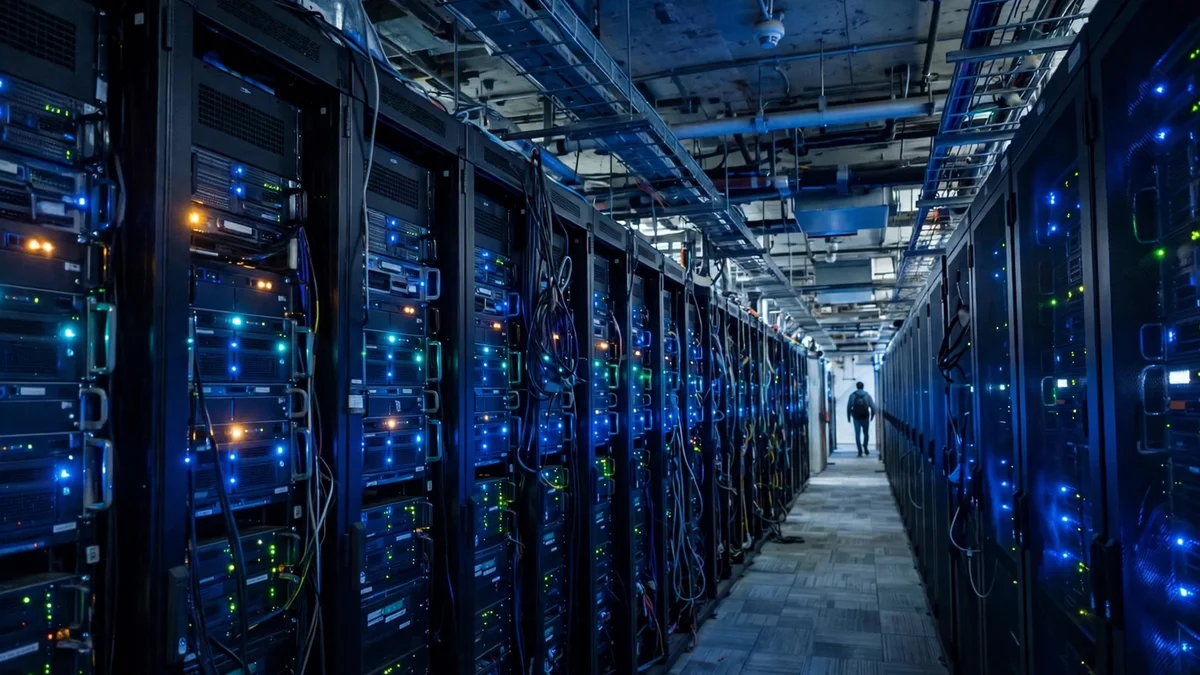
California’s public universities are building their own AI data centers and designing their own AI tools to rival ChatGPT. The University of California, California State University, and the California Community Colleges system are all exploring on-campus AI infrastructure, even as they keep signing deals with the same commercial providers they are trying to depend on less.
The move became visible in late November 2026, when the University of California announced another agreement with OpenAI to give ChatGPT to students, while university leaders were discussing building their own data centers and in-house alternatives to ChatGPT, Claude, and other commercial AI products. The two tracks are not a contradiction in the administrators’ telling: keep the commercial tools that work today, and build an independent option for tomorrow.
This article explains why California’s universities are setting up their own AI data centers, what they have already built, what it costs, and where the plan is weakest. It is based on the CalMatters reporting that first laid out the story in full, republished by KQED and Lookout Santa Cruz, with campus announcements and official proposals behind the key figures.
Key takeaways
- California’s three public higher-education systems, UC, CSU, and the California Community Colleges, are all exploring their own on-campus AI data centers and in-house AI tools.
- The California Community Colleges system has asked the state for $21 million to build a more independent AI network it says would cost a fraction of commercial solutions.
- Cost, control over student and research data, and the ability to track AI’s energy and water use are the three reasons campus leaders give for the shift.
- Real examples already exist: Cal Poly San Luis Obispo opened an AI data center, and UC San Diego runs TritonGPT from its supercomputer center.
- The universities still depend on commercial providers, and their own models are less polished than ChatGPT or Claude, so the independent track is a complement, not a replacement, for now.
The deal that exposed the tension
The story starts with a contract. On a Thursday in late November 2026, the University of California announced another deal with OpenAI to give ChatGPT to students. It was the latest in a series of system-wide agreements putting commercial AI into California classrooms at scale, and it was announced before the purchasing amendment was finalised, according to UC spokesperson Stett Holbrook.
The cost of those deals is the first reason universities are looking for an alternative. The UC’s previous OpenAI contract required a minimum of $10 per user per month for ChatGPT Edu licences, and $30 per user per month for another advanced ChatGPT platform. The Cal State system signed OpenAI contracts extending through 2029, worth roughly $56 million. Those buy real capability, but they lock a public university into a vendor’s pricing for years.
| System or campus | What is happening |
|---|---|
| California Community Colleges | Asking the state for $21 million to build an independent AI network across 116 colleges |
| University of California | Considering a similar independent system; no formal proposal yet, while renewing its OpenAI deal |
| California State University | In initial conversations with UC and the community colleges; OpenAI contracts run through 2029 at roughly $56 million |
| Cal Poly San Luis Obispo | Opened an on-campus AI data center, the AI Factory, funded in part by a $3 million gift from the estate of Intel co-founder Robert N. Noyce |
| UC San Diego | Runs TritonGPT and TritonAI from the San Diego Supercomputer Center; shared its approach with Berkeley and UC Merced |
| Shared network | About 20 community college districts, UC, and CSU campuses already have AI computing access through the California Research and Education Network’s 8,000 miles of fiber |
| Previous UC OpenAI pricing | Minimum $10 per user per month for ChatGPT Edu and $30 for an advanced ChatGPT platform |
Three reasons campuses want their own AI
The case for campus-built AI rests on three benefits, set out most clearly by Craig Hayward, a strategic advisor to the community college chancellor’s office on AI. The first is cost. Commercial AI is expensive at university scale: individual plans for tools such as Claude can reach $200 per month, and system-wide licences multiply that across tens of thousands of users.
The open-weight route is what makes the campus plan technically possible. Universities do not build their AI from scratch: they take existing open-weight models, including Kimi and DeepSeek, or American ones such as Llama and Gemma, and run them on their own hardware. The code is typically free to use or change, so colleges can rename, rebrand, or repurpose the AI as they wish.
The second benefit is control. The Cal State contract with OpenAI specifically says the company cannot use student data to train its models, but Hayward said agreements like that still carry risks, and that there is a concern data could somehow leak. Internally developed tools give colleges what he called end-to-end control over the data. That control also helps research and operations: campuses can build AI for admissions or enrolment, and computer science students can run experiments without worrying a third party might change its model mid-experiment.
The third benefit is environmental. The community college system has ambitious climate goals, including reducing potable water usage by 50 per cent. By running open-weight models on their own hardware, colleges take on more of the computing burden internally and can track the power and water those systems use directly.
Data control is also why this story belongs next to the security questions every organisation faces when it hands student or customer records to an outside AI provider. Our explainer on what cybersecurity is covers how data moves, who can see it, and why keeping sensitive records inside systems you control changes the risk.
What campuses have already built
The most developed example is at UC San Diego, where campus IT staff teamed up with the supercomputing center to create TritonGPT, named for the campus mascot and ChatGPT. It began about three years ago as a student project to help the IT help desk, according to Zachary Johnson, UCSD’s senior director of AI strategy. Over time users brought it other questions, and UCSD now operates TritonAI, which includes TritonGPT plus other university and commercial AI products.
Cal Poly San Luis Obispo is the newest example. In November 2026 the university announced its AI data center, intended to serve the whole campus, according to Chris Lupo, director of the school of applied computing. The center, known as the AI Factory, was funded in part by a $3 million gift from the estate of Robert N. Noyce, a co-founder of Intel. Lupo has said the campus has yet to join the broader shared network but is discussing it.
Why this is not a break with Big Tech
For all the talk of independence, the universities are not walking away from commercial AI. While they discuss designing their own AI, the UC, Cal State, and community college systems continue to use commercial providers, and even UC San Diego has integrated commercial products from Anthropic and OpenAI into its platform. The honest description is a dual track: own systems where they make sense, commercial systems where they are better.
The campus-built models have a weakness their supporters admit. University-designed AI is cheaper and more private, but not quite as intuitive as the commercial products, in Hayward’s words, and getting value out of them requires better prompting. Johnson at UCSD made the same point: open-weight platforms are adequate for the vast majority of users, but some heavy AI users may need commercial models, so a university doing innovative work needs the full range available.
Students feel this trade-off directly. A campus chatbot built on an open-weight model can answer most everyday questions and help with enrolment, but it will not match the fluency of the best commercial systems on hard or open-ended questions. For students learning to use AI well, the practical skill is the same on either system. Our roundup of the best AI tools for students in 2027 covers the commercial tools most students will meet first.
What it means for you: how to read the campus AI shift
If you study, teach, or work at a university, expect two AI systems on your campus, not one: a commercial tool such as ChatGPT, provided through a system deal, and a campus-built alternative such as TritonGPT, BearGPT, or SCOUT. The campus one will usually be the better choice for anything involving student records, unpublished research, or administrative data, because the data stays inside the university.
Second, watch the small-business parallel, because the same logic is spreading beyond universities: organisations of every size are weighing the cost of renting AI against running their own. Our roundup of the best AI tools for small business in 2027 covers the commercial side of that choice, and the campus story previews how it plays out at scale.
Checklist: what to watch as campus AI develops
Use these checks to follow the story as it develops.
- Watch whether the community colleges’ $21 million request is approved, and what it actually funds.
- Check whether the UC puts forward a formal proposal for its own independent AI system.
- Look for more campuses joining the shared fiber network and adding their own AI hardware.
- Compare the campus chatbot with the commercial one on the same question, and note where each is stronger.
- Ask where your data goes when you use a campus AI tool, and whether it stays inside the university.
- Remember the scale: campus AI is growing fast, but it still trails the computing power of the big commercial providers.
Frequently asked questions
Why are California’s universities building their own AI data centers?
To cut licence costs, keep control of student and research data, and track the energy and water their AI use consumes, while keeping commercial tools for the jobs that need them.
What is the $21 million the community colleges are asking for?
It is a request to the state for funding to build a more independent AI network across the community colleges, which the proposal says would cost a fraction of commercial solutions. It is a request, not an approved budget.
What is TritonGPT?
TritonGPT is UC San Diego’s campus-built AI chatbot, run from the San Diego Supercomputer Center. It began as a student help-desk project about three years ago and now sits inside TritonAI, which also includes commercial AI products.
Are the universities stopping using ChatGPT?
No. The UC, Cal State, and the community colleges all continue to use commercial providers, and even UC San Diego integrates commercial products into its platform.
What are open-weight models?
Open-weight AI models, such as Llama, Gemma, DeepSeek, and Kimi, have code that is typically free to use or change, and universities run them on their own hardware instead of renting access to a commercial model.
Is campus-built AI as good as ChatGPT or Claude?
Not yet. Campus models are cheaper and more private, but less intuitive, and they need more careful prompting.
The bottom line
California’s universities are building their own AI data centers because the commercial deal no longer looks like enough on its own. The licences are expensive, the data questions are unresolved, and the universities have found they can build useful AI themselves, on open-weight models, on their own hardware, connected by a fiber network they already own. Cal Poly’s AI Factory and UC San Diego’s TritonGPT show the idea working in practice.
The plan’s limits are just as clear. The independent systems are less polished than the commercial ones, the funding is not yet secured, the UC has no formal proposal, and the universities still depend on the providers they are trying to escape. The most likely outcome is a permanent dual track: commercial AI where it is best, campus AI where control and cost matter most, and students and staff learning to use both.



