Best AI Tools for Museums in 2027
Museums have always been good at telling stories, but visitors now expect to hear them differently. People arrive with a phone in hand, limited time, and an expectation the visit will adapt to them — shorter tours for children, deeper context for enthusiasts, tickets bought in seconds. The best AI tools for museums in 2027 meet visitors where they are, turning a static gallery into something that responds and guides.
The tools in this list cover the four jobs that matter to a museum team: selling tickets without friction, guiding visitors, making sense of a collection, and keeping people engaged after they leave. Some are built for cultural institutions; others are general tools museums have adopted because they fit the work. What they share is a focus on the visitor experience.
We picked tools small and mid-sized museums can actually run. Prices change often, so confirm current pricing before you commit.
Key takeaways
- AI guides are the biggest win for most museums: they personalise tours, answer visitor questions, and work in many languages without extra staff.
- Ticketing tools with AI forecasting help museums staff the front desk correctly and lift sales on quiet days.
- Collection tools can tag, describe, and connect thousands of objects far faster than manual cataloguing ever could.
- Visitor analytics tools turn footfall into useful patterns, showing which galleries hold attention and which ones visitors skip.
- Start with one problem — ticketing, guiding, or collections — and add a second tool only once the first works well.
Best AI tools for museums at a glance
| Tool | Best for | Standout AI feature | Starting point |
|---|---|---|---|
| Smartify | AI audio guides and artwork recognition | Point a phone at an artwork | Free visitor app; paid museum plans |
| Bloomberg Connects | Free digital guides for any museum | Curated multimedia guides and maps | Free for cultural institutions |
| Tessitura | Ticketing, membership, and fundraising | Predictive analytics on visitors and donors | Quote-based pricing |
| Spektrix | Ticketing and audience insight | Audience segmentation and demand signals | Quote-based pricing |
| Dexibit | Visitor analytics and forecasting | Forecasts attendance and dwell time | Quote-based pricing |
| Veevart | Collections and visitor management | AI-assisted cataloguing and search | Quote-based pricing |
| Artivive | Augmented reality for artworks | Artworks that move and respond on screen | Free starter plan; paid upgrades |
Smartify: the AI guide in every visitor’s pocket
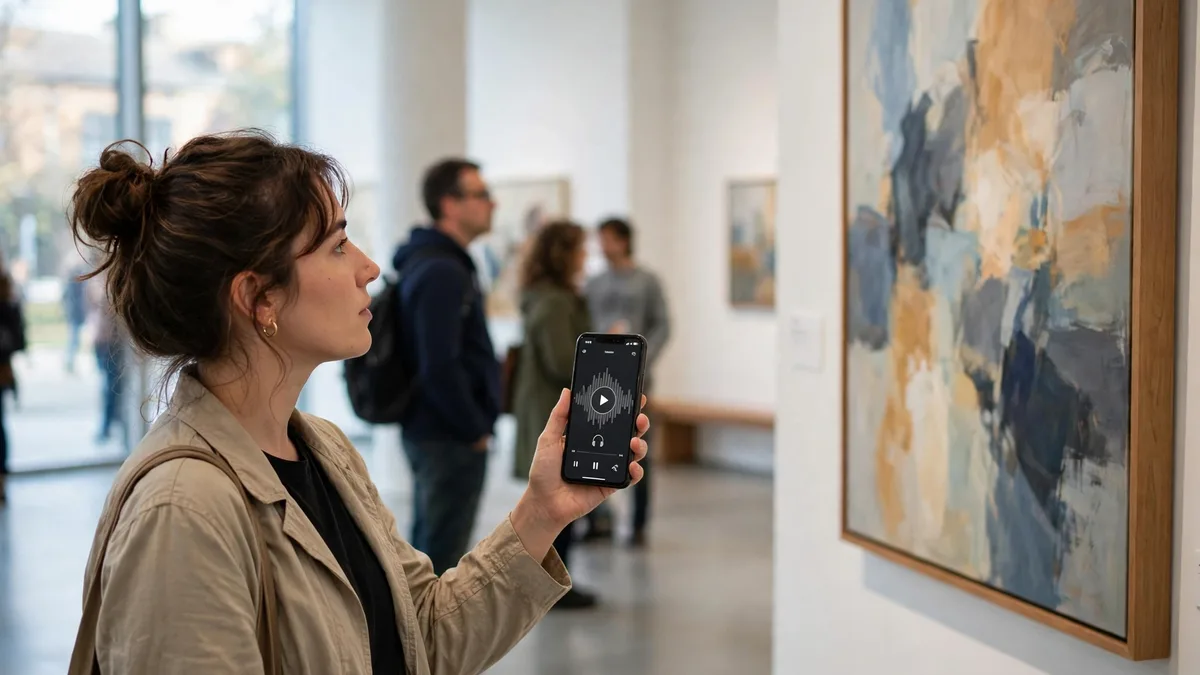
Smartify is the closest thing museums have to a standard AI guide. Visitors point their phone at a painting or an object, and the app recognises it and plays audio, video, or text about it — no hardware to rent or devices to charge. Museums can build themed tours, from a thirty-minute highlights route to a family trail, and update content from a dashboard. The platform also reports which objects visitors scan most.
Pros:
- Visitors use their own phones — no hardware to buy or maintain.
- Artwork recognition feels effortless and impresses first-time visitors.
- Tour content can be updated instantly for new exhibitions.
Cons:
- Recognition struggles in dark galleries or behind reflective glass.
- Paid plans may stretch a small museum’s budget.
Bloomberg Connects: a free guide platform with real polish
Bloomberg Connects is a free app that lets cultural institutions publish their own digital guides. Museums upload images, audio, video, and maps, and visitors get a polished guide that works before, during, and after the visit. Because the app already has a large audience of culture lovers, a small museum can reach people who would never have found its own app. AI-assisted search helps visitors find content that matches their interests, and guides support many languages. The trade-off is control: your guide lives inside someone else’s app.
Pros:
- Free for museums, with a polished app visitors already trust.
- Built-in audience helps smaller museums get discovered.
- Guides work before, during, and after the visit.
Cons:
- Your guide sits inside another brand’s app, limiting customisation.
- Less visitor data comes back than with a self-hosted tool.
Tessitura: ticketing and fundraising with predictive insight
Tessitura is the system behind the box office at many large museums, theatres, and concert halls, and its AI focuses on the money side: tickets, memberships, and donations. It brings ticketing, fundraising, and marketing into one database, so a museum can see that the person who bought a ticket on Saturday is the same person who donated last year. Its predictive analytics score how likely a visitor is to become a member and which donors are most likely to give again. It is an enterprise system with enterprise pricing and a long setup.
Pros:
- One database for tickets, memberships, donations, and marketing.
- Predictive scoring helps small teams focus on the likeliest donors.
- Dynamic pricing lifts revenue on busy days and fills quiet ones.
Cons:
- Enterprise pricing and long setup put it out of reach for small museums.
- Staff need training to use the analytics well.
Spektrix: smarter ticketing for audience-led museums
Spektrix is a ticketing and customer relationship system built for arts organisations, and museums use it to sell tickets, manage memberships, and understand their audiences. Its strength is segmentation: the system groups visitors by behaviour — first-timers, regulars, families, lapsed members — and lets the marketing team send each group a message that fits. Its AI-assisted reporting highlights patterns a busy box office would miss, such as which exhibitions bring in new visitors versus repeat ones. It also handles timed entry and is faster to adopt than the largest enterprise systems.
Pros:
- Clear audience segments make marketing far more effective.
- Timed entry and flexible pricing handle busy exhibitions smoothly.
- Faster to set up than the biggest enterprise systems.
Cons:
- Quote-based pricing makes it hard to budget before a sales call.
- No built-in guide or collections features.
Dexibit: forecasting what your visitors will do next
Dexibit is a visitor analytics platform built specifically for museums, and it answers the question every director asks on a Monday morning: how many people are coming, and what will they do? It pulls together ticket sales, membership data, weather, school holidays, and web traffic, then forecasts attendance and dwell time. If the model expects a busy Saturday, the museum can roster extra staff; if it expects a quiet Tuesday, that is the day for maintenance or a promotion. It also shows which galleries hold visitors longest.
Pros:
- Forecasts attendance and dwell time from many data sources.
- Shows which galleries engage visitors and which ones they skip.
- Built for museums, so reports speak the sector’s language.
Cons:
- Needs clean ticketing data to give good forecasts.
- Priced for institutions, not for the smallest museums.
Veevart: AI help for the collection itself
Most museum AI talk focuses on visitors, but the collection is where the backlog lives. Veevart is a collections platform that uses AI to speed up cataloguing: suggesting tags, descriptions, and connections between objects that a cataloguer can accept or correct. For a museum with thousands of objects and one registrar, that is the difference between a searchable collection and a storeroom of mysteries. Its plain-language search lets staff find objects by describing them, and AI descriptions still need human review before they go public.
Pros:
- AI-assisted tagging and descriptions cut cataloguing time sharply.
- Plain-language search makes the collection usable for non-specialists.
- Collections, loans, and exhibitions in one system.
Cons:
- AI cataloguing still needs human review on every record.
- Less proven at very large scale.
Artivive: artworks that respond and move
Artivive adds augmented reality to physical artworks: visitors point their phone at a painting and see it animate, reveal hidden layers, or play a short film about how it was made. For contemporary art, that moment of surprise is exactly what gets visitors talking — and posting — after they leave. The tool is deliberately simple: curators upload an image of the artwork and the digital layer that goes with it, with no coding needed, so a small museum can build an AR layer for one exhibition in an afternoon.
Pros:
- Creates memorable, shareable moments from ordinary artworks.
- No coding needed, so small teams can build AR quickly.
- Free starter plan makes it cheap to experiment.
Cons:
- Best for a few artworks at a time, not a whole collection.
- Needs visitors to download an app, which some will skip.
How to choose the right AI tools for your museum
Start with the visitor journey, not the technology. Walk through your museum as a first-time visitor: buying a ticket, finding the entrance, choosing what to see, and deciding whether to come back. The step where visitors struggle most is where an AI tool will pay for itself fastest — usually guiding, which points to Smartify or Bloomberg Connects. Budget shapes the choice more than features do: a free platform can transform a small museum, while enterprise systems only make sense once ticket and donation income justifies them. As our roundup of the best AI tools for real estate shows, the right tool fits the team’s actual workflow, not the longest feature list.
Checklist: before you buy an AI tool for your museum
- Map the visitor journey and pick the single step where visitors struggle most.
- Check the tool works with your existing ticketing and collections systems.
- Run a one-gallery pilot with real visitors for a month.
- Confirm pricing, including per-visitor fees, support, and content hosting.
- Make sure AI-generated text is reviewed by staff who know the collection.
- Plan how you will measure success — scans, dwell time, ticket sales, or repeat visits.
Frequently asked questions
What is the best AI tool for a small museum?
For most small museums, a free guide platform like Bloomberg Connects or an artwork-recognition app like Smartify delivers the most visible improvement for the least money.
Do visitors actually use AI guides, or do they prefer human guides?
Both have a place. Many visitors like the freedom of an AI guide they can pause and use in their own language, while others prefer a human guide for the conversation. The best museums offer both: AI guides for independent visitors and human tours at set times.
Can AI help catalogue a museum collection?
Yes, with human supervision. Tools like Veevart can suggest tags, descriptions, and links between objects, which speeds up cataloguing considerably. But AI descriptions can be wrong about dates and materials, so a curator should review every record before it goes public.
How much do AI tools for museums cost in 2027?
It ranges from free to enterprise pricing. Guide platforms can cost nothing, AR tools have free starter plans, and ticketing or analytics systems are usually quote-based. A small museum can run a good AI guide for a few hundred dollars a year.
Do AI museum tools work in multiple languages?
Most modern guide apps support many languages, and AI translation has improved enough that a small museum can offer tours in five or six languages. Human review still matters, so have a native speaker check the most-read stops.
Will AI replace museum staff?
No. AI handles repetitive work — answering the same questions, selling tickets, describing objects — so staff can do the work only people can do: welcoming visitors and caring for the collection. The same pattern shows up in the best AI tools for podcasting and the best AI tools for email marketing.
The bottom line
The best AI tools for museums in 2027 are the ones that disappear into the visit: a guide that answers the question a visitor is already asking, a ticket bought in seconds, a forecast that puts the right staff on the floor. Smartify and Bloomberg Connects are the strongest starting points, with Tessitura, Spektrix, and Dexibit adding depth as ticketing needs grow, and Veevart and Artivive solving specific collection and engagement problems.
Pick one problem, pilot one tool in one gallery, and measure what changes. Museums that adopt AI this way — carefully, with visitors in mind, and with staff checking the output — end up with fuller galleries and more time for the human work that makes a museum worth visiting.