Square vs Toast for Food Trucks in 2027
A food truck lives or dies at the serving window, and the point-of-sale system stands between a hungry queue and a smooth service. Square vs Toast for food trucks in 2027 is the comparison most operators make once a truck outgrows a card reader and a paper ticket pad. Both take card payments and run on a tablet, but they were built for different kinds of business, and that shows up fast in a small kitchen on wheels.
Square started as a simple card reader and grew into a full business platform, so it is strongest where simplicity matters: fast setup, low upfront cost, and tools that work out of the box. Toast started in restaurants and grew into a full hospitality platform, so it is strongest where the kitchen matters: menu modifiers, kitchen display screens, and orders flowing from the window to the grill.
This comparison tests both systems where a food truck operator actually feels them: taking payment at the window, surviving a dead signal, pricing as the truck grows, and hardware that must work in heat, grease, and a queue that never stops moving. Prices are approximate starting prices, so check current pricing before you decide. What matters most is fit: the right till is the one your crew can run at full speed on your busiest day.
Key takeaways
- Square is the better pick for most trucks starting out: free software, cheap hardware, one-day setup.
- Toast is the better pick for busy trucks with a complex menu, a kitchen display, and a crew needing orders routed.
- On card fees alone the two are close, at around 2.6% to 3% plus a small fixed fee, so the decision turns on hardware and monthly costs.
- Offline mode matters more on a truck than in a shop: Square’s offline payments are simpler, while Toast needs a stronger connection.
- Neither system replaces good truck habits: either one still needs a clean menu, accurate stock counts, and a crew that knows the till.
| Feature | Square | Toast |
|---|---|---|
| Best for | New trucks, simple menus | Busy trucks, complex menus |
| Software cost | Free; paid plans from $29 a month | From around $69 a month |
| Card fee | Around 2.6% + 10¢ | Around 2.99% + 15¢ |
| Offline mode | Yes, built in | Limited offline |
| Kitchen display | Basic, via add-ons | Built in |
| Hardware | Reader $49, Terminal $299 | Handheld from $799 |
Square for food trucks
Square is the easiest way to start taking proper payments from a truck. The software is free, the card reader costs around $49, and you can take orders the same day you sign up. The till is a clean grid of menu buttons, so a new crew member learns it in one shift, and the same app handles online ordering, gift cards, and loyalty.
Square also wins on the boring parts that keep a small business alive. Invoices and end-of-day reports are simple, payouts land fast, and the free plan means a seasonal truck pays almost nothing while parked. Offline mode is the quiet hero: when the festival Wi-Fi dies, Square keeps taking card payments and syncs them later.
The limits show up as the menu and crew grow. Modifier-heavy menus get fiddly on the simple till, and there is no kitchen display built in, so most trucks end up with a printer shouting tickets. Fine for a short menu and two people, but a truck doing 300 covers with a build-your-own menu will feel the strain.
Pros:
- Free software and cheap hardware
- Simple till new crew learn in one shift
- Strong offline mode for festivals
Cons:
- No built-in kitchen display screen
- Complex modifiers and combos get fiddly
Toast for food trucks
Toast is the system you buy when the kitchen, not the till, is the bottleneck. Built for restaurants, it treats a food truck like a small restaurant on wheels: orders flow from the window to a kitchen display screen, modifiers and 86’d items update everywhere at once, and the crew sees timers on every ticket.
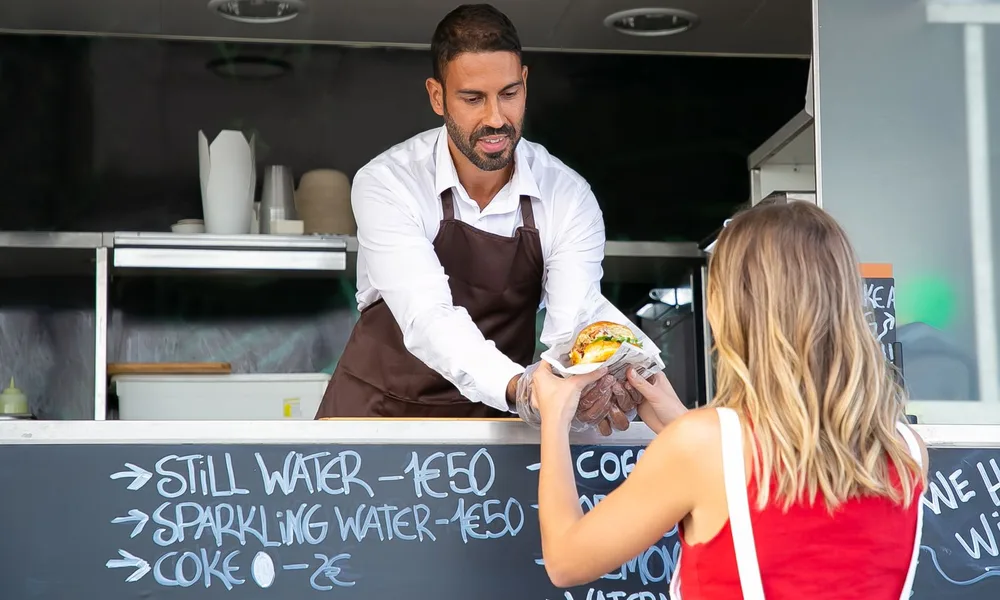
Toast also handles parts of truck life that Square treats as extras. Online ordering and pre-orders are built in, so customers can order from the queue or before they arrive, and loyalty and gift cards run through the same system. The trade-off is cost and complexity: software starts at around $69 a month, hardware costs more, and setup takes longer with guided onboarding.
The other trade-off is the connection. Toast does more of its work online, so a weak signal at a festival hurts more than on Square, and trucks running it usually invest in a mobile router and a backup connection — a real cost to factor in.
Pros:
- Built-in kitchen display with routing and timers
- Handles complex menus, modifiers, and 86’d items
- Online ordering and pre-orders built in
Cons:
- Higher monthly cost and pricier hardware
- Setup takes longer, with guided onboarding
Square vs Toast: payments, fees, and payouts
On a single sale the difference is small: Square charges around 2.6% plus 10¢ for a tapped or swiped card, Toast around 2.99% plus 15¢. On a $12 lunch that is a few cents, and across a $2,000 festival day roughly $10 — real money over a season, but rarely decisive.
The bigger difference is the monthly bill. Square is free to start, with paid plans from around $29 a month, while Toast starts at around $69 a month, usually with a longer contract. A part-time truck trading three days a week feels that gap sharply; one trading six days a week barely notices it.
Square vs Toast: hardware, offline mode, and the serving window
Hardware is where the two systems feel most different. Square’s kit is small and cheap: a $49 reader that pairs with your phone, a $299 Terminal for the counter, or a full Register setup for around $799 — all easy to replace if a fryer splash kills one. Toast’s kit is built for a restaurant pass: handhelds from around $799, terminals, printers, and kitchen display screens, all rugged and pricier to replace.
Offline mode is the test that matters most at a festival. Square was designed for it: the till keeps taking payments without a signal and syncs later. Toast can keep serving offline, but more of its features — live menu changes, online orders, kitchen display updates — pause until the connection returns. On a field with one bar of signal, Square is safer; with solid Wi-Fi or your own router, the gap closes.
Square vs Toast: menus, orders, and the kitchen
Menus are where Toast earns its higher price. Building a menu with modifiers — protein, extra cheese, no onions, spicy or mild, make it a combo — is straightforward in Toast, and changes push to every screen at once. When the kitchen runs out of chicken, one tap 86s it everywhere. Square handles simple menus beautifully, but a build-your-own menu becomes a long list of buttons that slows the till.
Toast’s screen shows tickets in order, with timers, and the crew bumps orders off with a tap. Square has no equivalent: most Square trucks print paper tickets and hang them on a rail, which works at low volume but gets messy in a rush.
Verdict: which POS should your food truck run?
Choose Square if you are starting out, trading part-time, running a simple menu, or working pitches where the signal is unreliable. It costs almost nothing to start, your crew learns it in a day, and its offline mode saves festival days Toast would struggle through.
Choose Toast if your truck is busy, your menu is complex, your crew is four or more, or you take a lot of pre-orders. The kitchen display, modifier handling, and queue-busting handhelds pay for the higher monthly cost once paper tickets start costing you orders. A second truck is also far easier, with Toast’s reporting and central menu control.
Start on Square, grow into Toast when the kitchen becomes the bottleneck, and do not buy the bigger system before you need it.
How to choose between Square and Toast
Start with your menu and your pitches. Count your modifiers: if most orders are a single item with one or two choices, Square handles it. If most orders are built to order with five choices each, Toast saves your crew real time every hour. If you trade at festivals, test both systems with the Wi-Fi off before you commit.
Then run the numbers honestly. Add the monthly software cost, the hardware you need, and the card fees on your real average sale, not the headline rate. A truck doing $3,000 a week barely notices the fee gap; one doing $800 a week feels the subscription far more. Trial the winner at a real service with your actual crew — a till that works in the office can still fall apart in a rush.
It helps to see how the same decision plays out elsewhere. The way Square compares with Clover for service businesses shows what changes when customisation matters more than simplicity, while Square vs Booksy for salons shows how a booking-first system differs from a payments-first one. And Shopify vs Square for service businesses is worth reading if you sell a lot online as well as at the window.
Checklist: switching your food truck to a new POS
- Write out your full menu with every modifier
- Test offline mode at a real pitch
- Train the whole crew on the till during a quiet service
- Set up payouts, tips, and refunds first
- Print a backup paper menu for signal failures
- Run both systems side by side once
Frequently asked questions
Is Square or Toast cheaper for a food truck?
Square is cheaper to start and month to month, with free software and lower card fees. Toast costs more, from around $69 a month, but can pay for itself on a busy truck through faster service.
Can Toast work offline on a food truck?
Toast has an offline mode, but its full features need a connection: display updates, live menu changes, and online ordering pause without one. Square’s offline mode is simpler and more forgiving, suiting festival pitches with weak signal.
Which is better for a new food truck?
Square, in most cases. Free software, a $49 reader, and same-day setup let you start trading immediately, and you can switch to Toast later when volume justifies it.
Do I need a kitchen display screen on a food truck?
Not for a small truck with a short menu and two crew members — printed tickets work fine. With four or more crew, a complex menu, or 150 covers a day, a kitchen display like Toast’s pays for itself.
Can I take pre-orders with Square or Toast?
Yes, both offer online ordering. Toast’s is built into the kitchen flow, so pre-orders land on the display like any other ticket. Square’s runs through its online store, which works well but feels separate.
Can I switch from Square to Toast later?
Yes. Export your menu, customer list, and sales history from Square first, then build the menu in Toast during a quiet week. Many operators switch in the off-season, when there is time to train the crew.
Bottom line
For most food trucks in 2027, Square is the right starting point: free software, cheap hardware, strong offline mode, and a till your crew learns in a day. It gets you trading fastest and costs you least while you find your pitches and build regulars. If your truck is already busy, your menu is complex, and your kitchen is the bottleneck, Toast is the upgrade that pays for itself.
Pick the system that fits the truck you run today, not the one you hope to run next year. Start simple, measure what slows you down at the window, and upgrade when the till tells you it is time.