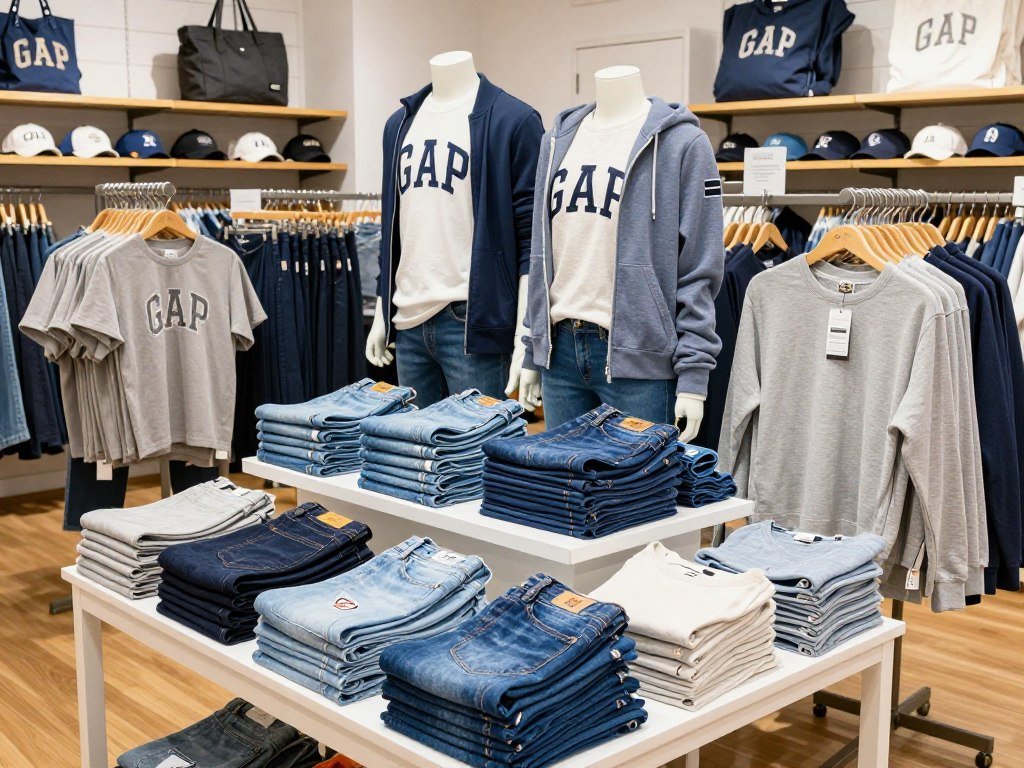
Gap is the clothing label, while Gap Inc. is the parent corporation behind it. A publicly traded company is one whose shares are bought and sold on a stock exchange. That difference matters to customers who want to know who owns Gap, whether shopping for apparel or learning about the business.
The label has shaped casual fashion for decades, but the corporation has a wider role. It runs a retail business and manages the company behind the familiar name. Knowing which name refers to the clothing and which refers to the business makes ownership claims easier to understand.
This overview explains how the ownership works and how the company grew from a San Francisco store into a retail group. It also gives customers a clearer way to think about the products, shopping experience, and public company behind the label.
Keep the distinction in mind: owning a Gap-branded product is different from owning shares in Gap Inc.
Key Takeaways
- Gap is a clothing label owned by Gap Inc.
- Gap Inc. shares belong to its shareholders.
- Gap Factory is an outlet channel, not a separate parent corporation.
- Gap Inc. also owns Old Navy, Banana Republic, and Athleta.
- The company began with a San Francisco store in 1969.
Who Owns Gap Today?
Gap Inc. is a public company, so its shareholders own the corporation behind the Gap label. Today, those owners include members of the founding Fisher family and investment firms that hold stock for their funds and clients.
Gap Inc. trades on the New York Stock Exchange under ticker GAP. Its shares give investors ownership in the parent corporation, not direct ownership of one store or clothing line. Readers comparing public companies can also learn how an [Apple stock quote](https://occcy.com/apple-stock-price/) lists share and market data.

The Fisher family’s disclosed stakes
In ownership figures reported for 2025, William S. Fisher held 16.09% of Gap Inc., while Robert J. Fisher held 15.39%. Those percentages describe stakes in the company, not the brothers’ total wealth.
Doris Fisher helped found the business with Don Fisher, but a person’s net worth is not the same as a reported shareholding. Online estimates of Doris Fisher’s net worth or the Fisher family’s Gap net worth may include assets beyond company stock.
A reported ownership percentage measures a stake in Gap Inc.; it does not measure an owner’s complete wealth.
Institutional shareholders
Institutional shareholders are firms that manage investments, including stock holdings. As of June 30, 2026, BlackRock held 22.96 million shares, or 6.54% of shares outstanding.
On the same date, Dimensional Fund Advisors held 16.19 million shares, equal to 4.61%. AQR Capital Management held 14.68 million shares, or 4.18%.
Together, the family and institutional holdings show that ownership is spread across different investors. Treat a reported ownership percentage as a stake in Gap Inc., not as a complete measure of an individual’s wealth.
How Gap Inc. Differs From the Gap Brand
Gap Inc. is the corporation; Gap is one of the clothing labels it operates. That distinction helps explain why a store, a label, and the company that manages the business can have different names.
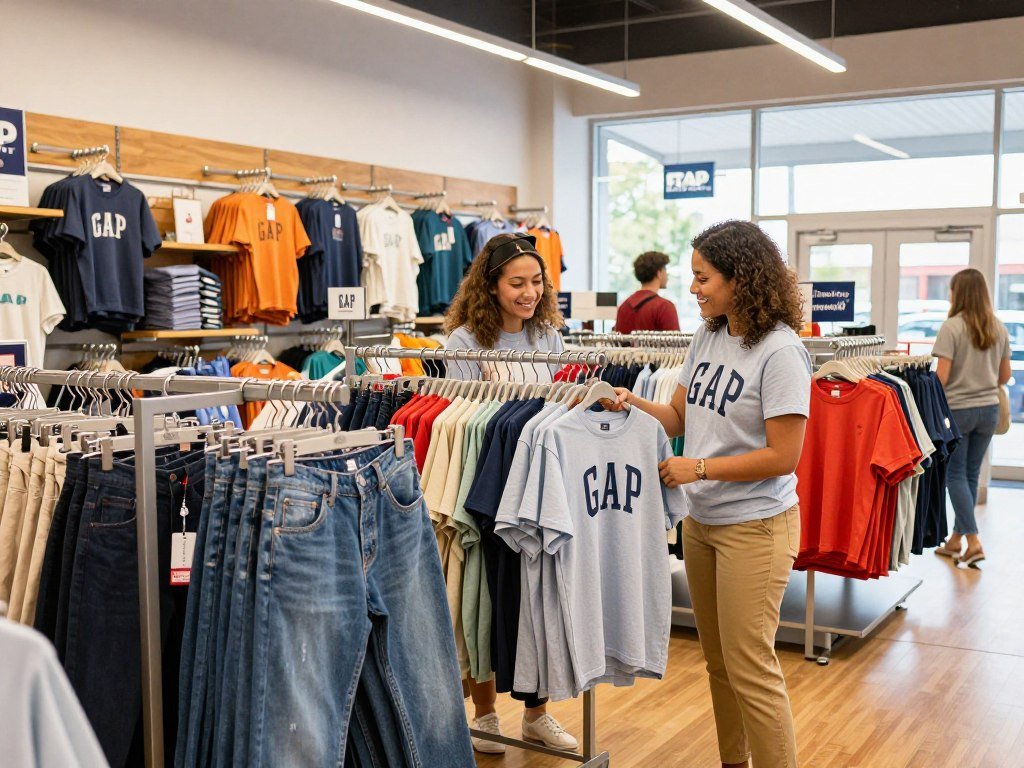
Gap Inc. oversees the brand portfolio and sells through company-operated stores, franchise stores, and e-commerce. The Gap brand is one part of that retail business, rather than another name for the whole corporation.
| Entity | What it is | Retail role |
|---|---|---|
| Gap Inc. | Parent corporation | Oversees the brand portfolio |
| Gap | Clothing label | Mainline apparel brand |
| Gap Factory | Outlet channel | Sells Gap-branded merchandise through its outlet channel |
Gap Factory is an outlet channel for Gap-branded merchandise, not a separate parent corporation. Its assortment can differ from the mainline Gap assortment, so products at one channel may not appear in the other.
Stores can carry distinct merchandise even when their names share the same label. Online shopping follows the same distinction, since the company sells through e-commerce as well as physical retail locations.
Check the label on a store or website to tell whether you are shopping the mainline Gap brand or Gap Factory.
Which Brands Does Gap Inc. Own?
Gap Inc. brings four distinct labels together, from value-focused Old Navy to women’s activewear brand Athleta. Each label serves a different shopping need, even when customers find apparel for everyday wear across the group.
The four brands are Old Navy, Gap, Banana Republic, and Athleta. Their different styles and price positions help shoppers choose a collection that suits their needs.
Old Navy and Gap serve everyday apparel shoppers
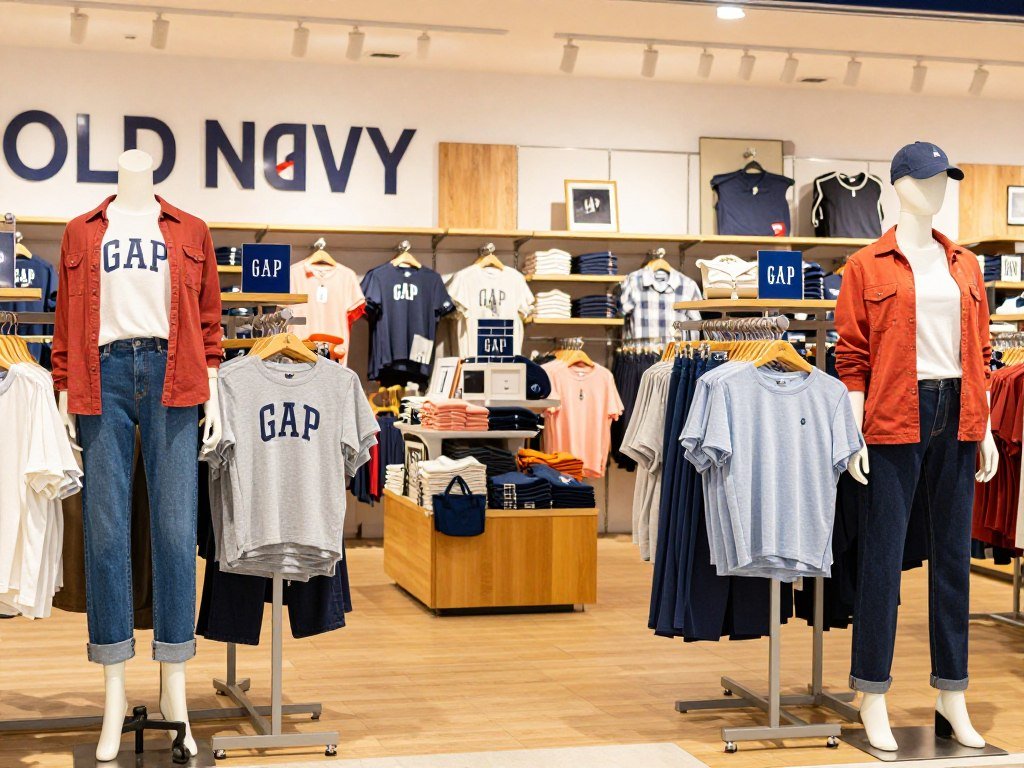
Old Navy emphasizes value, with everyday clothing for adults and children. Its first store opened in Colma, California, in 1994. The label is known for accessible apparel and a broad selection of products.
Gap focuses on casual clothing, including denim and classic basics. The two labels can both serve family wardrobes, but they offer different shopping experiences and style choices.
Shoppers looking for another way to find clothing can consider local thrift stores, where selection depends on what people have donated.
Banana Republic and Athleta fill different niches
Banana Republic has an upscale apparel position, with clothing suited to work and more polished occasions. The brand began in Mill Valley, California, in 1978, then Gap Inc. acquired it in 1983.
Athleta specializes in women’s activewear, including clothing designed for movement and exercise. It began as a women’s activewear catalog company in 1998. Gap Inc. acquired Athleta in 2008.
These histories show how the company added labels with distinct product ranges over time. Compare the label’s intended style and audience before assuming the brands offer the same shopping experience.
How Did the First Gap Store Begin?
Don and Doris Fisher opened the first Gap store on San Francisco’s Ocean Avenue in 1969. The first shop sold Levi’s jeans, records, and tapes, giving customers a focused place to find denim and music.
The name “the Gap” referred to the generation gap between young people and their parents. The original store stood at 1950 Ocean Avenue, in San Francisco, California.
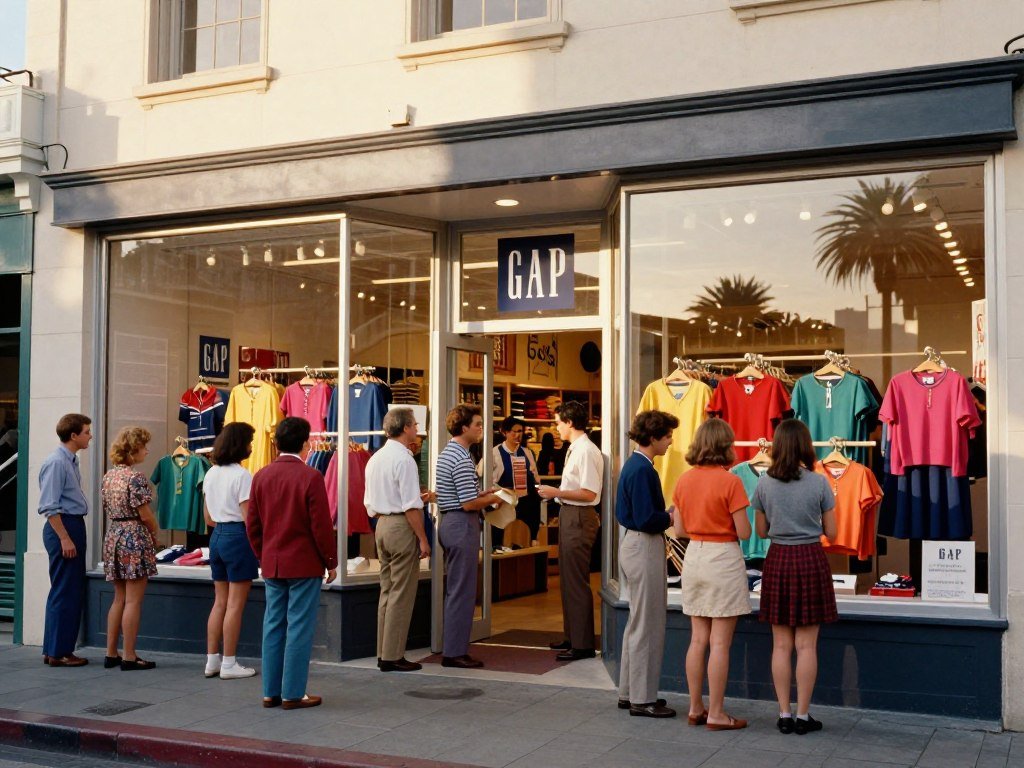
- In 1969, Don and Doris Fisher founded Gap Inc. in San Francisco and opened the first Gap store on August 21.
- The original store sold men’s Levi’s jeans, records, and tapes.
- Gap opened a second store in San Jose in 1970.
- By 1973, the retailer had grown to more than 25 locations.
- In 1974, Gap began selling private-label merchandise. In 1976, Gap Inc. went public with 1.2 million shares offered at $18 each.
The first store’s mix paired clothing with music, while later locations helped the retailer reach more shoppers. The expansion did not erase the original name’s nod to the generation gap.
Private-label merchandise means clothing sold under the retailer’s own label rather than another company’s name. The move into private-label merchandise marked a shift from selling another company’s jeans to developing Gap’s own products.
Who Leads Gap Inc. and Its Creative Work?
Richard Dickson leads Gap Inc. as president and CEO, while Zac Posen holds creative roles at the company and Old Navy. Their jobs differ: Dickson leads the corporation, while Posen guides design and brand work.
Posen joined Gap Inc. as executive vice president and creative director in 2024. His Old Navy role has a separate focus and reporting line.
- Richard Dickson serves as president and CEO of Gap Inc.
- Zac Posen serves as Gap Inc.’s executive vice president and creative director.
- At Old Navy, Posen is chief creative officer, leading design, merchandising, and marketing. He reports to Old Navy President and CEO Haio Barbeito.
Posen’s Old Navy responsibilities cover how the brand develops and presents its products. The work connects creative choices with merchandising and marketing, while Dickson leads the wider company.
Annual proxy statements report executive compensation for a specified fiscal year. Total pay can include more than base salary, so the listed categories matter when comparing numbers.
Check the fiscal year and the compensation category before comparing executive pay figures.
What Is Gap Inc.’s Business Scale Today?
Gap Inc. reported $3.5 billion in net sales for the first quarter of fiscal 2026. The quarter’s results show a large retail business, with sales from several labels and both stores and online orders.
Net sales measure revenue for a set period, while comparable sales track changes at stores and online sales open long enough for comparison. Gap Inc.’s comparable sales rose 2% in the quarter.
Store footprint and online sales
Gap Inc. ended the first quarter of fiscal 2026 with nearly 3,500 store locations in about 35 countries. That total included 2,477 company-operated stores, which the company owns and runs.
Online sales made up 38% of Gap Inc.’s net sales for the quarter. The company had 82,000 employees in 2025, reflecting the scale of its retail operations.
Recent revenue and brand performance
Gap Inc. reported $15.4 billion in revenue and $816 million in net income for fiscal 2025. The table below gives first-quarter fiscal 2026 net sales and year-over-year changes.
| Entity | Q1 fiscal 2026 net sales | Year-over-year change |
|---|---|---|
| Gap Inc. | $3.5 billion | Up 1% |
| Gap brand | $796 million | Up 10% |
| Old Navy | $2.0 billion | Up 1% |
Gap brand comparable sales rose 10% in the quarter, matching its net-sales growth. Old Navy’s net sales rose 1%, while the company’s total comparable sales increased 2%.
Read the fiscal period beside each figure, since annual revenue and quarterly net sales measure different periods.
What Can Gap’s Political Giving and Competitors Tell You?
Gap’s PAC contributions are specific political donations, not proof of a corporate endorsement of Donald Trump. The distinction matters because a political action committee’s records describe donations, not every view held by a corporation.
Gap’s corporate PAC made 13 contributions totaling $25,000 to members of Congress who sought to invalidate the 2020 presidential election results. The donations took place during the 2021-2024 election cycles and represented 14% of the company’s giving.
What the PAC contributions do and do not show
A PAC is a political action committee that makes political contributions. The donation count and amount describe recorded giving by Gap’s PAC, but do not establish a corporate endorsement of a presidential candidate.
PAC records show specific committee donations; they do not, by themselves, establish the company’s official candidate endorsement.
That distinction keeps a record of contributions separate from a claim about a company’s official position. The listed donations went to members of Congress, not directly to a presidential campaign.
The apparel-market peer group
Gap Inc. is listed alongside several retailers in the U.S. apparel market. This peer group helps readers recognize other companies selling clothing, footwear, or related products.
- Lululemon Athletica
- TJX Companies
- Nike
- H&M
- PVH
- Inditex
The apparel-market peer group is not a ranking of the biggest competitor. Each retailer has a different mix of products and store formats, so the comparison offers context rather than a single direct match.
Separate a PAC’s recorded donations from claims about a company’s official candidate endorsement.
Conclusion
Gap is the clothing label; Gap Inc. is the publicly traded parent corporation. Its shares belong to shareholders, while the brand serves shoppers through a larger retail business.
The difference matters when a claim names the company, a brand, or a specific investor. Those terms describe separate parts of the business, even when they appear together in a store or news report.
For current ownership or executive disclosures, check Gap Inc.’s latest SEC filing. That document can help confirm who holds shares and who leads the company.
For a current ownership or leadership detail, compare the claim with Gap Inc.’s latest SEC filing.
FAQ
What is the difference between Gap and Gap Factory?
Gap is the mainline clothing label, while Gap Factory is its outlet channel. Gap Factory sells Gap-branded merchandise, but its assortment can differ from the mainline stores. A shopper may find different styles or products through each channel. The name on the store or website helps show which assortment the shopper is viewing.
How much does the CEO of Gap Inc. make?
Richard Dickson’s total compensation is reported by fiscal year in Gap Inc.’s annual proxy statement. Total compensation includes more than base salary, such as other reported pay categories. The amount can change from one year to another. For a fair comparison, use the same fiscal year and compare the same compensation category.
Who is the creative director of Gap Inc.?
Zac Posen is Gap Inc.’s executive vice president and creative director, a role he took in 2024. He also serves as Old Navy’s chief creative officer. That Old Navy position covers design, merchandising, and marketing, and he reports to Old Navy President and CEO Haio Barbeito. The two creative titles cover different parts of the business.
Where did the Gap brand originate?
The Gap brand began in San Francisco, California. Don and Doris Fisher opened the first store at 1950 Ocean Avenue on August 21, 1969. It sold men’s Levi’s jeans, records, and tapes. The name “the Gap” referred to the generation gap, a phrase tied to differences between young people and their parents.
Does Gap Inc. support Trump?
The PAC’s donations do not establish that Gap Inc. endorsed Donald Trump. During the 2021-2024 election cycles, Gap’s corporate PAC made 13 contributions totaling $25,000 to members of Congress who sought to invalidate the 2020 presidential election results. The amount represented 14% of the company’s giving. PAC donations and corporate candidate endorsements are different claims.
What’s nicer, Gap or Old Navy?
Gap is the more classic casual option, while Old Navy focuses more on value. A shopper who wants familiar basics may prefer Gap’s style, while someone seeking value-focused everyday clothing may choose Old Navy. The better fit depends on the shopper’s preferred style and price position. Both labels sell apparel for daily wear.
Who is Gap’s biggest competitor?
TJX Companies is a major competitor in the wider apparel retail peer group, but the group is not a ranking of the largest rival. Other named peers include Lululemon Athletica, Nike, H&M, PVH, and Inditex. They sell different mixes of clothing and related products, so the closest competitor can depend on the market being compared.
What age group does the gap target?
Gap serves a broad customer base rather than one single age group. Its casual clothing can suit shoppers across generations, while Old Navy emphasizes families and younger customers. The labels also differ in style and price positioning, which can matter as much as age. A shopper’s needs and preferred look help determine which label fits best.