
A low monthly payment is only useful if the amount due at signing and the lease term also fit your budget. If you are comparing Honda CR-V deals, weigh the monthly costs against upfront fees and the length of the contract. The advertised amount is only one part of what you agree to pay.
Your quote can change with your location, credit approval, and selected trim. Compare the cash needed to start the lease with the payments due over its full term. That gives you a clearer view of whether the offer works with your budget.
Key Takeaways
- Compare monthly payment, due at signing, lease term, and mileage together.
- A low advertised payment can still require thousands of dollars upfront.
- Model year, trim, location, and credit approval affect your quote.
- Financing may suit you better if you want to own the vehicle.
- Ask for written terms that show the full amount due at signing.
Compare the full written lease quote, not the monthly number alone.
Honda CR V Deals Lease: What Do 2026 Payments Include?
A listed 2026 CR-V LX lease starts at $269 per month, but that offer also calls for $4,199 due at signing. The monthly payment shows only one part of the lease commitment, so read it beside the term and upfront amount.
A payment below $300 can still require thousands of dollars at signing. The listed offers below pair each monthly amount with its term and due-at-signing total.

| Model year and trim | Monthly payment | Term | Due at signing |
|---|---|---|---|
| 2026 LX FWD | $269 | 39 months | $4,199 |
| 2026 LX FWD | $289 | 39 months | $4,199 |
| 2026 LX AWD | $289 | 39 months | $4,899 |
| 2027 LX FWD | $339 | 36 months | $4,199 |
| 2027 LX AWD | $349 | 36 months | $4,899 |
Another listed 2027 CR-V LX FWD offer is $349 per month for 36 months, with $4,199 due at signing. That gives you two listed payment options for the 2027 front-wheel-drive LX.
A lease payment alone does not show the total commitment. Compare it with the term and the full due-at-signing amount.
As one example, $269 multiplied by 39 months equals $10,491 in scheduled payments. That amount does not include the $4,199 due at signing, taxes, or other charges.
The payment may also reflect a particular trim, location, credit approval, or other offer terms. An advertised lease deal is not a promise that every shopper will receive the same quote.
The listed promotions expire November 2, 2026, so confirm the written terms before relying on an advertised payment.
Should You Lease or Finance a 2026 or 2027 CR-V?
Financing rewards shoppers who want to own the CR-V, while leasing trades ownership for a contracted term and mileage limit. Choose based on whether ownership or a shorter commitment matters more to you. Each model year and trim also carries a different price.
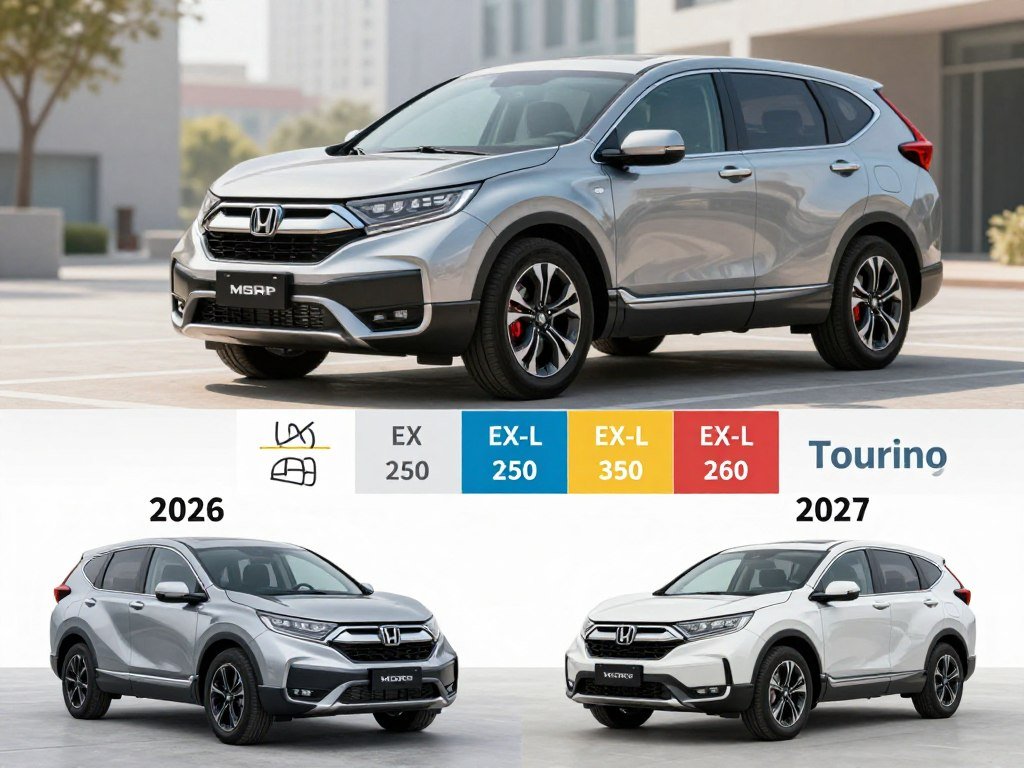
The MSRP is the manufacturer’s suggested retail price, before taxes, title, registration, and other applicable charges. The table shows the starting and upper trim prices for both years.
| Year | Trim | Drivetrain | MSRP |
|---|---|---|---|
| 2026 | LX | FWD | $32,470 |
| 2026 | EX-L | AWD | $38,450 |
| 2027 | LX | FWD | $33,070 |
| 2027 | EX-L | AWD | $38,850 |
Other 2026 CR-V prices are $33,970 for the LX AWD, $34,700 for the EX FWD, $36,200 for the EX AWD, and $36,950 for the EX-L FWD.
For 2027, the LX AWD is $34,570, the EX FWD is $35,100, the EX AWD is $36,600, and the EX-L FWD is $37,350. A higher trim price can change the lease amount or the loan principal.
For a 2026 CR-V, the listed financing offer is up to $1,250 cash or 2.99% APR for 36 months. The 2027 offer is up to $500 cash or 3.99% APR for 36 months.
Both financing offers require Honda Financial Services. A cash incentive can reduce the amount you finance, while a lower APR can reduce interest over the loan term. Which helps more depends on your loan amount and chosen term.
Leasing may suit a driver who prefers a set term and accepts the contract limits. Financing can lead to ownership after you make the final loan payment, but it requires taking on the vehicle’s full price and loan terms.
Compare the cash incentive and APR using the loan term you would actually choose, not just the headline offer.
What Changes the Monthly Payment and Due-at-Signing Total?
Two CR-V lease ads with similar monthly payments can have noticeably different effective costs once upfront cash is spread across the term. The effective cost adds the due-at-signing amount to the scheduled payments, then spreads that total over the lease months.
Effective monthly costs below exclude taxes and fees. They offer a clearer comparison than the advertised payment alone, though they do not replace the contract’s full price breakdown.
| Model and drivetrain | Effective cost per month before taxes and fees | Applicable note |
|---|---|---|
| 2026 LX FWD | $377 | Standard listed example |
| 2026 LX FWD | $397 | Alternate listed example |
| 2026 LX AWD | $415 | Listed AWD example |
| 2027 LX FWD | $456 | Listed example |
Other listed examples come to $466 per month for a 2027 LX FWD and $485 for a 2027 LX AWD, before taxes and fees. Different advertised terms and upfront amounts can explain why the same trim has more than one figure.
Which numbers shape the monthly payment?
The capitalized cost is the negotiated vehicle amount used to calculate lease payments after applicable credits and reductions. The capitalized cost, residual value, money factor, and contract term all shape the payment.
The residual value is the vehicle’s estimated value at lease end. A higher residual can lower payments, while a higher capitalized cost or money factor can raise them.
- Capitalized cost after credits and reductions
- Residual value at the contract’s end
- Money factor used to calculate rent charges
- Number of months in the lease term
What can be included in the upfront amount?
The due-at-signing total may include the first payment, a capitalized-cost reduction, an acquisition fee, taxes, title, registration, and dealer document fees. A quote should show which charges are paid upfront and which enter the lease balance.
Compare payment, term, and cash due together before deciding which quote is cheaper overall.
Does a $0-Down CR-V Lease Mean Nothing Is Due?
No, $0 down does not automatically mean $0 due at signing. A zero-down lease means no money goes toward reducing the capitalized cost, not that every start-up charge disappears.
Check the cap-cost reduction and the total due at signing separately. Those are different figures, even when an ad uses “$0 down” in large type.

What zero down means in a lease quote
A quote can show $0 as the capitalized-cost reduction while still requiring the first monthly payment and other charges. For example, a lease could need the first payment, an acquisition fee, and local taxes before you take the vehicle home.
That quote has no down payment applied to the vehicle amount, yet it still calls for cash at signing. The word “down” does not describe every charge due that day.
Charges that may still be due at signing
Upfront charges may include the first payment, acquisition fee, taxes, title, registration, and dealer document fee. The exact mix depends on how the quote handles those items.
Ask whether taxes and fees are paid upfront or added to the lease. Adding them may change the monthly payment or the balance you owe during the contract.
A clear quote separates the capitalized-cost reduction from the total cash due at signing. That distinction helps you judge the real amount needed to start the lease.
Ask the dealership to show cap-cost reduction and total due at signing as separate figures on the written quote.
Is Leasing a Honda CR-V Smart for Your Driving Habits?
Leasing can be a smart CR-V choice if you value changing vehicles every few years and can stay within the contract’s mileage limit. Buying may fit better when you drive a lot or want to keep one vehicle long term.
New-vehicle leases commonly run about 24-36 months. At the end, you return the vehicle or use the contract purchase option, which may let you buy it.
When leasing can fit
A lease can work well if you like getting a newer vehicle every few years. You make payments during a set term, then follow the contract’s end rules.
It can also suit you if your annual driving is steady and fits the mileage allowance. The limit matters because your regular commute, family trips, and weekend drives all add miles.
Leasing does not build ownership equity unless you buy the vehicle. Your payments cover use during the contract, rather than paying off a loan that can leave you with an owned CR-V.
When buying may suit you better
Buying often makes more sense if you drive beyond common lease mileage limits or plan to keep the vehicle after loan payments end. Once the loan is paid, you can keep driving without monthly loan payments.
The disadvantages of leasing a Honda CR-V include mileage limits, possible excess-wear charges, and no ownership equity unless you complete the buyout. Those terms can make a lease less appealing if you want freedom to keep or change the vehicle on your own schedule.
Think about how many years you usually keep a vehicle and how much you drive each year. A short lease can feel flexible, but repeated contracts keep you making payments if you continue leasing.
Choose buying if keeping the same vehicle beyond the lease term matters more than changing vehicles regularly.
What Mileage Limits and End Options Apply to a Honda CPO Lease?
Honda CPO leases typically allow 10,000-15,000 miles per year, with the specific allowance set in the contract. Going over your contract’s mileage limit can add charges. Match the allowance to the miles you actually expect to drive.
Your annual estimate should include regular trips and longer vacations, not only your daily commute. A low limit can become costly if your plans change or your driving grows.
At the end of a Honda CPO lease, you have four common choices:
- Return the vehicle
- Buy the vehicle
- Lease another CPO vehicle
- Buy a new Honda
The contract sets your mileage allowance and the charges for driving beyond it. A yearly limit gives you a simple way to compare your normal driving with the terms before you sign.
Estimate your annual driving before accepting a mileage limit, including regular trips and longer vacations.
Can You Lease a Used Honda CR-V Through HondaTrue Certified?
A used CR-V can qualify for Honda CPO leasing only when it meets the HondaTrue Certified age and mileage rules. Eligible vehicles must be up to 6 years old and have fewer than 80,000 miles.
A 2023 CR-V may meet the age rule in 2026 only if it has HondaTrue Certified status and fewer than 80,000 miles. Apply the same checks to a 2022 CR-V instead of assuming every used example qualifies.
Who qualifies for Honda CPO leasing?
HondaTrue Certified vehicles and HondaTrue Certified EVs can qualify for Honda CPO leasing when they meet the age and mileage rules. HondaTrue Used vehicles and other used-vehicle tiers do not qualify.
The certification tier matters as much as the model year. Two used CR-Vs of the same year may have different eligibility if only one carries HondaTrue Certified status.
That difference also matters when comparing a used lease with a new CR-V offer. Check the vehicle’s listed tier and odometer reading before treating it as an eligible choice.
What coverage comes with HondaTrue Certified?
HondaTrue Certified vehicles receive a multi-point inspection and a downloadable vehicle report. The report gives you vehicle details to review alongside the inspection status.
Powertrain coverage extends up to 7 years or 100,000 miles. The exact limit depends on the applicable coverage terms and the vehicle’s age or mileage.
HondaTrue Certified EVs have high-voltage battery coverage up to 8 years or 100,000 miles. That battery limit applies to certified EVs, not every used Honda vehicle.
Use the report to review the vehicle’s recorded details, then compare its coverage with your planned lease period. Certification describes a specific tier, not all used CR-Vs on a dealership lot.
Verify the vehicle’s exact HondaTrue tier and report before comparing its lease with a new CR-V offer.
Which Used CR-V Years Deserve a Closer Look?
For an older used CR-V, shortlist a clean 2016; for a newer cabin and safety technology, look at 2020-2022 examples. Model year alone cannot tell you whether a specific vehicle is a good choice. Condition and maintenance history matter too.
The 2016 CR-V can suit shoppers seeking an older model in good condition. The 2020-2022 models offer a newer cabin and newer safety technology.
Used model years worth shortlisting
Honda said all 2020 CR-V trims came standard with Honda Sensing. The 2020 model year also introduced a hybrid-electric CR-V version.
Those features can make 2020-2022 models worth a closer look if you want newer technology. Still, a well-cared-for older vehicle may be a better buy than a newer one with gaps in its service history.
Check the individual car, not just the year printed on its registration. Maintenance records and completed repair work give you a clearer picture of how it was treated.
Year-specific repair and recall checks
Honda shared customer information about a software update for the 2015 CR-V. The update aimed to reduce vibration during acceleration between 1,000 and 1,200 rpm.
A product update campaign covered certain 2017-2018 CR-Vs with the 1.5-liter turbo engine. It included software updates and oil-related repair steps tied to oil dilution.
Campaign work and safety recalls are not the same check. Confirm the exact vehicle’s repair history and open recall status before taking delivery.
How to check a vehicle’s recall status
NHTSA’s recall lookup can show whether a specific vehicle needs a recall repair. Honda’s recall website covers safety recalls announced in the past 15 calendar years.
- Review maintenance records and completed campaign work.
- Run the specific VIN through NHTSA’s recall lookup.
- Confirm any open recall repair is completed before taking delivery.
Check the specific vehicle’s VIN and repair records rather than rejecting or choosing it by model year alone.
Which 2026 CR-V Hybrid Trim Fits Your Budget?
The 2026 CR-V Hybrid pairs a 2.0-liter four-cylinder engine with a two-motor system rated at 204 horsepower. Its four trims are Sport Hybrid, Sport-L Hybrid, TrailSport Hybrid, and Sport Touring Hybrid.
The system also produces 247 pound-feet of torque. Fuel economy differs by drivetrain and trim, so price the version you would actually lease.
Hybrid power and fuel economy
With front-wheel drive, the EPA-estimated fuel economy is 43 MPG city, 36 highway, and 40 combined. Those three figures describe different types of driving.
All-wheel-drive models reach EPA estimates of up to 40 MPG city, 34 highway, and 37 combined. AWD figures vary by trim, so the highest estimate may not match every version.
The hybrid’s two-motor setup works with the gas engine to deliver power while using less fuel than the front-wheel-drive figures suggest for some city driving. Your actual mileage can differ with roads, weather, and driving style.
Choosing among the four trims
The Sport Hybrid, Sport-L Hybrid, TrailSport Hybrid, and Sport Touring Hybrid are the four trims to compare. Features and drivetrain choice can affect the lease quote, so identify your preferred version before comparing prices.
Consider which equipment matters to you and whether you want front-wheel drive or all-wheel drive. A trim that costs more may also have a different EPA estimate, making it important to weigh both the lease price and expected fuel use.
Ask for a quote tied to the exact hybrid trim and drivetrain, rather than a general CR-V Hybrid payment. That keeps the advertised terms aligned with the vehicle you would take home.
Check the exact trim’s drivetrain and EPA estimate before treating the highest listed figure as your expected mileage.
How Does the CR-V Compare With Toyota RAV4 Lease Deals?
If resale value is the deciding factor, Toyota RAV4 is the stronger general starting point, while a well-maintained CR-V can still be the better individual vehicle. Judge reliability and long-term use by the exact vehicle, not its badge alone.
The RAV4 and CR-V are both established compact SUV models. Service history and condition can change how a specific used vehicle compares with another.
Reliability and long-term use
A Toyota badge does not guarantee that a particular RAV4 will outlast a particular CR-V. The model year, maintenance record, condition, and inspection all help you judge the vehicle in front of you.
A CR-V with stronger maintenance records and better condition can be the better used choice. The same rule applies when you look at a RAV4 with a less complete service history.
For a lease, reliability still matters because you will drive the vehicle through the contract term. Compare the specific model year and the vehicle’s care rather than relying on a broad brand claim.
Resale value and lease choice
The RAV4 is the general default when resale value is your main concern. A lease shopper may care less about selling the vehicle later, but resale can still affect how a lender estimates its end value.
Compare Toyota and Honda lease offers using the same term, annual mileage, trim level, and cash due at signing. A lower displayed payment is hard to judge if one contract asks for more money upfront or allows fewer miles.
Some shoppers may also compare other compact plug-in hybrids. For example, the RAV4 Plug-in Hybrid comparison with the Mitsubishi Outlander PHEV looks at electric range, seating, and other vehicle differences.
Compare specific vehicles and contract terms, not brand reputation alone.
How Do You Compare CR-V Lease Offers Near You?
Start by asking dealerships for written CR-V quotes that use the same trim, term, mileage allowance, and due-at-signing amount. At least three written quotes make it easier to spot different contract terms.
Local inventory, your ZIP code, credit approval, and dealer fees can affect the final quote. An advertised payment is not a promise of approval or a guaranteed price in your area.
Build a like-for-like quote request
Use the same details in every request so the offers can be compared fairly:
- Same model year and trim
- Same lease term
- Same annual mileage
- Same total due at signing, with taxes and fees itemized
Ask each dealership to show the monthly payment, contract length, mileage allowance, and total due at signing. A quote that leaves out taxes or fees can make the initial amount look lower than it is.
Check the final written terms
Review whether the quote matches the vehicle you want and lists the same fees as the other offers. Check that the monthly payment and due-at-signing total appear in writing.
Credit approval can affect the terms you receive, while inventory affects which trim a dealership can offer. A quote for a different vehicle or mileage allowance is not a true comparison, even if its payment looks appealing.
Choose a quote only after the written terms show the vehicle, payment, term, mileage, and full amount due at signing.
Choose the quote whose complete written terms fit your budget, not the one with the smallest displayed payment.
Conclusion
A good CR-V lease is the one whose total upfront cost, monthly payment, and mileage terms fit how you actually drive. Compare those figures with the contract term, since a low payment can come with more cash due at signing.
A used CR-V lease calls for an extra check: confirm its HondaTrue tier and review its vehicle history. Ask for a written quote for the trim you want, then compare its full terms with at least two other offers.
FAQ
What car can I lease for $300 per month?
A listed 2026 CR-V LX offer is $269 per month for 39 months, with $4,199 due at signing. That monthly amount is below $300, but the upfront cash changes the full cost. Taxes and fees can also affect your quote. Compare the total due at signing and all scheduled payments before deciding whether the deal fits your budget.
How much is a lease on a new CR-V?
A listed new CR-V lease starts at $269 per month for a 2026 LX, with a 39-month term and $4,199 due at signing. The figure applies to that listed offer, not every trim or location. Your quote can change with credit approval, selected vehicle, and local charges. Review the full written terms before treating the advertised payment as your own.
Is it smart to lease a Honda CR-V?
Leasing can suit you if you want a newer vehicle every few years and can stay within the mileage limit. It gives you a set contract term, but does not build ownership equity unless you complete the buyout. Buying may work better if you drive many miles or want to keep the vehicle after loan payments end. Match the choice to your driving and ownership plans.
Which is more reliable, Toyota RAV4 or Honda CR-V?
The Toyota RAV4 is a reasonable general reliability default, but the exact vehicle matters more than the badge. Compare its model year, service history, condition, and inspection with those of the CR-V. A well-maintained CR-V can be a better used vehicle than a neglected RAV4. Check records for the vehicle you are considering rather than relying on a broad brand ranking.
What are the disadvantages of the Honda CR-V?
For a leased CR-V, the main disadvantages are mileage limits, possible excess-wear charges, and no ownership equity unless you buy it. Those limits may matter if your driving changes or you want to keep the vehicle long term. Review the mileage allowance and the contract’s wear rules before signing. Buying may suit you better if you want fewer contract limits.
What lasts longer, RAV4 or CR-V?
A well-maintained RAV4 or CR-V can last, so the badge alone cannot tell you which will go farther. Service records, vehicle condition, model year, and inspection results give you a better basis for comparison. Look for steady maintenance and clear repair records. A newer vehicle with weak care may be a poorer choice than an older one with a strong history.
Which CR-V to stay away from?
Do not reject a CR-V by model year alone; check the vehicle’s repair records and VIN-specific recall status. For a 2015, ask about the vibration software update. For certain 2017-2018 models with the 1.5-liter turbo engine, check for campaign work tied to oil dilution. A completed repair and sound condition can matter more than the year itself.
Which is better for resale, the Toyota RAV4 or the Honda CR-V?
The Toyota RAV4 is the general resale-value default, though the exact year, trim, condition, and local market still affect value. A well-kept CR-V may be a stronger individual choice than a RAV4 in poor condition. If you plan to sell later, compare similar vehicles in your area. If you lease, focus first on matching the contract terms and total cost.



