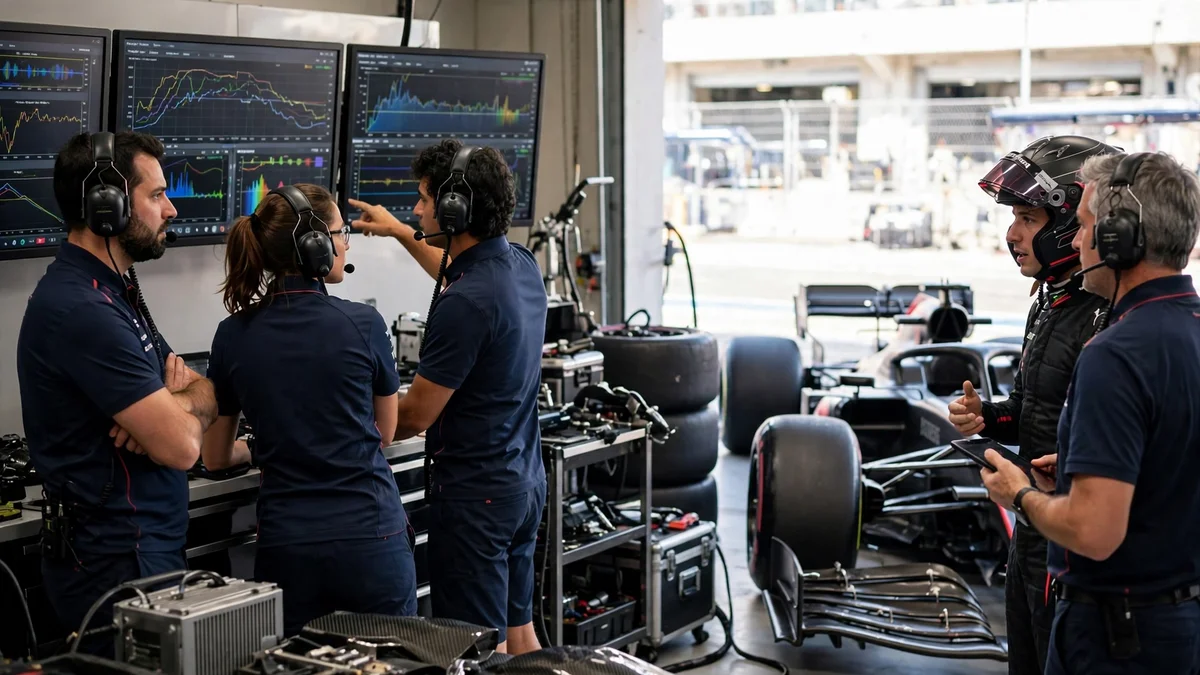
AI in Formula 1 has moved from the margins of the garage to the centre of how teams design cars, plan races and run their businesses. A new report from The Athletic, published through The New York Times, describes a sport that now leans on machine learning and generative AI at almost every step, while insisting that people still make the final calls.
The report, part of the Changing Lanes series on AI and human engineering, draws on interviews with Williams chief information officer James Smith, McLaren boss Andrea Stella and AWS motorsports chief Michael Aghataher. A single car carries around 300 sensors and generates about 1.1 million data points per second during a race, and AI helps teams turn that flood into decisions.
Yet the teams are drawing a clear line. Under Formula 1’s cost cap, every pound spent on AI is a pound not spent on the car, so teams only invest where they can see a return in lap time. When the data and the driver disagree, the human wins.
Key takeaways
- Teams use AI across race strategy, car design, aerodynamics, simulator training, software work and the new 2026 engines.
- A single F1 car carries about 300 sensors and generates roughly 1.1 million data points per second.
- AI spending falls under F1’s cost cap, in place since 2021, so teams must justify every AI investment in lap time.
- Williams uses AI across the whole business, including human resources, finance and legal work.
- Teams and the FIA agree: AI supports human decisions, and a human remains accountable for every call.
| Area | How AI is used | Who decides |
|---|---|---|
| Race strategy | Models pre-compute scenarios and predict safety car and tyre outcomes | Strategists and the pit wall |
| Car design | AI supports aerodynamics and simulates the effects of rule changes | Engineers and aerodynamicists |
| New 2026 engines | AI adjusts power delivery across a lap based on the previous lap | Drivers, with engineers setting limits |
| Driver preparation | AI organises past performance data and speeds up simulator work | Driver performance engineers |
| Team operations | AI assists HR, finance, legal and internal information search | Team staff and managers |
| Rule-making | F1 used AWS AI tools to design the ground-effect rules for 2022 to 2025 | F1 and the FIA |
Formula 1 has been a data sport for decades
Formula 1 did not become a data sport overnight. The championship began in 1950, and engineering innovation has mattered from the start, but it was in the 1980s that the sport became a digital, data-driven operation. What began with simple sensors and telemetry mapping laid the foundation for the systems teams use today. Williams chief information officer James Smith described the work as finding patterns in data, which he called the definition of Formula 1.
The history is full of stepping stones. In 1985, Honda created a data logger, and Williams became the first team to use it the following season. It evolved into a telemetry system allowing remote data collection and real-time monitoring while cars were moving, and it quickly became standard across the grid. In the 1990s, algorithms improved race strategy, and the Monte Carlo simulation, which estimates outcomes such as tyre life, became a key tool that remains central today.
How AI shapes race strategy on a Sunday
Race strategy is where AI is most visible to fans, even if they never see it working. During a race, teams pre-compute what might happen in different scenarios using machine learning, so that when something changes on track, they already know how to react. Smith said all the teams on the grid are likely doing this while the cars circulate, preparing for safety cars, crashes and weather changes.

The 2026 Mexico City Grand Prix provided a vivid example. Ferrari pitted Lewis Hamilton just after Cadillac driver Valtteri Bottas crashed, calculating that if a safety car period occurred, the odds would favour stopping. In principle the calculation was right, since stopping under a safety car saves far more time than stopping at racing speed. But the safety car period turned into a red flag, and Hamilton did not gain time. The model can weigh probabilities correctly and still be undone by an outcome it could not foresee.
AI in car design, aerodynamics and the new engines
Beyond strategy, AI supports car design, aerodynamic development, simulator training, software engineering and the new engines introduced for 2026. Formula 1 used AWS-provided AI tools to design the rules for the ground-effect car era of 2022 to 2025, running many simulations to develop the rules efficiently. According to AWS head of motorsports Michael Aghataher, high-performance computing cut simulation time from 60 hours to 12 hours, and the work freed up 68 hours of time for engineers.
At team level, the new 2026 engines show how deeply AI is embedded in the machinery itself. McLaren team principal Andrea Stella explained at July’s Belgian Grand Prix how the engines deploy AI systems to adjust how much power a driver gets across a lap, based on how the driver drove the previous lap. That can lead to unexpectedly higher or lower power if a driver makes a mistake, and Stella said this is quite difficult for drivers to master. With about 1.1 million data points per second, AI helps teams surface patterns that inform live decisions.
AI is now part of running the whole team
The use of AI extends well beyond the garage and the track. Smith said Williams now uses AI across the entire business of running a team, including human resources, finance and legal work. His reasoning was economic: any time the team makes a human better, it saves money, and that money can then be spent on the car to make the car faster. In Formula 1, he said, money effectively equals milliseconds on track.
Williams driver performance engineer Russell Paddon, who joined at the end of the 2024 season, connects drivers with the engineering operation, turning driver feedback into engineering requirements. He uses AI tools across Atlassian and the team’s AI partner, Anthropic, mainly to organise information. Instead of manually searching old reports, he can query the team’s knowledge base for patterns. Work that once took about 60 percent of his time, writing code to answer each new question, has largely disappeared.
The cost cap forces teams to choose carefully
Teams must decide carefully how to use AI, because Formula 1 has operated under a cost cap since 2021. If AI spending goes towards operations or car development, it falls within the cap, and there is no separate budget for AI expenditure, tokens or model usage. Smith was direct: the team cannot afford many unfunded experiments, and most of its limited money must go into tangibly improving the car.
The cost cap also shapes the debate about fairness. AI companies are now prominent partners: Williams signed Anthropic as its Official Thinking Partner, and Google works with McLaren as Gemini AI. Ampere Analysis put tech sponsorship at 565 million dollars so far this year. The FIA is developing rules for AI use, with updates expected to phase in from 2027, aiming to keep car development led mainly by human engineers and to stop AI becoming an uncontrolled area of spending.
Drivers, emotion and the human heart of the sport
Behind all the technology, the sport still turns on human emotion. Smith pointed to the scenes when Mercedes driver Kimi Antonelli won his first world championship in Mexico, saying the combination of man and machine is what makes the sport so exciting. That connection with the audience is something no model can manufacture. Formula 1’s appeal has always rested on people, and AI is being asked to serve that appeal rather than replace it.
Mercedes team principal Toto Wolff has said that when ten million simulations point one way and the driver says another, he trusts the human, describing the driver as the team’s most valuable sensor. Drivers use AI in their own lives too: Lewis Hamilton has appeared in a campaign for Perplexity, using it for breathing guides and playlists. Williams team principal James Vowles has said that if AI makes aerodynamicists more efficient, he would probably hire more of them, not fewer.
What it means
Formula 1’s approach to AI offers a template other industries may follow: adopt the tools aggressively where they save time and surface insight, but keep the decisions and the accountability with people. The cost cap makes that discipline unavoidable, since every AI experiment competes for the same limited budget as a new front wing.
For fans, the practical effect is a sport that looks the same on television but is prepared very differently behind the scenes. The more interesting question is what happens when AI tools become so capable that the line between support and substitution blurs. Agentic AI versus traditional automation explains how autonomous AI systems differ from older automated workflows. Copilot versus ChatGPT-5 for business compares two AI assistants that office teams now rely on. And MCP versus traditional API integration looks at the standard that lets AI tools talk to the many systems an organisation runs on.
Checklist: how to follow AI in Formula 1
- Watch the pit wall: strategy calls are where AI support is most visible.
- Follow team partnership announcements, which show which AI companies are entering the sport.
- Read FIA rule updates from 2027 onwards for the limits on AI use.
- Compare how different teams describe their AI use.
- Listen to driver interviews about energy management in the new engine era.
- Watch the business side: back-office AI savings are turned directly into car performance.
Frequently asked questions
How is AI used in Formula 1?
Teams use AI for race strategy, car design, aerodynamics, simulator training, software engineering and the new 2026 engines, plus business tasks such as HR, finance and legal work. Models pre-compute scenarios and search past data, but humans make the final calls.
How much data does a Formula 1 car generate?
A single car carries about 300 sensors and generates roughly 1.1 million data points per second during a race, according to AWS head of motorsports Michael Aghataher.
Does AI spending count under the Formula 1 cost cap?
Yes. AI spending on operations or car development falls within the cost cap in place since 2021, with no separate budget for AI. Teams must weigh AI investment against spending on the car.
Will AI replace Formula 1 engineers or drivers?
Team leaders say no. Williams team principal James Vowles has said that if AI makes aerodynamicists more efficient, he would probably hire more of them.
How does AI feature in the new 2026 engines?
The engines deploy AI systems to adjust how much power a driver gets across a lap based on how they drove the previous lap, McLaren team principal Andrea Stella has explained. Drivers say this is quite difficult to master.
What is the FIA doing about AI in Formula 1?
The FIA is developing rules for AI use, with updates expected to phase in from 2027. The aim is to allow useful technical development while preserving human skill, and to prevent AI becoming an uncontrolled area of spending.
Bottom line
AI is changing Formula 1 in real ways: strategy is faster, design work is quicker, and running a team is more efficient. The numbers tell the story, from 1.1 million data points per second to simulation times cut from 60 hours to 12. But the teams want a supporting character for their engineers, not a replacement, and the final call stays with accountable people.
Formula 1 has always been the ultimate test of man and machine, as James Smith put it, and the sport’s leaders intend to keep it that way. AI will keep getting better and the rules will keep evolving, but the human endeavour at the heart of the sport is the part the teams are determined to protect.