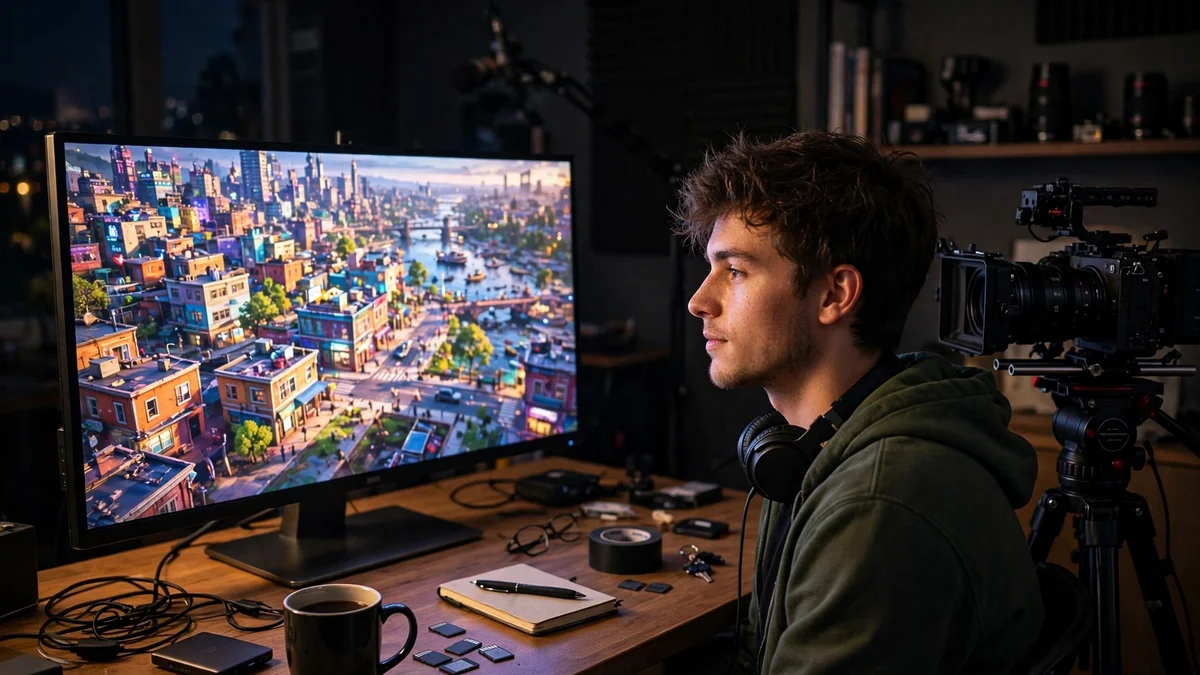
A filmmaker could make the next breakout video game with AI, according to Ben Feder, the former Take-Two Interactive chief executive who led the company when Grand Theft Auto IV came out in 2008. In a Fortune conversation published on 25 November 2026, Feder argued AI will soon let a creative mind with no technical background build a major game by pointing and clicking.
The prediction is striking because it comes from a man who ran one of the biggest publishers in games, and because it arrives just as the industry’s biggest title, Grand Theft Auto VI, is proving the opposite approach still works. Rockstar Games built GTA VI the old-fashioned way, without generative AI, and it is on track to be the biggest entertainment launch of any kind.
Feder does not see a contradiction. He believes the blockbuster model will survive, but the way blockbusters get made is about to change, and the next great game maker may be someone who would otherwise have gone into movies. His firm, Tirta Ventures, invests in AI-native game projects.
Key takeaways
- Ben Feder, former Take-Two CEO during the GTA IV era, says AI will let a filmmaker with no technical background make the next breakout video game.
- Grand Theft Auto VI was built without generative AI, according to current Take-Two CEO Strauss Zelnick, who says its worlds are handcrafted building by building.
- GTA VI is estimated to have cost over $1 billion after 13-plus years, with first-three-days revenue projected at about $1.85 billion.
- Feder expects AI to flood the market with new games, but only a small share will break through, much like video on YouTube.
- He argues AI will make software cheaper, so games will depend more on storytelling and craft than coding skill.
| Detail | What is known |
|---|---|
| Who said it | Ben Feder, former Take-Two Interactive CEO, now managing partner of Tirta Ventures |
| Prediction | A filmmaker could make the next breakout game; AI makes it point and click |
| GTA VI approach | Built by hand, no generative AI (Zelnick) |
| GTA VI budget | Estimated at $1 billion to $1.5 billion, after more than 13 years |
| Projected revenue | About $1.85 billion gross in the first three days, per Oppenheimer via Reuters |
| Feder’s firm | Tirta Ventures, which invests in AI-native game projects |
| Key quote | “Some great creative mind who would have otherwise gone to make a film will make a video game.” |
GTA VI was built by hand
Grand Theft Auto VI, on track to be the biggest entertainment launch of any kind, was made the old-fashioned way. Take-Two Interactive chief executive Strauss Zelnick said in February that Rockstar Games built the game without generative AI. “With regards to GTA 6, generative AI has zero part in what Rockstar Games is building. Their worlds are handcrafted. That’s what differentiates them,” Zelnick told GamesIndustry.biz. “They’re built from the ground up, building by building, street by street, neighborhood by neighborhood.”
That approach took time and money. Analysts estimate Take-Two spent more than a billion dollars on the game, which arrived more than 13 years after its predecessor. Take-Two has not disclosed the cost, though estimates put it at $1 billion to $1.5 billion; Zelnick admitted only that it was expensive. Brokerage Oppenheimer projected about $1.85 billion in gross revenue in the game’s first three days, Reuters reported.
Feder, who ran Take-Two when GTA IV came out in 2008, called the return extraordinary. “Thirteen years of investment you make back in a day. Unbelievable,” he said. “But it only happens if you create the most awesome game ever.”
The filmmaker who becomes a game maker
Feder’s central claim is about who gets to make games next. “Some great creative mind who would have otherwise gone to make a film will make a video game because it’s as simple as point and click,” he said in conversation with Fortune about the state of the entertainment industry. The next great game maker, he argues, might be someone who would otherwise have gone into movies, because AI lowers the technical barrier.

Video games have long sat at the intersection of the software and entertainment businesses. Feder said AI will shrink the software side as writing code gets cheaper and easier. “The argument would be that because AI is making software development commoditized, and software points to zero, it becomes much more about entertainment than it does about both entertainment and computer science,” he said.
Feder described the result as somewhere between democratizing creativity and commoditizing it, but argued true creativity cannot be commoditized unless AI itself can be creative. The tools may get cheaper, he argues, but genuine creative talent will not. Feder wrote a Fortune commentary this month arguing that AI will change how big games get made, and his firm invests in AI-native game projects. “We put our money where our mouth is,” he said of Tirta’s investments.
The economics that could change everything
The financial case for Feder’s prediction is simple. If AI can produce a game nearly as good as a handcrafted blockbuster for a fraction of the cost, the case for spending $2 billion on a single title gets harder to make. “It’s going to get harder to justify a $2 billion game in a world where the next best alternative is two orders of magnitude less,” Feder said. Two orders of magnitude less is roughly $20 million, a budget a small team could plausibly raise.
Yet Feder himself offered the counterargument. GTA VI, ironically, did make back all the money poured into it, and then some. “What’s the argument for not spending another $2 billion on the next one and making it back in a day?” he said. “That’s a valid argument.” A game earning close to $2 billion in three days can justify almost any budget, if it becomes a cultural event.
That tension will shape the next decade: big publishers keep betting on a handful of enormous titles, while AI-powered creators attack from below with smaller, cheaper games. For the tools already available to small creators, see Best AI Tools for Video Game Design in 2027.
More games will not mean more hits
Feder expects a flood of new titles as AI lowers the barrier to entry, but he does not expect a flood of hits. Only a small share will break through, he said, pointing to YouTube. “I don’t know how many billions of minutes of video have been on YouTube, but how many of them actually are good? How many of them actually get traction?” he said. “But the ones that do get traction and are good reach billions of people, literally, and can create enormous outcomes, both creatively and commercially.”
The same pattern is likely in games. Millions of people will be able to make something playable, but only a few will make something people love, talk about and return to. Discovery becomes the bottleneck, not production.
The shift also changes what publishers are for. When anyone can build a game, the value of a publisher moves from funding production towards finding, polishing and marketing the rare titles that deserve attention. Feder’s own history points the same way. “Even when I was at Take-Two for GTA IV, we were the first, and others followed, to develop a strategy of fewer, bigger titles,” he said. Indie games struggle to break through the noise, and the pressure falls on mid-tier games with big budgets and smaller audiences. “It’s hard to make the numbers work.” For what players may pay for the biggest titles, see GTA VI Price: Expected Cost by Edition and Platform.
What it means for the GTA franchise
Feder does not expect the rise of AI-made games to hurt the franchise he once oversaw. “I don’t think GTA is going anywhere. In fact, it probably goes from strength to strength,” he said. “But that’s not to say it’s going to get created in the exact same way that it got created here.”
Part of what makes GTA VI remarkable, in Feder’s telling, is how close its characters come to the cinematic realism he once saw as the industry’s next frontier. When he ran Take-Two, he said the next frontier was characters that look like movie actors rather than figures in a game. Of GTA VI, he said: “This gets as close to it as I’ve ever seen.”
Big publishers have long concentrated money on a handful of games and franchises, as the Marvel Cinematic Universe shows for film. AI could loosen that grip by letting outsiders in, but franchises with deep worlds and loyal audiences will not disappear. Creators starting out can try tools that cost little or nothing: see AI Game Dev Tools With Free Trials: 2026 Guide.
What it means
Feder’s prediction is less about technology than about talent. If AI removes the coding barrier, the people who make the next great games may come from film schools, not computer science departments, and the skills that matter most will be story, character and taste.
For players, the likely outcome is more choice and more noise. There will be more games worth playing, and far more games not worth anyone’s time. The winners will be creators with a story only they could tell, and the curators who help players find them.
Checklist: what to watch next
- Whether any AI-assisted game breaks into the mainstream charts next year, and who made it.
- Whether Rockstar or Take-Two changes its stance on generative AI for future GTA titles.
- Which AI game tools gain real traction with independent creators, and which fade away.
- Whether big publishers cut mid-tier budgets as AI alternatives improve.
- How platforms handle discovery when thousands of new AI-made games arrive each month.
- Whether filmmakers start naming games, not films, as their first project.
Frequently asked questions
Who is Ben Feder?
Ben Feder is the former chief executive of Take-Two Interactive, who led the company when Grand Theft Auto IV came out in 2008. He is now managing partner of Tirta Ventures, which invests in AI-native game projects.
What did Feder say about filmmakers and AI?
He said a great creative mind who would otherwise have gone to make a film will make a video game instead, because AI makes development as simple as point and click.
Was GTA VI made with generative AI?
No. Take-Two CEO Strauss Zelnick said in February that generative AI played no part in what Rockstar Games built, and that the game’s worlds are handcrafted building by building.
How much did GTA VI cost to make?
Take-Two has not disclosed the cost. Analysts estimate the development budget at $1 billion to $1.5 billion, after more than 13 years in development.
How much could GTA VI earn in its first days?
Brokerage Oppenheimer projected about $1.85 billion in gross revenue in the game’s first three days, Reuters reported.
Will AI-made games replace big studio blockbusters?
Feder does not think so. He expects a flood of new titles but says only a few will break through, and he believes the GTA franchise will go from strength to strength.
Bottom line
Ben Feder’s argument is that AI will not replace creativity in games, it will relocate it. The coding that once kept filmmakers out of game development is getting cheaper by the month, and the next breakout hit may come from a storyteller who never learned to program.
Grand Theft Auto VI shows what the old model can still achieve: more than a billion dollars spent by hand, repaid in days. The question is whether a filmmaker with AI tools can build something earning even a fraction of that, and whether players will care how it was made.