
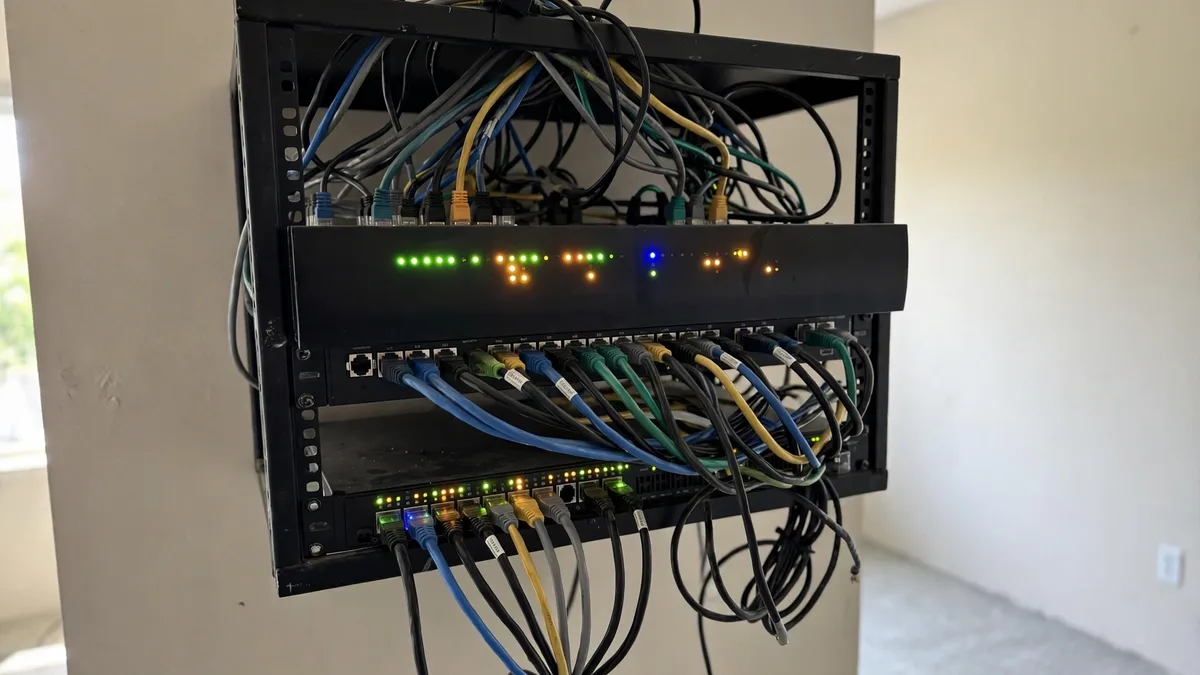
AI Firewall vs Traditional Firewall in 2027
Every business network has a gatekeeper. For thirty years that gatekeeper has been the traditional firewall: a device or program that checks network traffic against a list of rules and blocks what does not match. In 2027 a new gatekeeper is joining it, the AI firewall, which uses machine learning to judge traffic, spot new attacks, and even inspect what goes in and out of AI tools.
The confusion comes from the shared name. These are not two versions of the same product doing the same job faster. A traditional firewall guards the network boundary using rules written by people. An AI firewall watches behaviour, learns what normal looks like, and flags the strange — including risks that never touch the network boundary at all, such as an employee pasting customer records into a public chatbot. If you want the full background on the field first, our guide on what cybersecurity is explains the basics these tools sit on.
This comparison explains what each type does, where each one is strong, what each costs, and how small businesses are combining them in 2027. The short answer is that most businesses still need the traditional firewall, and the AI firewall is an extra layer for the newer threats, not a replacement for the old one.
Key takeaways
- A traditional firewall blocks network traffic using fixed rules, and it remains the foundation of business network security in 2027.
- An AI firewall adds behaviour analysis, catching new and unusual attacks that no fixed rule would recognise.
- AI firewalls also guard AI use itself, such as prompts and files sent to chatbots, which traditional firewalls cannot see.
- Traditional firewalls are cheaper, more predictable and easier to audit; AI firewalls cost more and need tuning to avoid false alarms.
- Most small businesses should keep a traditional firewall and add AI protection where staff use cloud apps and AI tools heavily.
At a glance: the comparison
| Factor | Traditional firewall | AI firewall |
|---|---|---|
| How it decides | Fixed rules written by people | Learns normal behaviour, flags the unusual |
| Best at | Blocking known threats and ports | Catching new, unknown and AI-based attacks |
| AI app protection | None — cannot inspect prompts | Checks prompts, files and AI responses |
| False alarms | Rare, rules are explicit | More common until tuned |
| Typical cost | From around $300 a year for small business | From around $50 per user per month |
| Setup effort | Hours, then occasional rule updates | Days to weeks of learning and tuning |
| Works offline | Yes | Often needs cloud updates |
Prices above are approximate starting prices, so check current pricing before you buy, since security vendors change tiers and bundles often.
Traditional firewalls: the rule-based gatekeeper

A traditional firewall sits between your network and the internet and inspects traffic packet by packet. Each packet is checked against rules: which ports are open, which addresses are allowed, which services may pass. Anything that breaks a rule is dropped. It is simple, fast and predictable, and when something is blocked you can point to the exact rule that blocked it, which makes audits and troubleshooting straightforward.
Modern traditional firewalls do more than the early ones. Next-generation firewalls add inspection of application traffic, intrusion prevention and filtering of known malicious sites, but they still work from signatures and rules — lists of threats that security teams have already seen and catalogued.
For a small business the traditional firewall is usually a box from a vendor such as Fortinet, SonicWall or pfSense, or a firewall built into the router, plus the software firewall on each computer. It needs little attention once set up: update the rules when staff or services change, keep the firmware current, and review the logs now and then.
Pros: Cheap, predictable, easy to audit, and proven over decades.
Cons: Cannot catch new or unknown attacks, and cannot see inside encrypted AI traffic or chatbot use.
AI firewalls: the behaviour-watching layer
An AI firewall works differently. Instead of only matching traffic against a list, it builds a picture of what normal looks like for your business — which staff open which apps, at what hours, from which devices — and flags behaviour that does not fit. A login at 3am from a new country, a sudden flood of data leaving the network, or a prompt that tries to trick a chatbot into revealing internal data all stand out against that picture. Our explainer on what an AI firewall is covers the concept in more depth.
That second job, guarding AI use, is the part traditional firewalls cannot do at all. Staff now paste documents into chatbots, developers connect AI agents to internal databases, and customers talk to AI assistants that can trigger real actions. None of that looks like a classic attack, so a network firewall waves it through. An AI firewall inspects prompts, uploaded files and generated responses, blocking leaked secrets, injected instructions and sensitive data leaving the company through a chat window.
The cost is money and attention. AI firewall products are usually sold per user per month, which adds up for a team, and they need a learning period plus tuning: too strict and they block legitimate work, too loose and they miss the threats they were bought for. Used well, though, they catch the attacks that rules alone never will.
Pros: Catches new and unusual attacks, and guards AI tools and prompts that other defences miss.
Cons: More expensive, needs tuning to avoid false alarms, and inspects content, which raises privacy questions.
Head to head: where each one wins
On known threats, the traditional firewall wins. It blocks a flood of port scans, known malware servers and unauthorised services cheaply and reliably, and it does so without ever needing to learn anything. On new threats, the AI firewall wins: a phishing page registered an hour ago or a novel attack pattern has no signature yet, so only behaviour analysis stands a chance of spotting it.
On AI and cloud-app risks, there is no contest at all — the traditional firewall cannot see them. A prompt injection, a data leak through a chatbot, or a rogue AI agent calling internal systems are invisible to a device that only checks ports and addresses. On simplicity and auditability, the traditional firewall wins again: its rules can be printed, reviewed and explained to an auditor in an afternoon, while an AI model’s decisions are harder to explain.
On cost, the traditional firewall is the clear winner for a small office, often a few hundred dollars a year. An AI firewall priced per user per month can cost several times that for the same team. The honest picture is that they are complementary layers, not rivals, and the businesses that sleep best in 2027 run both.
The verdict: which should your business choose?
If you have to pick one, pick the traditional firewall. It is the foundation: without it, the office network is open to every automated scan and known attack on the internet. No AI product replaces that basic boundary, and any vendor that tells you otherwise is selling you a gap in your defences.
Add an AI firewall when the business leans on cloud apps and AI tools. The trigger points are clear: staff using chatbots daily, developers wiring AI agents into company data, customer data moving through cloud apps, or a previous incident that came through a channel the old firewall never saw.
The strongest setup in 2027 is both, with the traditional firewall guarding the network edge and the AI layer watching behaviour and AI use. That combination also pairs naturally with identity checks: our guide on what zero trust AI is explains how verifying every user and device fits alongside these two layers.
How to choose in 2027
Start by listing what actually needs protecting. A shop with a till, a back-office computer and email needs a traditional firewall and little else. A consultancy whose staff live in cloud apps and chatbots needs the AI layer too. Map the real risks before shopping, or you will buy features for threats you do not have.
Then trial before you commit. Run an AI firewall in monitoring mode first, where it flags problems without blocking anything, and read the alerts for two weeks. If most alerts are noise, the product needs tuning or is not a fit. Check what data the vendor collects and stores, where it is stored, and whether you can turn off content inspection for sensitive teams. Finally, confirm the total price per user per month including every module you will actually switch on, since AI security products often bundle the useful parts into higher tiers.
Checklist: buying a firewall without regret
Use these checks before you sign a contract.
- Confirm a traditional firewall is in place first, before adding any AI layer.
- List the cloud apps and AI tools staff actually use, and check the product covers them.
- Trial the AI firewall in monitoring mode and read two weeks of alerts.
- Ask the vendor what content it stores, where, and for how long.
- Get the full per-user monthly price, including every module you will switch on.
- Plan who reviews alerts weekly, since an unmonitored firewall protects no one.
Frequently asked questions
Can an AI firewall replace a traditional firewall?
No. An AI firewall is an extra layer that watches behaviour and AI use, while the traditional firewall guards the network boundary against known attacks. Most businesses in 2027 should run both, with the traditional firewall as the foundation.
Is an AI firewall worth it for a small business?
It is worth it when staff use cloud apps and AI tools heavily, or handle sensitive customer data. For a small team with simple office work and little AI use, a traditional firewall plus good habits is usually enough.
Do AI firewalls slow the network down?
Cloud-based AI firewalls add little delay to ordinary browsing, since the heavy analysis happens off-site. Hardware AI appliances can slow traffic if undersized, so match the device to your connection speed before buying.
What is a prompt injection attack?
It is an attack that hides instructions inside text an AI system reads, such as a document or a web page, tricking the AI into revealing data or taking actions it should not. AI firewalls inspect prompts and inputs to catch these before they reach the model.
Can a traditional firewall block AI data leaks?
No. A traditional firewall checks network addresses and ports, and chatbot traffic to a legitimate AI service looks normal to it. Only a tool that inspects the content of prompts and uploads can catch data leaving through an AI service.
How much does an AI firewall cost?
Most AI firewall products for small businesses start at roughly $50 per user per month, with higher tiers for advanced features. Traditional firewalls for a small office often cost a few hundred dollars a year. Check current pricing before you buy.
The bottom line
The AI firewall vs traditional firewall debate in 2027 is not a contest with one winner. The traditional firewall remains the essential foundation: cheap, predictable and proven at blocking known attacks at the network edge. The AI firewall is the newer layer that catches what rules cannot — unusual behaviour, new attacks, and data leaking through AI tools.
For most small businesses the right answer is to keep the traditional firewall and add AI protection when staff use of cloud apps and AI tools justifies it. Trial it in monitoring mode, read the alerts, check the privacy terms, and only then switch on blocking. Security is a set of layers, and these two belong together.



