Artificial intelligence has started doing work that once belonged only to theoretical physicists, and the shift is now visible in published results rather than predictions. In November 2026, a paper on a black hole problem that had stayed open for more than twenty years appeared with an AI system listed as its sole author. Two months earlier, an internal OpenAI model spent 88 hours producing a proof about one of the hardest equations in fluid dynamics.
These are not isolated stunts. Benchmarks built from real, unpublished physics problems show the best AI models improving fast, from about 4 percent accuracy to roughly 32 percent within a year. That is still far from human-level research, but the direction is clear enough that physicists are openly debating what their job becomes when machines can carry out the calculations.
The emerging answer is less dramatic than replacement and more complicated than business as usual. AI looks set to take over much of the grinding mathematical work of theory, while the human role shifts toward asking the right questions, checking the answers, and turning machine output into understanding.
Key takeaways
- A paper on the weakly coupled Hawking-Page transition, a black hole problem open for more than twenty years, appeared on 7 November 2026 with Claude, Anthropic’s AI system, listed as its sole author.
- An internal OpenAI model spent 88 hours in September 2026 producing a proof about singularities in the three-dimensional Navier-Stokes equations, a result that still needs independent verification.
- On the CritPt benchmark of unpublished physics problems, the best models rose from about 4 percent accuracy to roughly 32 percent in a year, while still failing around 70 percent of tasks.
- Harvard physicist Matthew Schwartz predicts language models will pass human intelligence within five years, while Google DeepMind’s Matthew Ginsberg argues that asking good questions remains entirely human territory.
- The likely outcome is a new division of labour: AI does the heavy calculation, and physicists become interpreters, checkers, and question-setters rather than being replaced outright.
What happened
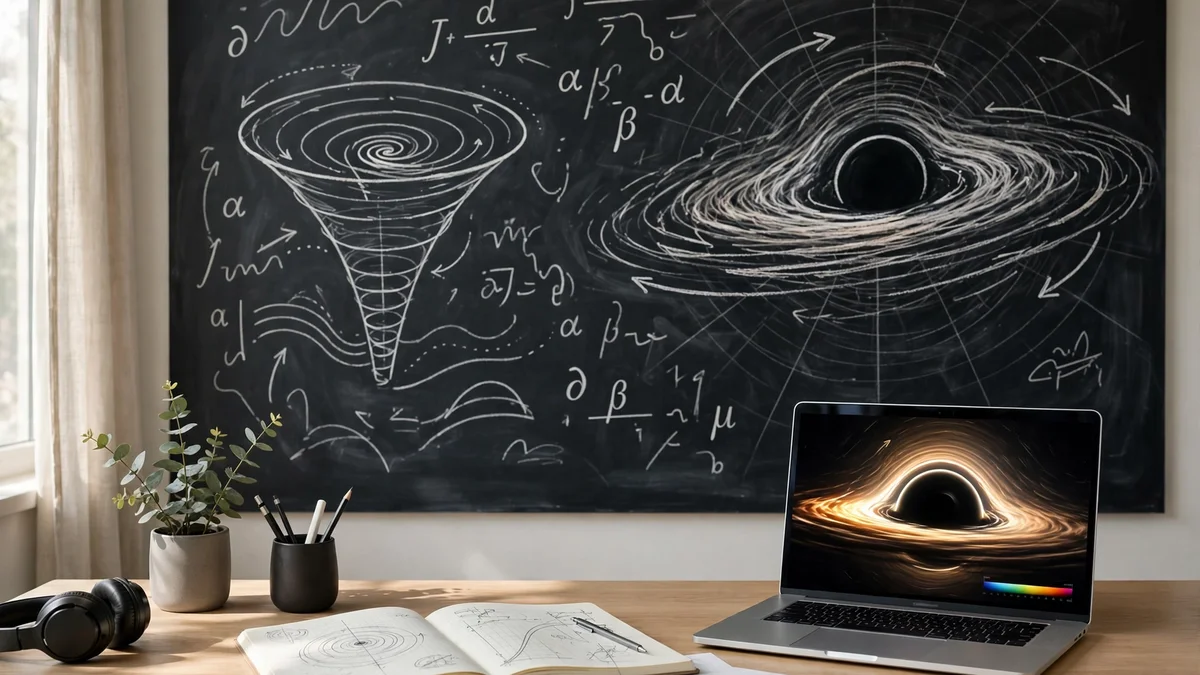
The clearest marker so far arrived on 7 November 2026, when a paper on the weakly coupled Hawking-Page transition appeared on the Hexagon research platform. Its unusual feature was the author list: a single name, Claude, the AI system built by Anthropic. According to the account of the work, a physicist first set out the problem, and Claude then organised much of the research itself, directing several AI agents working at the same time.
The Hawking-Page transition describes how a black hole in a particular theoretical setting can switch between states, much as water turns to steam. Stephen Hawking first explored the idea decades ago, and the weakly coupled version of the problem, where the interactions between particles are faint, had resisted a full solution for more than twenty years. Human researchers had identified the calculation that needed doing and announced it, then left it unfinished because they could not complete it.
Claude’s reported result was negative: in the regime studied, the transition keeps its abrupt character even when interactions are weak. That matters because it shows the gravitational description of the system and the quantum description agreeing at both ends of the range examined. The calculation also recovered states matching those in the gravitational picture, including a state linked to radiation, one linked to a large black hole, and an intermediate state linked to a small, unstable black hole.
The episode also carried a warning. Analysis of the work found that two programs involved in the effort had not made arithmetic mistakes at all. They had correctly calculated a theory that was not the one they were supposed to be studying. A machine can do the sums perfectly while answering the wrong question, which means verification has to cover the set-up, the assumptions, and the mathematical structures used, not only the final numbers.
Whether the Hawking-Page paper has passed independent peer review is unconfirmed, and that distinction matters. A platform posting is not the same as a refereed result, and the physics community will judge the work on whether other researchers can reproduce and check it. What is confirmed is that the paper exists, that it claims an AI-led solution to a long-open calculation, and that it has forced a serious conversation about authorship and credit in science.
Benchmarks back up the anecdotes. CritPt, built by more than fifty physicists from unpublished research problems, found the best model, GPT-5 at its highest setting, managed just 4.0 percent accuracy in 2025, rising to around 10 percent with coding tools. A year later, the latest models reached about 32 percent, which means they still fail roughly 70 percent of research-level tasks.
Why it matters
The reason this moment feels different is that theoretical physics has always been defined by the calculation itself. A theorist’s core skill was the ability to carry a long, intricate derivation from a set of assumptions to a testable prediction. If machines can now do a large share of that work, the profession has to decide what a theorist is for. The debate is no longer abstract, because the examples above show machines completing calculations that humans had set aside as too hard.
Harvard theoretical physicist Matthew Schwartz put the provocative case at the American Physical Society’s Global Physics Summit in Denver, in a session on navigating the AI revolution and future-proofing science careers. He predicted that large language models will surpass human intelligence within five years, pointing to the roughly tenfold annual growth in model capacity against human ability that barely changes. Machines, he noted, can visualise higher-dimensional spaces, hold far more information in memory, and process more complex equations than any person. His summary was blunt: if physicists use AI augmentation, they could get ten thousand Einsteins a century instead of one.
The opposing view came in the same session from Matthew Ginsberg of Google DeepMind, speaking in a personal capacity. He disagreed sharply with the idea that AI will eat away at physics, arguing that asking questions is the essence of being a good physicist and that this remains entirely human territory. Language models, he said, generate the consensus response to hard questions, while the best physicist is the one who gives the not-consensus answer, which AI cannot do. His conclusion was hopeful: physicists still have a role to play, and it is built on creativity and judgment rather than raw calculation.
Both views capture part of the truth, and the evidence supports a middle path. A 2024 perspective in Nature Reviews Physics concluded that theorists are unlikely to be replaced by AI in the near future, while human expertise combined with AI will become increasingly common. The same logic applies to the benchmarks: a system that solves a third of research problems is a powerful collaborator and a poor replacement. The physicist who can frame a problem, spot a wrong assumption, and explain what a result means still has work that no model can do alone.
The change also reaches into how physics works as a job. Cheaper AI tools threaten postdoctoral positions, and AI could flood the literature with lower-quality papers, so journals and funding agencies will need new ways to judge contributions. The DeepMind Gemini 4 work on quantum algorithms shows how quickly AI capability is advancing in neighbouring fields, and physics will feel the same pressure.
What’s next
There is also the question of what counts as a discovery. If a machine finds a result and a human explains it, the discovery belongs to both in some sense, but science has always rewarded the explanation as much as the calculation. The theorists who thrive in this new setting will be the ones who treat AI as a powerful instrument rather than a rival or a shortcut, much as biologists now use AI for protein design. The need to check AI-generated output carefully applies just as much to equations as it does to images, and the habit of verification will separate serious work from noise.
AI and theoretical physics at a glance
| Detail | What is known |
|---|---|
| The Hawking-Page paper | Posted 7 November 2026 on Hexagon, with Claude listed as sole author; peer review status unconfirmed |
| The problem solved | Weakly coupled Hawking-Page transition, open for more than twenty years |
| The result | Transition stays abrupt even at weak coupling; states match the gravitational description |
| The Navier-Stokes proof | Internal OpenAI model, 88 hours, 5 September 2026; independent verification still needed |
| CritPt benchmark | Best models rose from about 4 percent to roughly 32 percent accuracy in a year |
| What AI still fails | Roughly 70 percent of research-level physics tasks in the benchmark |
| The optimistic case | Matthew Schwartz of Harvard: models pass human intelligence within five years |
| The sceptical case | Matthew Ginsberg of Google DeepMind: asking good questions stays entirely human |
Checklist: judging AI physics claims honestly
- Check whether the result has passed peer review or only appeared on a preprint or research platform.
- Look for independent reproduction by a separate group before treating a claim as settled.
- Ask whether the model solved the intended problem or a different theory by mistake.
- Separate the calculation from the interpretation, and judge each on its own merits.
- Weigh benchmark scores against real research tasks, not only against problems designed for testing.
- Watch for who takes responsibility for the result when an AI system is listed as an author.
Frequently asked questions
Has AI really solved a physics problem humans could not?
According to the account of the Hawking-Page work, yes in one specific sense: a calculation humans had identified and left unfinished was completed with Claude organising the research. It still needs peer review and independent reproduction before the community treats it as settled.
What is the Hawking-Page transition?
It describes how a black hole in a particular theoretical setting switches between states, similar to water turning to steam. The weakly coupled version, where particle interactions are faint, had stayed unsolved for more than twenty years.
Will AI replace theoretical physicists?
The evidence points to reshaping rather than replacement. A 2024 perspective in Nature Reviews Physics found theorists unlikely to be replaced in the near future, and the best models still fail about 70 percent of research-level benchmark tasks. The human role is shifting toward questions, checks, and interpretation.
How good are AI models at physics right now?
On the CritPt benchmark of unpublished research problems, the best models reached about 32 percent accuracy, up from about 4 percent a year earlier. That is rapid progress, but it leaves most hard problems unsolved by machines alone.
Why does verification matter so much for AI physics?
Because a machine can calculate the wrong theory correctly. In the Hawking-Page work, programs correctly solved a theory that was not the one under study. Checking the set-up and assumptions matters as much as checking the arithmetic.
What should physics students do differently now?
Learn to frame problems, verify machine output, and interpret results, alongside the traditional mathematics. Directing an AI system and spotting when it has gone astray is becoming as valuable as carrying out a long calculation by hand.
The bottom line
AI has crossed a line in theoretical physics: it is no longer only a tool for crunching numbers, but a system that can organise research and complete calculations humans had set aside. The Hawking-Page paper and the Navier-Stokes proof, whatever their final verification status, show what is now possible. The benchmarks show the same trend in numbers, with accuracy climbing fast from a low base.
Yet the job of the theoretical physicist is not disappearing; it is changing shape. The calculation is becoming the machine’s work, while the question, the check, and the explanation remain human. Physicists who learn to work with that division of labour will do more science, faster, than ever before. Those who ignore it will find the field moving on without them.