
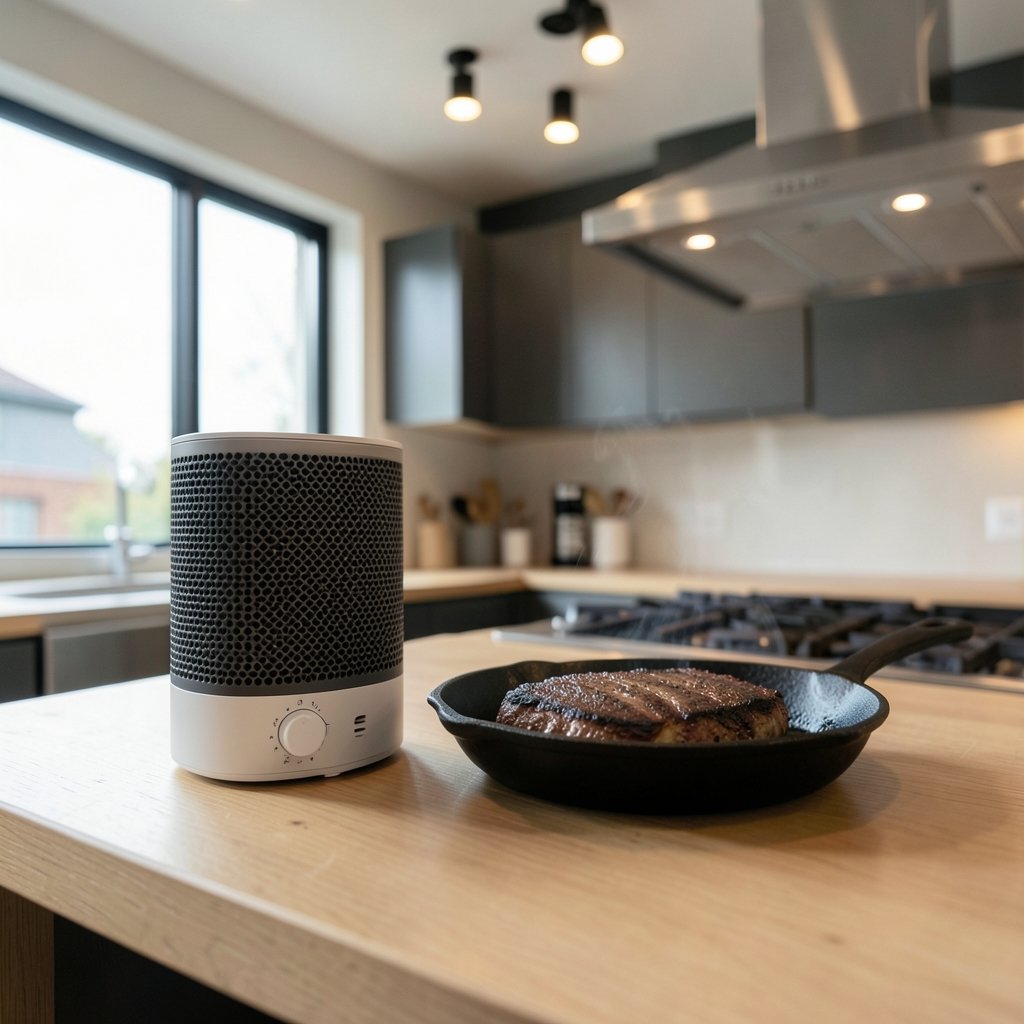
Ever seared a steak and noticed the smell still hanging around two days later? You are not imagining it. Cooking produces a complex cloud of gases and fine particles that drifts through open-plan kitchens, settles into curtains, and reappears every time the heating clicks on. An air purifier can help, but only if it is built for the job. Most units on store shelves are designed for dust, pollen, and pet dander, not the aldehydes, sulfur compounds, and grease aerosols that come off a hot pan. This guide explains what works, what does not, and how to choose a machine that genuinely tackles kitchen odor.
Why cooking smells are harder to remove than dust
Cooking emissions come in two forms, and they behave very differently. The first is particulate matter: tiny droplets of oil and smoke, often in the PM2.5 range. The second is gas-phase pollution: volatile organic compounds (VOCs), aldehydes, and sulfur-based molecules that carry the actual smell. A filter that captures particles will not touch the gases, and a filter that absorbs gases will not stop grease from clogging it.
That distinction is the single most common mistake people make. They buy a high-CADR purifier with a thin carbon pre-filter, run it during cooking, and wonder why the kitchen still smells like fried fish an hour later. HEPA media is excellent at particles but essentially useless against odor molecules. Odor removal is a chemistry problem, and chemistry requires adsorbent media, usually activated carbon or a specially treated carbon blend.
There is another wrinkle: grease. Kitchen aerosol is sticky. It coats fan blades, clogs filter pleats, and shortens the life of every component downstream. This is why dedicated kitchen air cleaners often include washable metal pre-filters, and why general-purpose bedroom purifiers age badly when placed next to a stove.
The real hero is ventilation, not filtration
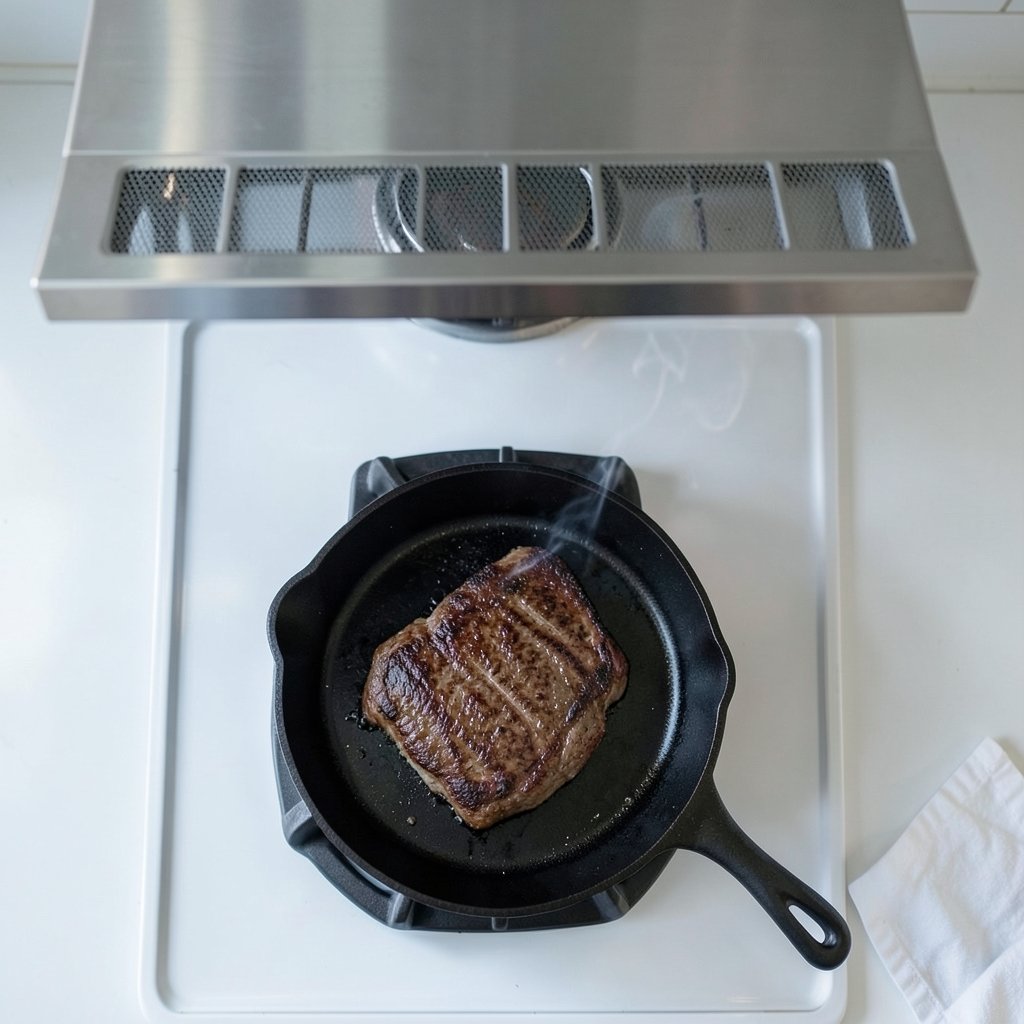
Before spending money on a purifier, it is worth being honest about priorities. A vented range hood captures smoke, moisture, and odor at the source, before they ever spread into the room. Source capture is always more efficient than diluting the whole kitchen and then filtering it. A hood that actually vents outdoors, sized correctly for the stove and ducted with minimal bends, does more for cooking odor than any plug-in device.
Recirculating hoods are a different story. They pass air through a carbon or mesh filter and blow it back into the room. They help with grease and some odor, but their carbon filters are small and saturate quickly. If a recirculating hood is the only option, plan to replace its filter far more often than the manual suggests.
So where does a purifier fit? It is the second line of defense. It handles what the hood misses: odors that escape during plating, smells from ovens, air fryers, and slow cookers that run for hours, and lingering traces in adjacent rooms. In homes without any hood, or with a hood that vents poorly, a purifier becomes far more important.
What to look for in a purifier for kitchen odor
Shopping for odor control means reading specs differently than you would for allergy season. Here is what matters, in order.
| Feature | Why it matters for cooking smells | What to watch for |
|---|---|---|
| Activated carbon mass | Gas removal depends on how much adsorbent media is present | Measured in pounds or kilograms, not “carbon filter included” |
| Carbon type | Plain carbon handles many VOCs; treated blends target specific gases | Vague claims with no media weight disclosed |
| Particle CADR | Clears smoke and grease aerosol faster | High CADR with tiny carbon layer is a red flag |
| Pre-filter design | Captures grease before it ruins the main filters | Washable metal or thick disposable pre-filters |
| Airflow and room size | Odor spreads; the unit must move enough air | Match rating to actual open-plan volume |
| Noise at usable speed | You will run it during meals, when people talk | Check decibels at medium speed as well as low |
| Filter cost and availability | Carbon is consumable and needs regular replacement | Annual filter spend, stock reliability |
Carbon quantity is where most products fall short
Manufacturers love to advertise a “carbon filter” without saying how much carbon is inside. A thin impregnated fabric sheet might weigh a few ounces. A serious gas-removal canister can hold several pounds. The difference in real-world odor performance is enormous, and it is rarely reflected in the marketing copy. When a spec sheet lists media weight, treat that as a sign of confidence. When it does not, assume the carbon layer is light.
CADR tells you about smoke, not smell
CADR (Clean Air Delivery Rate) is a useful, standardized number, but it measures particle removal: smoke, dust, and pollen. It says nothing about gas-phase performance. A purifier with a sky-high CADR can still leave your kitchen smelling of garlic, because the odor molecules sail straight through the HEPA media. Use CADR to judge how quickly smoke and grease particles clear, and judge odor control separately by carbon mass and independent reviews.
Watch out for ozone
Some devices marketed for odor removal generate ozone on purpose. Ozone is a respiratory irritant, and health agencies have consistently cautioned against using ozone-generating air cleaners in occupied spaces. If a product promises to “oxidize” odors or lists ozone output as a feature, that is a reason to walk away, not a selling point. In California, air cleaning devices sold to consumers must be certified under the state’s ozone emissions regulation, which is a useful baseline check even if you live elsewhere.
Matching the purifier to your kitchen
There is no universal best unit, because kitchens differ enormously. A studio apartment with a two-burner hob has different needs than a large open-plan space where a wok hits high heat nightly.
Small apartments and open-plan living
In a studio, cooking odor travels straight into the sleeping area. Look for a purifier with a genuine carbon canister and enough airflow to cycle the whole space several times per hour. Place it between the kitchen and the rest of the room, not tucked in a corner. Running it on a higher setting for twenty minutes after cooking, then dropping to a quiet setting, works better than leaving it on low the entire time.
Heavy cooking households
If stir-frying, deep-frying, or roasting happens most days, filter life becomes the dominant cost. Budget for carbon replacement every few months, and choose a model with widely available, reasonably priced filters. A cheap unit with expensive or scarce filters is a false economy. Many people in this category pair a strong hood with a purifier and treat the purifier as insurance for the rooms the hood cannot reach.
Homes with recirculating hoods
This is the toughest scenario. The hood moves air but does not remove much gas. A purifier with substantial carbon, run continuously during and after cooking, becomes the main odor tool. Keeping windows cracked during cooking helps more than most people expect, simply because dilution is cheap.
Practical habits that make any purifier work better
Equipment is only half the story. How you cook and where you place things changes results dramatically.
- Run the hood before and after cooking. Turn it on a few minutes before the pan heats and leave it running five to ten minutes after. Odor peaks during cooking, but residual emissions keep coming off hot surfaces.
- Place the purifier in the path of the smell. Between the stove and the doorway to the rest of the home is usually better than against a far wall.
- Clean the pre-filter regularly. Grease-loaded pre-filters choke airflow and push odor past the carbon before it can be adsorbed.
- Replace carbon on schedule, not on smell. Once you can smell last night’s dinner, the carbon is already exhausted. Change it earlier than feels necessary.
- Reduce the source. Lower heat, use a splatter screen, and cover pans when possible. Less aerosol means less work for every device in the room.
- Ventilate while you cook. A cracked window or open door lowers the concentration the purifier has to handle.
A common mistake is buying an oversized purifier and running it on the lowest setting to keep it quiet. Low speed often means very little air actually passes through the carbon, so odor removal stalls. Medium speed for a shorter period beats low speed all evening. If you are also setting up a workspace nearby, the same airflow logic applies when choosing accessories like a USB-C hub for a MacBook Air — capacity and placement matter more than headline specs. (Air purifier)
How long should it take to clear cooking smells?
With a properly sized unit on a medium-to-high setting, noticeable improvement usually comes within fifteen to thirty minutes, and most lingering odor is gone within an hour or two. If smells persist for a full day, one of three things is happening: the carbon is exhausted, the unit is too small for the space, or the odor has soaked into soft furnishings and is off-gassing slowly. That last case is not a filtration failure. Textiles absorb cooking VOCs and release them over time, which is why washing curtains and cushion covers does more than running the purifier longer.
Common myths worth discarding
A few beliefs keep circulating and keep costing people money.
“HEPA removes odors.” It does not. HEPA captures particles. Odor is gas.
“Ionizers clean cooking smells.” Ionizers charge particles so they clump and settle. They do not remove gas-phase odor, and some produce ozone.
“A bigger purifier always wins.” Only if the carbon is substantial. A large HEPA filter with a token carbon layer is a particle machine, not an odor machine.
“Air fresheners solve it.” They mask odor and add their own VOCs. Fragrance plus cooking fumes is not an improvement.
Conclusion
Cooking smells are a gas problem wrapped in a particle problem, and the fix has to address both. Start with ventilation, because capturing odor at the source beats chasing it around the room. Then add an air purifier with real activated carbon mass, a washable pre-filter for grease, and enough airflow to cycle your actual space. Judge it on carbon weight and honest reviews rather than CADR alone, avoid anything that generates ozone, and replace the carbon before it gives out. Do those things and the smell of last night’s dinner will stay where it belongs: in the past.
Frequently asked questions
Do air purifiers really remove cooking smells?
Yes, but only models with meaningful activated carbon. HEPA media captures smoke and grease particles, while carbon adsorbs the gas molecules that carry odor. A purifier with a thin carbon sheet will clear the haze but leave the smell.
How much activated carbon do I need for a kitchen?
There is no universal number, but more is better and media weight is the key spec. Units that disclose several pounds of carbon generally outperform those that mention only a “carbon filter.” In heavy-cooking homes, plan on replacing carbon every few months.
Can I use a regular bedroom air purifier in the kitchen?
You can, but expect problems. Kitchen grease clogs fine filters quickly, and most bedroom units have minimal carbon. If you must, add a washable pre-filter and accept shorter filter life.
Are ozone air purifiers safe for cooking odors?
Ozone is a respiratory irritant, and health agencies advise against ozone-generating cleaners in occupied spaces. Devices that advertise ozone output as an odor solution should be avoided, especially in small kitchens.
Should I run the purifier during cooking or after?
Both. Run it during cooking to capture emissions as they are produced, then keep it on medium or high for twenty to thirty minutes afterward to clear residual gases. Running it on low all evening is usually less effective.
What if the smell comes back days later?
That usually means odor has absorbed into curtains, upholstery, and rugs and is slowly releasing. Wash or steam soft furnishings, ventilate thoroughly, and keep the purifier running at a moderate setting while the room airs out.



