
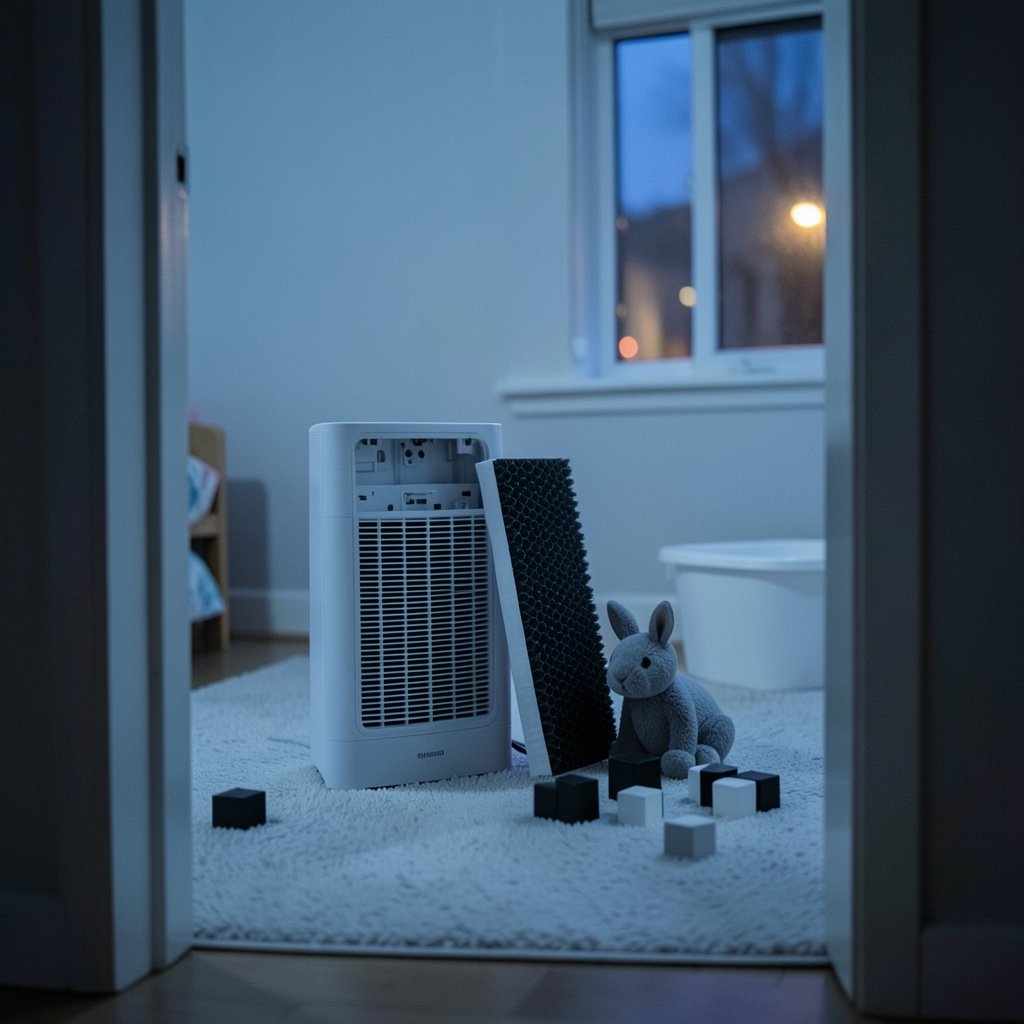
What if the air purifier you bought is fighting half the battle and you never knew it? Most people assume any filter labeled “air purifier” handles everything floating through their home. Then allergy season hits, or wildfire smoke rolls in, or a new sofa off-gasses that chemical smell for weeks, and suddenly the difference between filter types matters a lot.
The short version: HEPA filters trap particles, and activated carbon filters trap gases and odors. They are not competitors. They are teammates. But the market treats them like rivals, and that confusion costs people money. This guide breaks down how each one works, where each one fails, and how to choose without overspending.
What Each Filter Actually Does
A HEPA filter (High-Efficiency Particulate Air) is a dense mat of randomly arranged fibers. Air gets pushed through it, and particles get snagged by interception, impaction, and diffusion. HEPA-grade media is defined by capturing at least 99.97% of particles at 0.3 micrometers under standard test conditions. That covers dust, pollen, pet dander, mold spores, and most smoke particles. The Wikipedia entry on HEPA covers the history and the technical definitions if you want the deep dive. (HEPA)
An activated carbon filter works on a completely different principle. Carbon is heated to create millions of tiny pores, which gives it an enormous internal surface area. Gases and vapors stick to those surfaces through adsorption. That is how it handles volatile organic compounds (VOCs), cooking odors, pet smells, and some chemical fumes.
Here is the distinction that trips people up: HEPA does not remove gases, and carbon does not reliably remove particles. A purifier with only a HEPA filter will not touch formaldehyde. A purifier with only a carbon pad will not catch your cat’s dander. The U.S. Environmental Protection Agency’s indoor air quality guidance makes this split clear when it discusses air cleaners and what different technologies target.
How HEPA Filtration Works in Practice
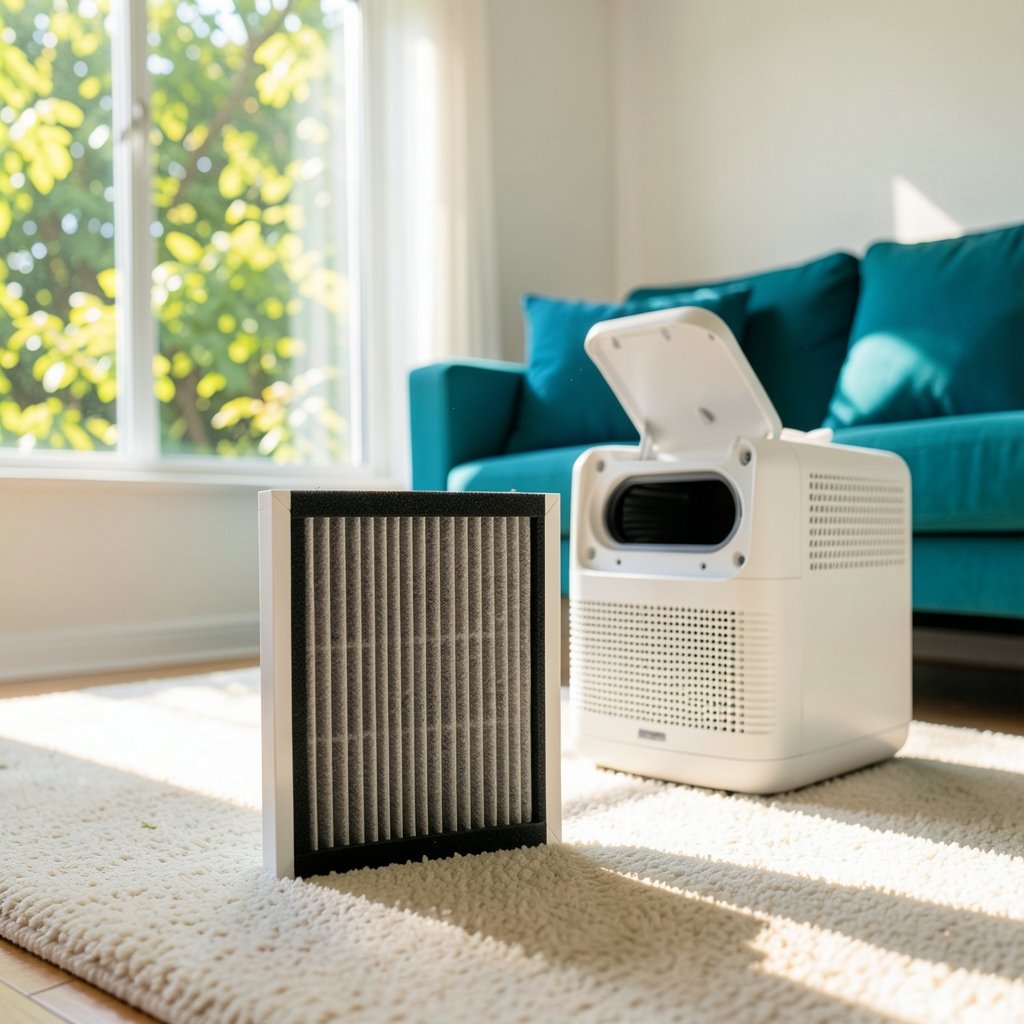
Mechanical filtration is simple and predictable. Air passes through the media, particles get caught, and the filter loads up over time. Efficiency actually improves slightly as the filter collects dust, but airflow drops, which is why manufacturers recommend replacement intervals.
What matters in practice:
- True HEPA vs “HEPA-type.” The word HEPA is not tightly regulated for consumer products in the United States. Some units labeled “HEPA-type” or “HEPA-like” do not meet the 99.97% threshold. Look for units tested to recognized standards such as IEST-RP-CC001 or EN 1822.
- Seal quality. A perfect filter in a leaky housing is a leaky filter. Air takes the path of least resistance, so gaskets and frame fit matter as much as the media itself.
- Airflow and room size. A HEPA filter that is too small for the room just churns clean air in one corner. Match the clean air delivery rate to the square footage.
- Pre-filters save money. A cheap washable pre-filter catches hair and lint so the expensive HEPA filter lasts longer. Skipping this step is one of the most common mistakes people make.
The U.S. Department of Energy maintains technical standards for HEPA filters used in critical applications, and the gap between those lab-grade specifications and consumer marketing claims is wider than most shoppers realize.
How Activated Carbon Filtration Works in Practice
Carbon is where things get murky. Unlike HEPA, there is no single universal efficiency standard for gas-phase filtration. Performance depends on three things: how much carbon is in the filter, how long the air spends in contact with it, and what it has already absorbed.
Thin carbon “pre-filter” pads in budget purifiers hold very little carbon. They handle light odors for a few weeks and then saturate. Once saturated, a carbon filter can release previously adsorbed compounds back into the air, a phenomenon called breakthrough. This is not a scam; it is chemistry. Adsorption is reversible.
What actually works:
- Check carbon weight. Manufacturers rarely disclose it, but when they do, more carbon is better. Pelletized or granular carbon in a substantial bed outperforms a sprayed-on fabric layer.
- Check dwell time. Fast airflow through a thin carbon layer means molecules do not have time to stick. A high-flow fan paired with a token carbon pad is mostly noise.
- Replace on schedule. Carbon life depends on pollutant load and humidity; hours of runtime alone do not determine it. High humidity and heavy cooking shorten it considerably.
- Ventilate while you can. Carbon is a supplement to source control and fresh air, not a replacement for either.
For a broader look at how gas-phase filtration fits into building ventilation, the ASHRAE standards on filtration and indoor air quality are the reference most engineers reach for.
Side-by-Side Comparison
| Feature | HEPA Filter | Activated Carbon Filter |
|---|---|---|
| Targets | Particles (dust, pollen, dander, smoke) | Gases, VOCs, odors, chemical fumes |
| Mechanism | Mechanical capture | Adsorption onto porous surfaces |
| Standard efficiency benchmark | 99.97% at 0.3 µm (HEPA-grade) | No single universal standard |
| Does it remove odors? | No | Yes |
| Does it remove particles? | Yes | Minimally, unless paired with a pre-filter |
| Lifespan driver | Particle loading, airflow | Pollutant load, humidity, carbon mass |
| Can it release what it captured? | Rarely, and only under unusual conditions | Yes, through breakthrough when saturated |
| Typical replacement interval | 6 to 12 months | 2 to 6 months, highly variable |
The table tells the story in one glance: these filters solve different problems. A purifier with both, arranged as pre-filter, then carbon, then HEPA, handles the widest range. That layered design is standard in serious air cleaning equipment and increasingly common in consumer units.
Common Mistakes People Make
Buying on filter count instead of filter mass. A unit advertising “four-stage filtration” may have three stages that do almost nothing. Stage count is marketing; media quality is engineering.
Assuming a carbon filter lasts a year. Many manufacturers print a yearly replacement schedule because it is convenient, not because it reflects real-world saturation. If you cook daily or live with pets, expect shorter life.
Ignoring the pre-filter. This is the cheapest component and the one most often neglected. Rinse it monthly. Your HEPA filter will thank you.
Trusting “HEPA” without a standard. Ask which test standard the filter was certified against. If the answer is vague, the claim probably is too.
Running a purifier with windows open. You are filtering the neighborhood. Close up, then run the unit.
Expecting carbon to fix a mold problem. Carbon adsorbs the musty compounds mold produces, but it does not kill mold or fix moisture. Source control comes first, always.
Matching the Filter to the Problem
The right choice depends entirely on what is bothering you.
If the issue is allergies, dust, or wildfire smoke, HEPA is the workhorse. Smoke is a hybrid problem, though: it contains both particles and gases, so a combined unit performs better than HEPA alone.
If the issue is cooking smells, new furniture off-gassing, or pet odor, carbon is doing the heavy lifting. A HEPA-only unit will not make a dent in those.
If the issue is both, which is common, buy a unit with a genuine carbon bed and a certified HEPA filter. Expect to pay more and replace filters more often. That is the honest cost of doing both jobs properly.
For context on how indoor pollutants affect health, the World Health Organization’s air quality resources document the scale of the problem globally, and household air is a significant part of that picture.
A Note on Standards and Claims
Consumer air purifier marketing runs ahead of the science. “HEPA” is often used loosely. Carbon efficiency numbers are rarely comparable across products because test conditions differ or are not disclosed at all. A unit claiming “99% VOC removal” may be quoting a test on a single compound at a concentration that never occurs in a living room.
The practical takeaway is skepticism with a purpose. Ask three questions before buying: Which standard was the HEPA filter tested to? How much carbon is in the filter, in grams? What is the recommended replacement interval, and is it based on testing or convenience? Sellers who can answer all three are usually selling a better product. For a wider look at how filtration fits into a healthy home, see OCCCY.
Conclusion
HEPA and activated carbon are not rivals, and framing them that way leads people to buy the wrong thing. HEPA is a particle specialist with a clear, testable standard. Carbon is a gas and odor specialist with real limitations and no universal benchmark. The best setups use both, in the right order, with honest replacement schedules. Know what you are trying to remove, match the filter to that problem, and treat manufacturer claims with the same skepticism you would apply to any other purchase. Clean air is worth the homework.
Frequently Asked Questions
Can I use only a HEPA filter and skip carbon?
Yes, if particles are your only concern. Dust, pollen, and dander are particle problems, and HEPA handles them well. But if you cook, have pets, or notice chemical smells, you are leaving the gas side of the problem untouched.
Do activated carbon filters remove viruses?
No, not reliably. Viruses are particles, not gases, so they fall under HEPA’s job description. Carbon adsorbs gases and vapors. Some carbon media is treated to be antimicrobial, but that is a different claim from virus removal, and the evidence is thin.
How often should I replace a carbon filter?
Filter life depends on pollutant load and humidity, not runtime alone. In a busy kitchen or a home with pets, two to three months is realistic. In a clean, low-odor home, four to six months may be fine. If odors return before the recommended interval, the filter is saturated.
Why does my air purifier still smell after replacing the filter?
Two likely culprits. First, the new carbon filter may need a few hours to settle, or it may be a thin pad that saturates fast. Second, the smell may be coming from the unit’s housing, the pre-filter, or the room itself. Clean the pre-filter and check for moisture or mold inside the unit.
Is a more expensive carbon filter always better?
Not always, but carbon mass matters more than price. A heavy pelletized carbon bed outperforms a thin sprayed-on layer regardless of brand prestige. Ask for the carbon weight in grams. Vague answers usually mean a light filter.
Can a carbon filter release trapped chemicals back into the air?
Yes. Adsorption is reversible, and a saturated filter can release previously captured compounds, especially with rising humidity or temperature. This is why replacement schedules matter. A carbon filter is a storage device, not a destruction device.
What about ozone generators? Some devices marketed as “air purifiers” produce ozone intentionally. Ozone is a respiratory irritant, not a cleaning agent, and health agencies advise against using it in occupied spaces. If a unit advertises “activated oxygen” or “ionization plus oxidation,” read the fine print carefully. HEPA and carbon remove pollutants; ozone generators add one.
Does a bigger filter always mean better performance? Filter volume helps, but only if air actually passes through it. A large carbon bed behind a weak fan does little, and an oversized HEPA filter on an undersized motor just starves the airflow. The system has to be matched: fan, media, and housing working together. That is why reputable manufacturers publish clean air delivery rates rather than filter dimensions alone.
The bottom line on maintenance. Every filter is a consumable, and every consumable has a real cost. Budget for replacements before you buy, not after. A purifier that runs on a saturated filter is furniture with a fan.



