
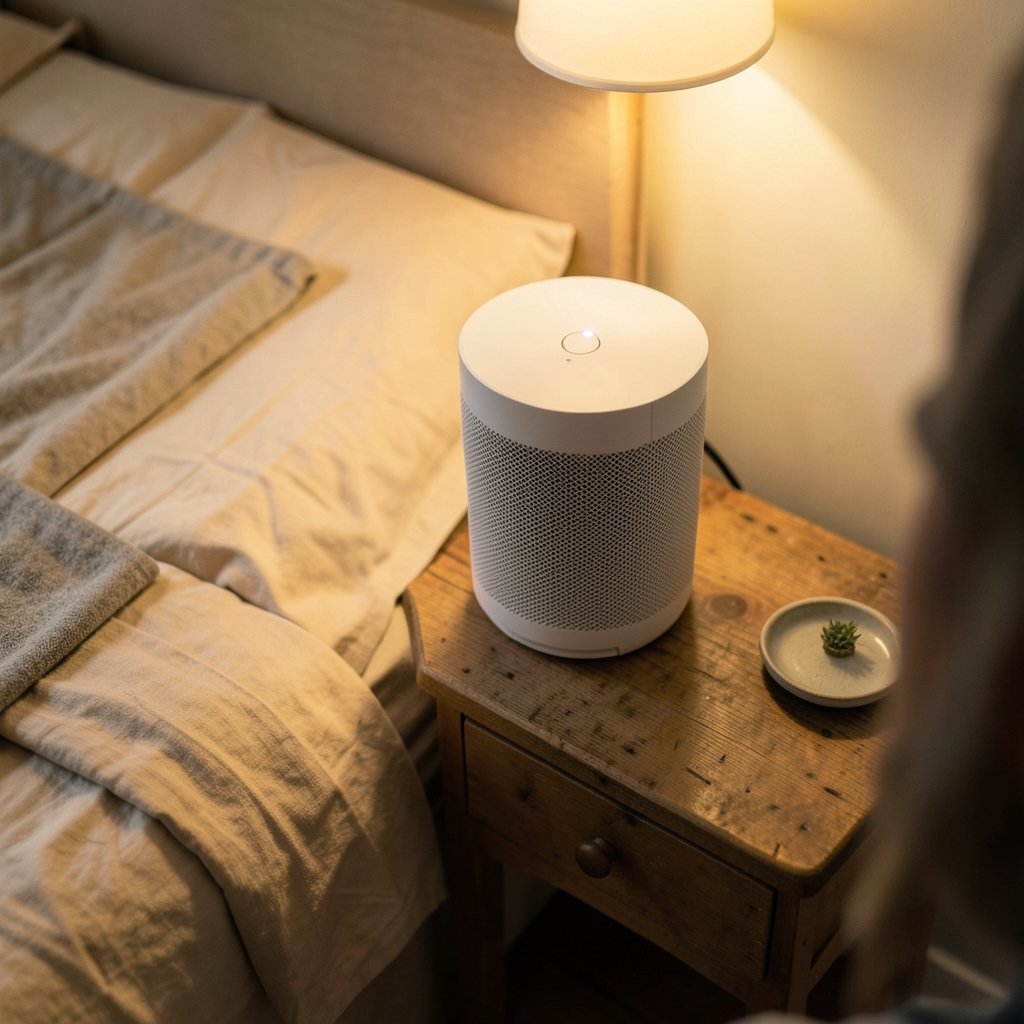
Can a machine the size of a wastebasket really clean the air in a 100-square-foot bedroom, or is that just clever marketing? The answer depends far less on brand hype than on three unglamorous numbers: CADR, decibels, and filter cost. Get those right and a compact purifier can quietly transform how a small bedroom feels. Get them wrong and you end up with a noisy box that eats filters and barely moves air. (Air purifier)
This guide cuts through the spec-sheet fog. It covers sizing math, the noise tradeoff nobody mentions in ads, ozone concerns, placement mistakes, and the maintenance habits that separate a purifier that lasts from one that dies in eighteen months.
Why Small Bedrooms Are a Different Buying Problem
A bedroom is not a living room with a bed in it. It is a room where you spend seven or eight hours motionless, breathing air that has had all night to accumulate whatever is in it. Dust mites, pet dander, pollen tracked in on clothes, and fumes from paint or furniture all concentrate in a small, often poorly ventilated space.
That cuts both ways. A small room is easier to clean, so a modest purifier can achieve a high number of air changes per hour (ACH). But small rooms also punish bad placement. A unit wedged behind a nightstand or buried in curtains is recirculating its own exhaust. In tight quarters, six inches of clearance matters more than an extra 50 CADR on the box.
There is also a budget angle. Small bedrooms often sit in apartments, guest rooms, or shared houses where the purifier has to coexist with a bed, a dresser, and a door that swings. Footprint and cord length become real specs, not afterthoughts.
The Sizing Rule That Prevents Most Bad Purchases
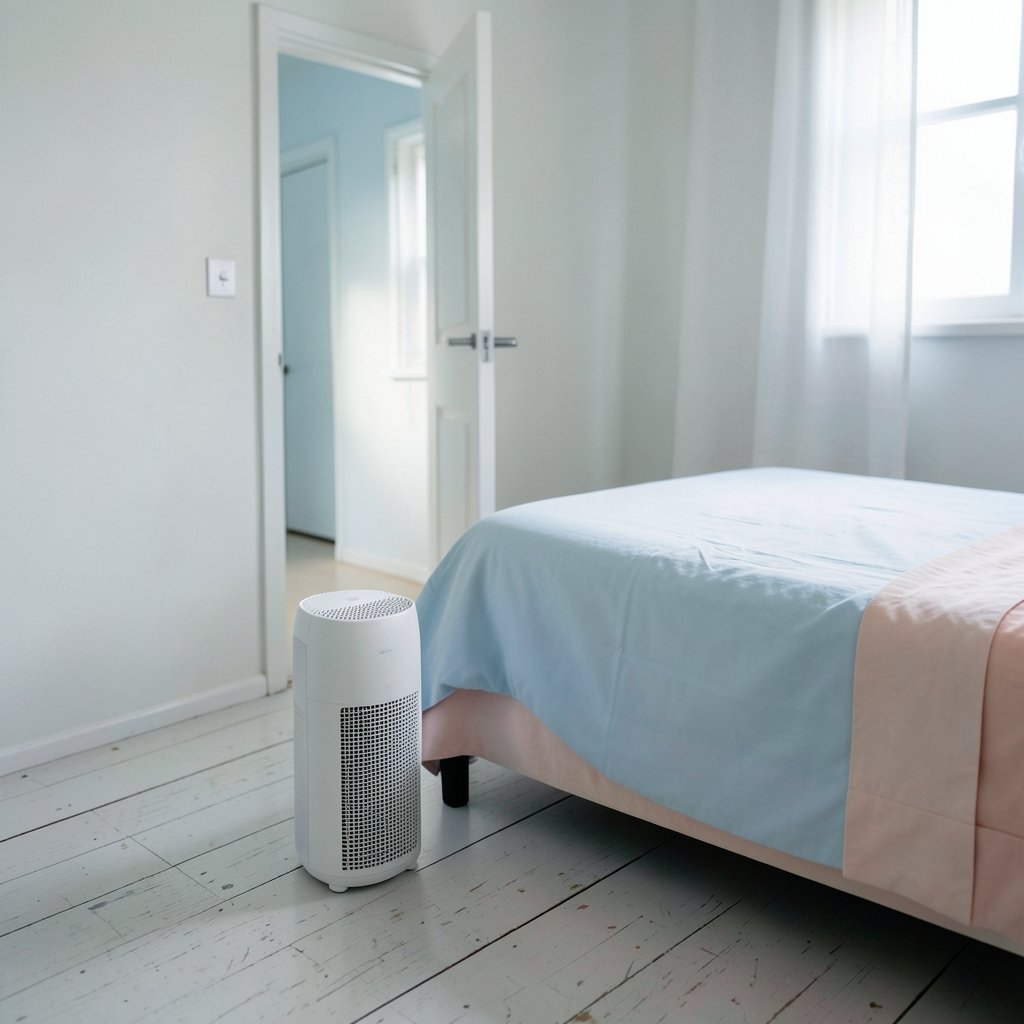
The most useful heuristic in the category: match the purifier’s smoke CADR to the room’s square footage, assuming a standard ceiling height of about eight feet. A 100-square-foot bedroom pairs with a CADR around 100. A 150-square-foot room wants roughly 150.
This is a rule of thumb, not a law of physics, and different sources frame it differently. Some manufacturers recommend more headroom, especially for allergy sufferers or rooms with pets. Treat the number as a floor, not a ceiling.
| Room Size | Minimum Smoke CADR | Realistic Use Case |
|---|---|---|
| 80–100 sq ft | 80–100 | Nursery, guest room, small apartment bedroom |
| 100–150 sq ft | 100–150 | Standard primary bedroom |
| 150–200 sq ft | 150–200 | Primary bedroom with a pet |
| 200+ sq ft | 200+ | Large bedroom or open loft sleeping area |
Two caveats matter. First, CADR is measured on high speed. A unit rated at 150 CADR might deliver 60 on its quiet setting, which is the setting you will actually sleep with. Look for the CADR at the noise level you can tolerate, or accept that the headline number is a best-case figure.
Second, open doors change everything. A bedroom with the door open all night is effectively part of a larger volume, so a purifier sized for the bedroom alone will underperform. If air flows freely into a hallway, size up.
Noise: The Spec That Decides Whether You Keep the Unit
Here is the pattern that shows up again and again in owner reviews: people buy on CADR, then return on noise. Many purifiers run at 40 to 60 decibels or more on high. Sleep-friendly operation generally means staying under about 30 to 35 decibels, roughly the sound of a quiet refrigerator hum.
The trap is that noise ratings are not standardized across manufacturers. Some publish sound power, some publish sound pressure measured at a specific distance, and some publish nothing useful at all. A “24 dB” claim on one box and a “24 dB” claim on another may describe very different experiences.
Practical advice that actually works:
- Read independent noise measurements rather than relying only on the box.
- Check whether the quiet mode still moves enough air, or whether it is essentially a fan pointed at nothing.
- Look for a night mode that dims or turns off display lights, since a bright LED in a dark bedroom is its own annoyance.
- Consider a unit with a sleep timer so it does not run at full speed all night.
If you are already optimizing a small space with limited outlets and cable clutter, the same discipline applies here: fewer, better-chosen devices beat a pile of compromises. That logic runs through guides like best soundbars for small living rooms, where footprint and placement decide the outcome as much as raw specs.
HEPA, HEPA-Type, and the Ozone Question
True HEPA filtration captures at least 99.97 percent of particles at 0.3 microns. That is the benchmark worth paying for. The phrase “HEPA-type” or “HEPA-like” is a marketing term with no fixed definition and should be treated with suspicion.
Then there is ozone. Some purifiers include ionizers or plasma features that intentionally generate charged particles. These can produce ozone as a byproduct, and ozone is a respiratory irritant. The safest approach for a bedroom, where you are breathing the air for hours on end, is to choose a unit with no ionizer, or one where the ionizer can be switched off permanently rather than resetting to “on” every time the unit powers up.
For anyone with asthma or chemical sensitivity, this is not a minor detail. A purifier that cleans particles while adding irritants is a net loss.
Filter Costs: The Expense That Sneaks Up
Replacement filters typically run somewhere in the range of 30 to 100 dollars or more per year, depending on the unit and how hard it works. In a small bedroom, a compact purifier’s smaller filter has to process the same air volume, so it can clog faster than a larger unit’s filter would. (Air Cleaners and Air Filters in the Home)
Before buying, check three things:
- Availability. Is the filter sold by the manufacturer directly, or only through third-party sellers who may vanish?
- Price per replacement. Multiply by expected replacements per year.
- Washable vs. disposable. Washable pre-filters are genuinely useful; washable “main” filters are usually a compromise.
A cheap purifier with expensive, hard-to-find filters is not cheap. It is a subscription with a fan attached. The same total-cost-of-ownership thinking applies to small business purchases, as covered in this breakdown of best small business accounting software — the sticker price is rarely the real number.
Placement Mistakes That Undo Good Specs
Small rooms leave little room for error. The most common placement mistakes:
Blocking the intake. Purifiers pull air from the back or sides. Pushed against a wall or behind a curtain, the unit starves. Give it several inches of clearance on all intake sides.
Putting it in a corner. Corners create dead zones. A spot along a wall, roughly centered, moves air more evenly.
Placing it directly beside the bed. Tempting for white noise, but the exhaust blows straight at your face. A few feet away is usually better.
Ignoring the door. If the bedroom door stays open, the purifier is fighting the whole house. If it stays closed, the unit works far more efficiently.
Forgetting the ceiling fan or HVAC. A ceiling fan on low helps distribute cleaned air. A closed HVAC vent in the bedroom means the purifier is the only air mover in the room.
Energy Use and Running Costs
Most bedroom-sized HEPA units draw roughly 20 to 60 watts on low to medium settings. Run eight hours a night at 40 watts, and the electricity cost is trivial in most markets, often a few dollars a month. The bigger running cost is filters, not power.
That said, running a purifier at maximum speed 24/7 shortens filter life and adds noise for no benefit. A common, sensible pattern: high speed for an hour before bed to scrub the room, then low or auto mode overnight. Some units include air-quality sensors that automate this, though sensors vary widely in accuracy and can be fooled by humidity or aerosols.
Matching the Purifier to Your Actual Bedroom
A few scenarios worth thinking through before checkout:
The allergy sufferer. Prioritize true HEPA, high CADR relative to room size, and a sealed filter housing. Skip ionizers entirely.
The light sleeper. Noise and light matter more than CADR. Look for sub-30 dB operation, a display-off mode, and no clicking relays.
The pet owner. Dander and hair load filters fast. A washable pre-filter is close to mandatory, and sizing up one tier is wise.
The small-apartment dweller. Footprint and cord management matter. A unit that fits on a dresser beats a superior unit that lives in the closet.
The budget buyer. A mid-priced unit with cheap, available filters usually beats a discounted premium unit with 80-dollar replacements.
If you are outfitting a compact living space more broadly, the same “measure the room first” principle shows up in guides like best small camper vans, where every inch and every watt has to earn its place.
Conclusion
The best air purifier for a small bedroom is not the one with the biggest number on the box. It is the one whose CADR matches the room, whose noise level disappears at night, whose filters are cheap and easy to find, and which sits somewhere it can actually breathe. Nail those four things and a modest, unglamorous unit will outperform a flagship shoved into a corner. Small rooms reward precision over power, and a bedroom rewards quiet over everything.
Frequently Asked Questions
How big a purifier do I need for a 100-square-foot bedroom?
Aim for a smoke CADR around 100 as a starting point, based on the common rule of matching CADR to square footage at standard ceiling height. If the door stays open, if there are pets, or if someone in the room has allergies, size up one tier. Also check the CADR at the noise level you can sleep through, since headline figures are usually measured on high speed.
Is a HEPA purifier worth it for a small bedroom?
Yes, if the goal is reducing particles like dust, pollen, and pet dander. True HEPA filtration captures at least 99.97 percent of particles at 0.3 microns, and a small room is easy to clean thoroughly. The caveat is that HEPA does little for odors and gases, which require activated carbon, and it does nothing for a room with no air movement and a blocked intake.
How loud is too loud for a bedroom purifier?
Under roughly 30 to 35 decibels is the sleep-friendly zone, comparable to a quiet refrigerator. Many units hit 40 to 60 decibels or more on high. Since noise ratings are measured inconsistently across brands, cross-check independent measurements rather than trusting the box, and confirm that the quiet mode still moves enough air.
Do air purifiers with ionizers produce ozone?
Some do. Ionizers and plasma features can generate ozone as a byproduct, and ozone is a respiratory irritant. For a bedroom, where you breathe the air for hours, the safer choice is a unit with no ionizer or one where the ionizer can be permanently disabled rather than resetting on each power cycle.
How often should I replace the filter in a bedroom purifier?
It depends on the unit, the filter size, and how hard it runs, but most manufacturers suggest every six to twelve months. Small purifiers in small rooms can clog faster because the filter is compact. Check filter price and availability before buying, since replacements often cost 30 to 100 dollars or more per year.
Where should I put an air purifier in a small bedroom?
Along a wall, roughly centered, with several inches of clearance on every intake side. Avoid corners, avoid tucking it behind curtains or furniture, and avoid pointing the exhaust directly at the pillow. If the door stays closed at night, the unit works far more efficiently than if it is fighting the air volume of the whole house.



