
What happens when a chipmaker buys a spatial-intelligence startup, a programmable-logic giant, and an AI server builder within a few years of each other? The short answer is that three very different kinds of work land on the same desk. The longer answer is what this article is about. Anyone planning hardware, AI or infrastructure projects for 2027 needs to understand that these deals are not interchangeable, even when headlines lump them together under one company name.
One caution before going further. The phrase “AMD World Labs deal” circulates widely, but no confirmed transaction between AMD and World Labs appears in public records available at the time of writing. Treat any claim that it has closed as unverified. The comparison below separates what is documented from what is speculation, then shows how the workflow lessons differ.
Why These Three Deals Get Confused
All three stories share the same ingredients: AMD, a large sum of money, and a promise about artificial intelligence. That is roughly where the similarity ends.
The Xilinx acquisition was announced in October 2020 and completed in February 2022 as an all-stock deal valued at roughly $49 billion when announced. Xilinx built field-programmable gate arrays, or FPGAs, which are chips that customers can reprogram after manufacturing.
The ZT Systems agreement was announced in August 2024. ZT Systems designs and integrates AI servers and racks. AMD said at the time that it intended to divest the manufacturing portion of that business and keep the design and integration work.
World Labs is a startup focused on spatial intelligence, the idea that machines should reason about three-dimensional space rather than only text. It is associated with Fei-Fei Li. Whether AMD has any deal with it is not established by public documentation.
That difference matters because each deal changes a different part of the working day. One changes how silicon is designed and sold. One changes how systems are assembled and shipped. One, if it happens at all, would change how models understand the physical world.
The Workflow Differences at a Glance

| Dimension | Xilinx (FPGA) | ZT Systems (AI servers) | World Labs (spatial AI) |
|---|---|---|---|
| Core work | Chip design, EDA tooling, IP cores | Rack integration, thermal and power design | 3D perception, world models, simulation |
| Typical customer | Industrial, automotive, telecom, defense | Cloud providers, AI labs, enterprises | Research groups, robotics, simulation teams |
| Main constraint | Timing closure and tool licensing | Supply of accelerators and power at the site | Data quality and compute for training |
| Release rhythm | Multi-year silicon and tool cycles | Quarterly to annual platform refreshes | Rapid model iteration |
| Skill that transfers | Digital design and verification | Systems engineering and logistics | Computer vision and graphics |
Read that table as a warning. A team that is good at one row is not automatically good at another. The mistake people make is assuming “AMD hardware” means one workflow. It does not.
Workflow One: Designing Around FPGAs
The Xilinx workflow is the oldest and the most stubborn. Engineers write hardware descriptions in languages like Verilog or VHDL, synthesize them into a netlist, then place and route the logic onto a specific device. Timing closure is the recurring bottleneck. A design that simulates perfectly can still fail because signals arrive a few nanoseconds late.
In practice, three habits separate teams that ship from teams that stall:
- Lock the target device early. Changing part numbers late forces a full re-run of place and route.
- Budget for tool licenses and compute. Synthesis and simulation farms are expensive and often underestimated.
- Version-control the constraints file as carefully as the source code. Pin assignments and clock definitions cause more silent failures than logic bugs.
The 2027 twist is that FPGAs are increasingly paired with fixed-function AI accelerators. That means design teams now need to understand both reprogrammable logic and compiled model pipelines. The FPGA does not disappear; it becomes the glue around the accelerator. For a broader look at how compiled systems behave in production, the patterns in this breakdown of real world examples digital twins 7 working systems you can show how simulation and live data get stitched together, which is close to the problem FPGA teams now face.
Workflow Two: Integrating AI Servers at Scale
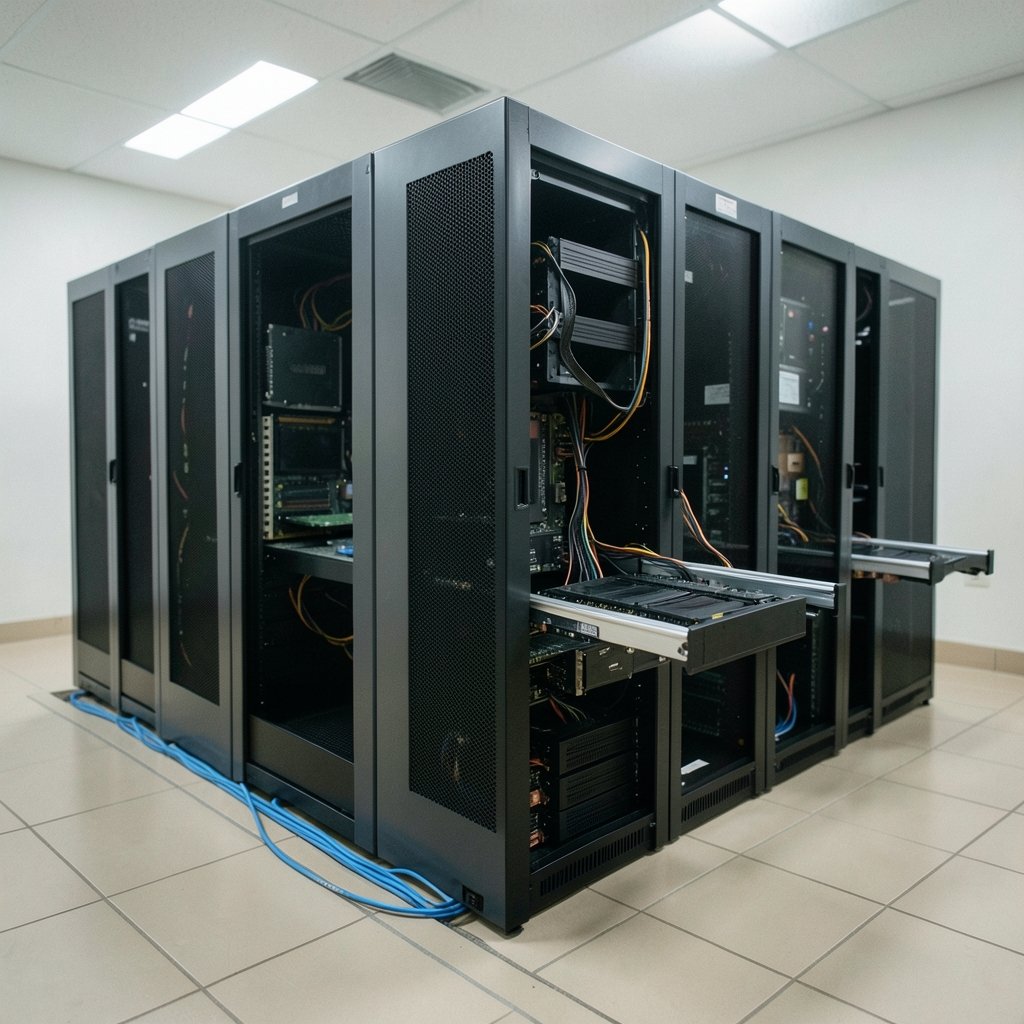
The ZT Systems workflow looks nothing like chip design. Here the unit of work is the rack, not the transistor. Teams juggle power delivery, liquid cooling, cabling, firmware baselines and burn-in testing. A single rack can draw enough power to strain a building’s electrical service, so facility engineers become part of the project.
What actually works in practice:
- Standardize the bill of materials before the first rack ships. Custom cabling per customer destroys margin.
- Test thermal behavior under sustained load, not idle. Many integration failures appear only after hours of full utilization.
- Keep firmware versions identical across a deployment. Mixed baselines create support nightmares that look like hardware faults.
The common mistake is treating integration as assembly. It is closer to manufacturing engineering. Every change to a rack design ripples through procurement, testing and field support. Teams that plan for that ripple ship on time; teams that do not spend the first quarter of every deployment firefighting.
The other practical issue is power. AI racks are constrained less by silicon than by megawatts. Sites that assumed they could scale by ordering more servers discover the limit is the substation. Planning for 2027 means planning the electrical envelope first and the hardware second.
Workflow Three: Building Spatial Intelligence
If a World Labs-style collaboration were to happen, the workflow would center on 3D data. Spatial models learn from depth sensors, camera arrays, lidar and synthetic scenes. The pipeline involves capture, cleaning, annotation, training and evaluation in simulated environments.
Three differences stand out compared with the other two workflows:
- Data is the bottleneck, not the chip. Collecting high-quality 3D scenes is slow and expensive.
- Evaluation is harder. There is no simple accuracy number for “understands a room.” Teams build custom benchmarks.
- Iteration is fast. Models retrain in days or weeks, not the years a silicon design takes.
This is why spatial AI teams and hardware teams often talk past each other. The AI team wants flexible compute and fast feedback. The hardware team wants stable specifications and long qualification cycles. Bridging that gap is a management problem as much as a technical one.
Where the Workflows Collide in 2027
Three pressure points will define planning for the next few years.
Tooling fragmentation. FPGA teams live in vendor-specific design suites. Server teams live in orchestration and firmware tools. Spatial AI teams live in machine-learning frameworks. Unifying them is not realistic, so the practical answer is clear interfaces between them rather than one mega-toolchain.
Security across the stack. Every layer added to a system is another attack surface. The patterns in these multi factor authentication examples 12 real world setups are a reminder that identity controls must extend to firmware and management interfaces beyond user logins. A compromised baseboard controller can undo a great chip design.
Legacy drag. Acquired products rarely arrive clean. Older toolchains, undocumented build steps and orphaned scripts slow every integration. The lessons in this piece on how application modernization actually works when legacy systems apply directly: inventory first, then replace in slices, never in one heroic rewrite.
A useful analogy comes from another domain entirely. Comparing Spain vs Cabo Verde: Key Differences & Surprising Ties – occcy shows how two places with shared history still operate on different rhythms. Corporate acquisitions behave the same way. Shared ownership does not create shared calendars.
Practical Planning Advice for Teams
If a team expects to work across these product lines, the following sequence tends to work better than jumping straight to architecture diagrams.
- Map which workflow each deliverable depends on. Label every task as chip, rack or model.
- Assign an owner per workflow. One person cannot be expert in timing closure and thermal design.
- Set interface contracts early. Define how firmware, models and hardware hand off data.
- Run a small pilot before committing budget. One rack, one FPGA board, one model pipeline.
- Revisit assumptions quarterly. Supply chains and roadmaps move faster than annual plans.
The most common failure is organizational, not technical. Companies merge purchasing departments and assume engineering will follow. It rarely does without deliberate effort.
How to Verify Claims Before You Plan
Because deal reporting moves quickly and headlines blur, verify before committing resources. Check primary sources: regulatory filings, official announcements and the companies’ own investor pages. If a claimed transaction has no filing and no announcement, treat it as rumor. (NIST CHIPS Program overview)
This is especially true for the AMD and World Labs question. A spatial-intelligence partnership would be significant, but significance is not evidence. Planners who build roadmaps on unconfirmed deals expose their teams to wasted quarters.
The same discipline applies to the ZT Systems manufacturing divestiture. AMD stated an intention to divest that portion of the business. Intentions and completions are different events, and the workflow implications differ depending on which has occurred.
Conclusion
The three stories teach different lessons. Xilinx is about patient silicon engineering and tool discipline. ZT Systems is about systems integration, power and logistics. World Labs, if a deal ever materializes, would be about 3D data and fast model iteration. Treating them as one “AI hardware” story hides exactly the differences that determine whether a project ships.
For 2027, the winning approach is unglamorous. Know which workflow you are actually in, staff it with people who have done that work, define clean interfaces to the other workflows, and verify every deal claim against primary sources before you spend a dollar. Curiosity about the technology is good. Confusion about which technology is expensive.
FAQ
Is there a confirmed AMD World Labs deal?
No confirmed transaction appears in public records available at the time of writing. World Labs is a real company working on spatial intelligence, and AMD has made several large acquisitions, but the two are not documented as connected. Anyone citing a closed deal should be able to point to a filing or an official announcement. Without one, treat the claim as unverified and plan accordingly.
How is the ZT Systems deal different from the Xilinx deal?
They touch different parts of the business. Xilinx brought programmable logic, design tools and a customer base in industrial and embedded markets, so the work is chip design and verification. ZT Systems brought AI server design and integration, so the work is racks, cooling, power and firmware. AMD also said it intended to divest ZT’s manufacturing operations, which adds a structural difference the Xilinx deal never had.
What is spatial intelligence, in plain terms?
It is the attempt to give machines an understanding of three-dimensional space. Instead of only processing text, a spatial model reasons about objects, distances, surfaces and how a scene changes over time. Practical uses include robotics, simulation, augmented reality and training environments. The hard part is data: capturing accurate 3D scenes at scale is slow and costly compared with collecting text.
Which workflow is hardest to integrate after an acquisition?
Most teams say the legacy software toolchain. Silicon design depends on long-qualified vendor tools, and server platforms depend on firmware baselines that are rarely documented well. Model pipelines are usually the easiest to migrate because the frameworks are open and the iteration cycle is short. The hard part is not moving code; it is preserving the undocumented knowledge that made the code work.
What should planners watch for in 2027?
Three things. First, whether announced divestitures and integrations actually complete. Second, how power availability constrains AI deployments, since electricity is now a harder limit than chip supply in many regions. Third, whether FPGA and accelerator workflows converge into a single design flow or stay separate. Each answer changes staffing, tooling budgets and timelines.
How can a small team prepare without a big budget?
Pick one workflow and go deep. A small team that masters FPGA timing closure or rack thermal testing will be more valuable than one that dabbles in all three. Use vendor documentation and public design examples, run a single pilot project end to end, and document every undocumented step you discover. That documentation becomes the team’s real asset when the next acquisition reshuffles priorities.



