
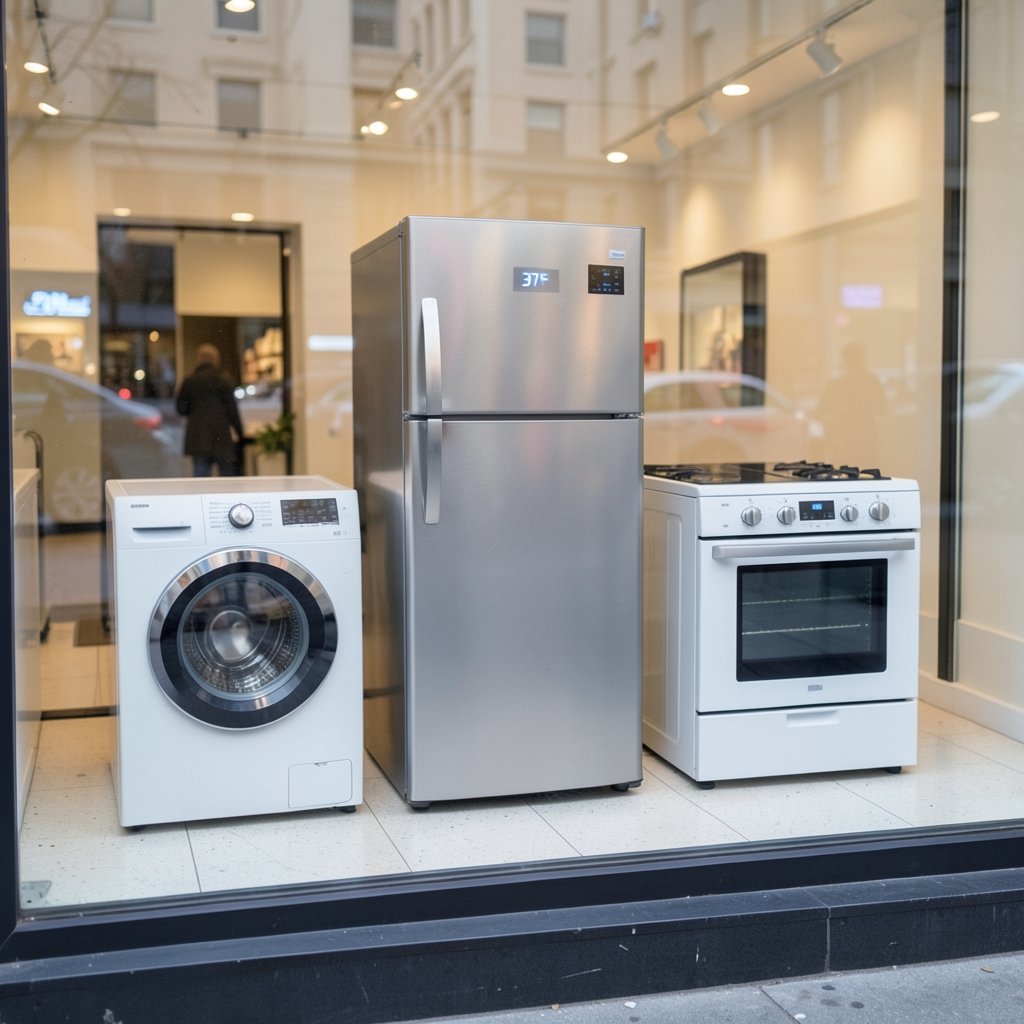
What if the appliance review you just read was written by someone who never plugged the thing in? It happens more than most shoppers realize. A “review” can be a rewritten press release, a paid placement, or a star rating farmed from people who left feedback on delivery speed rather than wash performance. That is the core problem with appliance reviews: the category is expensive, the products are hard to test, and the internet is full of confident opinions backed by very little evidence.
The good news is that a smart reading strategy fixes most of this. This guide walks through where appliance reviews come from, how the big labels and ratings actually work, what lab tests can and cannot tell you, and the mistakes that cost people money. It also covers how to read reviews for specific categories like washers, fridges, and robot vacuums, plus how to spot fake feedback before it skews your decision.
Why appliance reviews are harder to trust than phone reviews
A phone reviewer can buy a unit, use it for a week, and publish something useful. An appliance reviewer faces a much bigger problem. A refrigerator’s real test is whether it still holds temperature evenly in year seven. A washing machine’s real test is whether the drum bearing survives 2,000 cycles. Nobody films that.
So appliance reviews split into three rough types, and each answers a different question:
| Review type | What it measures | What it misses |
|---|---|---|
| Lab test | Performance under controlled conditions | Long-term durability, real-home noise |
| Owner survey | Satisfaction and failure rates over time | Standardized conditions, comparable scores |
| Sponsored or affiliate content | Nothing measurable, usually | Independence, negative findings |
Readers who confuse these three get burned. A lab test that says a dishwasher cleans well at 130°F tells you nothing about whether the control board dies in year three. An owner survey that says 78% of buyers would buy again tells you nothing about whether the machine actually cleans better than a cheaper model.
The practical fix is to read at least one of each type before buying. Lab data tells you the ceiling of performance. Owner data tells you the floor of reliability. Sponsored content tells you what the manufacturer wants you to believe, which is occasionally useful context and never a decision-maker on its own.
How the official labels fit into appliance reviews

Most appliance reviews mention Energy Star and the yellow EnergyGuide tag, but few explain what each one is for. They are not the same tool.
Energy Star is a voluntary labeling program run jointly by the EPA and the DOE. Products must meet or beat federal efficiency specifications to carry the mark, and those specifications vary by category and get revised over time. A fridge that earned the label in 2015 may not qualify today. That matters when a review quotes an old certification as if it were current.
The EnergyGuide label is different. It is required on many appliances and shows estimated annual energy use or cost, letting you compare models within the same category. It is a comparison tool, not a performance rating. A machine can be cheap to run and mediocre at its actual job. The label’s content and display are governed by the FTC’s Energy Labeling Rule, which has been amended over the years, including for online sales listings.
Federal minimum efficiency standards for major appliances are set by the DOE under a law dating to 1975, and they get updated through rulemaking. Any review claiming a product meets “current standards” needs a date attached. Standards move; reviews often don’t.
In Europe, the picture shifted too. The EU energy label was rescaled to plain A to G classes starting in 2021 for several product groups, retiring the old A+/A++/A+++ tiers. An old label and a new label are not directly comparable, and reviews that mix them create false rankings.
What lab testing can and cannot tell you
Consumer Reports is the name most US shoppers know. It is a nonprofit that buys products anonymously and accepts no advertising, which is why reviewers cite it so often. Its published methodology describes how protocols work for each category.
Lab testing is genuinely valuable, but it has limits worth understanding:
- Sample size is usually small. One or two units per model is normal. That catches design flaws, not manufacturing variance.
- Tests run under controlled conditions. A washer tested on a standard cycle in a 70°F lab may behave differently in a humid garage.
- Durability is simulated, not observed. Accelerated cycle testing is a proxy. It is a good proxy, but a proxy.
- Scores compress real differences. A model scoring 82 and one scoring 79 may be functionally identical for your household.
The takeaway is not to distrust lab reviews. It is to use them for what they are good at: ranking performance within a category and catching outright failures. Then layer owner experience on top for the long haul.
Reading owner reviews without getting fooled
Owner reviews are where appliance research gets messy. The FTC’s Endorsement Guides require reviews and endorsements to reflect honest opinions and to disclose material connections, and they were revised in 2023 to address fake and incentivized reviews. In 2024, the FTC finalized a rule banning fake or AI-generated reviews and the buying of positive or negative feedback. Enforcement exists. So does cheating.
A few habits cut through most of it:
- Filter by “verified purchase” and sort by newest. A five-star review from 2019 describes a different product revision than the one shipping now.
- Read the two- and three-star reviews first. They tend to be specific: “ice maker froze over in month four” beats “love it!” for usefulness.
- Watch for review clustering. Twenty five-star reviews posted in the same week, all mentioning the same phrase, is a pattern, not a coincidence.
- Separate delivery complaints from product complaints. Many one-star reviews are about the freight company, not the machine.
- Check whether the reviewer owns the same model number. Appliance lines reuse names across sizes and configurations.
The same skepticism applies to platform scores more broadly. If you have ever tried to reconcile a critics’ aggregate with a user score, the piece on metacritic vs opencritic vs steam reviews read each score makes a useful parallel point: each scoring system measures a different audience, and averaging them together produces noise. Appliance ratings work the same way.
And when a review platform starts paying for reviews, the whole signal degrades. The analysis of how Amazon reviews money paid reviews backfire buyers sellers lays out the mechanics clearly, and the lesson transfers directly to appliance listings on big retail sites.
Category by category: what to actually look for
Refrigerators
Reviews obsess over capacity and finish. The things that break are the ice maker, the door seal, and the compressor. Look for owner reports covering three years or more, and check whether the model uses a linear compressor, since some brands had well-documented failure patterns in specific years. Measure your doorway before you fall in love with a French-door model.
Washing machines and dryers
Front-loaders clean better and use less water; top-loaders with agitators are simpler and often more repairable. Reviews rarely mention that a washer’s real cost includes the dryer pair and the pedestal. Check spin speed and cycle time as well as capacity. A 5.0 cu ft drum that takes 90 minutes per load is not more convenient than a 4.5 cu ft drum that takes 45.
Dishwashers
Noise ratings in decibels are one of the few specs that translate almost perfectly to real life. Below 44 dB is genuinely quiet. Also check whether the model has a filter you have to clean by hand, because reviews almost never mention it and owners complain about it constantly.
Robot vacuums and small appliances
This is where review quality collapses fastest, because the products are cheap enough to buy, test for a week, and post about. Battery degradation and brush tangling only show up in long-term owner threads. For a sense of how quickly review ecosystems get gamed in low-cost product categories, the breakdown of free vpns safe use honest answer most reviews skip is a good reminder that “free” and “top-rated” often hide the real cost.
Printers
Printer reviews are a special case because the purchase price is almost irrelevant next to ink costs. A cheap printer can cost more over three years than an expensive one. The Epson ecotank et 2800 review real printing costs trade offs is a good model for how to read a printer review: ignore the sticker, follow the consumables.
The mistakes that cost shoppers the most
Most bad appliance purchases trace back to a short list of avoidable errors.
Trusting the star average alone. A 4.3-star average across 40 reviews and a 4.3 across 4,000 are different animals. Read the distribution, not the mean.
Ignoring the repair ecosystem. In the EU, ecodesign right-to-repair requirements for certain appliances took effect in 2021, covering spare parts availability and repair information. In the US, there is no equivalent blanket rule, so check whether a local technician services the brand before buying. A great machine nobody can fix is a bad machine.
Buying on day-one pricing. Appliance prices swing hard around holidays and model-year rollovers. Reviews that quote launch MSRP are often stale within weeks.
Skipping the installation cost. Haul-away, water lines, and venting can add hundreds. Reviews rarely fold this into value judgments.
Overweighting aesthetics. A fingerprint-resistant finish is nice. A reliable compressor is better.
How to build a five-source decision
A workable process looks like this:
- Shortlist two or three models by size, fuel type, and budget.
- Pull the EnergyGuide numbers for each and compare annual cost.
- Read one professional lab test per model.
- Read 20 to 30 owner reviews, sorted newest, focusing on failures.
- Check parts availability and local repair coverage.
- Confirm the exact model number matches what you are reading about.
That is maybe 90 minutes of work. It routinely saves several hundred dollars and, more importantly, several years of annoyance.
The broader lesson is that review literacy is a transferable skill. The same instincts that help you judge a washer apply to financial products and software. A skeptical read of bmg money reviews borrowers should check before signing uses the same moves: find the incentive structure, check the date, and look for what the review is not saying. Even a Revolut review 2027 super app worth risk rewards the same discipline. Appliances are just the version of this problem that sits in your kitchen.
Conclusion
Appliance reviews are not broken so much as unevenly useful. Lab tests give you a performance ceiling. Owner reviews give you a reliability floor. Official labels give you running costs and a baseline for efficiency. None of them works alone, and the content that pretends to do all three at once is usually the least trustworthy of the bunch.
The shoppers who end up happy are the ones who slow down for an afternoon, read across sources, check dates and model numbers, and ask what the reviewer had to gain. That is not glamorous advice. It is just the advice that keeps a fridge running in year eight.
What is the most trustworthy source for appliance reviews?
There is no single best source, because each type answers a different question. Independent lab testing is the strongest option for performance comparisons, and owner surveys are the strongest for long-term reliability. The most reliable approach is to combine one professional test with a large sample of recent owner feedback, then check official efficiency labels for running costs.
How do I spot fake appliance reviews?
Look for clusters of reviews posted in a short window using similar phrasing, reviews that never mention the specific model number, and five-star ratings that describe delivery rather than performance. Filtering for verified purchases and sorting by newest helps. Reviews that describe a specific failure with a timeline are usually genuine, since fake reviews rarely include inconvenient detail.
Are Energy Star ratings the same as performance ratings?
No. Energy Star is an efficiency certification, not a measure of how well an appliance cleans, cools, or dries. A product can be efficient and still perform poorly. The EnergyGuide label is a comparison tool for estimated annual energy use or cost within a category. Neither label tells you about durability or repair costs.
How many owner reviews should I read before buying an appliance?
Around 20 to 30 recent reviews is usually enough to surface recurring problems, provided you sort by newest and read the middle and low ratings. Pay more attention to patterns than to individual complaints. If three separate reviewers describe the same failure at roughly the same age, treat it as a real signal rather than bad luck.
Why do appliance reviews disagree so much with each other?
They often test different things. A lab might measure cleaning performance under controlled conditions while owners report on noise, reliability, and service experience over several years. Different model years and regional variants add more confusion. Before comparing two reviews, confirm they cover the same model number and were published close together.
Do professional appliance reviews account for repair costs?
Rarely in a systematic way. Most lab testing focuses on performance and efficiency, not on parts pricing or service networks. That gap is why checking local repair coverage and spare parts availability is worth doing separately. In the EU, right-to-repair requirements for certain appliances have improved parts availability since 2021, but coverage still varies by brand and region.



