
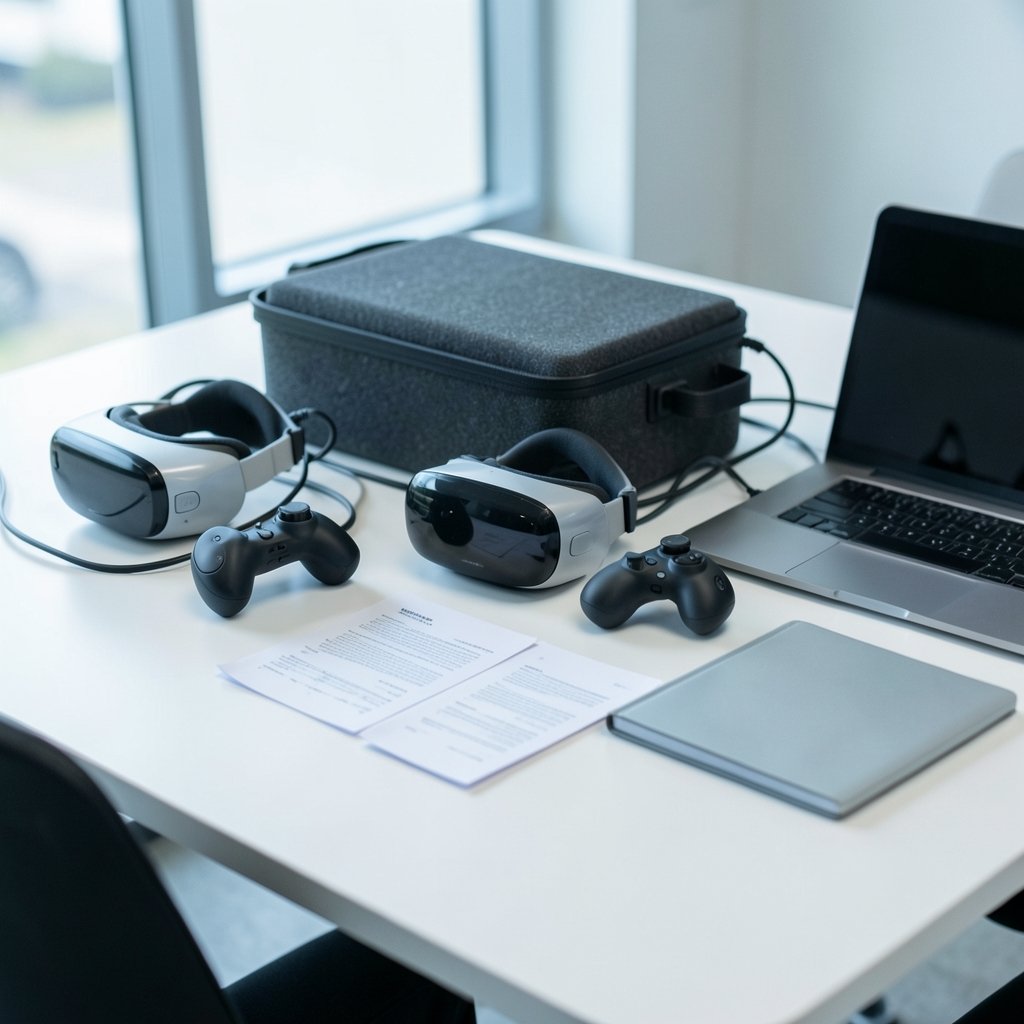
Picture the demo. The headset goes on, the virtual showroom loads, and everyone in the room nods. Three months later the app stutters on older headsets, the asset files are locked inside a vendor’s proprietary tool, and nobody can explain who owns the code. Sound familiar? It happens more often than the industry likes to admit, and almost every failure traces back to questions nobody asked before the contract was signed.
AR and VR projects are expensive, hardware-dependent, and easy to demo badly. A slick prototype says almost nothing about whether a studio can ship, maintain, and hand over a production build. The questions below are the ones that separate teams who have shipped from teams who have only pitched.
Quick Answer: What questions should I ask an AR VR development company before hiring?
Ask about standards first: whether the studio builds on OpenXR for headsets and WebXR for browser-based experiences, which determines how portable your app will be. Then ask which devices and stores they have actually shipped to, and who owns testing on each target.
A good studio will also explain its asset pipeline, confirm that 3D files stay in portable formats such as glTF 2.0, and describe how it handles accessibility and sensor-data privacy. Native builds and WebXR experiences differ sharply in cost, install friction, and reach, so the answer should match your audience rather than the vendor’s comfort zone.
Before signing, compare supported-device matrix, store-shipping history, performance targets, IP and source-code ownership, data-retention terms, accessibility features, and post-launch support costs.
Why These Questions Matter More Than the Demo
The XR market is fragmented in a way that web and mobile never were. Headsets run different operating systems, hand-tracking behaves differently across devices, and store review processes change without much warning. Apple’s Vision Pro arrived in February 2024 after its June 2023 announcement, Meta rebranded its headset software as Horizon OS in April 2024, and a long tail of Pico, HoloLens 2, and phone-based AR devices sits underneath all of it.
That fragmentation means the studio you hire is really making a series of architecture bets on your behalf. If those bets are never explained, you cannot evaluate them. The questions in this guide are designed to surface those bets early, while switching costs are still low.
Standards and Portability Questions
Do you build on OpenXR, or a proprietary SDK?
OpenXR reached version 1.0 in July 2019 and gives developers one API that works across headsets and runtimes. A studio that targets OpenXR can move your app between devices with far less rework than one that ties everything to a single vendor’s SDK. Ask directly, and ask them to show a project where they did it.
Can you deliver WebXR, and should we want that?
The WebXR Device API reached Candidate Recommendation status in 2021 and lets AR and VR run in a browser without an app install. That is a huge advantage for retail, training, and marketing experiences where friction kills conversion. It is a poor fit for graphically heavy simulations. A studio should be able to explain the trade-off in plain language rather than defaulting to native because that is what they know.
What is your 3D asset pipeline?
glTF 2.0, published in June 2017, is the de facto interchange format for 3D assets. If a studio insists on proprietary formats or refuses to hand over source files, your content is effectively hostage. Ask what tools they use, what formats they deliver, and whether assets can be re-imported into standard engines without their help.
Device, Store, and Testing Questions
Which devices and stores have you actually shipped to?
Shipping is different from building. Ask for a supported-device matrix covering the headsets and phones you care about, then ask which of those the studio has taken through a real store review. Platform guidelines matter: Apple’s App Store rules on minimum functionality, for example, reject apps that are little more than a repackaged website, which trips up plenty of thin AR marker apps.
Who owns testing on each target device?
Device testing is where XR budgets quietly evaporate. Ask whether the studio owns a device lab, rents time on one, or expects you to supply hardware. Get the answer in writing, including how many test passes are included and what happens when a new headset launches mid-project.
What performance targets will you commit to?
Frame rate and motion-to-photon latency are not abstract numbers; they decide whether users feel comfortable or sick. Ask for specific targets per device tier and for a plan to measure them. A fixed-scope pilot with defined performance criteria is a far better first engagement than a full production contract.
Accessibility and Comfort Questions
How do you handle accessibility?
WCAG 2.2 became a W3C Recommendation in October 2023, and while it was written for web content, its principles translate well to XR. Ask about captions, adjustable text, seated mode, teleport locomotion, and comfort vignettes. Motion sickness is the single biggest reason first-time users abandon VR, so a studio without a comfort plan is a studio that has not watched enough people try its work.
What happens for users with limited mobility or vision?
Hand-tracking and eye-tracking are exciting, but they exclude people too. Ask whether every interaction has a controller or voice alternative, and whether the studio has tested with users outside its own team.
Privacy, Data, and Legal Questions
What sensor data does the app collect?
Under the EU GDPR, which has applied since May 2018, eye-tracking and hand-tracking data can qualify as special-category biometric data. Ask exactly what is captured, whether it leaves the device, where it is processed, and how long it is retained. “We do not collect anything” is a valid answer, but it needs to be true and documented.
Who owns the code and the IP?
This is the question that causes the ugliest post-launch disputes. Clarify IP assignment, source-code escrow, and whether the studio relies on licensed third-party SDKs whose terms could restrict distribution. If a middleware license forbids commercial use above a certain revenue threshold, you want to know that before launch, not after.
Commercial and Process Questions
What does the pilot include, and what does production cost?
Ask for a fixed-scope proof of concept with a clear deliverable, then a separate estimate for full production. Studios that cannot scope a pilot usually cannot scope a project. Watch for estimates that exclude device testing, accessibility work, or store submission.
How do you handle change requests?
XR projects invite scope creep because stakeholders react to demos in real time. Ask how changes are priced, how often builds are delivered, and what the review cadence looks like. Weekly playable builds beat monthly slide decks every time.
What does post-launch support look like?
Headsets receive firmware updates that break things. Ask about warranty periods, maintenance retainers, and response times. If the studio disappears after launch, your app has a shelf life measured in months.
Red Flags Worth Walking Away From
A few answers should end the conversation. A studio that cannot name a single shipped title, refuses to discuss source-code ownership, or dismisses accessibility as a nice-to-have is telling you something. So is one that quotes a price before asking about your devices, audience, or performance needs.
The same instinct applies outside XR. Buyers researching everything from a managed detection response checklist to an AI chatbot security review run into vendors who answer questions with enthusiasm instead of evidence. The pattern is universal: specifics signal competence, vagueness signals risk.
A Practical Comparison: Native Build vs WebXR
| Factor | Native build | WebXR experience |
|---|---|---|
| Install friction | Requires store download | Opens in a browser |
| Graphics ceiling | High | Moderate |
| Device reach | Limited to supported headsets | Broad, browser-dependent |
| Store review | Required | Not required |
| Update speed | Store submission cycle | Instant deployment |
| Best for | Training, simulation, games | Retail, marketing, quick demos |
Neither column is better in the abstract. The right choice depends on your audience and how much friction they will tolerate.
How to Run the Evaluation Itself
- Send the question list before the first call so the studio can prepare real answers.
- Ask for two references you can contact, ideally from projects similar in scope.
- Request a short paid discovery phase rather than a free speculative pitch.
- Review the supported-device matrix and performance targets in writing.
- Have legal review IP, escrow, and third-party SDK terms before signing.
Practical tip: keep a simple scorecard with one row per question and a score from one to five. It sounds bureaucratic, but it stops the most confident presenter in the room from winning the contract by default. Common mistake: evaluating studios on their demo rather than their documentation. What actually works is asking for the boring artifacts, such as test plans, device lists, and handover checklists.
If hardware purchasing is part of the plan, apply the same scrutiny you would to any high-ticket item, whether that means reading a Rillabox review before ordering or checking a Fidelity money market funds guide before moving savings. Due diligence is a habit, not a one-off.
Conclusion
Hiring an AR or VR studio is an architecture decision disguised as a procurement decision. The questions that matter are unglamorous: which standards, which devices, which performance numbers, who owns the code, and what happens to sensor data. Ask them early, ask them in writing, and insist on a scoped pilot before committing to full production. A studio that welcomes those questions is usually the one worth hiring.
FAQ
Is OpenXR really necessary, or can we skip it?
It is not mandatory, but it is the clearest signal of portability. A studio building on OpenXR can move your app across headsets with less rework. Skipping it is fine if you are committed to one device family for the long term and accept the lock-in.
How much should a pilot project cost compared with full production?
There is no universal figure, but a pilot typically represents a small fraction of total production cost because it covers a narrow feature set. Treat any pilot priced close to full production as a warning sign, and any pilot priced near zero as a sales tactic.
Can a web development agency handle a WebXR project?
Sometimes, yes. WebXR runs on web technology, so a strong web team can deliver simple browser-based AR experiences. The gap appears with 3D performance, comfort design, and device testing, which are specialist skills worth verifying with references.
What is a reasonable timeline for a first AR or VR build?
Timelines vary with scope, but most studios will want a discovery phase before committing. Ask for a milestone schedule with playable builds at each stage rather than a single delivery date, and confirm how device testing fits into that schedule.
How do we protect ourselves if the studio shuts down?
Source-code escrow, complete asset handover in standard formats, and documented build instructions are the practical safeguards. Ask for all three in the contract, and confirm that third-party licenses transfer or remain valid if the studio ceases trading.
Do we need to buy headsets before the project starts?
Usually not for discovery, but yes before testing begins. Ask the studio whether it supplies devices or expects yours, and budget for at least two units of each target headset so testers are not queuing for hardware.



