

Quick Answer: How much do AR VR development services cost?
There is no standard price list for AR and VR development services. Most studios quote per project or per team-month, and public rate cards for software agencies have long clustered roughly between US$50 and US$150 per hour in North America and Western Europe, with lower rates in Eastern Europe and Asia. A simple mobile AR marketing demo and a tethered VR training simulator can differ in price by a factor of ten.
Content type matters as much as platform. A 360-degree video tour needs far less engineering than a multi-user simulation with custom 3D assets built from scratch. Browser-based WebXR experiences are often cheaper to distribute than native apps, while OpenXR support reduces rework across devices.
Before signing anything, compare scope definition, hourly versus fixed-price billing, asset ownership, hardware assumptions, platform targets, accessibility requirements, maintenance terms, and payment milestones.
Why the Price Tag Feels So Unpredictable
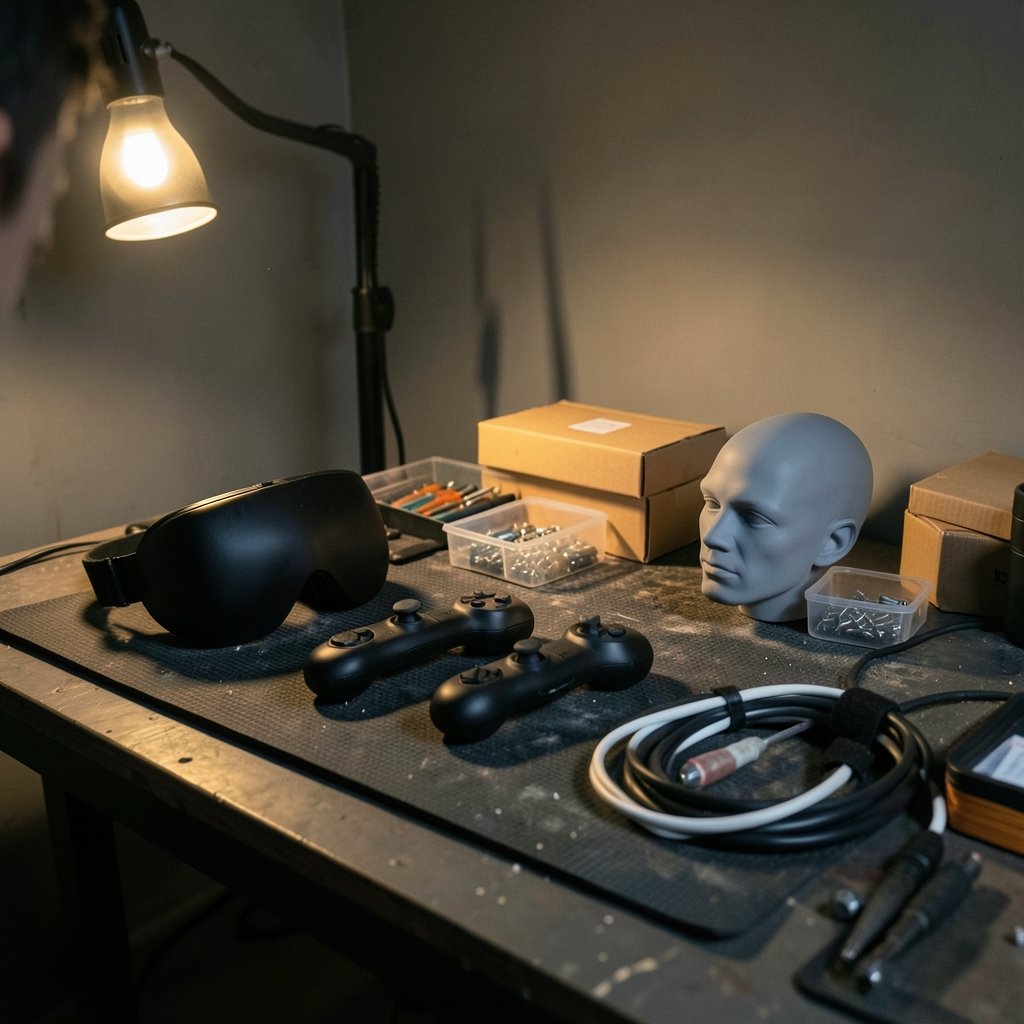
Ask five studios for a quote on the same AR app and you may get five numbers that share almost nothing. That is not because four of them are lying. It is because immersive development is still a craft business, not a commodity. Two teams can describe identical deliverables and mean completely different things: one plans a single-device prototype, the other plans a multi-user product with analytics, onboarding, and a support contract.
The biggest driver is labor. In immersive projects, art and 3D asset production plus engineering typically consume the large majority of the budget. Hardware is usually a small fraction for enterprise buyers, especially when devices are leased or shared across shifts. That flips the usual intuition. People expect the headset to be the expensive part. It rarely is.
The second driver is ambiguity. Vague briefs produce padded quotes, because agencies price risk. A studio that cannot tell whether your 3D models exist will assume they must build them, and you will pay for that assumption.
The Main Cost Drivers, Ranked by Impact
Scope and content type
A promotional AR filter, a product configurator, a guided VR factory tour, and a multi-user surgical rehearsal platform are not the same product category. Each step up adds design, engineering, and testing time. Interactive simulations with physics, voice, or hand tracking sit at the top of the range.
Platform and distribution
Mobile AR reaches users through phones they already own. Tethered VR requires headsets, setup, hygiene protocols, and often a managed device fleet. Browser-delivered AR and VR through WebXR often costs less to distribute than native apps, though it may constrain access to device-specific features.
Asset creation
Custom 3D models, scanned environments, animation, and spatial audio are frequently underestimated. Reusing existing CAD data or purchased asset libraries can cut weeks from a schedule. Building everything from scratch can double it.
Standards and compliance
Building to OpenXR, the cross-platform standard maintained by the Khronos Group, reduces per-platform rework and therefore cost. Accessibility work aligned with WCAG 2.2, the W3C recommendation published in October 2023, adds design and QA time. For VR, comfort and motion-sickness mitigation plus session-length limits are not optional polish; they are scope.
Team location and seniority
Blended day rates vary widely by region. Self-reported agency listings have for years placed North American and Western European studios in a broad band well above Eastern European and Asian teams. Those listings are marketing material, not audited data, so treat them as directional.
A Realistic Budget Framework
Exact figures belong in a quote, not an article. What travels well is the structure of a budget. Most credible proposals break down like this:
| Cost line | What it covers | Typical share of budget |
|---|---|---|
| Discovery and design | Requirements, user flows, spatial UX, prototyping | 10 to 20 percent |
| 3D art and content | Modeling, texturing, animation, audio | 25 to 40 percent |
| Engineering | Client app, backend, integrations, device support | 25 to 40 percent |
| QA and accessibility | Device testing, comfort testing, compliance checks | 10 to 15 percent |
| Deployment and handover | Store submissions, MDM setup, documentation | 5 to 10 percent |
| Maintenance | Updates, SDK cycles, content refreshes | Recurring, annual |
The maintenance line is the one buyers forget. Immersive apps need operating system and SDK updates, engine upgrades on long-term-support cycles, content refreshes, and device fleet support. Budget it as a recurring annual cost from day one rather than discovering it in year two.
Hardware anchors the per-user line. The Meta Quest 3 launched at US$499 for 128 GB and US$649 for 512 GB when it was announced in September 2023. Apple Vision Pro arrived in the US at US$3,499, announced in June 2023 and available from February 2024. Microsoft priced HoloLens 2 from US$3,500 back in 2019. Those are list prices at launch and change often, so confirm before you build a business case.
What Actually Works in Practice
Practical experience across immersive projects points to a handful of habits that consistently protect budgets.
Start with a paid discovery sprint. Two to four weeks of prototyping answers the questions that cause change orders later. It feels like an extra cost. It usually is not.
Build one platform first. Teams that target every device at once pay for porting twice. Ship to the primary device, validate the experience, then extend through OpenXR where it makes sense.
Buy assets before commissioning them. Generic props, environments, and UI kits are cheap. Bespoke hero assets are not. Spend the custom budget where users will actually look.
Write accessibility and comfort criteria into the contract. Retrofitting them after QA is expensive and often forces redesign of core interactions.
Ask who owns the source files. If the answer is vague, the cost of switching vendors later is effectively infinite.
Common Mistakes That Inflate the Invoice
The most expensive mistakes are rarely technical. They are contractual and procedural.
- Briefing in features instead of outcomes. “Add hand tracking” is a feature. “Let trainees assemble the part without a controller” is an outcome you can price.
- Skipping device testing on real hardware. Simulators miss tracking loss, latency, and comfort problems that surface only in a headset.
- Assuming engine licensing is static. Unity’s 2023 runtime-fee announcement, later revised, was a sharp reminder that engine terms can change project economics mid-flight.
- Treating maintenance as optional. Immersive software ages faster than most apps because the underlying platforms move quickly.
- Forgetting the operational side. Charging, cleaning, updating, and supporting a headset fleet is real work with a real cost.
How AR and VR Pricing Compares to Other Tech Spend
Buyers often benchmark immersive projects against familiar software budgets. The comparison is useful, but only up to a point.
A website or a standard mobile app usually reuses mature patterns. Immersive work reuses far less, because spatial interaction, comfort, and device fragmentation are still young problems. That is why a modest VR training module can cost more than a polished web app with similar screen count.
For a sense of how software pricing is structured elsewhere, it helps to look at how licensing models work in adjacent categories, such as how much WordPress costs and whether it is worth paying for premium add-ons, or how much Google Chrome costs and whether it is ever worth paying for anything beyond the free browser. The pattern repeats: the platform is often free or cheap, and the real spend sits in customization, integration, and ongoing upkeep.
Consumer hardware offers another reference point. Readers weighing a PlayStation 5 purchase or a PlayStation Plus subscription are looking at a few hundred dollars of entertainment spend. An enterprise VR deployment can exceed that per user before a single line of custom software is written.
Subscription software sets expectations too. Buyers used to transparent password manager pricing or Redis hosting costs for a small project often expect immersive vendors to publish similar tiers. They do not, and that gap is a frequent source of friction in procurement.
Questions to Ask Before You Sign
A good quote survives interrogation. A bad one collapses. Ask these before committing.
- What is included in discovery, and what is explicitly excluded?
- Which devices and operating system versions will you test on?
- How do you handle change requests, and at what rate?
- Who owns source files, 3D assets, and build pipelines at handover?
- What does year-one maintenance cover, and what does it cost?
- How will you measure whether the experience works for users?
If a vendor cannot answer the maintenance question with a number, that is a signal. It usually means maintenance was not priced into their model, and it will be priced into yours later.
Conclusion
AR and VR development services resist simple price tags because they are still custom work with a wide range of possible scopes. The honest answer to what they cost is a range, shaped by content complexity, platform choice, asset creation, standards compliance, and team location. What a buyer can control is the shape of the spend: a paid discovery phase, a single primary platform, disciplined asset strategy, accessibility built in from the start, and a maintenance budget agreed before launch. Get those right and the number that lands on the contract is far more likely to resemble the number you planned for.
FAQ
Is AR cheaper to develop than VR?
Usually, yes. Mobile AR runs on phones people already own, which removes device procurement and fleet management from the equation. VR projects add headset logistics, comfort testing, and often a managed device program, all of which carry cost. The gap narrows when an AR experience needs precise spatial tracking or custom hardware.
How long does an AR or VR project take?
Timelines track scope more closely than budget does. A focused marketing demo can move from brief to launch in a few weeks. A training simulation with custom assets, integrations, and compliance review typically runs several months. Multi-user platforms with backend services run longer still, and maintenance continues after launch.
Can I reduce costs by using a no-code authoring tool?
Sometimes. Low-code and no-code authoring tools can cut build cost for simple experiences such as virtual tours or basic product showcases. They raise different considerations around licensing, platform lock-in, and long-term maintenance. For complex interaction, custom integration, or performance-critical VR, hand-built engineering usually wins.
Do I need to budget for hardware separately?
Yes, and it is usually a smaller line than people expect. Device costs matter most at scale, when every user or location needs a headset plus charging, cleaning, and replacement cycles. Confirm current list prices before building a business case, since they shift frequently.
What is OpenXR and why does it affect price?
OpenXR is a cross-platform standard for AR and VR development maintained by the Khronos Group. Building to it reduces the work needed to support multiple devices, which lowers porting cost. The trade-off is that some device-specific features may be harder to reach, so the decision depends on your target hardware.
Is maintenance really necessary after launch?
Immersive software ages quickly. Operating systems update, engines release new long-term-support versions, and device fleets need support. Skipping maintenance typically means paying more later for a rushed upgrade, or watching the experience degrade as devices update around it. Budget it annually from the start.
Beyond the contract itself, the cheapest projects are the ones with a named internal owner: someone who can make decisions, triage feedback, and keep device logistics moving. Vendors can build the experience, but they cannot supply product direction. Assign that role before kickoff, and the number of billable meetings, revisions, and stalled weeks drops noticeably. Budget for it in staff time as well as vendor fees, and treat it as part of the total cost of ownership. That single habit does more for cost control than any negotiation tactic.



