
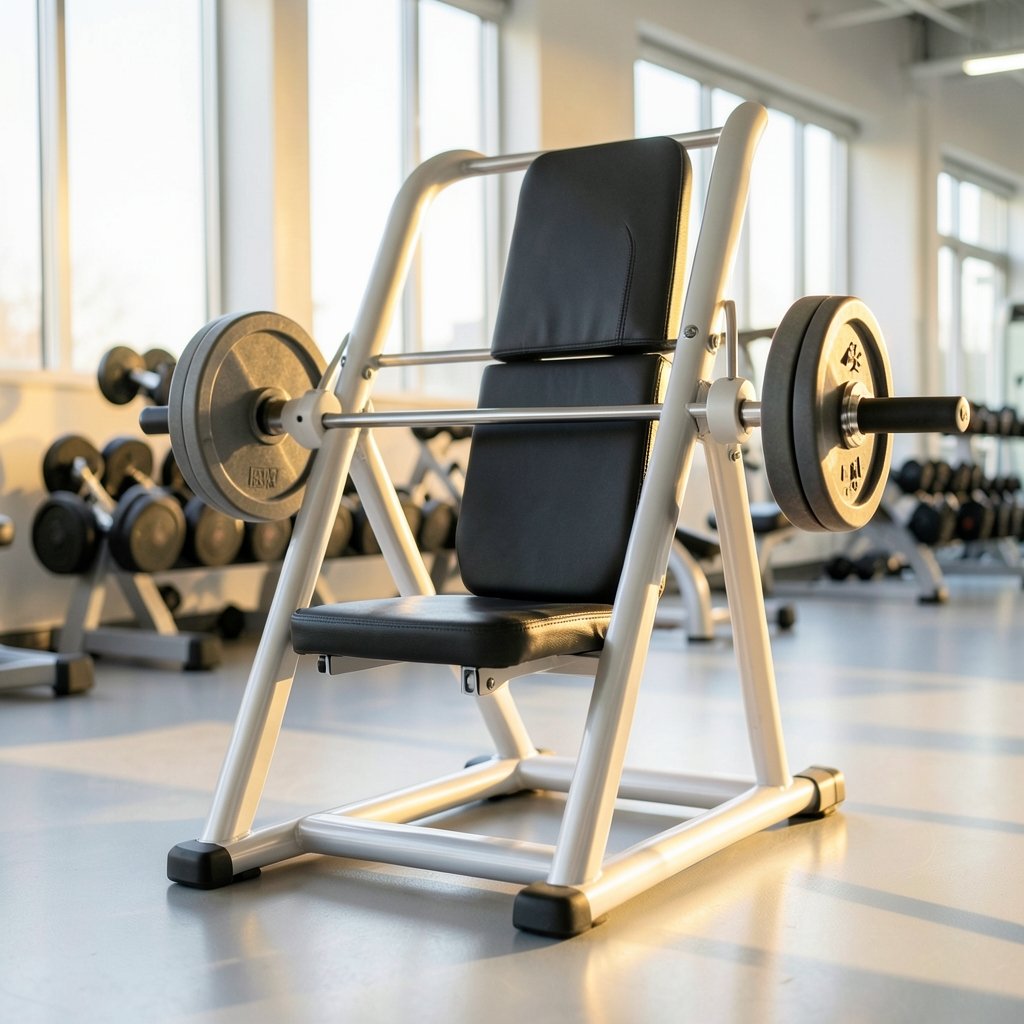
What if the biggest obstacle between you and a stronger chest isn’t your effort, but the equipment you’re pressing on? Walk into any commercial gym and you’ll see the bench press machine sitting there quietly. It doesn’t get the glory of the free-weight bench. Nobody posts videos of their machine press. And yet, for a huge number of lifters, it’s the tool that actually keeps them training consistently, safely, and with real progress.
The trouble is that “bench press machine” is a fuzzy term. It can mean a seated chest press with a weight stack, a plate-loaded press with lever arms, or even a Smith machine where a barbell slides along a fixed track. Those are three very different pieces of equipment, and buying the wrong one (or training on it the wrong way) is a common and expensive mistake. This guide breaks down what these machines actually do, who they’re for, how they compare to free weights, and what to check before you spend money.
What Counts as a Bench Press Machine?
A bench press machine is resistance-training equipment that guides your hands along a fixed or semi-fixed path to mimic the horizontal push of a barbell bench press. Instead of balancing a loaded bar, you push handles or arms, and the machine controls the direction of the movement.
There are three main designs, and the differences matter:
| Type | How it loads | Best for | Trade-off |
|---|---|---|---|
| Selectorized (weight stack) | Pin into a stack | Beginners, quick transitions, home gyms | Limited path, stack increments may be large |
| Plate-loaded | Olympic plates on lever arms | Intermediate and advanced lifters | Takes more space, loading is slower |
| Smith machine | Barbell on a fixed vertical track | Lifters who want barbell feel with guidance | Still requires plate loading and setup |
A fourth category, the seated chest press, is often lumped in with bench press machines. It’s a similar pushing motion but usually at a more upright angle. Knowing which one you’re looking at is the first step to choosing well.
Why Lifters Use a Guided Press at All

The free-weight bench press is the reference movement. It’s a standard upper-body strength test, and a one-rep-max bench press has long been used as a core strength assessment in strength and conditioning settings. So why would anyone swap it for a machine?
Safety and independence top the list. A fixed-path machine reduces the need for a spotter and the risk of getting pinned under a bar. That single factor explains why these machines are everywhere in commercial gyms and why they’re popular in home setups where training alone is the norm.
Control is the second reason. The guided path and adjustable load make machine pressing easier to manage than free weights, which is why machine-based pressing shows up in physical therapy and rehab settings. When someone is rebuilding strength after an injury, a predictable movement with a light, precise load is often the smarter starting point.
Consistency is the third. With a machine, your setup is repeatable. You sit or lie in the same position every session, which makes it easier to track progress and harder to cheat the movement with momentum.
Machine vs. Free Weights: What the Research Actually Says
Here’s where people expect a clean answer, and there isn’t one. Research comparing muscle activation between fixed-path machines and free-weight bench pressing generally finds similar or somewhat lower activation on machines, with results depending heavily on the machine’s path and how much stability the movement demands. The findings are mixed across studies, so anyone who tells you machines are “useless” or “just as good, period” is oversimplifying.
What’s more reliable is the practical distinction:
- Free weights demand balance and stabilization, which recruits more supporting musculature and carries over to real-world and athletic tasks.
- Machines let you push closer to failure with less technical risk, which is useful for accumulating volume.
- Both build strength and muscle when programmed with progressive overload.
The honest takeaway: machines aren’t a lesser version of the bench press. They’re a different tool with different costs and benefits. Most well-built programs use both.
Common Mistakes People Make With Bench Press Machines
First-hand gym experience surfaces the same errors again and again. These are the ones worth fixing before you blame the equipment.
Mistake one: treating the machine as a bench press substitute rather than a complement. People ditch free weights entirely, then wonder why their stability and carryover feel flat. Use the machine to add volume and train safely, not to replace every pressing movement.
Mistake two: ignoring seat and handle adjustment. Almost every machine has a seat height pin and sometimes handle-position settings. If the handles sit too high or too low relative to your chest, you shift the load onto the wrong muscles and stress the shoulders. Set the handles to line up roughly with mid-chest before your first rep.
Mistake three: bouncing out of the bottom. The guided path invites momentum. Control the eccentric (lowering) phase for a count of two, pause briefly, then press. That tempo alone often exposes how much you were relying on bounce.
Mistake four: ego-loading a machine with a short range of motion. Because there’s no bar to fail on, it’s easy to pile on plates and cut the rep short. Full range beats heavy partials almost every time.
Mistake five: never checking the machine itself. Cables fray, pins bend, and welds crack. On home equipment especially, inspect the frame, cables, and locking mechanisms regularly. Gym equipment in the U.S. isn’t governed by a single mandatory federal safety standard; voluntary consensus standards and manufacturer instructions set the expectations, so the owner’s manual is genuinely worth reading.
What to Look For Before You Buy
Shopping for a home bench press machine is where buyers get burned. The category is crowded, reviews are noisy, and the specs that matter aren’t always the ones printed in big letters.
Begin with footprint and ceiling height. Plate-loaded presses and Smith machines need floor space and clearance. Measure the room as well as the machine.
Then check load capacity and increment size. A selectorized stack with 10-pound jumps can stall progress on small muscles. Plate-loaded arms let you micro-load with fractional plates.
Look hard at adjustability. Seat height, back pad angle, and handle position determine whether the machine fits your body. A machine that doesn’t adjust well is a machine you’ll stop using. (Best nespresso machine)
Finally, consider the path of the press. Some machines press straight forward, others angle upward or converge. Try before you buy if you can. If you’re comparing equipment categories more broadly, the same buyer-beware logic applies to other machines, and it’s worth reading about the mistakes money counting machine buyers get wrong before they spend, because the pattern is identical: the specs that decide satisfaction are rarely the headline features.
If your training leans toward espresso and morning routines rather than iron, that’s a different shopping problem entirely, and the best espresso machine for home is a genuinely separate rabbit hole.
Programming a Bench Press Machine Into Your Week
A machine press slots into almost any split. Here’s a straightforward approach that works for most lifters:
- Pick your primary press. If free-weight benching is your main lift, keep it first in the session while you’re fresh.
- Add the machine as a secondary movement. Two to three sets of 8 to 12 reps after your main press builds volume with low technical risk.
- Use it as a finisher on upper-body days. Higher reps (12 to 15) with controlled tempo and short rest.
- Progress deliberately. Add reps before weight. When you hit the top of your rep range on all sets, add the smallest increment available.
- Deload when needed. Machine work is easy to overtrain because it feels manageable. Back off every fourth or fifth week.
For lifters training around an injury or returning after time off, machine pressing can be the entire pressing program for a few weeks, then gradually give way to free weights.
Where the Machine Fits in a Home Gym
Home gym owners face a real trade-off. A bench press machine takes up space that could hold a rack and a barbell. But it also solves the spotter problem, which is the number one reason home lifters avoid heavy pressing.
The practical answer for most people: a plate-loaded or Smith-style press works well as the anchor of a pressing setup, paired with dumbbells for unilateral work. A selectorized machine is the better pick if space is tight and multiple people of different strengths will use it, since changing weight takes a second.
If you’re building out a broader home setup and comparing equipment tiers, the same decision framework behind choosing the best home espresso machine applies: match the machine to your actual habits, not to an aspirational version of them. The best at-home espresso machine for a daily latte drinker is overkill for someone who drinks one shot a week, and the same is true of a commercial-grade press.
For readers who spend more time comparing specs than lifting, there’s a parallel in how people evaluate the best nespresso machine: convenience, consistency, and repeatability often beat raw capability. A guided press wins on exactly those three fronts.
The Verdict
The bench press machine earns its place. It’s not a shortcut and it’s not a replacement for the barbell, but it’s a genuinely useful tool that solves real problems: training alone, training around injury, and accumulating pressing volume without technical risk. The lifters who get the most from it are the ones who adjust it properly, control the tempo, and treat it as one piece of a bigger program rather than the whole thing.
Buy with your measurements and your habits, not the marketing copy. Then set the seat, load it sensibly, and press.
Frequently Asked Questions
Is a bench press machine as effective as a barbell bench press?
It’s effective, but not identical. Research generally shows similar or somewhat lower muscle activation on fixed-path machines compared with free-weight benching, and results vary by machine design. Machines remove the balance demand, which makes them easier to push close to failure safely. Most lifters get the best results using both.
Can beginners use a bench press machine?
Yes, and it’s often a smart starting point. The guided path teaches the pressing motion without the coordination demands of a barbell, and there’s no risk of being pinned. Beginners should still learn free-weight technique early, ideally with light loads and coaching.
Do I need a spotter to use a bench press machine?
No. That’s one of the main reasons people use them. The fixed path means you can set the weight down safely if a rep fails, which makes machine pressing popular for home gyms and solo training.
What’s the difference between a bench press machine and a Smith machine?
A Smith machine is a barbell mounted on a fixed track, so you still load plates and grip a bar, but the bar can’t drift. A bench press machine typically uses handles or lever arms and may load via a weight stack. Both guide the path, but the feel and setup are different.
How much does a home bench press machine cost?
Prices vary widely by type and build quality, from budget selectorized units to heavy plate-loaded presses. Rather than chasing a number, compare load capacity, adjustability, footprint, and warranty. A well-built mid-range machine you’ll actually use beats a cheap one that wobbles.
How often should I use a bench press machine?
Two sessions per week is plenty for most lifters as a secondary pressing movement, usually 2 to 3 sets of 8 to 12 reps. If it’s your primary press during rehab or a free-weight break, three sessions weekly with moderate volume works well. Progress by adding reps first, then small weight increments.



