

Accounts payable is one of the last finance workflows still running on paper in many companies. Invoices arrive by email, sit in inboxes, get printed, approved by hand, and keyed into the accounting system days later. The best AI tools for accounts payable automation in 2027 remove most of that manual work by reading invoices, matching them to purchase orders, routing approvals, and scheduling payments automatically.
The difference between a basic invoice scanner and a real AP automation tool is what happens after capture. Strong tools run three-way matching against purchase orders and receipts, flag price and quantity mismatches, learn each vendor’s invoice format, and keep a full audit trail of every approval. That is what turns a pile of PDFs into a controlled, auditable process.
This guide covers eight tools that automate accounts payable well in 2027, from dedicated AP platforms to finance suites with strong invoice automation. Prices are approximate starting prices; check current pricing before buying.
Key takeaways
- Tipalti is the best overall AP automation platform, with global payments and deep invoice matching.
- Bill and Stampli suit small and mid-sized teams that want fast setup and simple approvals.
- Coupa and SAP Ariba fit large enterprises with complex procurement and multi-entity payables.
- Expect to pay roughly $45 to $80 per user per month for dedicated AP tools, with enterprise pricing quoted.
- Three-way matching is the feature to test first, because it catches the errors that cost real money.
At a glance: the shortlist
| Product | Best for | Starting price | Standout limit |
|---|---|---|---|
| Tipalti | Global AP and payments | From $129/month | Best at higher volumes |
| Bill | Small business AP | From $45 per user/month | Limited advanced matching |
| Stampli | Fast invoice approvals | Custom quote | Pricing not public |
| Coupa | Enterprise spend control | Custom quote | Long implementation |
| SAP Ariba | Large procurement teams | Custom quote | Complex setup |
| AvidXchange | Mid-market AP | Custom quote | Best for US suppliers |
| MineralTree | Mid-sized finance teams | Custom quote | Smaller vendor ecosystem |
| Airbase | AP plus spend control | Free core plan | Advanced features on paid tiers |
Tipalti — Best overall
Tipalti handles the full accounts payable cycle, from invoice capture to payment, and it does it across borders and currencies. Its AI reads invoices in any format, extracts line items, matches them against purchase orders and receipts, and routes exceptions to the right approver. Payments then go out through the same platform, with tax forms and compliance checks built in. For finance teams that pay vendors in many countries, that end-to-end coverage is the reason Tipalti leads this list, and it pairs naturally with the wider automation covered in our guide to the best AI tools for working capital management, where payables timing directly affects cash flow.
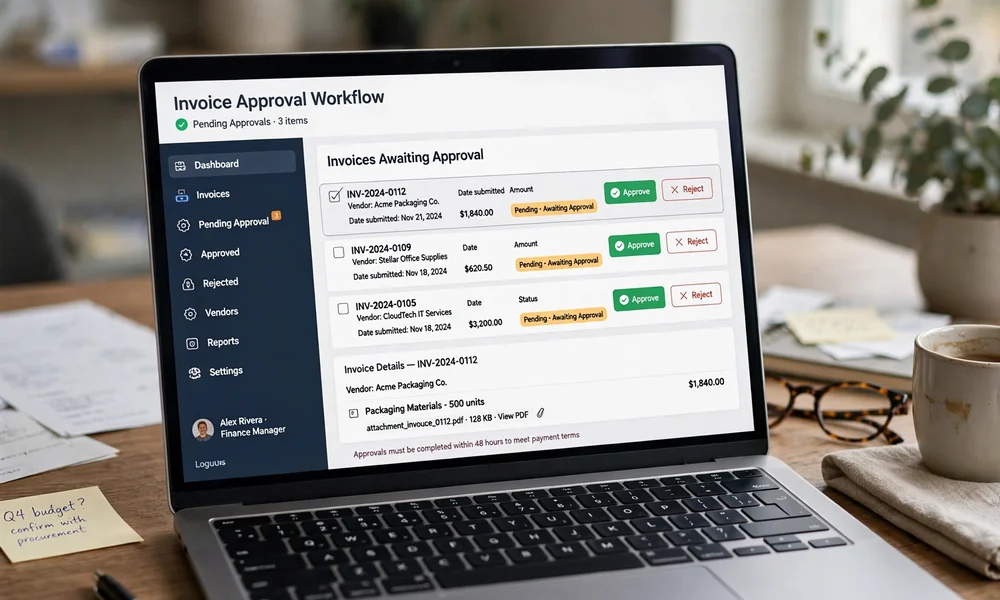
The platform also manages supplier onboarding, collects tax documentation, and screens payees against sanctions lists, which matters for companies with hundreds of vendors. Its approval workflows are flexible enough for multi-entity businesses, and the audit trail records every action on every invoice.
Pros: Full AP cycle including global payments; strong three-way matching; supplier onboarding and tax compliance built in.
Cons: Starting price is higher than simpler tools; best value at higher invoice volumes.
Bill — Best for small business AP
Bill, formerly Bill.com, is the most popular AP tool for small businesses, and its appeal is simplicity. Invoices arrive by email or upload, the AI reads the vendor, amount, and due date, and the bill is ready for approval in minutes. Payments go out by ACH, check, or card, and everything syncs with QuickBooks, Xero, or NetSuite.
The approval workflows handle multi-level sign-off, and the mobile app lets approvers clear invoices from anywhere. It does not offer the deep matching of enterprise platforms, but for a team processing a few hundred invoices a month, it removes the bulk of the manual work.
Pros: Very easy to set up; strong accounting integrations; reliable payment execution.
Cons: Three-way matching is limited; per-user pricing adds up as the team grows.
Stampli — Best for fast invoice approvals
Stampli focuses on one thing: getting invoices approved quickly. Its AI, called Billy, learns how each invoice should be coded and routed by watching past approvals, then suggests the right general ledger account, department, and approver for every new invoice. Approvers can approve directly from email without logging in, which cuts cycle times sharply.
The platform keeps the full conversation about an invoice in one place, so questions and answers stay attached to the document instead of scattered across email. That context is genuinely useful during audits and vendor disputes.
Pros: AI learns coding and routing from history; email-based approvals are fast; good audit trail.
Cons: No public pricing; payment features are less developed than Tipalti or Bill.
Coupa — Best for enterprise spend control
Coupa treats accounts payable as part of a larger spend management system, covering procurement, invoicing, and payments together. Its AI matches invoices to purchase orders automatically, flags pricing discrepancies, and benchmarks supplier costs against data from other large companies.
For enterprises with complex approval chains and multiple entities, Coupa brings consistency across the whole procure-to-pay process. The trade-off is the same as with any enterprise platform: implementation takes time, and the cost only makes sense at scale.
Pros: End-to-end procure-to-pay coverage; strong matching and benchmarking; proven at enterprise scale.
Cons: Custom pricing and long rollout; more than a small team needs.
SAP Ariba — Best for large procurement teams
SAP Ariba is the standard choice for very large companies that already run SAP. Its invoice management pairs with a huge supplier network, so many invoices arrive electronically in structured form rather than as PDFs, which makes matching faster and more accurate.
The platform supports complex approval hierarchies, multi-currency payments, and deep integration with SAP S/4HANA. For finance teams inside the SAP ecosystem, the native integration is the main reason to choose it over a standalone AP tool.
Pros: Massive supplier network; deep SAP integration; handles complex global payables.
Cons: Expensive and complex to implement; poor fit outside the SAP ecosystem.
AvidXchange — Best for mid-market AP
AvidXchange is built for mid-market companies, particularly in real estate, construction, healthcare, and financial services. Its AI reads invoices, matches them to purchase orders, and routes them through configurable approval workflows, with a supplier network that handles payment delivery.
The platform supports over 200 accounting systems, which makes it a practical choice for companies with established ERP setups. Its utility-bill handling is a useful extra for property-heavy businesses with hundreds of recurring invoices.
Pros: Strong mid-market fit; wide accounting system support; good utility and recurring invoice handling.
Cons: Custom pricing; strongest in the US market.
MineralTree — Best for mid-sized finance teams
MineralTree automates invoice capture, approval, and payment for mid-sized companies, with a clean workflow that finance teams can configure without heavy IT support. Its AI extracts invoice data, matches it against purchase orders, and flags exceptions for review.
The platform supports two-way and three-way matching, virtual card payments, and fraud controls such as duplicate invoice detection. It is a solid middle ground between simple tools like Bill and enterprise platforms like Coupa.
Pros: Good matching at a mid-market price; virtual card payments; quick to configure.
Cons: Smaller ecosystem than the largest rivals; custom pricing only.
Airbase — Best for AP plus spend control
Airbase combines accounts payable with broader spend management, covering invoices, corporate cards, and employee reimbursements in one system. Its AI reads invoices, matches them to purchase orders, and enforces budgets at the point of approval.
Finance teams like the single view of all spending, which makes month-end close faster and gives controllers real-time visibility into committed cash. The free core plan makes it easy to start, with advanced approval rules and integrations on paid tiers.
Pros: One system for invoices, cards, and reimbursements; real-time budget enforcement; free tier available.
Cons: Advanced features need paid tiers; newer than the established AP leaders.
How to choose
Start with invoice volume and vendor complexity. A team processing under 500 invoices a month with mostly domestic vendors will do well with Bill, Stampli, or Airbase. A team handling thousands of invoices, multiple entities, or international payments should evaluate Tipalti, Coupa, or SAP Ariba. The right tool fits the volume you actually process, not the volume you hope to reach.
Next, test three-way matching with your real data. Ask each vendor to run a sample of your invoices against your purchase orders and receipts, and show you exactly which mismatches get flagged and which slip through. Pay attention to partial receipts, price changes, and tax differences, because those are where real AP errors hide. Teams comparing AP tools alongside a wider finance refresh should also read our guide to the best AI tools for finance teams to see how payables fit the full stack.
Finally, check payment execution. Capturing and approving invoices is only half the job; the tool must also pay vendors reliably, handle your preferred payment methods, and reconcile cleanly with your accounting system. Confirm the payment timing, fees, and failure handling during the trial, not after signing.
Checklist: before you pay
- Run a trial with at least 100 real invoices, including problem cases such as partial receipts.
- Test three-way matching against your actual purchase orders and goods receipts.
- Confirm the tool supports your payment methods and currencies.
- Check how duplicate invoices are detected and blocked.
- Ask for renewal pricing in writing, including per-transaction fees.
- Verify the audit trail exports cleanly for your auditors.
Frequently asked questions
How much time does AP automation actually save?
Most teams cut invoice processing time by 50 to 80 percent once capture, matching, and approvals are automated. The biggest savings come from eliminating manual data entry and chasing approvers by email, not from any single AI feature.
What is three-way matching?
Three-way matching compares the invoice, the purchase order, and the goods receipt. If all three agree on quantity and price, the invoice is approved automatically. If they disagree, the invoice is flagged for review with the discrepancy highlighted.
Can AP tools handle invoices in different languages and currencies?
Enterprise tools such as Tipalti, Coupa, and SAP Ariba handle multiple languages, currencies, and tax rules well. Simpler tools are usually strongest in one market, so check your specific vendor mix during the trial.
Do I need to change my ERP to automate AP?
No. Most AP tools integrate with common accounting systems and ERPs, including QuickBooks, Xero, NetSuite, and SAP. Confirm your specific system and version are supported before you commit.
How does AP automation prevent fraud?
It checks for duplicate invoices, verifies vendor bank details against known records, flags unusual amounts, and keeps a complete audit trail. No system catches everything, but automated checks catch far more than manual review of the same volume.
Should AP automation replace my accounting system?
No. AP tools sit alongside your accounting system and feed it clean, approved data. If you are also reviewing your accounting setup, our guide to the best AI tools for accounting teams covers the bookkeeping side that AP automation feeds into.
The bottom line
For most companies with meaningful invoice volume, Tipalti is the strongest choice, because it covers capture, matching, approvals, and global payments in one platform. For small businesses, Bill is the simplest path to automation, and Airbase is the best pick when you want AP and spend control in a single system.
Whatever you choose, trial it with your real invoices, your real purchase orders, and your real approvers. The tool that matches your messy invoices correctly, routes approvals without delays, and pays vendors on time is the right one, and only a trial with your own data will prove it.


