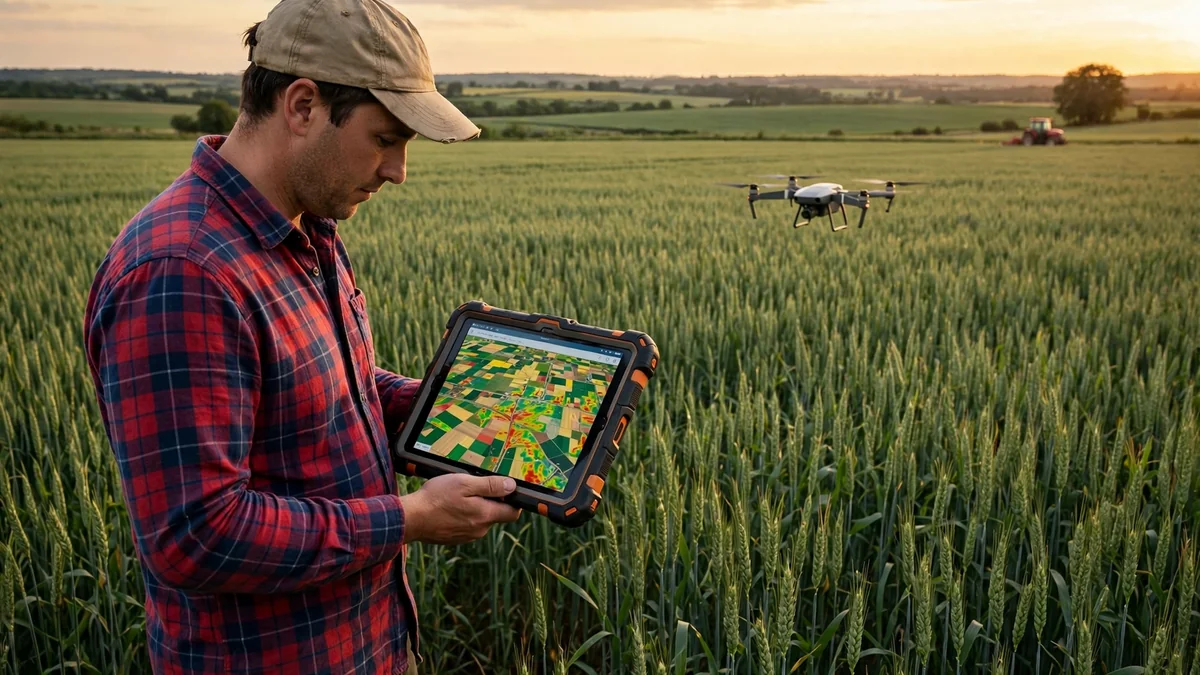
Best AI Tools for Farmers in 2028
Farming in 2028 looks very different from farming even five years ago. The best AI tools for farmers now turn a phone, a drone, or a tractor into a decision-making partner, spotting disease before it spreads, telling you exactly where water is needed, and predicting yields weeks before harvest. What once required a team of agronomists and a lot of guesswork can now start with a photo of a leaf.
The change matters because margins have never been tighter. Input costs keep climbing, weather keeps getting less predictable, and labour is harder to find in almost every growing region. AI does not replace a farmer’s judgement, but it stretches it: instead of walking every acre, you walk the acres the data says need attention, and you spend money only where it will actually pay back.
This guide rounds up the strongest AI tools for farmers in 2028, from crop-scanning apps you can use today to full farm-management platforms that tie drones, sensors, and machinery together. Each one is judged on what it actually does in the field, what it costs, and who it suits best, so you can pick the right starting point for your farm rather than the flashiest demo.
Key takeaways
- Start with a phone-based crop-scanning app if you want fast value for little money; the best ones identify pests and nutrient problems from a single photo.
- Drone and satellite imagery pay off fastest on farms over 100 acres, where walking every field is no longer realistic.
- Look for tools that work offline or with weak signal, because rural connectivity is still the biggest practical barrier to farm AI.
- The best platforms connect scouting, irrigation, and machinery data in one place instead of trapping your records in separate apps.
- Free tiers are useful for testing, but budget for a paid plan before the growing season starts so you are not locked out mid-season.
| Tool | Best for | Starting price | Works offline |
|---|---|---|---|
| Plantix Vision | Crop disease detection | Free tier | Yes |
| FarmWise Scout | Drone field mapping | $49/month | Partial |
| AgriSense Irrigate | Smart watering | $29/month | Yes |
| SoilMind AI | Soil health and fertiliser | $39/month | Yes |
| HarvestCast | Yield forecasting | $59/month | No |
| PasturePal | Livestock monitoring | $45/month | Partial |
| WeedBot Field | Precision weeding | $199/month | Yes |
| FarmFlow Suite | Whole-farm management | $89/month | Partial |
1. Plantix Vision — Best for Crop Disease Detection
Plantix Vision is the simplest entry point on this list, and for many small and mid-size farms it is the only AI tool they will ever need. Point your phone camera at a leaf, a stem, or a fruit, and the app identifies the likely disease, pest, or nutrient deficiency within seconds, then suggests treatment options with dosage guidance. It covers the major staple crops, vegetables, and fruit, and its library keeps growing as farmers upload new photos from their own fields.
What sets it apart in 2028 is how well it works away from a signal. The core detection model runs on the phone itself, so you can scout a back field with no bars and still get answers. Results sync to a simple field log when you are back in range, giving you a dated record of every problem you found and what you did about it. For a farm that has never used AI before, that combination of simplicity and offline reliability is hard to beat.
Pros: free tier covers everyday scouting; works fully offline; huge crop and disease library; simple photo-based workflow anyone can learn in minutes.
Cons: photo quality matters, so blurry shots can mislead; treatment advice is general rather than tailored to your local regulations; no drone or satellite integration.
2. FarmWise Scout — Best for Drone Field Mapping
FarmWise Scout pairs a mapping drone with AI analysis to turn a twenty-minute flight into a full health map of your fields. It flags stressed patches, counts plant emergence, and highlights weed pressure zones, then turns those maps into variable-rate prescriptions your spreader or sprayer can follow. On larger farms this is where AI starts paying for itself in a single season, because you stop treating the whole field the way only ten percent of it needs.

The platform is built for farmers who already fly drones or are ready to start. Flight planning is mostly automatic: you draw the field boundary, the drone flies the grid, and the maps appear in the dashboard the same day. Integration with common tractor displays means the prescription maps actually reach the machine instead of sitting in an app. If your farm is over 100 acres, this is the upgrade that changes how you scout.
Pros: fast, accurate field health maps; variable-rate prescriptions save inputs; works with popular drone and tractor brands.
Cons: needs a drone and a learning curve; subscription plus hardware cost; needs a connection to process maps.
3. AgriSense Irrigate — Best for Smart Watering
Water is the most expensive input many farmers waste without realising it, and AgriSense Irrigate exists to stop that. Soil moisture sensors feed live readings into an AI model that also watches weather forecasts, crop stage, and soil type, then tells you exactly when and how much to water each zone. Farmers who switch from fixed schedules to its recommendations commonly report water savings of twenty to thirty percent with no yield penalty.
Setup is deliberately low-friction: battery-powered sensors push into the soil in minutes, and the hub connects over long-range radio rather than farm Wi-Fi, so it works on remote fields. The app shows a simple green, amber, or red status per zone, which means a farmhand can check irrigation needs without understanding the model behind it. In dry regions, this is often the first AI tool that earns its keep.
Pros: clear water and cost savings; sensors are easy to install; works over long-range radio without farm Wi-Fi; simple traffic-light interface.
Cons: sensor batteries need seasonal replacement; accuracy depends on placing sensors in representative spots; limited value on rain-fed farms.
4. SoilMind AI — Best for Soil Health and Fertiliser
Fertiliser is too expensive to guess at, and SoilMind AI turns soil testing from an annual chore into a living picture of your fields. You feed in lab results, past yields, and crop plans, and the model builds a nutrient map that recommends exactly what each zone needs, and just as importantly, what it does not. The result is less wasted fertiliser, healthier soil over time, and a paper trail that helps with certification and subsidy paperwork.
The 2028 version adds carbon and soil biology estimates, which matter if you are selling into markets that pay for sustainable practice or reporting emissions. The interface stays practical rather than academic: it shows a map, a shopping list of inputs, and the expected cost per acre. Pair it with a scanning app like the ones above and you cover both what is happening above ground and what is happening below it.
Pros: cuts fertiliser waste with zone-level plans; tracks soil health over seasons; useful records for certification and subsidies.
Cons: still needs proper lab soil tests to start; recommendations need local agronomic sense-checking; annual subscription adds up.
5. HarvestCast — Best for Yield Forecasting
HarvestCast answers the question every farmer asks from mid-season onward: how much will I actually harvest? It combines satellite imagery, weather data, and your own field records to forecast yields weeks ahead, updating the estimate as the season develops. That early warning changes real decisions, from booking storage and transport to forward-selling part of the crop at a good price.
Accuracy improves with your data, so the first season is a learning year and the second is where the forecasts get genuinely useful. The dashboard is clean and honest about uncertainty, showing a range rather than a single false-precision number. For farms selling into contracts or managing tight harvest logistics, knowing the likely tonnage early is worth more than the subscription costs.
Pros: early yield estimates aid selling and logistics; forecasts improve as your farm data grows; honest uncertainty ranges.
Cons: needs an internet connection; first-season accuracy is modest; most valuable for larger, contract-selling farms.
6. PasturePal — Best for Livestock Monitoring
PasturePal brings AI to the livestock side of the farm, using collar sensors and camera monitoring to track each animal’s movement, feeding, and resting patterns. When a cow eats less, moves differently, or separates from the herd, the system flags it, often a day or two before visible symptoms of illness appear. Early detection like that saves animals, vet bills, and lost production.
For grazing operations, the heat and health alerts are the standout feature: the system spots animals in oestrus and tracks grazing rotation, helping you manage pasture more evenly. Setup takes a day for a mid-size herd, and the alerts arrive as simple phone notifications rather than a dashboard you have to babysit. If animals are a core part of your business, this is the AI tool most likely to pay for itself through losses avoided.
Pros: early illness and heat detection; reduces vet costs and losses; simple phone alerts; helps manage grazing rotation.
Cons: per-animal hardware costs add up; collars need maintenance; limited benefit for very small herds.
7. WeedBot Field — Best for Precision Weeding
WeedBot Field is the most ambitious tool on this list: a camera-guided system that identifies weeds plant by plant and removes them mechanically or with a micro-dose of herbicide, leaving the crop untouched. The promise is dramatic — herbicide use cut by up to ninety percent — and on high-value vegetable and row crops the numbers are starting to back it up. It is also the most expensive option here, so it suits farms where weed control is a major cost or where chemical reduction is a market requirement.
The system works best on uniform row crops with clear spacing, and it needs a compatible tractor or its own carrier unit. Early adopters report a real learning curve in the first weeks, but also the most satisfying moment in farm AI: watching a machine tell a weed from a crop at speed, all day, without getting tired. For organic and low-chemical growers, it opens options that hand weeding never could at scale.
Pros: huge herbicide savings; works tirelessly at consistent accuracy; strong fit for organic and low-chemical systems.
Cons: highest cost on this list; best only on uniform row crops; needs compatible machinery and setup time.
8. FarmFlow Suite — Best for Whole-Farm Management
FarmFlow Suite is the all-in-one option: scouting records, irrigation, machinery, inventory, labour, and finances in a single platform, with an AI assistant that answers plain-language questions like which field needs attention today or what last year’s wheat cost per acre. It is the tool for farms that have tried three or four separate apps and are tired of retyping the same data everywhere. If you already use a couple of tools on this list, FarmFlow is the system that ties them together.
The AI assistant is the real draw in 2028. Instead of hunting through menus, you ask a question and get an answer drawn from your own records, with the source field or receipt attached. That sounds small, but across a busy season it saves hours a week and catches mistakes — like ordering seed you already have in the shed. It is priced for serious operations, so small farms should start with a single-purpose tool first and graduate to a suite when the admin burden justifies it.
Pros: one home for all farm data; AI assistant answers questions from your own records; reduces duplicate admin work.
Cons: the priciest software-only option here; setup takes real time; overkill for small or single-crop farms.
How to Choose the Right AI Tool for Your Farm
Start from your biggest cost or biggest headache, not from the tool. If disease keeps eating your yield, a scanning app is the answer; if water bills dominate, start with irrigation sensors; if you cannot walk your fields any more, drone mapping comes first. One tool solving a real problem beats five tools solving problems you do not have. Farmers who pick this way see a return in one season; farmers who buy the shiniest platform often see a subscription they never open.
Next, test the practical fit before you commit. Check that the tool works with your phone, your signal, and your machinery, and that it covers your actual crops rather than only the big commodity ones. Use the free tier or a trial through a full scouting round, not just an afternoon, and ask a neighbour who uses it what breaks in real conditions. Finally, look at where your data lives: prefer tools that let you export your records, because the farm that owns its data can switch tools without losing its history. If you want a broader view of everyday AI options first, our guide to the best AI tools for farmers is a good place to compare the established names before you commit to a 2028 upgrade.
Checklist: Getting Started with Farm AI
- Pick one problem to solve first, such as disease scouting or irrigation, and choose the tool for that problem.
- Check the tool covers your crops and works offline or on weak signal in your fields.
- Run the free tier or trial through a full scouting round before paying.
- Train everyone who will use it, including seasonal workers, in one short session.
- Keep a simple log of what the tool flagged and what you did, so you can judge its accuracy after one season.
- Make sure you can export your data before you build a season of records inside any app.
Frequently Asked Questions
Are AI tools for farmers worth the money in 2028?
For most farms, yes, provided you start with a tool that targets your biggest cost. A free scanning app costs nothing to try, and irrigation or drone tools commonly pay for themselves within one season through saved water, chemicals, or labour. The tools that fail are usually the ones bought without a specific problem in mind.
Do I need a drone to use farm AI?
No. Phone-based apps for disease detection and soil advice need nothing more than a smartphone. Drones add value mainly on larger farms where field mapping saves hours of walking. Start with phone tools and add a drone only when the farm size justifies it.
Will AI tools work without internet in the field?
Many of the best ones will. Scanning apps and soil sensors increasingly run their core models on the device or over long-range radio, syncing when you are back in range. Always check offline support before buying, since rural signal is still unreliable in many areas.
Can small farms benefit from AI, or is it only for big operations?
Small farms benefit most from the cheap end of the market: free or low-cost scanning and soil apps that cost less than a single bag of fertiliser. The expensive machinery and suite platforms are aimed at larger operations, but a small farm can get real value from a phone and one good app. Our roundup of the best AI tools for small businesses covers the same low-cost logic for smaller operations of every kind.
How accurate is AI crop disease detection?
On common diseases in good light, the leading apps are right most of the time, and they keep improving as more farmers upload photos. They are a scouting aid, not a diagnosis: confirm a serious finding, especially before an expensive spray, and remember that a blurry or shaded photo can mislead any model.
What data do these tools collect about my farm?
They collect field maps, photos, sensor readings, and the records you enter, which is exactly what makes their advice useful. Read the privacy terms before signing up, prefer tools that let you export and delete your data, and avoid any service that claims ownership of your farm records. For a wider sense of how chatbot-style AI handles your information, see our guide to the best AI chatbots of 2026.
Bottom Line
The best AI tools for farmers in 2028 are the ones that solve a specific, expensive problem on your farm and work in your real conditions — weak signal, muddy boots, and all. Start small with a phone-based scanner, add irrigation or drone mapping when the farm size and the savings justify it, and only move to a full management suite when juggling separate apps costs you more time than the suite costs money.
Farm AI is no longer a futuristic promise; it is a practical set of tools with clear prices and measurable returns. Pick one problem, test one tool through a full season, and let the results decide what comes next. The farms getting the most from AI in 2028 are not the ones that bought the most software — they are the ones that bought the right tool first.