

Khmer is spoken by roughly 16 million people, most of them in Cambodia, yet it remains one of the least served languages in mainstream language-learning apps. For years, learners relied on textbooks, phrasebooks, and the occasional tutor. That has changed fast: AI tools now offer Khmer speech recognition, instant translation, conversation practice with a tireless tutor, and spaced-repetition drills that adapt to what you remember.
The catch is that Khmer support varies wildly. Some tools offer a full structured Khmer course with native-speaker audio; others bolt Khmer onto a generic translation engine. A few well-known apps do not offer Khmer at all, which makes shortlists copied from other languages useless here. Every tool in this guide was checked specifically for Khmer coverage.
We compared the tools on Khmer course depth, speech recognition for Khmer’s distinctive sounds, pricing, offline access, and handling of the Khmer script. The shortlist covers every budget, from free tools for a first trip to Phnom Penh to premium AI tutors that hold a real conversation. Start with the tool that matches your goal, and switch when your needs change.
Key takeaways
- Ling is the best overall pick for Khmer: a dedicated course, native audio, and a chatbot for conversation practice.
- Mondly and Drops are the strongest choices for beginners who want quick daily lessons and solid vocabulary.
- Talkpal and ChatGPT are the best AI conversation partners, letting you practise speaking Khmer without fear of embarrassment.
- Free tools such as Google Translate and Memrise community courses are useful, but they are supplements, not a full course.
- Khmer’s script and sounds make audio quality the deciding factor — try the free tier before paying for a year.
At a glance: the shortlist
| Product | Best for | Starting price | Standout limit |
|---|---|---|---|
| Ling | Best overall | Free; premium from about $8.99/month | Some advanced lessons locked behind premium |
| Mondly | Beginners and daily habits | Free; premium from about $9.99/month | Khmer course is shorter than major languages |
| Drops | Vocabulary and the Khmer script | Free; premium from about $13/month | Five-minute limit on the free plan |
| Memrise | Video-based listening | Free; premium from about $14.99/month | Khmer content is mostly community-made |
| Talkpal | AI conversation practice | Free; premium from about $9.99/month | Needs a decent internet connection |
| ChatGPT | Custom tutoring and explanations | Free; Plus from $20/month | No structured curriculum of its own |
| LingQ | Reading and listening immersion | Free; premium from about $12.99/month | Khmer library is smaller than European languages |
| italki | Live lessons with native tutors | From about $5 per lesson | Pay per lesson, so costs add up fast |
Ling — Best overall
Ling is the strongest all-round choice for learning Khmer in 2027, and it is not particularly close. Unlike the big generalist apps, Ling built a dedicated Khmer course with lessons structured around real situations: greetings, ordering food, asking directions, and shopping in a Cambodian market. The audio is recorded by native Khmer speakers, which matters enormously in a language where a small change in pronunciation can change a word’s meaning. Lessons run five to ten minutes, and the app tracks your streak.
What pushes Ling ahead is its AI chatbot. After a few lessons you can practise a scripted conversation, typing or speaking your answers, with the chatbot correcting mistakes gently. The app also teaches the Khmer alphabet stroke by stroke, which is essential because the script has 33 consonants and looks nothing like the Latin alphabet. Speech recognition checks your pronunciation after each phrase, with feedback specific enough to be useful rather than a generic pass or fail.
The free tier gives you a real taste of the course, including a handful of lessons and the chatbot, but the full library needs premium, around $8.99 per month, with annual plans cheaper. If you only pick one tool from this list, pick Ling, and pair it with a conversation tool below for speaking practice. Learners who enjoy structured courses will find the approach familiar from our guide to the best AI tools for learning Assamese, which follows the same format for another under-served language.
Pros: Dedicated Khmer course with native audio; AI chatbot for conversation practice; teaches the Khmer script stroke by stroke; short daily lessons.
Cons: Advanced content sits behind the paywall; fewer cultural notes than a textbook; chatbot conversations follow set scripts.
Mondly — Best for beginners and daily habits
Mondly is the easiest Khmer app to start with, and that is a genuine strength. Its lessons are short daily sessions combining vocabulary, phrases, and listening exercises, and speech recognition gives instant feedback on your pronunciation. The Khmer course covers the basics well: introductions, numbers, food, travel, and everyday small talk. If your goal is to survive a two-week trip to Cambodia or hold a polite conversation with Khmer-speaking relatives, Mondly gets you there with less friction than almost anything else.
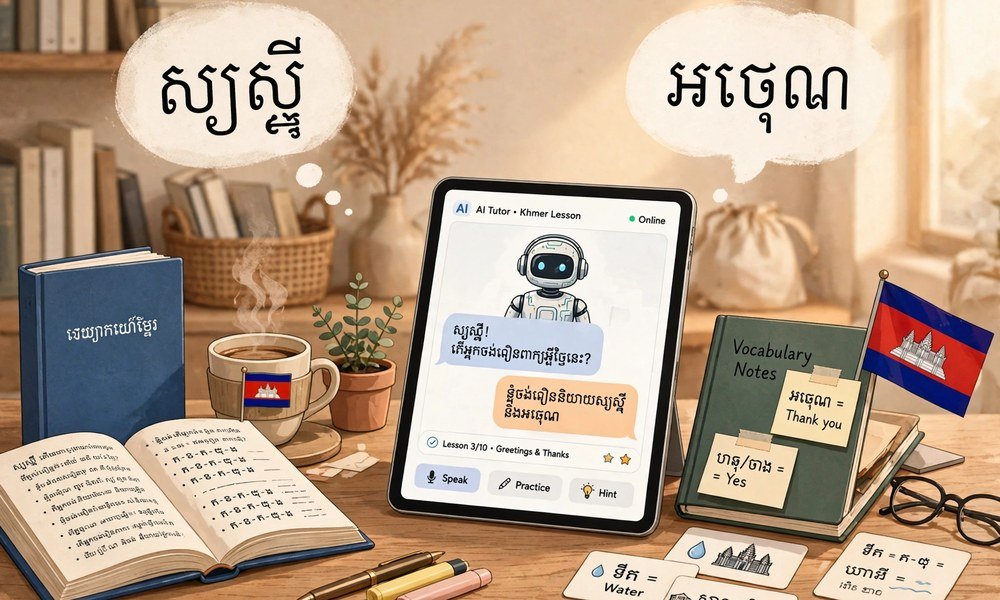
The app’s chatbot conversations are a highlight, letting you rehearse realistic dialogues such as checking into a hotel or ordering at a restaurant. The dashboard tracks your progress, and the daily lesson format makes it easy to build a habit that survives a busy schedule.
The main limitation is depth. Mondly’s Khmer course is shorter than its French or Spanish courses, and advanced learners will run out of new material sooner than they would like. The free version is limited, and premium costs around $9.99 per month, or less annually. Treat Mondly as your first three months of Khmer, then graduate to a deeper tool such as Ling or LingQ.
Pros: Very beginner-friendly; daily lessons build a strong habit; chatbot dialogues rehearse real situations; good speech recognition.
Cons: Khmer course is shorter than major-language courses; limited free tier; advanced learners will outgrow it quickly.
Drops — Best for vocabulary and the Khmer script
Drops takes a different approach: it is almost entirely visual. Every word is paired with a clean illustration, and you learn by tapping, matching, and swiping through five-minute sessions. That sounds simple, and it is, but it is remarkably effective for building Khmer vocabulary quickly. The app covers more than 2,000 Khmer words across topics such as food, travel, business, and daily life, each with native-speaker audio.
Where Drops really earns its place is the Khmer script. A dedicated alphabet section teaches you to recognise and write Khmer characters, the single biggest barrier for most learners. The visual method works well here because Khmer characters are distinctive shapes, and associating each one with an image and a sound helps it stick. The five-minute limit on the free plan forces short, focused practice that fits into a coffee break.
The trade-off is that Drops teaches words, not sentences. You will not learn grammar here, and you will not practise conversation. Think of Drops as a vocabulary engine to run alongside a fuller course, not a standalone path to fluency. Premium costs around $13 per month and removes the time limit, worth it if you plan several sessions a day.
Pros: Excellent for Khmer vocabulary and script recognition; beautiful, distraction-free design; native audio for every word; short sessions fit any schedule.
Cons: Teaches words, not grammar or conversation; five-minute limit on free plan; premium is pricier than some rivals.
Memrise — Best for video-based listening
Memrise’s strength is that it teaches you to understand real people, not just textbook recordings. Its “Learn with Locals” video clips show native speakers using phrases in natural contexts, which is invaluable for Khmer, where the rhythm and intonation of everyday speech differ sharply from slow lesson audio. Watching a Cambodian speaker order coffee at normal speed trains your ear in a way flashcards never will.
For Khmer specifically, it is important to know what you are getting. Memrise’s official Khmer course is modest, and much of the material comes from community-created courses. That is not necessarily a drawback — community courses often include practical phrases official courses skip — but quality varies, and some decks are better maintained than others. The spaced-repetition system is strong, bringing back words just as you are about to forget them.
Pricing starts at around $14.99 per month, with annual plans cheaper, making Memrise one of the pricier options here. The free tier is usable for vocabulary review. If listening comprehension is your weak point, Memrise is worth the money; if you want a structured Khmer curriculum, start with Ling and use Memrise as a listening supplement.
Pros: Real native-speaker video builds listening skills; strong spaced repetition; large community Khmer content; works well offline.
Cons: Official Khmer course is limited; community content quality varies; premium price is on the high side.
Talkpal — Best for AI conversation practice
Talkpal is a dedicated AI language tutor, and it is the closest thing on this list to a patient Khmer conversation partner on call at any hour. You can chat by text or voice, choose a topic, and the AI responds in Khmer at a level it adjusts to your ability. It corrects grammar, suggests more natural phrasing, and explains mistakes in English when you ask. For learners who freeze up when speaking to real people, an AI partner removes the social pressure entirely.
The app supports Khmer in text and voice modes, and offers role-play scenarios such as a market negotiation, a job interview, or a casual chat with a friend. Voice mode is particularly useful for Khmer because it forces you to produce the sounds yourself rather than just recognising them. Talkpal also includes debate and photo-description modes, which keep practice fresh once the basic scenarios feel easy.
Talkpal is not a course, so it will not teach you the alphabet or walk you through grammar in order. It works best after a few weeks of basics from Ling or Mondly, when you actually have something to say. Premium starts at around $9.99 per month, and a stable internet connection matters, since voice features run in the cloud. Used the right way, Talkpal is the fastest route from knowing Khmer words to actually speaking them.
Pros: Unlimited AI conversation in Khmer; voice and text modes; role-play scenarios; corrections with explanations in English.
Cons: Not a structured course; needs a good internet connection; free tier limits daily chats.
ChatGPT — Best for custom tutoring and explanations
ChatGPT is the most flexible tool on this list, because it is not a language course at all — it is a tutor you can shape however you like. Ask it to explain a Khmer grammar rule in plain English, to translate a sentence and break down every word, to quiz you on vocabulary, or to role-play a conversation at a Siem Reap market stall. It handles the Khmer script well and generates practice sentences at any difficulty you request. For self-directed learners, that flexibility is hard to beat.
The voice mode on the mobile app turns ChatGPT into a speaking partner. Ask it to speak slowly, repeat a phrase, or correct your pronunciation as you go. It is also excellent at creating personalised study material: paste in words you struggle with and ask for a story using all of them, or a dialogue using only vocabulary you have already learned. No fixed course adapts that precisely to one learner.
The trade-offs are real. ChatGPT has no curriculum, so you must decide what to study next, and it can occasionally make mistakes in Khmer — less common languages get less training data, and errors in tone or particle use do happen. Double-check anything important with a native speaker or a dedicated course. The free tier is genuinely useful; Plus costs $20 per month, mostly for faster responses and voice features. Use ChatGPT as your personal tutor alongside a structured app, not as your only teacher.
Pros: Fully customisable tutoring and explanations; voice mode for speaking practice; generates personalised exercises; free tier is strong.
Cons: No structured curriculum; occasional errors in Khmer; Plus at $20/month is the priciest option here.
LingQ — Best for reading and listening immersion
LingQ is built on a simple idea: you learn fastest by reading and listening to content you actually enjoy. The app lets you import Khmer texts, articles, and audio, then turns every unknown word into a flashcard with one tap. Its library includes Khmer stories and dialogues, and you can import your own material — a Cambodian news article, a song lyric, or a YouTube transcript — and study that instead. For intermediate learners, this is where real progress happens.
The Khmer library is smaller than the libraries for French or Japanese, so you will rely more on importing your own content. That is manageable, because Cambodian media is increasingly available online, and LingQ’s import tools handle web pages, ebooks, and audio files smoothly. The built-in dictionary and word-frequency tracking make vocabulary work feel purposeful rather than random.
LingQ is not a beginner tool. If you cannot yet read the Khmer script, start with Ling or Drops and come back once you can follow a simple paragraph. Premium costs around $12.99 per month and unlocks unlimited imports and vocabulary tracking. For learners at the intermediate plateau, LingQ is the best way to break through it.
Pros: Learn from real Khmer content you choose; excellent vocabulary tracking; import articles, ebooks, and audio; strong for intermediate learners.
Cons: Khmer library is smaller than major languages; not suitable for complete beginners; premium needed for unlimited imports.
italki — Best for live lessons with native tutors
No AI tool fully replaces a real teacher, and italki is where you find one. The platform connects you with native Khmer tutors for one-to-one video lessons, from around $5 per lesson for community tutors and more for professional teachers. You can filter by availability, price, and teaching style, book a trial lesson, and switch tutors freely until you find the right fit.
Live lessons fix the problems apps cannot. A tutor hears your pronunciation in real time and corrects the sounds you keep getting wrong. They can explain the cultural context behind a phrase, tell you when a textbook expression sounds stiff, and adjust the lesson to your goals — passing an exam, preparing for a work placement in Phnom Penh, or chatting with your partner’s family. Many tutors also provide homework and personalised materials between lessons.
The cost is the obvious drawback: even at $5 to $15 per lesson, weekly lessons add up to more than any app subscription. Use italki sparingly and strategically — one lesson a week or even one a fortnight — while doing daily practice in an app. Book a trial with two or three tutors before committing, and look for someone who teaches Khmer as a foreign language rather than simply speaking it.
Pros: Real-time correction from a native speaker; lessons tailored to your goals; cultural context apps cannot provide; flexible scheduling.
Cons: Pay per lesson, so costs add up; tutor quality varies; needs scheduling, unlike an app.
How to choose
Start from your goal, not from app store ratings. Travelling to Cambodia soon? Pick Mondly for fast phrases and Drops for vocabulary, and add Google Translate on your phone for live camera translation of signs and menus. Want conversational level over six to twelve months? Start with Ling as your core course, add Talkpal once you can hold a basic conversation, and book an italki tutor once a fortnight to fix your pronunciation.
Budget matters too. A free combination of ChatGPT, Memrise community courses, and Google Translate can carry a motivated beginner a long way before any payment is needed. If you do pay, subscribe to one app at a time. Check the free trial first, and confirm the Khmer content is actually there before entering payment details — catalogue depth varies most. The same applies to other less common languages, as covered in our guide to the best AI tools for learning Malayalam, where course depth also differs sharply between apps.
Finally, think about the script. If you cannot read Khmer yet, prioritise a tool that teaches the alphabet properly — Ling and Drops both do — because romanised Khmer will only carry you so far. Learners who skip the script hit a wall within weeks; learners who invest two weeks in the alphabet unlock every other resource on this list.
Checklist: before you pay
- Try the free tier first and confirm the Khmer course actually exists and has enough lessons for you.
- Test the speech recognition with Khmer sounds — if it cannot hear you, the app cannot help you speak.
- Check the renewal price, not just the introductory offer, and set a calendar reminder before it renews.
- Confirm you can cancel in the app without emailing support, and check whether your progress exports if you leave.
- Make sure offline downloads work if you will study on flights or in rural Cambodia.
- Pair any paid app with a free conversation tool, so you practise speaking as well as tapping answers.
Frequently asked questions
Can I learn Khmer with AI tools alone?
Yes, up to a solid intermediate level, if you combine a structured course such as Ling with a conversation tool such as Talkpal or ChatGPT. Apps handle vocabulary, grammar, and listening well, but speaking confidence and cultural nuance still improve faster with a human tutor, so most learners eventually add an italki lesson or two.
Which AI tool is best for learning Khmer in 2027?
Ling is the best overall choice, with a dedicated Khmer course, native audio, script lessons, and an AI chatbot. Mondly is the best starting point for complete beginners, and Talkpal is best once you are ready to practise real conversations.
Is Khmer hard to learn for English speakers?
Khmer is challenging mainly because of its script and sound system, which includes sounds English does not have. The grammar is relatively simple — no verb conjugations, no grammatical gender. Most learners find the alphabet takes two to four weeks of daily practice, after which progress speeds up noticeably.
Do any free AI tools teach Khmer?
Yes. ChatGPT’s free tier works well as a tutor, Memrise offers free community Khmer courses, and the free tiers of Ling, Mondly, and Drops all include real Khmer lessons. Google Translate is also free and useful for quick translations and camera translation of signs. For how free tiers compare across similar languages, see our guide to the best AI tools for learning Kannada.
How long does it take to become conversational in Khmer?
With thirty minutes of daily practice, most learners can handle everyday conversations — greetings, ordering food, asking directions, small talk — within six to nine months. Comfortable fluency usually takes one to two years. Daily speaking practice, even with an AI partner, shortens that timeline more than any other single habit.
Does Duolingo teach Khmer?
No. Duolingo does not offer a Khmer course, which is why it does not appear here. Ling and Mondly are the closest alternatives, with similar short-lesson formats and streak systems.
The bottom line
For most learners, the winning combination is Ling as the core course, Drops for vocabulary and the script, and Talkpal or ChatGPT for conversation practice. That trio costs less than a single weekly tutoring session and covers every skill a beginner needs. Add an italki lesson once a fortnight for a human ear on your pronunciation, and switch to LingQ once you can read simple Khmer texts.
Khmer has fewer learning resources than the big European languages, but the gap has closed dramatically thanks to AI. The best time to start is now — thirty minutes a day, every day, beats a weekend binge.
Note: Prices and plans change. Check the product’s current plan details before buying — no link is provided here by design, all links in this article go to other occcy.com guides.



