

Nepali is spoken by roughly 16 million people as a first language and many millions more across Nepal, northern India, Bhutan, and the global diaspora, yet it remains one of the hardest major languages to learn with mainstream apps. Most of the biggest language platforms still do not offer a full Nepali course, and the textbooks that do exist rarely teach the spoken Nepali you will actually hear in Kathmandu, Pokhara, or a Nepali home abroad. That gap is exactly where AI tools have changed the picture in 2027.
The tools in this guide were chosen for one reason: they genuinely support Nepali, not just in theory but in daily practice. We looked for Devanagari script support, Nepali audio from native speakers, conversation practice that corrects your mistakes, and pricing that makes sense for a learner who may study for a year or more. A tool that only translates a few words, or one that teaches Nepali through English explanations with no listening practice, did not make the list.
The shortlist below mixes a general AI assistant, dedicated Nepali courses, live tutors, and focused vocabulary trainers. No single tool does everything well, so the best approach for most learners is a combination: one main course for structure, one AI conversation partner for speaking, and one spaced-repetition tool for vocabulary. Start with the table, then read the two or three tools that match your level and budget.
Key takeaways
- ChatGPT is the best overall AI tool for learning Nepali in 2027, because it can converse, correct, and explain in Devanagari and Romanised Nepali on demand.
- Ling is the best structured Nepali course, with lessons, audio, and quizzes built specifically around the language.
- italki is the best choice for speaking confidence, pairing you with native Nepali tutors for live one-to-one lessons.
- Most learners should budget between 10 and 25 US dollars a month for a paid plan, and expect to pay more for live tutoring.
- Avoid tools that only translate Nepali without teaching it, and avoid any app that cannot show Devanagari script correctly.
At a glance: the shortlist
| Product | Best for | Starting price | Standout limit |
|---|---|---|---|
| ChatGPT | Overall learning and conversation | Free plan; paid from about $20 a month | Needs clear prompts to stay in Nepali |
| Ling | Structured Nepali course | Free trial; paid from about $9 a month | Smaller lesson library than major languages |
| Mondly | Daily conversation practice | Free starter; paid from about $10 a month | Less depth on Nepali grammar |
| Memrise | Vocabulary and listening | Free plan; paid from about $15 a month | Community content varies in quality |
| italki | Live lessons with native tutors | Pay per lesson, from about $5 | Costs add up with frequent lessons |
| Drops | Visual vocabulary for beginners | Free plan; paid from about $10 a month | Free plan limits daily study time |
| Clozemaster | Sentence practice for intermediates | Free plan; paid from about $8 a month | Not ideal as a first Nepali course |
| Anki | Custom flashcards and retention | Free on most platforms | Takes time to set up well |
ChatGPT — Best overall
ChatGPT is the most flexible tool on this list, and for Nepali that flexibility matters more than it does for French or Spanish. Because there is no single dominant Nepali course, a general AI assistant fills the gaps: it can hold a conversation in Nepali, switch between Devanagari and Romanised Nepali, explain a grammar point in plain English, and rewrite your sentences with corrections. You can ask it to act as a patient tutor, a shopkeeper in Kathmandu, or a friend making small talk, and it will stay in character while keeping the language at your level.
The strongest use is short, focused conversation. Ten minutes a day of Nepali dialogue, with the assistant correcting your errors and explaining why, builds speaking confidence faster than passive study. For reading, paste a short Nepali paragraph and ask for a word-by-word breakdown, then a summary in English, then the same paragraph with the difficult words explained.
Voice mode is where ChatGPT pulls ahead of most dedicated apps for Nepali. Speaking aloud and hearing a reply forces you to listen and respond in real time, which is the skill most self-study learners neglect. The same approach works for other low-resource languages, and our guide to the best AI tools for learning Kazakh shows how conversation practice transfers across languages with small course catalogues.
Pros: Unlimited conversation topics, clear explanations in English, Devanagari and Romanised output, voice practice, free plan is genuinely useful.
Cons: It can make mistakes in Nepali grammar, pronunciation is not native, and you need good prompts to get the most from it.
Ling — Best structured Nepali course
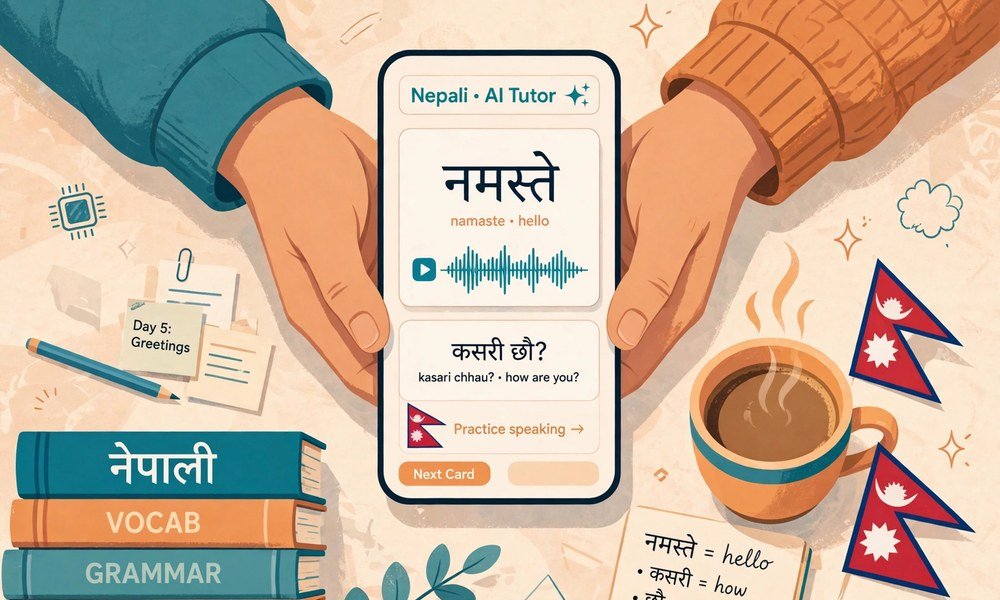
Ling is one of the few language apps that treats Nepali as a full course rather than an afterthought. Its lessons are built around everyday situations, such as greetings, ordering food, asking directions, and talking about family, and each lesson combines vocabulary, listening, and short quizzes. The audio uses native speakers, which matters for Nepali, where the difference between similar sounds can change a word entirely.
The lesson structure is short and repeatable. A typical session takes ten to fifteen minutes, which suits a daily habit, and the app tracks your streak and reviews words you have already met.
Ling also handles the script well. Nepali is written in Devanagari, and learning to read it is one of the biggest early hurdles. Ling shows words in Devanagari with Romanised transliteration alongside, so you can connect the sound, the script, and the meaning from the start. You can hide the transliteration as you improve, which pushes you to read the script itself. The course library is smaller than Ling’s offerings for major European languages, and advanced learners will outgrow it, but for the first year of Nepali it is the most complete structured option available.
Pros: A real Nepali course with native audio, clear lesson order, good Devanagari support, short daily sessions.
Cons: Fewer advanced lessons than major languages, and the conversation exercises are more scripted than a general AI chat.
Mondly — Best for daily conversation practice
Mondly takes a conversation-first approach to Nepali. Instead of starting with long grammar explanations, it drops you into short dialogues and asks you to respond, with speech recognition checking your pronunciation. The lessons are built around practical phrases, and the app repeats them in different contexts so they stick. For a learner who wants to speak Nepali on a trip or with family, that emphasis on usable phrases is a good fit.
The app’s daily lessons and weekly challenges give it a game-like feel, and the streak system encourages a short session every day rather than a long session once a week. The Nepali audio is clear and well-paced, and the app shows both Devanagari and transliteration, so you can follow along even before you can read the script fluently.
Where Mondly is weaker is depth. It explains less grammar than a structured course, so you may learn to say a phrase without understanding how to change it for a different situation.
Pros: Conversation-first lessons, speech recognition, clear native audio, motivating daily structure.
Cons: Limited grammar explanations, and the Nepali course is shorter than the courses for major languages.
Memrise — Best for vocabulary and listening
Memrise is built around a simple idea: you remember words better when you hear them from real people and review them at the right time. Its Nepali content includes video clips of native speakers, which helps you connect a word to a face, a voice, and a real situation. That is particularly useful for Nepali, where textbook pronunciation and everyday speech can sound quite different.
The app uses spaced repetition, showing you a word again just before you are likely to forget it. This is efficient for building a working vocabulary of the most common Nepali words, and the review sessions are short enough to fit into a commute or a coffee break.
Some Nepali content on Memrise is community-created, and quality varies between courses. Check the ratings and the number of learners before committing to a course, and favour official or highly rated community courses with audio. Used well, Memrise is an excellent second tool: it builds the vocabulary that makes your main course and your conversation practice easier, because you spend less time looking up words and more time using them.
Pros: Native-speaker video, effective spaced repetition, good for everyday vocabulary, short review sessions.
Cons: Community content quality varies, and it does not teach grammar in depth.
italki — Best for live lessons with native tutors
No app can fully replace speaking with a real person, and italki is the most direct way to do that for Nepali. The platform connects you with native Nepali tutors for one-to-one video lessons, and you choose the tutor, the price, and the schedule. Some tutors focus on structured lessons with homework, while others offer relaxed conversation practice. That choice matters: a beginner usually benefits from a structured tutor, while an intermediate learner often gets more from conversation with gentle correction.
A typical lesson costs from about five dollars, with experienced professional teachers charging more. One lesson a week is enough to keep your speaking honest, because a tutor will hear the mistakes an app lets slide, such as wrong word order, missing particles, or pronunciation that changes the meaning.
The main drawback is cost. Two or three lessons a week quickly becomes the most expensive item in a language-learning budget, so most learners combine italki with cheaper tools. A good balance is one lesson a week plus daily app study and AI conversation practice. Book a trial lesson with two or three tutors before committing, because teaching style and patience matter as much as price, and the right tutor makes the difference between lessons you look forward to and lessons you avoid.
Pros: Real native speakers, personalised feedback, flexible scheduling, choice of tutor and price.
Cons: Pay-per-lesson costs add up, and tutor quality varies, so trial lessons are essential.
Drops — Best for visual vocabulary for beginners
Drops teaches Nepali vocabulary through pictures rather than translations. Each word is shown with an illustration, the Devanagari script, and native audio, and you learn by matching, swiping, and tapping in five-minute sessions. The visual approach suits beginners who find long word lists boring, and it is particularly good for concrete nouns such as food, animals, colours, and household objects.
The five-minute session limit on the free plan is both a strength and a weakness. It forces a short, focused habit, which is easier to keep than an hour-long study session, but it can feel restrictive once you want to study for longer.
Drops does not teach grammar or conversation, so it works best as a supplement rather than a main course. Use it for ten minutes a day alongside a structured course, and you will build a solid base of everyday words that makes reading and listening much easier. It is also a good tool for children or for learners who prefer a visual, game-like style to a textbook approach.
Pros: Visual learning with illustrations, native audio, short sessions that are easy to keep up, good for concrete vocabulary.
Cons: Free plan limits daily time, and it does not teach grammar or conversation.
Clozemaster — Best for sentence practice for intermediates
Clozemaster is designed for learners who already know some Nepali and want to move from single words to real sentences. It shows you a sentence with one word missing and asks you to fill the gap, using context to work out the answer. This cloze method is effective because it forces you to think about how words fit together, including verb endings, particles, and word order, rather than just recognising a word on its own.
The Nepali content draws on sentences with audio, and you can practise in different modes, including multiple choice, typing, and listening. The listening mode is particularly useful: you hear a sentence and type the missing word, which trains your ear for the rhythm and sounds of spoken Nepali.
Clozemaster is not a beginner tool. If you do not yet know basic Nepali vocabulary and grammar, the sentences will feel random and frustrating. Start it after a few months of study, when you can read Devanagari slowly and understand simple sentences, and it will accelerate your progress. Used at the right stage, it bridges the gap between textbook exercises and reading real Nepali text.
Pros: Sentence-level practice, listening mode, spaced repetition for weak words, good for intermediate learners.
Cons: Not suitable for complete beginners, and the interface is less polished than the bigger apps.
Anki — Best for custom flashcards and long-term retention
Anki is a free, open flashcard app built on spaced repetition, and it is the most powerful retention tool on this list if you are willing to set it up. You create your own decks, or download shared Nepali decks, and Anki schedules each card for review at the moment you are most likely to forget it. That scheduling is more precise than most built-in review systems, and over months it makes a real difference to how much vocabulary you keep.
The strength of Anki is control. You can make cards for the exact words and sentences you meet in your course, your tutor lessons, or your reading, with audio, example sentences, and pictures.
The trade-off is effort. Anki has a plain interface, and building a good deck takes time and judgement. Shared Nepali decks vary in quality, so check them for errors and correct audio before relying on them. If you want a tool that works straight out of the box, choose a dedicated app instead. If you are a serious learner who wants to keep every word you learn, Anki is worth the setup time and will repay it over a year of study.
Pros: Free on most platforms, precise spaced repetition, fully customisable decks, excellent long-term retention.
Cons: Plain interface, takes time to set up, and shared deck quality varies.
How to choose
Start with your level and your goal. A complete beginner should pick one structured course, such as Ling, and use it daily for the first three months. Add a vocabulary tool such as Drops or Memrise for ten minutes a day, and use ChatGPT for simple conversation once you can form basic sentences. An intermediate learner should reverse the balance: spend most of your time on conversation, with italki or ChatGPT voice mode, and use Clozemaster and Anki to fill vocabulary gaps.
Budget matters too. If you can afford one paid subscription, spend it on the tool you will use every day, not the one with the longest feature list. A free plan plus a weekly tutor lesson often beats two subscriptions you rarely open. For a broader sense of how these language tools compare across languages, see our guide to the best AI tools for learning Armenian, which uses the same criteria of script support, native audio, and real conversation practice.
Finally, test the Nepali support before you pay. Open the app, check that Devanagari displays correctly, listen to the audio, and try a lesson. If the audio sounds robotic, the script is broken, or the course is only a few lessons long, move on. The best tool is the one you will actually use every day, and for Nepali that usually means a combination of a course, a conversation partner, and a review tool rather than a single app.
Checklist: before you pay
- Try the free plan or trial first, and check that Nepali audio and Devanagari script work properly on your device.
- Compare the renewal price, not just the introductory offer, and check how easy it is to cancel.
- Confirm the course has enough lessons for at least three months of study at your level.
- Make sure you can export or review your vocabulary, so your progress is not locked inside one app.
- Check whether the tool offers speaking practice, not just reading and multiple choice.
- Set a realistic daily habit, such as twenty minutes a day, before you commit to a yearly plan.
Frequently asked questions
Can AI really teach Nepali?
AI can teach a great deal of Nepali, especially vocabulary, grammar explanations, and conversation practice, but it works best alongside native audio and, ideally, a human tutor. Use AI for daily practice and explanations, and check pronunciation and natural phrasing against native speakers whenever you can.
How long does it take to learn basic Nepali?
Most learners can hold a simple conversation after three to six months of daily study of twenty to thirty minutes, including greetings, introductions, ordering food, and asking directions.
Do I need to learn Devanagari script?
Yes, if you want to read Nepali or use most learning materials. Romanised Nepali is useful at the start, but the script is not as hard as it looks, and learning it early makes every other tool more useful. Most of the apps in this guide show both script and transliteration while you learn.
Which tool is best for speaking Nepali?
italki is best for speaking with a real person, because a tutor gives personalised feedback that no app can match. ChatGPT voice mode is the best free or low-cost alternative for daily speaking practice, and it is available at any hour.
Are there free AI tools for learning Nepali?
Yes. ChatGPT and Anki both have useful free plans, and Drops, Memrise, and Clozemaster offer free tiers. A free combination of ChatGPT for conversation, Anki for vocabulary, and a free course trial can take a beginner a long way before any payment is needed. Our guide to the best AI tools for learning Azerbaijani follows the same free-first approach for another language with a smaller app catalogue.
Is Nepali hard to learn for English speakers?
Nepali is moderately challenging. The grammar is different from English, and Devanagari is a new script, but pronunciation is largely regular once you learn the sounds, and there are no tones to master. Consistent daily practice matters far more than talent, and the tools in this guide are designed to make that practice easier.
The bottom line
For most learners, the best combination in 2027 is ChatGPT for daily conversation, Ling for structured lessons, and Anki for vocabulary review. Add italki once a week when you are ready to speak with a real person, and use Drops or Memrise for short vocabulary sessions in between. That stack covers structure, speaking, listening, and retention without paying for tools you will not use.
If you only want one paid tool, choose Ling for a structured course or italki for live lessons, depending on whether you prefer self-study or speaking with a tutor. Whichever you choose, study a little every day, speak aloud from the first week, and learn Devanagari early. Nepali rewards consistency, and the AI tools in this guide make that consistency easier than it has ever been.
Note: Prices and plans change. Check the product’s current plan details before buying — no link is provided here by design, all links in this article go to other occcy.com guides.



