Tajik is spoken by roughly 8 million people, mostly in Tajikistan and in Tajik-speaking communities across Uzbekistan, Afghanistan, and Russia, yet it remains one of the least served languages in mainstream language-learning apps. Until recently, anyone who wanted to learn Tajik had to rely on textbooks, university courses, or a patient native speaker. In 2027, that has changed. AI-powered tools now offer Tajik courses, pronunciation feedback, and conversation practice that simply did not exist five years ago, even if the coverage is still thinner than for Spanish or French.
The catch is that not every app that claims to teach Tajik actually does. Some list Tajik in a language menu but offer only a handful of phrases. Others use machine-generated audio that mispronounces the language’s distinctive sounds, including the letters ғ, қ, ҳ, and ҷ that do not exist in Russian Cyrillic. A few tools are excellent for vocabulary but useless for speaking, while others are strong on conversation but weak on the Cyrillic script Tajik uses. Choosing the wrong tool can waste months.
This guide compares eight AI tools that genuinely support Tajik in 2027, ranked by how much Tajik content they offer, how accurate their pronunciation models are, and how well they fit different learners — from complete beginners to heritage speakers who want to reconnect with the language. Prices are starting prices at the time of writing and may change, so check the current plan details before buying.
Key takeaways
- Duolingo is the best overall pick for Tajik in 2027, with the most complete beginner course and the most reliable daily structure.
- Mondly is the best choice for absolute beginners who want quick, spoken phrases from day one.
- ChatGPT is the strongest AI tutor for Tajik, because it can explain grammar, correct your sentences, and role-play conversations on demand.
- Tajik’s Cyrillic script and its sounds ғ, қ, ҳ, and ҷ make pronunciation tools and audio quality more important than they are for most languages.
- No single app covers everything — pair one structured course with one speaking tool for the fastest progress.
At a glance: the shortlist
| Product | Best for | Starting price | Standout limit |
|---|---|---|---|
| Duolingo | Best overall | Free; paid from about $7 per month | Tajik course is shorter than major languages |
| Mondly | Beginners and spoken phrases | Free; paid from about $10 per month | Less grammar depth than rivals |
| Memrise | Vocabulary and memory | Free; paid from about $9 per month | Limited Tajik conversation practice |
| LingQ | Reading and listening | Free; paid from about $13 per month | Tajik library is smaller than big languages |
| Drops | Quick daily practice | Free; paid from about $10 per month | Five-minute sessions on the free plan |
| Clozemaster | Intermediate sentences | Free; paid from about $8 per month | Not suitable for complete beginners |
| ChatGPT | AI tutor and conversation | Free; paid from about $20 per month | Needs checking against native sources |
| italki | Live speaking with tutors | From about $5 per lesson | Tutor availability varies by week |
Duolingo — Best overall
Duolingo is the most complete way to start learning Tajik in 2027, and it is the first tool most learners should try. Its Tajik course covers the Cyrillic alphabet, core vocabulary, and everyday sentences in short, game-like lessons that take about ten minutes a day. The streak system, reminders, and bite-size exercises make it unusually easy to stay consistent, which matters more than any single feature when you are learning a language with few speakers around you.
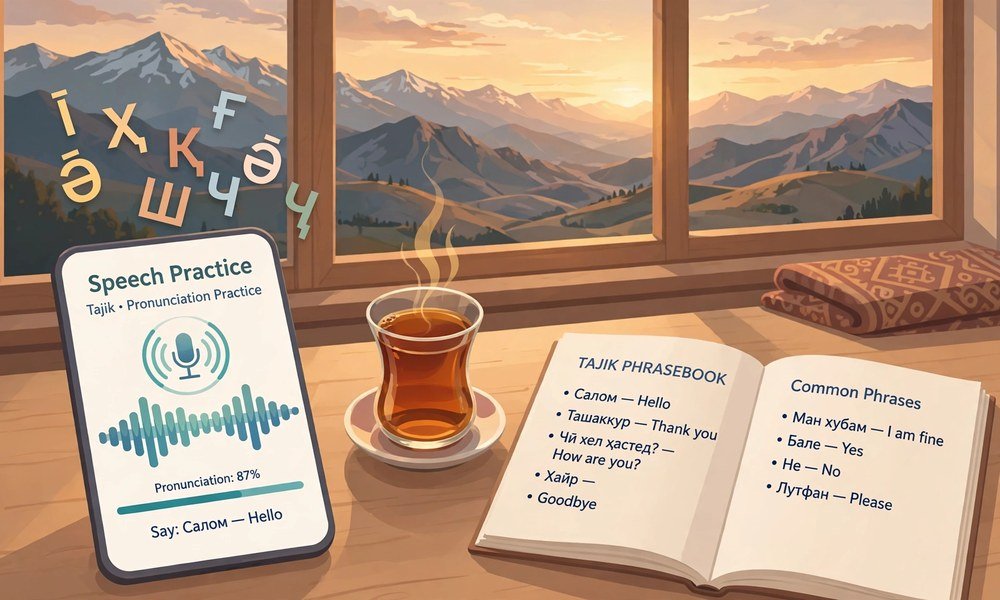
The app’s AI features have improved noticeably. Speech recognition now gives instant feedback on your pronunciation of Tajik words, and the adaptive review system brings back words you are about to forget. The course is not as deep as Duolingo’s Spanish or French courses, and advanced learners will run out of new material sooner, but for the first six to twelve months it provides the clearest path from zero to basic conversation. Learners who enjoy structured daily lessons will also appreciate how similar the experience is to the app’s other Central Asian courses — our guide to the best AI tools for learning Uzbek covers a close regional neighbour with a comparable course structure.
Pros: Free to start, excellent daily structure, good Cyrillic alphabet introduction, speech recognition included.
Cons: Tajik course is shorter than major-language courses, limited advanced grammar, ads on the free plan.
Mondly — Best for beginners and spoken phrases
Mondly takes a different approach from Duolingo: it throws you into useful spoken phrases from the very first lesson. Instead of drilling the alphabet for a week, you learn how to greet someone, order food, and ask for directions in Tajik, with native-speaker audio for every phrase. For travellers heading to Dushanbe or heritage learners who want to speak with family, that early payoff is motivating.
The app’s chatbot conversations are its standout feature. You practise short dialogues with an AI partner that responds to your spoken answers, which builds confidence faster than tapping multiple-choice questions. Speech recognition scores your pronunciation, and the daily lessons, weekly quizzes, and monthly challenges give the routine some shape. Mondly’s weakness is depth: it explains less grammar than Duolingo, and after the beginner and intermediate material you will need another tool to keep growing.
Pros: Fast route to spoken phrases, strong native audio, AI chatbot conversations, good for travel preparation.
Cons: Thin grammar explanations, smaller Tajik vocabulary set than Duolingo, premium subscription needed for full access.
Memrise — Best for vocabulary and memory
Memrise is built around one idea: you remember words better when you meet them often, in varied contexts, and just before you would forget them. Its spaced-repetition system is one of the best in the business, and for Tajik — a language where every new word feels unfamiliar at first — that matters. The app pairs Tajik words with audio, video clips of native speakers, and memory hooks that make vocabulary stick.
The Tajik content on Memrise is a mix of official courses and community-created decks, so quality varies. The official material is solid for core vocabulary, while community decks can fill gaps such as food words, family terms, and travel phrases. The newer AI features add adaptive review sessions and conversation videos that show words used in realistic situations. Memrise will not teach you to hold a conversation on its own, but as a vocabulary engine alongside a structured course, it is hard to beat.
Pros: Excellent spaced repetition, native-speaker video, strong for building a core vocabulary quickly.
Cons: Community content quality varies, weak on grammar and conversation, Tajik course is less polished than major languages.
LingQ — Best for reading and listening
LingQ is designed for learners who want to read and listen to real Tajik rather than drill flashcards. You import or choose texts — short stories, news articles, dialogues — and the app turns every unknown word into a flashcard with one tap. Audio accompanies most lessons, so you can listen and read at the same time, which is the fastest way to get used to Tajik’s rhythm and its Cyrillic spelling.
The Tajik library is smaller than the libraries for French or German, but it is growing, and the import feature is the real advantage: you can bring in Tajik news, song lyrics, or any text you care about and study it with built-in dictionaries and AI-generated explanations. Intermediate learners benefit most, because LingQ assumes you already know the alphabet and basic words. Beginners should start elsewhere and move to LingQ once they can read simple sentences.
Pros: Learn from real texts you choose, strong listening and reading practice, AI word explanations, import any Tajik text.
Cons: Not for complete beginners, Tajik library is limited, subscription is pricier than rivals.
Drops — Best for quick daily practice
Drops is the simplest tool on this list, and deliberately so. Each session lasts five minutes and focuses on one visual vocabulary topic: food, colours, numbers, travel, and so on. You match Tajik words to illustrations, hear the audio, and build a habit that fits into a coffee break. There are no grammar lessons and no conversations, just fast, focused word learning with beautiful design.
That narrow focus is both the strength and the limit. Drops is the best second app in a Tajik learning routine, because it keeps vocabulary fresh on days when you do not have time for a full lesson. The Tajik word lists cover everyday topics well, and the audio is clear. But five minutes a day will never make you fluent, and the free plan’s daily time limit means serious learners will need the premium version or a companion app.
Pros: Beautiful visual learning, perfect for busy days, clear Tajik audio, builds a daily habit fast.
Cons: Five-minute limit on the free plan, no grammar or conversation, vocabulary only.
Clozemaster — Best for intermediate sentences
Clozemaster is a fill-in-the-blank game that teaches Tajik in context. You see a sentence with one word missing, choose the right word from four options, and gradually absorb how Tajik sentences are actually built. It is the closest thing to reading real Tajik without opening a book, and it is surprisingly addictive once you know a few hundred words.
The app shines for intermediate learners who already know the alphabet and basic vocabulary but struggle to use words in sentences. Its large sentence bank exposes you to verb forms, case endings, and word order in a way that isolated flashcards cannot. The downside is that it assumes too much for beginners — if you cannot read Cyrillic yet, Clozemaster will frustrate you — and it teaches little about speaking or listening. Use it after three or four months with Duolingo or Mondly, not before.
Pros: Excellent for learning words in real sentences, large Tajik sentence bank, great for intermediate learners.
Cons: Too hard for beginners, minimal speaking practice, interface is plain compared with rivals.
ChatGPT — Best AI tutor and conversation partner
ChatGPT is the most flexible AI tool for learning Tajik, because it is not a fixed course at all. You can ask it to explain a grammar rule, correct a sentence you wrote, translate a phrase and explain the nuance, or role-play a conversation — ordering food in a Dushanbe cafe, for example — and it will adapt to your level instantly. No other tool on this list gives you a tutor available at any hour, on any topic, for free.
The paid plan adds voice mode, which turns ChatGPT into a speaking partner that listens to your Tajik pronunciation and replies in spoken Tajik. That is genuinely useful for a language with few conversation partners. The risk is accuracy: ChatGPT sometimes produces unnatural Tajik or confident-sounding errors, especially with less common words and formal registers. Treat it as a tutor whose answers you verify, not as a source of truth — cross-check anything important with a native speaker or a dictionary. Used wisely, it is the single most powerful supplement to a structured course.
Pros: Unlimited personalised explanations, voice conversation practice, adapts to any level, free tier is genuinely useful.
Cons: Occasional errors in Tajik, needs verification, no structured curriculum or progress tracking.
italki — Best for live speaking with tutors
italki is the only tool on this list that puts you in front of a real Tajik speaker, and for speaking confidence nothing else comes close. You book one-to-one video lessons with native Tajik tutors, many of whom charge less than ten dollars an hour, and you practise real conversation from the first lesson. Tutors can correct your pronunciation of sounds like ғ and қ, explain cultural context, and tailor lessons to your goals, whether that is travel, family, or work.
The trade-off is that italki is not an app you open for five minutes a day; it is a commitment. You need to schedule lessons, show up, and do the homework your tutor sets. Availability of Tajik tutors is thinner than for major languages, so popular tutors book up, and lesson quality varies between teachers. Even one lesson a week, combined with a daily app, transforms your speaking faster than any amount of solo study.
Pros: Real conversation with native speakers, personalised lessons, affordable Tajik tutors, instant pronunciation correction.
Cons: Requires scheduling, tutor availability varies, no built-in curriculum or daily exercises.
How to choose
Start with your goal, not with the app store ratings. If you want to speak with family or travel in Tajikistan, prioritise speaking tools: Mondly for phrases and italki for live conversation. If you want to read Tajik news or books, LingQ and Clozemaster will serve you better than any phrasebook app. And if you simply want a daily habit that sticks, Duolingo’s structure is the safest starting point, because the tool you actually open every day beats the tool with the best features that you open once a month.
Second, check the Tajik content before you pay. Free trials and free tiers exist for every tool on this list, and Tajik coverage varies far more than marketing suggests. Open the app, search for Tajik, and count how many lessons or word lists it actually offers before subscribing. A tool with a deep Tajik course is worth more than a famous brand with ten phrases. The same caution applies across Central Asian languages — the best AI tools for learning Kazakh show a similar pattern, where course depth matters far more than brand name.
Third, think in pairs. The strongest routine in 2027 is one structured course plus one speaking tool: Duolingo plus italki, or Mondly plus ChatGPT voice mode. Add Memrise or Drops for vocabulary on busy days, and LingQ once you can read. Budget for one paid subscription rather than three, and use free tiers for the rest. Finally, remember that Tajik has two scripts in daily life — Cyrillic is standard in Tajikistan, while Persian script appears in older texts and in Afghanistan — so confirm your chosen tool teaches the Cyrillic alphabet if Tajikistan is your focus.
Checklist: before you pay
- Try the free tier first and confirm Tajik is genuinely supported, with more than a phrase list.
- Check the renewal price, not just the introductory offer — monthly billing is usually far more expensive than annual.
- Test the audio quality on the sounds ғ, қ, ҳ, and ҷ before committing to a speaking tool.
- Confirm you can cancel easily and keep your progress data if you switch tools.
- Check whether your vocabulary and progress export to another app or at least survive a subscription lapse.
- Make sure the tool works offline or on your device if you travel in areas with patchy internet.
Frequently asked questions
Can I learn Tajik for free with AI tools?
Yes, up to a point. Duolingo, Mondly, Memrise, Drops, Clozemaster, and ChatGPT all have free tiers that cover beginner Tajik, and you can get surprisingly far without paying. The limits are real, though: ads, daily time caps, and locked advanced lessons. Most learners find one paid subscription worth it after a few months, but start free and only pay once you know which tool you actually use every day.
How long does it take to learn Tajik with these tools?
With thirty minutes of daily practice, most learners can handle greetings, introductions, and simple everyday conversations within three to six months. Reaching comfortable intermediate level — reading simple news and chatting about familiar topics — typically takes twelve to eighteen months. Tajik’s Cyrillic script adds a few weeks at the start, but its grammar is simpler than Russian, which helps. Speaking practice with a tutor shortens every stage.
Is Tajik hard to learn for English speakers?
Tajik is moderately difficult. The Cyrillic alphabet takes a few weeks to master, and sounds like ғ and қ need practice, but the grammar is regular and verb conjugation is simpler than in many European languages. Tajik shares vocabulary with Persian, so anyone who knows Persian has a head start. The hardest part is not the language itself but the shortage of learning material, which is exactly what the AI tools in this guide help to solve.
Do these apps teach the Cyrillic alphabet?
Duolingo and Mondly both introduce the Cyrillic alphabet used in Tajikistan, and LingQ and Clozemaster assume you can already read it. If you are starting from zero, begin with Duolingo’s alphabet lessons before moving to reading-focused tools. Be aware that Tajik is also written in Persian script in some contexts, but Cyrillic is the standard for learners focused on Tajikistan.
Which tool is best for Tajik pronunciation?
For solo practice, Mondly and Duolingo both offer speech recognition that scores your pronunciation, while ChatGPT’s voice mode gives more natural conversation feedback. For the best results, though, nothing replaces a native speaker: a weekly italki lesson will correct mistakes that apps miss, especially the sounds ғ, қ, ҳ, and ҷ. Learners comparing options across the region may also find the best AI tools for learning Azerbaijani useful, since its pronunciation tools face similar challenges with unfamiliar sounds.
Can ChatGPT really teach me Tajik?
ChatGPT is an excellent tutor and conversation partner, but it is not a complete course. It explains grammar well, corrects your sentences, and role-plays dialogues on any topic, and its voice mode is genuinely useful for speaking practice. Its Tajik is usually good but not perfect, so verify important phrases with a native speaker or a dictionary. Pair it with a structured course like Duolingo for the best results.
The bottom line
For most learners, Duolingo is the best place to start learning Tajik in 2027: it is free, structured, and covers the alphabet, vocabulary, and basic conversation in one place. Add Mondly if you want spoken phrases fast, or ChatGPT if you want a personal tutor that answers any question. Once you can read and speak a little, LingQ and Clozemaster will deepen your reading, and a weekly italki lesson will do more for your speaking than any app alone.
The real secret is consistency, not the perfect app. Thirty minutes a day with one good tool beats three hours on a Sunday with five of them. Pick the tool you will actually open tomorrow morning, start with the free tier, and let your routine — not a subscription — decide what you pay for next.
Note: Prices and plans change. Check the product’s current plan details before buying — no link is provided here by design, all links in this article go to other occcy.com guides.