
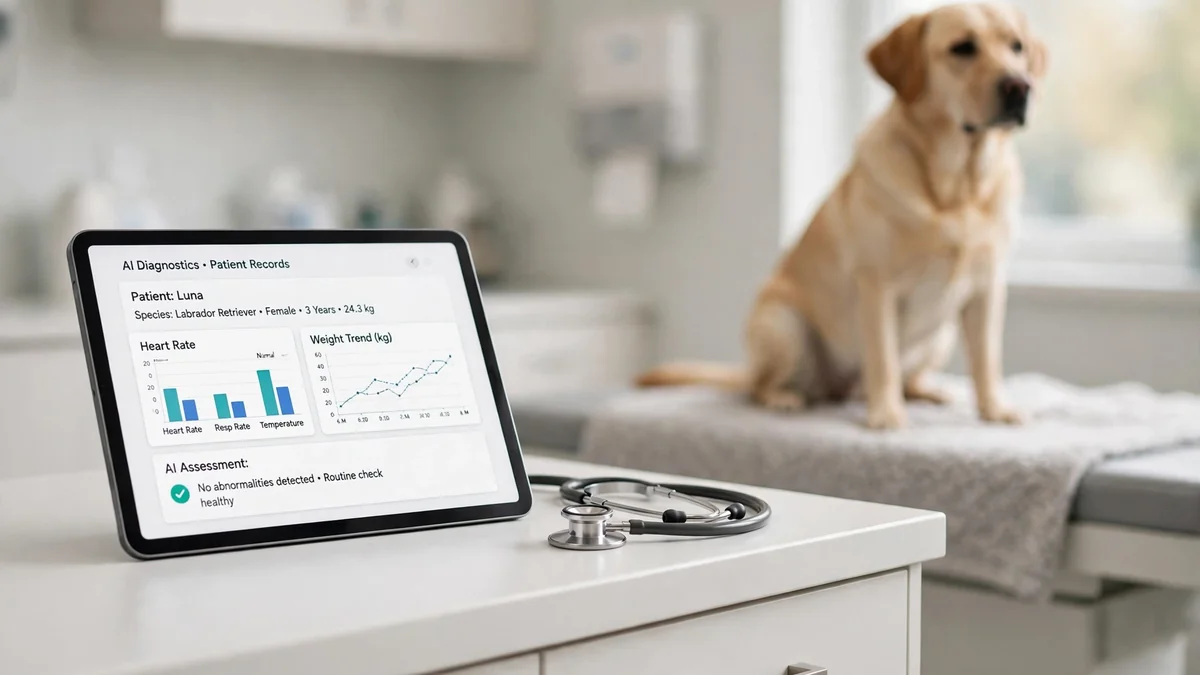
Best AI tools for veterinarians in 2027 are no longer a novelty for large referral hospitals. They are practical, everyday software that writes clinical notes, reads radiographs, flags abnormal bloodwork, answers client messages and keeps the appointment book full. The best AI tools for veterinarians now save clinicians thirty to sixty minutes a day, and in a profession where burnout and staff shortages are constant pressures, that time matters more than any single feature on a pricing page.
The market has split into clear groups. AI scribes listen to the consultation and draft the medical record. AI radiology tools give a second read on X-rays within minutes. AI assistants inside practice management systems handle scheduling, reminders and client chat. Oncology and laboratory tools turn test results into treatment options ranked by likely response. The tools below were chosen because they are built specifically for veterinary medicine, they are in live use in real clinics, and they solve a named job rather than promising general intelligence.
This guide covers eight tools, from the all-round scribe that suits most small practices to specialist radiology and oncology platforms for referral work. Every tool was judged on veterinary specificity, time saved, accuracy and independent validation, ease of use in a busy consult room, integration with the practice management system, and data handling.
Key takeaways
- ScribbleVet is the best overall pick for most practices because it covers notes, summaries and client communication in one scribe workflow.
- VetRec is the strongest choice for practices that want the record written directly into their practice management system with minimal editing.
- SignalPET and Vetology are the leading AI radiology options, and they solve different problems, so the right one depends on your caseload.
- ImpriMed is the standout specialist tool, using AI to rank cancer treatments for individual dogs and cats.
- Do not buy on price alone: check the per-clinician cost, the contract length, how records are stored, and whether the tool works with your existing software before you commit.
At a glance: the shortlist
| Product | Best for | Starting price | Standout limit |
|---|---|---|---|
| ScribbleVet | Best overall AI scribe | Check current pricing | Per-clinician subscription |
| VetRec | Records that write themselves | Check current pricing | Depends on practice system |
| CoVet | Fast notes for busy consults | Check current pricing | Per-clinician subscription |
| SignalPET | AI radiology in minutes | Per-study pricing, check current pricing | X-ray only |
| Vetology | Radiology second opinions | Per-study pricing, check current pricing | Needs good quality images |
| ImpriMed | AI-guided cancer care | Per-case pricing, check current pricing | Oncology only |
| Digitail | AI practice assistant | Check current pricing | Full system migration |
| Talkatoo | Voice dictation for vets | Check current pricing | Dictation, not full scribe |
ScribbleVet — Best overall
ScribbleVet is an AI scribe built for veterinary consultations. It records the conversation in the exam room, transcribes it, and drafts a structured medical record, a client-facing summary and follow-up notes. The veterinarian reviews and approves the draft rather than typing it from scratch. For a typical small animal practice, that is the single biggest time saving available from any AI tool, because notes are the task that most often spills into lunch breaks and evenings.

The workflow is deliberately simple. The clinician starts recording at the beginning of the consultation, talks normally, and receives a draft record organised into history, examination findings, assessment and plan.
ScribbleVet works best in practices that already run a consistent consultation structure. Clinicians who narrate findings aloud during the examination get the cleanest drafts, because the tool can only record what is said. Quiet examinations, or consultations where most of the assessment happens silently, produce thinner notes that need more manual input. The scribe writes the note, but appointments, billing and reminders still live elsewhere, so practices comparing their whole software stack should also review the best veterinary practice management software before deciding how the scribe fits into the wider workflow.
Pros: purpose-built for veterinary consultations; drafts notes, summaries and discharge instructions from one recording; reduces after-hours charting; straightforward to learn.
Cons: per-clinician pricing adds up in larger teams; draft quality depends on how much the clinician narrates aloud; check current pricing, as plans and limits change.
VetRec — Best for records that write themselves
VetRec takes a similar scribe approach but puts the emphasis on the finished record. It listens to the consultation and produces a complete medical record that is designed to land directly in the practice management system, with the structure and terminology the clinic already uses. The pitch is not just faster notes, but notes that look as though the clinician wrote them carefully, without the clinician spending twenty minutes doing so.
The difference shows in the details. VetRec is built to capture the small facts that make a record useful later: the exact dose discussed, the recheck interval agreed, the owner concern that was raised and answered.
VetRec suits practices with high consultation volumes and a team that shares records across shifts. The main question to ask before buying is integration: confirm that VetRec connects cleanly with your practice management system, how records are transferred, and what happens to the audio after the record is generated. Data handling and retention should be confirmed in writing.
Pros: complete, well-structured records; strong fit for high-volume and multi-vet practices; reduces handover gaps between clinicians.
Cons: value depends on integration with your practice system; still requires a careful human review of every draft; check current pricing.
CoVet — Best for fast notes in busy consults
CoVet is another veterinary AI scribe, positioned for speed. It records consultations and turns them into structured SOAP notes, client summaries and treatment plans, with an emphasis on getting the draft back quickly so the clinician can review it before the next patient arrives. In a clinic running ten-minute appointments, that turnaround matters: a scribe that delivers the note an hour later is far less useful than one that delivers it while the consultation is still fresh.
CoVet’s interface is intentionally light. There is little to configure, and the learning curve is short, which helps when the whole team needs to adopt it at once.
The trade-off is depth. Complex referral cases, multi-problem patients and long diagnostic workups will still need more manual writing than a simple wellness visit, and CoVet is best judged on those harder cases during a trial rather than on the easy ones.
Pros: fast draft turnaround; simple setup and short learning curve; good fit for routine and wellness consultations.
Cons: complex cases need more manual editing; per-clinician pricing; confirm how long audio and transcripts are stored.
SignalPET — Best for AI radiology in minutes
SignalPET is an AI radiology tool for veterinary X-rays. A radiograph is uploaded and the system returns an AI assessment within minutes, highlighting findings such as fractures, lung patterns, cardiac size and abdominal abnormalities, with measurements and annotations on the image. For a general practice vet who needs to decide whether a case can be managed in-house or needs referral, that speed is genuinely useful.
The tool is trained on veterinary images, which is the point that separates it from general medical AI. Dogs and cats have different anatomy, positioning and normal variation from human patients, and a tool trained on human radiographs would be unreliable here. SignalPET’s assessments are presented as an aid to the clinician, not a replacement for judgement, and the vet remains responsible for the final interpretation. Used that way, it works as a careful second pair of eyes that never gets tired at the end of a long day.
SignalPET is priced per study, which suits practices that take X-rays regularly but not constantly. A clinic doing a handful of radiographs a week pays only for what it uses, while a busy practice can look at a subscription or volume arrangement.
Pros: fast AI assessment of radiographs; trained on veterinary images; per-study pricing suits lower-volume practices.
Cons: X-ray only, so it does not help with ultrasound or bloodwork; results depend on image quality; the vet must still make the final call.
Vetology — Best for radiology second opinions
Vetology, from Vetology Innovations, offers AI-assisted radiology with a different emphasis: it combines AI analysis with access to board-certified veterinary radiologists. The AI provides an initial assessment, and the clinic can escalate to a specialist report when the case is complex or the stakes are high. That combination is valuable for practices that want both speed and a human specialist safety net.
The workflow fits naturally into a general practice day. Radiographs are submitted, the AI assessment arrives quickly, and the clinician can decide whether that is enough or whether a full specialist report is warranted. For an ambiguous chest film on a coughing dog, or a subtle orthopaedic finding, having the escalation path built into the same system saves the delay of sending images elsewhere and waiting for a separate report.
Vetology’s value depends on how often the practice needs that specialist layer. Clinics with in-house radiology confidence may find the AI assessment alone is enough most of the time, while clinics that refer frequently will use the specialist reports more. Either way, confirm turnaround times for both the AI assessment and the specialist report, and confirm how the findings are stored against the patient record.
Pros: AI assessment plus access to specialist radiologists; good fit for ambiguous or high-stakes cases; fast initial results.
Cons: specialist reports cost more than the AI assessment alone; per-study pricing, so check current pricing; needs good quality radiographs.
ImpriMed — Best for AI-guided cancer care
ImpriMed is the most specialist tool on this list. It uses AI to analyse a dog or cat’s cancer cells and predict which chemotherapy drugs are most likely to work for that individual patient. A sample is sent to the laboratory, the cells are tested against a panel of drugs, and the AI model ranks the options by predicted response. The oncologist or general practitioner then uses that ranking, alongside the patient’s condition and the owner’s preferences, to choose a treatment plan.
This is a different kind of AI from a scribe or a radiology tool. It does not save administrative time; it aims to improve a clinical outcome.
ImpriMed is priced per case, and it is not a tool every practice will use every week. Its place is in practices that see oncology cases regularly, or that work closely with a referral oncologist. The main questions are practical: sample handling and shipping, turnaround time, and how the results are explained to owners who are already dealing with difficult news. The AI ranking supports the decision; it does not make it.
Pros: genuinely personalised cancer treatment guidance; validated for common canine and feline cancers; helps vets and owners choose with more confidence.
Cons: oncology only, so a narrow use case; per-case pricing; turnaround time and sample logistics need planning.
Digitail — Best for an AI practice assistant
Digitail is a cloud-based veterinary practice management system with AI built in, rather than a standalone AI add-on. Its AI assistant, known as Tails, helps with appointment scheduling, client communication, reminders and workflow automation, and it can draft messages, summarise records and surface the information the team needs during a consultation. The idea is that the AI works across the whole practice, not just in one corner of it.
That breadth is Digitail’s main advantage and its main risk. A practice that adopts Digitail gets AI assistance in reception, in the consult room and in follow-up, all inside one system, without stitching together separate tools. Client messages can be triaged, appointment requests handled, and reminders sent with less manual work. For a growing practice that is already considering a change of practice management system, Digitail is worth a serious look.
The risk is the migration. Changing a practice management system is a major project: records must move, staff must relearn daily routines, and integrations with laboratories, imaging and payment systems must be rebuilt. Digitail only makes sense if the practice is ready for that change, or if it is a new practice choosing its first system. A clinic that is happy with its current system should look at standalone scribes and radiology tools instead, rather than changing everything to get an AI assistant.
Pros: AI assistance across scheduling, messaging and records in one system; modern cloud-based design; good fit for new practices or those already changing systems.
Cons: requires a full system migration for existing practices; check current pricing and contract terms; confirm laboratory and imaging integrations.
Talkatoo — Best for voice dictation for vets
Talkatoo is a veterinary dictation tool that turns spoken words into written records. Unlike a full scribe, which listens to the whole consultation, Talkatoo is designed for the clinician to dictate deliberately: findings, plans and instructions spoken clearly after the examination, then converted into text and placed in the record. It is trained on veterinary terminology, so it handles drug names, breeds, anatomical terms and abbreviations better than a general dictation tool.
The appeal is control. The clinician decides exactly what goes into the record and in what order, rather than relying on an AI to decide what mattered in a free-flowing conversation. That suits vets who already think in structured notes and want to keep that structure, and it suits practices where recording a full consultation raises privacy questions. Dictation after the client leaves is simpler to explain and simpler to manage.
Talkatoo is also the most affordable entry point on this list for a practice that wants to test AI-assisted notes without committing to a full scribe. The trade-off is that it saves less time than a scribe, because the clinician still has to dictate the whole note. It is a good fit for vets who like dictating, for practices with straightforward caseloads, and for anyone who wants a low-risk first step into AI tools.
Pros: trained on veterinary language; clinician keeps full control of the record; lower cost and lower risk than a full scribe.
Cons: saves less time than a consultation scribe; requires the habit of dictating after every case; check current pricing.
How to choose
Start with the problem, not the product. If notes are eating your evenings, a scribe such as ScribbleVet, VetRec or CoVet is the priority. If radiographs cause delays or uncertainty, SignalPET or Vetology will help sooner. If the practice is changing its whole system, Digitail deserves consideration. If oncology cases are a regular part of your work, ImpriMed is the specialist pick.
Next, check integration and data handling before you check price. Confirm that the tool connects to your practice management system, how records move between systems, where audio and images are stored, how long they are kept, and who can access them. Veterinary records are sensitive, and owners should be told when a consultation is recorded and why.
Finally, run a real trial and measure it. Pick two or three clinicians, run the tool for two full weeks across real appointments, and track the minutes saved per consultation, the editing time per draft, and whether the team actually uses it by week two. A tool that is used daily by the whole team is worth paying for; a tool that is used for a week and then forgotten is not. medical practice management software guides to see how veterinary systems compare with the broader practice software market.
Checklist: before you pay
- Confirm the tool integrates with your practice management system and test the connection during the trial, not after signing.
- Check the full cost: per-clinician fees, per-study or per-case charges, contract length, and what happens to pricing at renewal.
- Ask where consultation audio, images and records are stored, how long they are kept, and how they are deleted.
- Tell clients when a consultation is being recorded and get their agreement before the recording starts.
- Trial the tool for at least two full weeks with real appointments, including complex cases, and measure editing time per draft.
- Confirm the exit plan: how you export your records and data if you cancel, and whether any data is retained after you leave.
Frequently asked questions
Are AI tools for veterinarians accurate enough to trust?
They are accurate enough to use as an aid, and not accurate enough to use without review. Scribes draft notes that must be checked, radiology tools give an assessment that the vet must confirm, and oncology tools rank options that the vet must weigh. The tools that work best in practice are the ones where the clinician stays in charge and the AI does the repetitive work. Ask any vendor for validation data specific to veterinary patients, not human medicine.
Do AI scribes replace the veterinary nurse or receptionist?
No. A scribe replaces typing, not people. Nurses still prepare patients, run tests and support owners, and reception still manages the diary and the phone. What changes is that the vet finishes notes during the working day instead of after it, which reduces overtime and improves the quality of the record. The staff time saved is real, but it is the vet’s time, not a headcount reduction.
How much do AI tools for veterinarians cost?
It varies widely. Scribes and dictation tools are usually priced per clinician per month, radiology tools per study, and oncology tools per case. A single-vet practice might spend a modest monthly amount on one scribe, while a multi-vet practice with radiology and oncology tools will spend considerably more. Check current pricing with each vendor, and ask about volume discounts, annual billing and trial periods before committing.
Do clients need to consent to AI recording in the consult room?
Clients should be told when a consultation is being recorded and why, and their agreement should be obtained before recording starts. The exact legal requirement varies by location, so check the rules where you practise, but as a matter of good practice a short explanation at the start of the consultation is essential.
Can AI read X-rays as well as a veterinary radiologist?
AI radiology tools are good at flagging common findings quickly, and they are a strong second reader, but they are not a replacement for a specialist on complex cases. That is why tools such as Vetology pair AI assessment with access to a human radiologist. AI can now draft radiology reports and whether doctors should let it.
Will AI tools work with my existing practice software?
Most of the tools on this list are designed to work alongside common veterinary practice management systems, but integration quality varies. Scribes and radiology tools usually connect through an integration or a simple upload workflow, while a system such as Digitail replaces the practice software entirely. Confirm the integration with your specific system during the trial, and test it with real patient records before you sign a contract.
The bottom line
For most veterinary practices in 2027, the right starting point is ScribbleVet. It solves the biggest daily problem, which is notes, it is quick to learn, and it pays for itself in time saved within the first weeks. Practices that want the record to land directly in their system with minimal editing should trial VetRec alongside it, and practices that take a lot of X-rays should add SignalPET or Vetology. ImpriMed is the specialist addition for oncology work, and Digitail is the choice for practices ready to change their whole system.
Whatever you choose, keep the clinician in charge. AI tools for veterinarians work best when they handle the repetitive work and leave the judgement, the examination and the conversation with the owner to the vet. Trial before you buy, measure the time saved, check the data handling, and pick the tool that fixes your biggest frustration first.



