
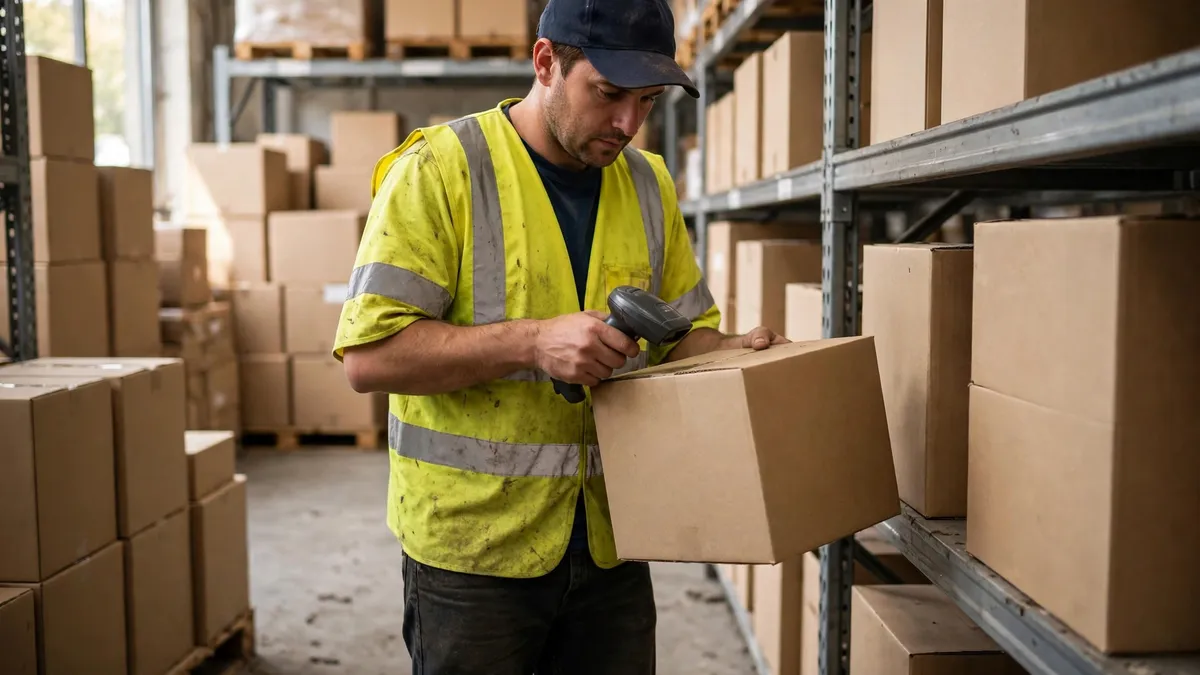
Top AI Tools for Warehouse Teams in 2027
The best AI tools for warehouse teams in 2027 do the jobs people hate and the jobs people cannot do fast enough: counting stock without closing the aisle, routing pickers so they stop crossing each other, and spotting a shelf problem before it becomes a missed shipment.
What has changed this year is that the tools have got practical. Robots now work alongside existing staff instead of demanding a rebuilt floor, and drones and cameras count inventory while the warehouse keeps running. None of it replaces the team; it takes the repetitive, error-prone work off their plates.
This roundup looks at six tools that cover the whole floor: robotic picking, drone counts, stock visibility, warehouse management, voice picking, and computer vision.
Key takeaways
- Robotic picking tools like Locus Robotics raise throughput by cutting picker travel, not by replacing your team.
- Drone and camera tools such as Gather AI and Dexory count stock without shutting aisles.
- A warehouse management system like Logiwa is the foundation: robots only help once stock data is trustworthy.
- Voice picking from Lucas Systems suits teams that need hands-free picking with a short learning curve.
- Start with one bottleneck, measure the result for a month, and only then add a second tool.
At a glance
| Tool | Best for | Main job | Starting price |
|---|---|---|---|
| Locus Robotics | High-volume picking | Autonomous mobile robots that carry shelves and totes to pickers | Custom pricing, robots as a service |
| Gather AI | Fast stock counts | Drones that scan barcodes and count inventory from the air | From about $1,000 per month |
| Dexory | Real-time stock visibility | Tall scanning robots plus a digital twin of the warehouse | Custom pricing |
| Logiwa | Cloud warehouse management | Order, inventory and fulfilment management for growing operations | From about $500 per month |
| Lucas Systems | Hands-free picking | Voice-directed picking and AI task optimisation | Custom pricing, per-user model |
| Vimaan | Receiving and auditing | Computer vision gates that scan pallets and parcels automatically | Custom pricing |
Prices shown are approximate starting points; check current pricing on each vendor’s site before budgeting, as warehouse tool pricing changes with volume, users, and the size of your site.
Locus Robotics — robots that bring the work to the picker
Locus Robotics builds autonomous mobile robots that carry totes and shelves to a picker who stays in one zone, instead of the picker walking kilometres a day between racks. The robots plan their own routes and queue at the pick station so the next job is always ready. For a high-volume warehouse, that is usually the biggest throughput gain available.

It is sold as robots as a service, scaled up for peak season and down afterwards, and it works with your existing warehouse management system. Teams commonly report doubling or tripling picks per hour, though it suits volume and needs tidy stock data.
Pros: Big throughput gains on high-volume picking; robots as a service scales with seasons; works with existing systems.
Cons: Custom pricing is hard to compare; overkill for small warehouses; needs tidy stock data to pay off.
Gather AI — drones that count your stock for you
Gather AI sends small autonomous drones down your aisles to scan barcodes and count stock, turning a cycle count that used to take a team all weekend into a job that runs while the warehouse keeps operating. The drones fly themselves, read labels at height, and flag mismatches. For tall racking, that alone is worth a look, because counting top shelves by hand is slow and often skipped.
Nothing changes on the floor: no new racking, no conveyor, no closed aisles. Your team only investigates the exceptions the software flags, which makes cycle counts frequent enough to trust. It is a focused tool, though; it counts stock well but will not pick orders.
Pros: Fast, frequent cycle counts with no aisle closures; reaches high racking safely; flags only the mismatches.
Cons: A single-purpose tool, not a full system; needs good barcode labelling to work well; subscription cost adds up.
Dexory — a live digital twin of your warehouse
Dexory pairs tall autonomous scanning robots with software that builds a digital twin of your warehouse: a live picture of where every pallet and product sits. The robots roam the aisles continuously, and the twin updates as they go. Managers can see the warehouse from their desk, find a product’s real location, and spot empty slots and misplaced pallets without walking the floor.
It earns its keep in problems found early: a pallet in the wrong bay, a location the system thinks is full but is empty, a product untouched for months. That visibility feeds better slotting, so fast-moving products end up near the packing benches.
Pros: Real-time visibility across the whole site; finds misplaced and idle stock early; supports smarter slotting.
Cons: Custom enterprise pricing; best suited to large sites; value depends on acting on the data.
Logiwa — cloud warehouse management for growing teams
Logiwa is a cloud warehouse management system for growing ecommerce and wholesale operations that have outgrown spreadsheets. It covers receiving, putaway, picking, packing, and shipping, and connects to the sales channels and couriers a warehouse already uses, so an online order flows straight to a pick list. Its AI helps with demand forecasting and order batching, grouping picks into efficient waves.
For many teams, Logiwa is the right first step before any robots or drones, because no robot can find stock the system does not know about. Its cloud model means no servers to maintain. The limit is that it is software, not automation; it organises work, but it will not move boxes.
Pros: Affordable cloud starting point; strong order and channel integrations; AI batching cuts picker travel.
Cons: Software only, no physical automation; advanced features cost more; setup needs clean product data.
Lucas Systems — voice picking that talks your team through the job
Lucas Systems, known for its Jennifer voice platform, turns picking instructions into spoken directions: the system tells the picker where to go and what to pick, and the picker confirms by speaking back, keeping both hands free and eyes on the stock. Its AI optimises the order of tasks across the shift, so pickers follow a sensible route. Voice picking remains one of the fastest, cheapest ways to raise accuracy, because speaking a check digit catches errors before the wrong item lands in the tote.
Training time is the quiet advantage: a new starter can pick accurately on day one, because they only have to listen and answer. That matters for warehouses that rely on seasonal staff. It works in cold stores too, though it needs a decent wireless network.
Pros: Hands-free picking with high accuracy; new starters productive fast; works in cold stores and with gloves.
Cons: Needs solid Wi-Fi coverage; less useful for full-pallet work; staff need a short adjustment period.
Vimaan — computer vision at the receiving dock
Vimaan puts computer vision gates at receiving and dispatch: pallets and parcels pass through a scanning arch that photographs them, reads labels, measures dimensions, and checks contents against the expected shipment, without anyone scanning each box by hand. A pallet that arrives short, damaged, or wrongly labelled gets flagged at the dock instead of being discovered weeks later when a customer complains.
The dock is where warehouse errors are born, because it is the busiest, most rushed part of the day. Vimaan’s gates automate the check, and the photos prove the condition of goods when they arrived or left. It is a specialist tool for busy sites; smaller warehouses will not see enough errors caught to justify it.
Pros: Catches receiving errors at the dock; photographic proof for disputes; accurate dimensions stop carrier surcharges.
Cons: Hardware install is a bigger commitment; custom pricing; overkill for low-volume docks.
How to choose
Start from your biggest bottleneck, not the most impressive demo. If pickers spend most of their shift walking, look at Locus Robotics or Lucas Systems. If stock counts are always late, look at Gather AI or Dexory. If orders are getting lost between channels, you need Logiwa first, because no robot fixes a broken order flow. If the dock is where mistakes happen, Vimaan is the tool.
Then check the practical constraints. Measure your aisle widths, racking heights, and Wi-Fi coverage, and ask each vendor what their system needs: robots need clear floors, drones need readable barcodes, voice needs wireless coverage. Ask for a trial on your own floor, and measure picks per hour, error rate, and stock accuracy before and after. Finally, think about the team that has to live with the tool; the best AI fails if pickers find it awkward or nobody owns it. If you are weighing automation across the wider business, our roundup of the best AI tools for manufacturing shows how factories make the same decisions, and our guide to the best CRM software for small business covers the customer side.
Checklist: before you buy
Use these checks before signing for any warehouse AI tool.
- Name your single biggest bottleneck in picks per hour, errors, or stock accuracy, and measure it now.
- Confirm the tool integrates with your warehouse management system and sales channels.
- Check floor, aisle, racking, and Wi-Fi requirements against your actual site, not a brochure.
- Run a trial on your own floor with your own products and staff, and compare the numbers.
- Price the total cost, including hardware, installation, training, and the subscription, not just the headline figure.
- Decide who owns the tool day to day, and make sure they have time in their shift to do it.
Frequently asked questions
What is the best AI tool for warehouse teams?
There is no single best tool, because warehouses have different bottlenecks. High-volume picking sites get the most from Locus Robotics, teams struggling with stock accuracy get the most from Gather AI or Dexory, and growing operations should start with Logiwa.
How much do warehouse AI tools cost?
It varies widely. Cloud software like Logiwa starts from about $500 per month, drone counting from about $1,000 per month, and robot or vision systems are usually custom-priced per site.
Do warehouse robots replace workers?
Mostly they change the work rather than remove it. Robots take over walking and carrying, while people handle picking, checking, and exceptions. Sites usually redeploy staff to packing, quality checks, and problem-solving.
Can AI tools work in a small warehouse?
Yes, but the right tools are different. A small warehouse usually gets the best return from cloud software like Logiwa and voice picking from Lucas Systems, while robot fleets pay off at higher volumes. Start with software, measure the gain, and add hardware later.
How long does it take to install a warehouse robot system?
Mobile robot systems are typically running within a few weeks, since they need no fixed infrastructure. Vision gates take longer, because of the hardware install. Ask every vendor for a realistic timeline based on a site like yours.
Is warehouse data safe with cloud AI tools?
Reputable vendors encrypt data in transit and at rest and limit access by role, but check their security practices. Our explainer on what cybersecurity is covers the basics every team should understand before connecting new systems.
Bottom line
The best AI tools for warehouse teams in 2027 are the ones that remove a real bottleneck: walking, counting, finding stock, or checking goods at the dock. Locus Robotics and Lucas Systems speed up picking, Gather AI and Dexory make stock trustworthy, Logiwa organises the operation, and Vimaan guards the dock. None is a magic fix on its own.
Pick that one problem, trial the tool that targets it on your own floor, and let the numbers decide whether to expand. A warehouse that counts accurately, picks fast, and ships what it promised keeps its customers.


