

The best antivirus software for Etsy sellers in 2027 protects the shop, the laptop, and the customer trust that a handmade business depends on. An Etsy seller handles payment details, customer addresses, and product photos every day, often from a single laptop or phone. One phishing email can lock a seller out of the shop and halt orders for days.
Etsy sellers face risks that are easy to overlook. Many work from home, use the same device for personal and business tasks, and click links in messages from supposed buyers. Attackers target small shops because they rarely have IT support, and a compromised account can be used to change payout details.
This guide compares eight leading options for Etsy sellers, from affordable plans for one laptop and a phone to fuller suites with a VPN, password manager, and ransomware protection. Prices are approximate starting prices, and readers should check current pricing before buying.
Key takeaways
- Norton 360 is the best overall pick, with strong protection, a VPN, and a password manager in one plan.
- Bitdefender Total Security is the best for detection, with excellent malware scores and light impact.
- McAfee Total Protection is the best value for covering a laptop, a phone, and a tablet on one subscription.
- Avast One is the best budget choice for new sellers who need solid core protection at a low price.
- Check renewal prices and device limits before buying, because first-year discounts often rise in year two.
At a glance: the shortlist
| Product | Best for | Starting price | Standout limit |
|---|---|---|---|
| Norton 360 | Best overall | From about $40 per year for 1 device | Higher renewal price |
| Bitdefender Total Security | Best detection | From about $40 per year for 5 devices | VPN has a daily limit |
| McAfee Total Protection | Best value | From about $40 per year for 5 devices | VPN limits on lower plans |
| Avast One | Best budget pick | From about $30 per year for 1 device | Fewer extras on basic plan |
| ESET Home Security Premium | Lightest on resources | From about $50 per year for 1 device | Interface feels technical |
| Trend Micro Maximum Security | Best for online shopping | From about $40 per year for 1 device | Extra devices cost more |
| Avira Prime | Best all-in-one bundle | From about $60 per year for 5 devices | Higher starting price |
| Malwarebytes Premium | Best extra layer | From about $45 per year for 1 device | Best paired with another antivirus |
Norton 360 — Best overall
Norton 360 is the best overall antivirus for Etsy sellers in 2027. It combines strong malware detection with a firewall, a VPN, a password manager, and dark web monitoring, all in a plan that is easy to install and manage.
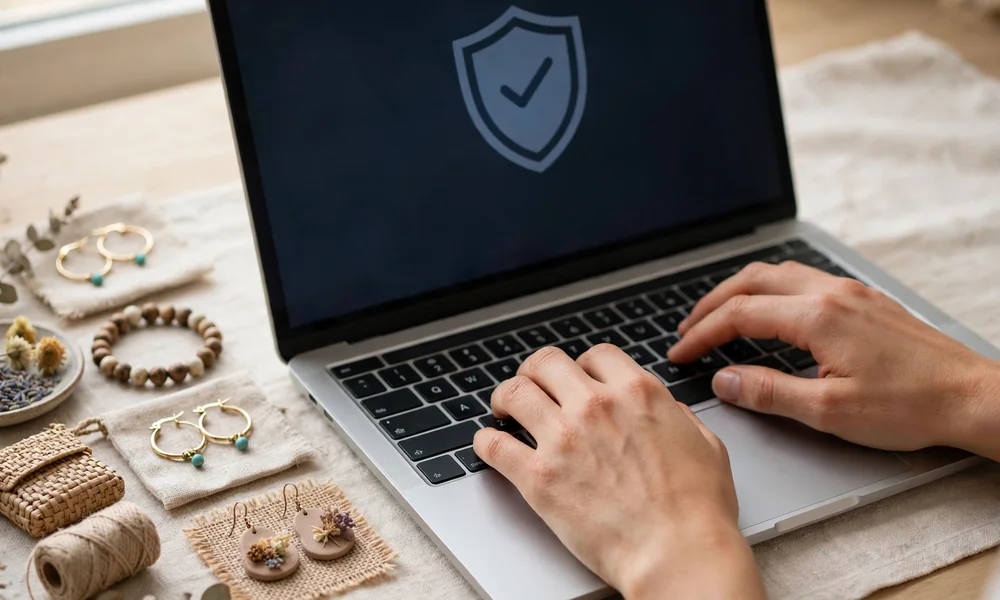
The password manager is especially useful: Etsy, email, banking, and supplier accounts each need a strong, unique password. Norton stores those logins securely and fills them in automatically.
The VPN protects sellers who work from cafes, markets, or hotels by encrypting traffic on public Wi-Fi. The main drawback is the renewal price, which is often higher than the discounted first year.
Pros: Strong detection, VPN and password manager included, dark web monitoring, simple dashboard.
Cons: Renewal price is higher than the first year, full scans can slow older laptops.
Bitdefender Total Security — Best detection
Bitdefender Total Security earns the top detection spot in this guide. Independent tests regularly give it high scores for catching malware, ransomware, and phishing pages, without slowing the computer much.
The suite includes ransomware remediation, web protection, and a firewall. The interface is clean, and most features work well with default settings.
The built-in VPN has a daily data limit on the standard plan, so sellers who need unlimited VPN access must pay for an upgrade. For most sellers, the limit is enough for occasional public Wi-Fi use.
Pros: Excellent malware detection, ransomware remediation, light system impact, clean interface.
Cons: VPN has a daily limit on the standard plan, some features need an upgrade.
McAfee Total Protection — Best value
McAfee Total Protection is the best value for Etsy sellers who need to cover several devices. One subscription protects Windows, Mac, Android, and iOS, so a seller can cover a laptop, a phone, and a tablet, and it includes antivirus, a firewall, a VPN, identity monitoring, and a password manager.
Identity monitoring alerts sellers when personal information appears in data breaches.
Detection scores are solid, though they trail Bitdefender and Norton slightly in some tests, and the VPN has limits on cheaper plans. For the devices covered, McAfee offers the most protection per dollar here.
Pros: Covers many devices on one plan, works across Windows, Mac, Android, and iOS, identity monitoring included.
Cons: VPN limits on lower plans, detection trails the leaders slightly.
Avast One — Best budget pick
Avast One is the best budget pick for new Etsy sellers. It covers the essentials, real-time malware scanning, web and email protection, and a firewall, at a low starting price, and a free version lets sellers try the interface before paying.
Setup is quick, updates are automatic, and the software runs quietly. For a seller with one laptop and a phone, the basic plan covers the main risks.
The trade-off is breadth: the basic plan has fewer extras than Norton or Bitdefender, and the full VPN sits on higher tiers. For a new shop on a tight budget, Avast One covers the core risks well.
Pros: Low starting price, quick setup, free version to try, reliable core protection.
Cons: Fewer extras on the basic plan, full VPN needs a higher tier.
ESET Home Security Premium — Lightest on resources
ESET Home Security Premium is the lightest option in this guide, a strong choice for sellers using an older laptop for listings and photo editing. It runs quietly, scans quickly, and rarely interrupts work.
Despite its small footprint, ESET includes ransomware protection, a firewall, anti-phishing, and a password manager.
The interface is more technical than Norton or Avast, with settings that assume some familiarity with security terms. Those who value speed and a quiet product will find ESET hard to beat.
Pros: Very light on system resources, fast scans, ransomware protection and password manager included.
Cons: Interface feels technical, fewer consumer-friendly extras.
Trend Micro Maximum Security — Best for online shopping
Trend Micro Maximum Security is a strong choice for sellers who spend much of their day buying supplies online. Its web protection blocks phishing pages, scam shops, and malicious links before they load, which helps when a seller clicks through supplier emails.
The suite includes antivirus, ransomware protection, a firewall, and a password manager.
Covering extra devices costs more than with McAfee or Bitdefender, so sellers with many devices should compare the multi-device price carefully. For sellers who shop online often, Trend Micro is a smart fit.
Pros: Excellent web and phishing protection, warns about risky sites, clear interface.
Cons: Extra devices cost more, fewer business features.
Avira Prime — Best all-in-one bundle
Avira Prime bundles antivirus, an unlimited VPN, a password manager, and cleanup tools into one subscription for up to five devices.
The unlimited VPN is the standout feature. Sellers who travel to craft fairs or manage the shop from hotels can use it without watching a data limit, and the cleanup tools help older laptops run faster.
The starting price is higher than Avast or McAfee, so Avira Prime suits sellers who will actually use the VPN, password manager, and cleanup tools. For a seller who wants one subscription for everything, it is the most complete bundle here.
Pros: Unlimited VPN, password manager and cleanup tools included, covers 5 devices.
Cons: Higher starting price, more than some sellers need.
Malwarebytes Premium — Best extra layer
Malwarebytes Premium is best used as an extra layer alongside a full antivirus, not as the only protection on a seller’s computer. It specialises in catching malware and ransomware that other tools sometimes miss, and it is good at removing infections already present.
Many sellers run Malwarebytes next to Windows Defender or another antivirus for broader coverage at little extra cost.
On its own, Malwarebytes Premium lacks a full firewall, so sellers should treat it as a complement, not a replacement. For cleaning up an infected laptop before a busy sales period, it remains one of the best tools available.
Pros: Excellent at removing existing malware, strong web and ransomware protection, light enough to run alongside other antivirus.
Cons: Best as an extra layer, lacks a full firewall.
How to choose
Start with the devices used for the shop. Count the laptop, the phone used for photos and messages, and any tablet used for listings, then choose a plan that covers them all. A plan that covers only one device leaves the phone unprotected. Sellers who also freelance can compare options in our guide to the best antivirus software for freelancers.
Next, think about where the shop is managed. Sellers who work from home need less VPN access than sellers who list products from markets, cafes, or hotels. If public Wi-Fi is a regular part of the working week, a plan with a usable VPN matters more than a slightly higher detection score. Sellers who buy supplies online should also weigh web protection heavily, and our guide to the best antivirus software for online shoppers compares options built for frequent online buying.
Finally, check the renewal price and the refund window. A short free trial is the best way to test performance on the actual laptop used for the shop.
Checklist: before you pay
- Count every device used for the shop, including the phone used for photos and messages.
- Check the renewal price, not just the discounted first-year price, and note the cancellation terms.
- Confirm the plan covers Windows, Mac, Android, and iOS if the shop uses mixed devices.
- Test the free trial on the laptop used for listings to check for slowdowns.
- Make sure ransomware and phishing protection are included.
- Back up product photos and listings separately, because antivirus alone cannot recover encrypted files.
Frequently asked questions
Do Etsy sellers really need paid antivirus?
Yes, in most cases. Free antivirus usually covers basic scanning, while paid plans add ransomware protection, phishing filters, a firewall, and a VPN.
Can one plan protect a laptop and a phone?
Most plans in this guide cover several devices on one subscription, including Windows, Mac, Android, and iOS. Some budget plans cover only one device, so check the limit first.
Is a VPN useful for an Etsy seller?
Yes, if the shop is managed on public Wi-Fi at markets, cafes, or hotels. A VPN encrypts that traffic and reduces the risk of login details being intercepted.
What should a seller do if the shop account is hacked?
Change the Etsy password and the email password immediately, turn on two-factor authentication, and check payout details for changes. Then run a full antivirus scan on every device.
Does antivirus slow down photo editing?
A good antivirus should not slow photo editing noticeably on a modern laptop. Light options such as Bitdefender and ESET are the safest choices for older machines.
Do content creators need the same protection as Etsy sellers?
Yes, the risks overlap. Creators also handle brand deals, payments, and audience data on shared devices. Our guide to the best antivirus software for content creators covers options suited to creators who publish and sell online.
The bottom line
For most Etsy sellers, Norton 360 is the best pick in 2027, with strong protection, a VPN, and a password manager in one easy plan. Sellers who want the strongest detection should choose Bitdefender Total Security, while McAfee is the best value for covering several devices.
Whatever the choice, the most important step is protecting every device used for the shop and keeping backups of listings and photos. A seller who combines a good antivirus with strong, unique passwords and two-factor authentication is far harder to attack.



