
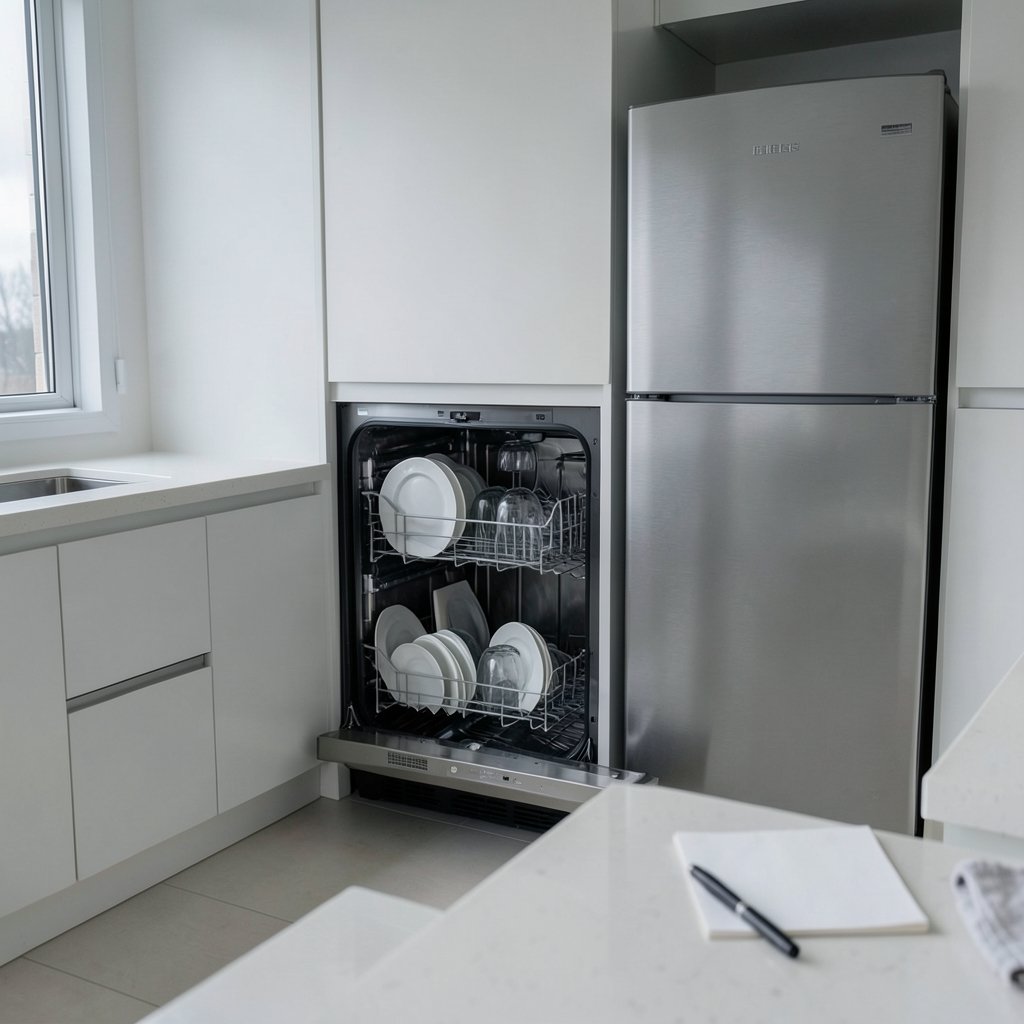
What if the dishwasher with the best reviews turned out to be the worst fit for your kitchen? It happens more often than you would think. Someone reads a glowing five-star write-up, buys the machine, and discovers it does not fit under the counter, sounds like a freight train in a small flat, or costs more to run than the old unit it replaced. The review was not lying. It just was not written for that reader.
That is the trap with best dishwasher reviews. Most of them rank machines by lab scores and star ratings, but the things that actually decide whether you will be happy two years later are quieter and less photogenic: noise in an open-plan room, drying performance on plastic, how easy the filter is to clean, and whether spare parts exist when something breaks. This guide walks through what good reviews measure, where they mislead, and how to translate a test score into a decision for your own kitchen.
Why “best” is the wrong question to start with
There is no single best dishwasher, and any roundup that claims otherwise is selling you a framing device. A machine that tops a list for a family of five running a load every night is overkill for one person rinsing a couple of plates. A whisper-quiet model that wins on decibels may dry poorly. A budget winner may last four years instead of ten.
Professional testers know this, which is why serious roundups split their picks by category: best for small kitchens, best for drying, best value, quietest. When you read a review, look for that structure. If a list has one winner and nine runners-up with no use-case labels, you are reading a ranking, not advice.
The practical move is to decide your own top two priorities before you read anything. Common pairings:
| Priority pair | What it means in practice |
|---|---|
| Quiet plus drying | Open-plan living, lots of plastic containers |
| Capacity plus speed | Large household, tight evening schedule |
| Running cost plus reliability | Long-term ownership, fixed budget |
| Small footprint plus flexibility | Rented flat, awkward galley kitchen |
Once you have your pair, most reviews become easy to filter. You are no longer asking “which is best” but “which is best at these two things.”
What independent test labs actually measure

The strongest reviews come from organisations that buy machines at retail and test them under controlled conditions. Consumer Reports in the US, Which? in the UK, and Stiftung Warentest in Germany are the best-known examples. Their methods differ, their paywalls differ, and that difference matters for how much you can verify yourself.
Test labs generally assess the same handful of things:
- Cleaning performance on standardised soil loads, including baked-on and dried-on residue
- Drying performance, often split between plastic and ceramic items
- Energy and water use per cycle, measured on specific programmes
- Noise, usually in decibels and sometimes with a subjective assessment
- Cycle time, because a three-hour eco programme changes how you live with the machine
- Ease of use, including loading flexibility, filter access, and control clarity
The detail that separates a useful review from a useless one is whether it states which test standard was used. Performance testing for electric dishwashers is covered by IEC 60436 internationally, and US testing conventions are set by industry bodies such as AHAM. If a review gives a cleaning score without saying how it was measured, treat that score as a vibe, not a fact.
The energy label numbers, and what they hide
In the EU and UK, dishwashers have carried a rescaled energy label since March 2021. The old A+++ tiers are gone, replaced by a plain A to G scale, and the label now shows energy consumption per 100 cycles alongside water use per cycle. That is genuinely useful, because it lets you compare machines on a like-for-like basis rather than trusting a marketing badge.
In the US, the equivalent shortcut is the Energy Star certification, which sets maximum annual energy use and water use per cycle thresholds for standard and compact models. Federal minimum standards sit underneath that, administered by the Department of Energy.
Here is the catch. Label figures are generated on a specific test cycle, usually an eco programme run under standardised conditions. Real households rarely run that cycle. They run the intensive programme because the pans were greasy, or the quick wash because guests are coming. So the label number is a comparison tool, not a prediction of your bill.
A sensible way to use it: compare two shortlisted machines against each other on the label, then read reviews to find out how the machine performs on the cycles you will actually use. A model with a great eco figure and a poor intensive wash is a bad buy for anyone who cooks with oil.
Noise ratings: the number and the reality
Noise is quoted in dB(A), and lower is quieter. Quiet models are often marketed in the 38 to 44 dB(A) range, while mainstream machines tend to sit around 45 to 50 dB(A). Those figures are useful but incomplete.
What the number does not tell you:
- Whether the sound is a low hum or an irritating whine
- How loud the drain pump is at the end of a cycle
- Whether the machine clicks or clunks when changing programmes
- How much noise transmits through cabinets in a small kitchen
This is exactly where video reviews and owner forums beat spec sheets. A machine rated at 42 dB(A) can still be annoying if its particular frequency cuts through conversation. If you live in a studio flat or an open-plan home, read the noise comments in owner reviews rather than trusting the headline figure alone.
Capacity and place settings across regions
Capacity is measured in place settings, and full-size models are commonly rated at 12 to 16. That sounds precise. It is not.
European and US measurement conventions differ, so a 14-place-setting European machine and a 14-place-setting American machine are not necessarily the same size inside. Reviewers who test loading with real dishes, including awkward items like tall stock pots and stemmed glasses, give you far more useful information than the number on the box.
Practical checks worth looking for in any review:
- Does a standard dinner plate fit upright in the lower basket without fouling the spray arm?
- Can the top basket be raised or lowered for tall glasses?
- Are the tines adjustable, or fixed and fragile?
- Is there a dedicated cutlery tray, and does it actually hold spoons without nesting?
A machine that scores brilliantly on cleaning but forces you to re-stack twice will wear you down. Loading flexibility is one of the most under-reviewed features and one of the most felt in daily use.
Water use, eco cycles, and the numbers that mislead
Modern full-size machines on eco cycles are often cited at roughly 9 to 12 litres per cycle in Europe, or about 3 to 5 gallons in the US. Intensive cycles use considerably more. Those ranges are useful context, but they are not universal constants, and any review that presents a single figure as the truth for all machines is oversimplifying.
The more interesting question is whether the eco cycle is usable. Some machines have eco programmes so long and so gentle that they fail on dried-on food, pushing owners back to intensive cycles and erasing the efficiency gain. Good reviews test the eco cycle on real soil rather than only light rinses.
This is the same principle that applies across consumer reviews generally. Ratings only mean something when you know what was tested and how. If you want a deeper look at how scoring systems shape what you read, this breakdown of metacritic vs opencritic vs steam reviews and how to read each score is a useful parallel from the games world, and the same skepticism about paid or incentivised ratings applies to appliance listings, as this piece on how paid Amazon reviews backfire on buyers and sellers explains.
Reliability, repairs, and the reviews nobody writes
The most common gap in dishwasher reviews is longevity. A lab can test cleaning in a week. It cannot tell you whether the drain pump will fail in year four.
Reliability data usually comes from subscriber surveys rather than lab tests, which means it is often paywalled and sometimes a year or two old. That is still more useful than nothing. When you find reliability information, check the survey year and sample size rather than trusting a summary.
Practical reliability signals you can check yourself:
- Parts availability. Search for the model plus “spare parts” and see whether filters, spray arms, and door seals are easy to find at reasonable prices.
- Service network. In some regions, certain brands have far better repair coverage than others.
- Owner reports at the two-year mark. Reviews written after a couple of years of use are worth more than first-week impressions.
- Warranty length and what it covers. A long warranty on the electronics but not the pump is less reassuring than it sounds.
The same instinct applies to any big purchase where reviews and fine print collide. If you have ever read BMG money reviews that borrowers should check before signing, you will recognise the pattern: the headline number is fine, but the conditions underneath decide the outcome.
Common mistakes people make when reading dishwasher reviews
A few traps catch almost everyone.
Trusting the star average. A machine with 4.6 stars from 40 reviews and one with 4.4 stars from 4,000 reviews are not comparable. Read the distribution rather than the average alone.
Ignoring the one-star reviews. Not because they are always right, but because they cluster around recurring faults. If fifteen people mention the same door latch problem, that is a signal.
Assuming quiet means good. A very quiet machine may run longer cycles to compensate. Check cycle times alongside noise.
Skipping the installation requirements. Height, depth, plumbing position, and whether the machine needs a cold feed or hot feed all matter. A brilliant dishwasher that will not fit is not a brilliant dishwasher.
Overweighting lab scores. Lab tests are excellent for comparison and poor for predicting how a machine fits your life. Balance test results with owner experience.
How to build your own shortlist in an afternoon
You do not need to read twenty reviews. You need a process.
- Set a budget range and note your two priority features.
- Check the energy label or Energy Star listing for your shortlist to compare running costs.
- Read one independent lab review per candidate, focusing on the test methodology and the cycle used.
- Read owner reviews filtered to the two-year-plus mark, looking for recurring faults.
- Confirm dimensions, plumbing, and delivery access against your kitchen.
- Check spare parts availability for the final two.
- Buy from a retailer with a clear returns policy.
That sequence takes about two hours and beats an afternoon of scrolling rankings. It also mirrors the discipline behind good buying decisions everywhere, from subscription services (this Revolut review on whether the super app is worth the risk applies the same test) to hardware purchases like an Epson EcoTank ET-2800 review weighing real printing costs against trade-offs, where the sticker price tells only part of the story.
Conclusion
The best dishwasher reviews are not the ones with the highest scores. They are the ones that tell you what was tested, on which cycle, under which standard, and for whom the result matters. Read the methodology before the verdict. Compare label figures as a like-for-like tool rather than a promise. Weight owner reports from year two more heavily than first-week enthusiasm. And decide your own priorities before anyone else’s ranking decides them for you.
Get those habits in place and the “best” question answers itself. You will not be choosing the machine that topped a list. You will be choosing the one that fits your kitchen, your dishes, and your evenings.
Frequently asked questions
Are professional dishwasher reviews worth paying for?
Often yes, if the publication explains its test method and tests the cycles you will use. Paywalled labs typically buy machines at retail and run standardised soil loads, which is more rigorous than most free content. The value depends on whether the review states which standard was used and whether it separates results by cycle. If it does, the subscription is usually cheaper than one bad purchase.
How many decibels is quiet enough for an open-plan kitchen?
There is no fixed threshold, but models marketed as quiet commonly sit in the 38 to 44 dB(A) range, while mainstream machines are often around 45 to 50 dB(A). In an open-plan room, lower is generally better, but the character of the sound matters as much as the number. Read owner comments about pump noise and programme changes, rather than relying on the headline figure alone.
Do EU energy labels and US Energy Star ratings compare directly?
No. The EU label uses an A to G scale with energy per 100 cycles and water per cycle, while Energy Star sets maximum annual energy and water thresholds for qualifying models. The underlying test cycles and units differ, so you cannot place a European figure and an American figure side by side and draw a clean conclusion. Compare within a region, not across regions.
Is a higher place setting count always better?
Not necessarily. Place settings are a standardised capacity unit, but measurement conventions differ between regions, and real loading depends on basket design, tine adjustability, and whether tall items fit. A 13-place-setting machine with flexible baskets can hold more usable dishes than a 15-place-setting machine with rigid ones. Look for reviews that test loading with real cookware.
How much water does a dishwasher use per cycle?
Eco cycles on modern full-size machines are often cited at roughly 9 to 12 litres per cycle in Europe, or about 3 to 5 gallons in the US, with intensive cycles using more. These are approximate ranges, not universal figures, because consumption varies by model, programme, and test standard. Use the energy label for comparison and treat any single number as a guide only.
What is the biggest red flag in a dishwasher review?
A strong verdict with no stated test method. If a review gives cleaning and drying scores without saying which standard or cycle was used, the numbers cannot be compared with anything else. The second red flag is a roundup with no use-case categories, because it implies one machine suits every kitchen. Both are common, and both are easy to spot once you know to look.



