Roughly 80% of electric vehicle charging happens at home, according to the U.S. Department of Energy’s Alternative Fuels Data Center. That single number explains why the home charger has quietly become one of the most important purchases an EV owner makes. It runs for years, it gets used almost daily, and a poor choice means slow nights, tripped breakers, or a unit that dies two winters in.
The 2026 market looks different from even a couple of years ago. NACS connectors are spreading fast, load-management features have moved downmarket, and prices have settled into a clearer range. This guide cuts through the spec sheets and focuses on what matters when the box is bolted to your wall.
2026: NACS, Load Management, and Smarter Hardware
Three shifts define this year’s chargers.
First, connector confusion is fading. The J1772 plug still serves most older EVs, but Tesla’s North American Charging Standard (NACS) is now built into a growing share of new models. Many 2026 chargers ship with a NACS plug and include a J1772 adapter, or offer both variants at checkout. Buy for the car you’ll own in three years, instead of only the one in your driveway today. The SAE J3400 standard formalized NACS, which means the plug is no longer a Tesla-only curiosity. (Hybrids & EVs)
Second, load management went mainstream. Instead of forcing a costly panel upgrade, many chargers now monitor your home’s total draw and throttle the car automatically. For older houses with 100-amp service, this feature alone can save well over a thousand dollars in electrical work.
Third, smart features matured. Scheduling, time-of-use rate optimization, and Wi-Fi firmware updates are now table stakes rather than premium add-ons. The Open Charge Alliance’s OCPP protocol gives buyers a way to check whether a charger plays nicely with utility demand-response programs.
How to Judge a Home EV Charger
Before comparing models, get the fundamentals right. These are the criteria that separate a good purchase from a regret.
Power output and your actual driving
A 48-amp hardwired charger delivers about 11.5 kW, adding roughly 40 to 45 miles of range per hour to an efficient EV. A 32-amp plug-in unit delivers around 7.7 kW and about 25 miles per hour. If you drive 40 miles a day, even a modest 32-amp unit refills your battery overnight without breaking a sweat. Chasing maximum amperage is one of the most common mistakes buyers make; it often triggers a panel upgrade for capacity you’ll never use.
Hardwired versus plug-in
Hardwired units allow higher amperage and tend to be more weather-resistant. Plug-in models (NEMA 14-50) are easier to swap if you move. For outdoor installations, hardwiring is usually the safer call.
Safety certification
Look for UL 2594 listing and, where applicable, ENERGY STAR certification. An uncertified bargain charger is a fire risk sitting in your garage, and some utilities won’t pay rebates on uncertified equipment.
Smart features that earn their keep
Scheduling and time-of-use optimization can cut charging costs meaningfully on rate plans with cheap overnight windows. Load management prevents breaker trips. App quality matters more than feature count; a clunky app you abandon after a month is worse than a simple unit with a good schedule timer.
The Best Home EV Chargers for 2026, by Use Case
There’s no single “best” charger, because garages, panels, and cars differ. Here’s how the leading options stack up by situation.
| Charger | Best for | Max output | Connector | Standout feature |
|---|---|---|---|---|
| ChargePoint Home Flex | Overall pick for most drivers | 50A (hardwired) | J1772 or NACS | Adjustable amperage, strong app |
| Tesla Wall Connector | Tesla owners and NACS cars | 48A | NACS | Best dollar-per-mile value |
| Emporia Level 2 | Budget-minded smart charging | 48A | J1772 or NACS | Detailed energy monitoring |
| Wallbox Pulsar Plus | Small garages, shared panels | 48A | J1772 or NACS | Compact body, power sharing |
| Grizzl-E Classic | Cold climates, simple setups | 40A | J1772 | Rugged, no-frills reliability |
| Enel X JuiceBox | Utility rebate programs | 40A | J1772 | Deep demand-response support |
ChargePoint Home Flex: the safe all-rounder
The Home Flex remains the easiest recommendation for a mixed household. Amperage is adjustable from 16 to 50 amps in the app, which means you can install it on a modest circuit and dial it up later if you upgrade your panel. It’s available in both J1772 and NACS versions, and the scheduling tools are among the most polished in the category. The trade-off is price; it typically sits at the higher end of the mid-range.
Tesla Wall Connector: the value benchmark
For anyone with a NACS-port car, the Wall Connector is hard to beat on price per delivered kilowatt. It’s compact, reliable, and supports power sharing across multiple units, which matters for two-EV households. Its app integration is thinner than rivals’, and non-Tesla owners need an adapter or the J1772 variant. If you’re cross-shopping phones and cars together, the same logic applies: ecosystem lock-in is real, so weigh it deliberately, much like buyers do when comparing the best phones in 2026. (Black Friday Car Deals: Best Offers and Prices for 2026)
Emporia and Wallbox: the smart-value picks
Emporia’s Level 2 unit undercuts most rivals while offering circuit-level energy monitoring that shows exactly what each appliance costs. Wallbox’s Pulsar Plus wins on size and its power-sharing feature, which lets two chargers split one circuit safely. Both are solid choices for renters-to-owners and anyone with limited panel capacity.
Grizzl-E: the winter workhorse
The Grizzl-E Classic is deliberately dumb: no app, no Wi-Fi, just a beefy NEMA 4 enclosure and a reputation for surviving brutal cold. In regions where temperatures plunge, that simplicity is a feature. You give up scheduling, so pair it with your car’s built-in timer instead.
What Installation Really Costs and How to Avoid Surprises
The charger is often the cheap part. A straightforward install near your panel might run a few hundred dollars; a long conduit run across a finished garage or a panel upgrade can push past two thousand. Before you buy anything, take three photos: your electrical panel with the breaker labels visible, the wall where the charger will go, and the path between them. A licensed electrician can quote from those in minutes.
Practical tips that save real money:
- Check utility and state rebates first. Many programs cover part of the charger cost or offer off-peak charging credits, and some require specific eligible models.
- Ask your electrician about the federal tax credit. The IRS publishes current rules for home energy improvements, and eligibility has changed in recent years, so verify before assuming.
- Size the circuit to your daily driving, not the spec sheet maximum. A 40-amp circuit often costs far less to install than a 60-amp one.
- Get two quotes. Installation pricing varies wildly by region and electrician.
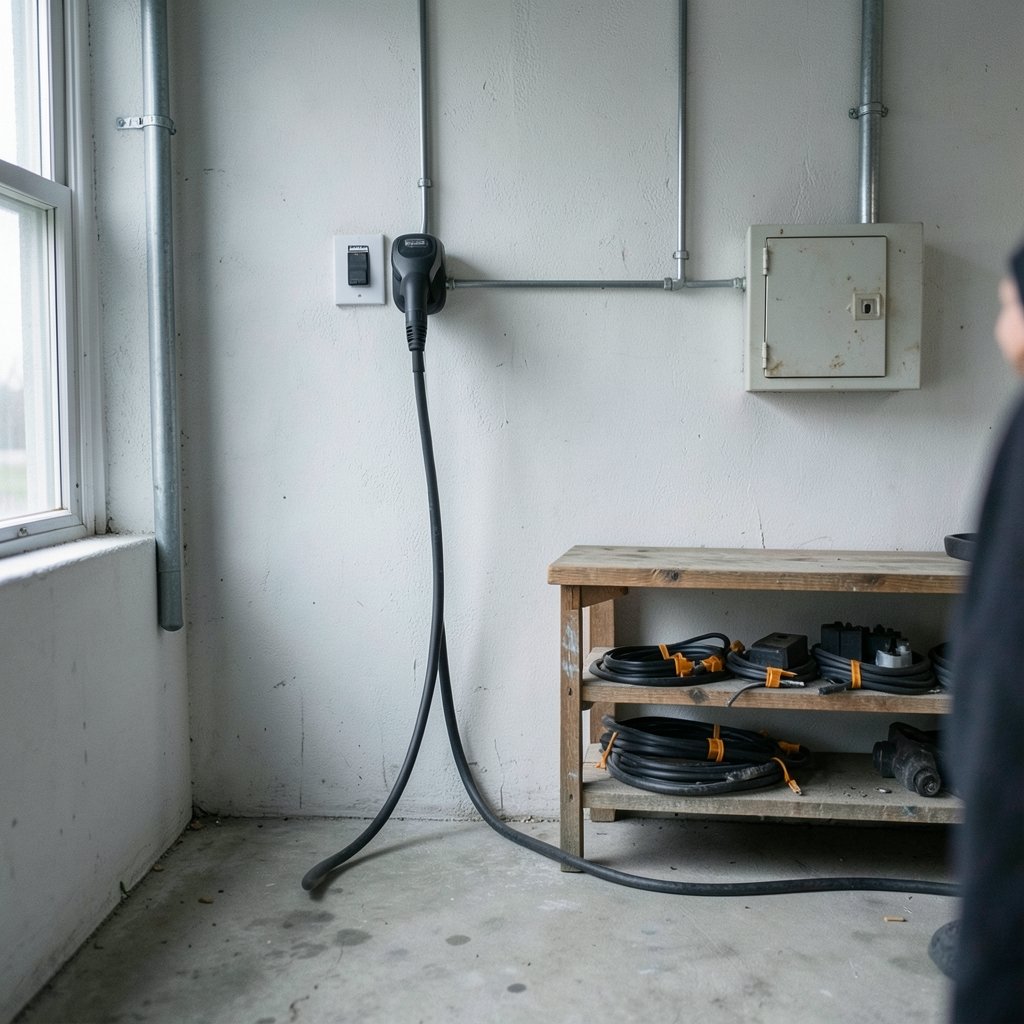
- Decide on cable management early. A holster mounted at the right height prevents the daily annoyance of a cable coiled on the floor.
One common mistake: buying a plug-in charger and then discovering the electrician recommends hardwiring for code or weather reasons. Confirm the install type before the box ships.
Living With a Home Charger: Habits That Pay Off
Ownership experience separates good installs from great ones, and most of it comes down to routine. Set charging to start during your utility’s off-peak window and let the car sit plugged in; modern EVs manage their own battery health. Keep the connector clean and dry, and check the cable for wear at the strain relief point once a year, since that’s where most failures begin.
Firmware updates matter more than people expect. A charger that receives regular updates tends to gain features and fix connectivity bugs, while abandoned models slowly lose app support. Before buying, check when the manufacturer last updated its app. If the answer isn’t recent, treat that as a warning.
It also helps to think about resale and moving. Plug-in units travel with you; hardwired ones usually stay with the house and can even add appeal to a listing. Neither choice is wrong, but deciding upfront avoids an awkward conversation with a buyer later.
Finally, don’t overlook the broader smart-home angle. A charger that talks to your home energy system can shift load automatically when the dryer or oven kicks on. That kind of coordination is becoming the norm, and it’s the same pattern of connected-device integration showing up across categories, from the best home security cameras for 2026 to major appliances.
Common Mistakes Buyers Make
A few traps show up again and again in owner forums and electrician complaints.
- Buying for peak specs instead of real needs. Most drivers never need 48 amps.
- Skipping the panel check. A 100-amp service with electric heat may need load management or an upgrade.
- Ignoring the connector roadmap. A J1772-only charger may need an adapter soon.
- Chasing the cheapest uncertified unit. The savings vanish if the unit fails or fails inspection.
- Forgetting the app. A charger with poor software support becomes a dumb box within two years.
Conclusion
The best home EV charger in 2026 isn’t the most powerful or the most feature-packed. It’s the one that matches your panel, your daily mileage, and your car’s connector, with certified safety and software that will still be supported in five years. For most households, the ChargePoint Home Flex is the safest all-round pick; Tesla owners get the best value from the Wall Connector; budget-focused buyers should look hard at Emporia; and cold-climate drivers who want zero fuss will appreciate the Grizzl-E. Get the installation quoted before you buy, check every rebate you qualify for, and size the circuit for how you actually drive. Do that, and the charger becomes what it should be: invisible infrastructure that quietly fills the car every night.
Frequently Asked Questions
How much does it cost to install a home EV charger in 2026?
Equipment typically ranges from about $400 to $800 for mainstream models. Installation adds anywhere from a few hundred dollars for a short run near the panel to well over $2,000 if you need a panel upgrade or a long conduit path. Getting two quotes and checking utility rebates first is the most reliable way to control the total.
Do I need a 60-amp circuit for a home EV charger?
No. Most drivers are well served by a 40-amp circuit delivering around 7.7 kW, which adds roughly 25 miles of range per hour. A 60-amp circuit only makes sense if you regularly arrive home nearly empty and need a fast turnaround, or if you’re future-proofing for a larger battery.
Can I install an EV charger myself?
Hardwired installations generally require a licensed electrician and a permit, and insurance may not cover DIY electrical work. A plug-in unit on an existing NEMA 14-50 outlet is closer to a DIY job, but the outlet itself must be properly rated and installed. When in doubt, hire a professional.
What’s the difference between NACS and J1772 chargers?
J1772 is the older standard plug used on most non-Tesla EVs built before 2025. NACS is Tesla’s connector, now standardized and adopted by a growing number of automakers. Many 2026 chargers come in both versions, and adapters let either plug work with either car, so match the charger to your vehicle’s native port.
Do smart features actually lower charging costs?
Yes, when your utility offers time-of-use rates. Scheduling charging during cheap overnight windows can cut per-mile costs substantially, and some utilities pay credits for letting them pause charging during peak demand. The savings depend entirely on your rate plan, so check that before paying extra for smart features. (Charging station)
How long do home EV chargers last?
Most quality units are built to last around a decade, though connectors and cables wear faster with daily use. Choosing a certified model from a manufacturer with active firmware support matters more than any single spec, because software abandonment is what typically ends a charger’s useful life early.