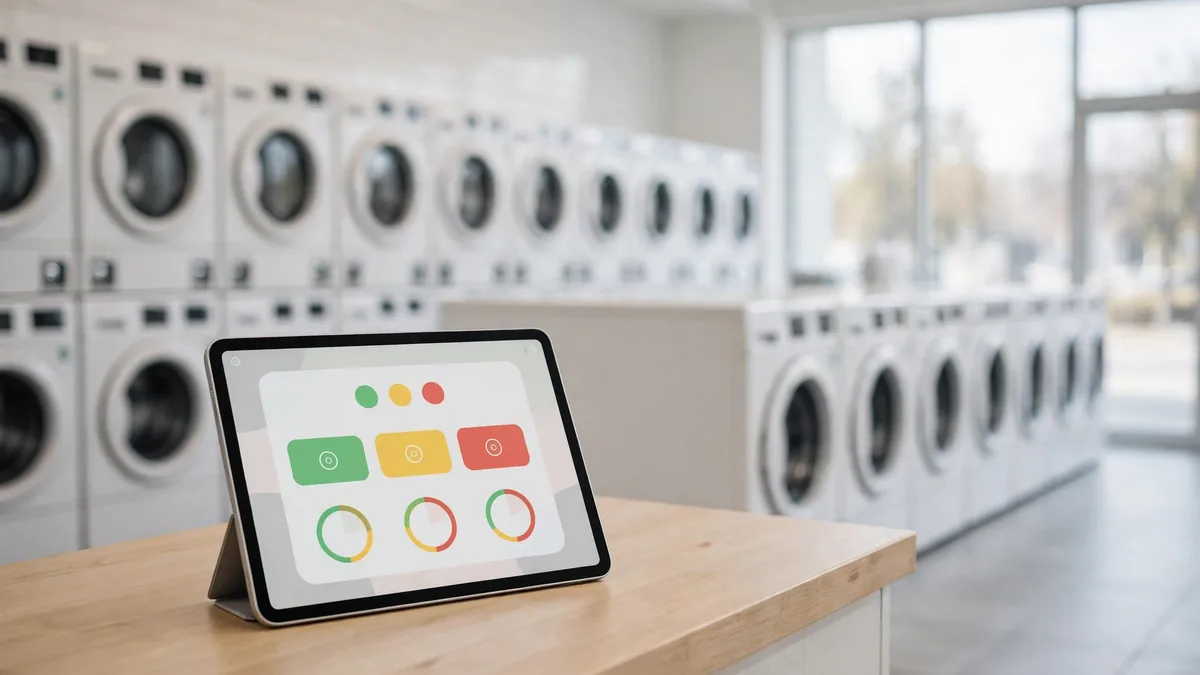
Best laundromat management software in 2027 helps owners run a self-service laundry, a wash-and-fold service, or a multi-store chain from one dashboard instead of juggling coins, paper tickets, and spreadsheets. The right platform tracks every washer and dryer, takes card and mobile payments, schedules pickup and delivery, and shows which machines earn money and which ones sit idle.
Laundromats look simple from the front, but the back office is not. Owners must price washers by size and cycle, manage loyalty, handle refunds, watch utility use, and keep machines running. A store that still relies on coin boxes alone loses customers who carry no cash, and it loses the data that shows whether a price rise helped or hurt.
This shortlist covers eight platforms that laundromat owners actually use in 2027, from full business systems such as Cents and CleanCloud to machine-connected tools from Dexter and Speed Queen and payment-only options such as Washlava and PayRange. Each one is judged on the same points: payments, machine monitoring, wash-and-fold and delivery support, reporting, ease of setup, and cost.
Key takeaways
- Cents is the best overall choice for most laundromats because it combines point of sale, machine monitoring, wash-and-fold orders, and delivery in one system.
- CleanCloud is the strongest pick for wash-and-fold and dry-cleaning work, with detailed order tracking from intake to delivery.
- DexterLive and Speed Queen Insights are the best options if your store already runs Dexter or Speed Queen machines, because they connect directly to the equipment.
- Payment-only tools such as Washlava and PayRange cost less and install faster, but they do not manage orders, staff, or customers.
- Check current pricing before you commit, because most vendors price by location, machine count, or order volume, and published prices change often.
At a glance: the shortlist
| Product | Best for | Starting price | Standout limit |
|---|---|---|---|
| Cents | Most laundromats, overall | Custom, check current pricing | Full system, so setup takes longer than a payment-only app |
| CleanCloud | Wash-and-fold and dry cleaning | Subscription, check current pricing | Machine payment hardware is an add-on, not the core |
| DexterLive | Dexter machine owners | Check current pricing | Only works with Dexter equipment |
| Speed Queen Insights | Speed Queen owners | Check current pricing | Only works with Speed Queen equipment |
| Washlava | Cashless payments | Check current pricing | No full order or staff management |
| LaundroWorks | Card payment systems | Check current pricing | Payment-focused, limited business reporting |
| Starchup | Pickup and delivery | Subscription, check current pricing | Best for delivery-led businesses, less so for coin stores |
| PayRange | Simple mobile payments | Check current pricing | Payment only, no order tracking |
Cents — Best overall
Cents is the most complete laundromat management software on this list, and it is the best overall pick for a store that wants one system for the counter, the machines, and the back office. It was built specifically for laundromats rather than adapted from a generic retail point of sale, and that shows in the way it handles wash-and-fold orders by weight, machine payments, and pickup and delivery routes. Owners can run a single store or several stores from the same dashboard, with staff permissions that keep cashiers from seeing owner-level reports.
The self-service side covers card and mobile payments, loyalty, and machine status that customers can check before they arrive. The full-service side covers order intake, weighing, tagging, and customer notifications, so a bag is tracked from drop-off to pickup without paper tickets. Reporting covers revenue by machine, by service, and by store, which makes it easier to spot an underperforming dryer or a price that needs adjusting. Similar service businesses face the same choice between a payment app and a full system, and the comparison in our guide to car wash management software shows how that trade-off plays out in another machine-based business.
Cents also handles employee management, including clock-ins and role-based access, and it connects to common accounting and marketing tools so sales data does not have to be retyped. Support is aimed at laundry owners, which matters when a question is about a wash-and-fold workflow rather than a generic checkout problem.
Pros: Purpose-built for laundromats; covers self-service, wash-and-fold, and delivery in one platform; strong machine-level reporting; multi-store support with staff permissions.
Cons: Pricing is custom and quoted per business, so you cannot compare it at a glance; a full rollout takes more setup time than a payment-only tool.
CleanCloud — Best for wash-and-fold and dry cleaning
CleanCloud is a laundry and dry-cleaning management platform that suits laundromats with a serious wash-and-fold or dry-cleaning service. Its strength is order management: every order is logged, tagged, tracked through cleaning stages, and matched to the right customer at pickup. That matters when a store processes dozens of bags a day and a single mix-up costs a customer.
The platform also covers pickup and delivery scheduling, route planning, and driver tracking, which makes it a good fit for laundromats that want delivery to grow beyond a few regulars. Payments and receipts are handled inside the system, and reporting shows which services and customers bring in the most revenue. CleanCloud offers a customer-facing app and online booking, so regulars can place orders without phoning the store.
Where CleanCloud is weaker is the self-service floor. It is not primarily a machine payment system, so a coin-operated store may still need separate payment hardware. For a store whose income is mostly wash-and-fold and dry cleaning, that trade-off is fine. For a mostly self-service store, Cents or a machine-connected platform is usually a better fit. CleanCloud is priced as a subscription, so check current pricing for the plan that matches your order count.
Pros: Excellent order tracking for wash-and-fold and dry cleaning; pickup and delivery routing built in; customer app and online booking; clear service-level reporting.
Cons: Not a machine payment system at its core; subscription cost rises with features and volume.
DexterLive — Best for Dexter machine owners
DexterLive is the connected platform for Dexter Laundry machines, and it is the best choice if your store already runs Dexter washers and dryers. It connects the machines to the cloud so owners can see machine status, change prices and cycle settings remotely, and track revenue per machine without walking the floor. That remote control is a real time saver for owners who manage more than one store or who do not want to reprogram machines one by one.
Customers use the DexterPay app to pay by card or mobile, check which machines are free, and get a notification when a cycle finishes. That removes the need for coins and reduces the queue at the change machine. Owners get alerts when a machine stops and reports on usage and revenue, and they can run promotions or adjust pricing for quiet hours.
The obvious limit is that DexterLive only works with Dexter equipment. If your store mixes brands, you will need another system for the rest of the floor. For a Dexter-only store, the tight link between machine and software is hard to beat, because the data comes straight from the machine. Pricing is quoted by the vendor, so check current pricing before budgeting.
Pros: Direct connection to Dexter machines; remote pricing and cycle control; customer app with machine availability and cycle alerts; machine-level revenue reports.
Cons: Only works with Dexter equipment; not a full wash-and-fold or delivery management system on its own.
Speed Queen Insights — Best for Speed Queen owners
Speed Queen Insights is the connected platform for Speed Queen commercial laundry machines, built by Alliance Laundry Systems. Like DexterLive, it links the machines to an owner dashboard and a customer payment app, and it is the best option for a store that already runs Speed Queen equipment. Owners can monitor machine status in real time, adjust prices from anywhere, and review revenue and usage by machine and by store.
The customer side uses the Speed Queen app for cashless payment, machine availability, and cycle-finished alerts. That improves the customer experience in a busy store, because people can leave and come back when their load is done instead of waiting beside a machine. The platform also supports loyalty and promotions, which help a store keep regular customers without paper punch cards.
Speed Queen Insights is a strong fit for owners who want machine data and remote control without adding a separate point-of-sale system for the self-service floor. It is less complete as a wash-and-fold platform, so a store with a large full-service operation may pair it with separate order software. As with DexterLive, it only works with its own brand of machines. Check current pricing with the vendor, since pricing depends on machine count and setup.
Pros: Built for Speed Queen machines; real-time status and remote price control; customer app with cashless payment and alerts; loyalty and promotion tools.
Cons: Only works with Speed Queen equipment; limited wash-and-fold order management compared with Cents or CleanCloud.
Washlava — Best for cashless payments
Washlava is a mobile payment and machine management platform for laundromats that want to go cashless without replacing their whole back office. Customers pay through the Washlava app, start machines from their phone, and receive a notification when a cycle ends. Owners get a dashboard that shows machine use, revenue, and payment activity, and they can adjust pricing and run promotions without touching each machine.
The appeal of Washlava is speed. A store can add cashless payments and machine monitoring without a long software rollout or retraining staff on a full point-of-sale system. It works across machine brands through connected payment hardware, which makes it a practical choice for a mixed-brand floor. The app also supports loyalty, so regular customers can earn rewards for repeat visits.
Washlava is not a full business management system. It does not track wash-and-fold orders the way Cents or CleanCloud do, and it does not manage staff or delivery routes. For a self-service store that mainly needs payments, machine status, and simple promotions, that is enough. Check current pricing, since costs depend on hardware and transaction volume.
Pros: Fast to set up; cashless payment and machine status across machine brands; customer app with cycle alerts; loyalty and promotions included.
Cons: No full wash-and-fold order tracking; no staff or delivery route management.
LaundroWorks — Best for card payment systems
LaundroWorks, from Card Concepts Inc., is a card-based payment system for laundromats that want to replace coins with a store card or a card reader at each machine. Customers load value onto a card or pay by card, start the machine, and the system records the transaction. Owners get reports on machine revenue and usage, and they can set pricing, run bonus promotions, and manage the card system from a central terminal.
The system has been used in laundromats for many years, and its strength is reliability on the self-service floor. It is a proven way to cut coin handling, reduce theft risk from coin boxes, and give customers a payment method that works even when their phone battery is dead. The reporting is focused on what owners of a self-service store need most: which machines earn, which are busy, and how much value is held on cards.
LaundroWorks is a payment system first and a business system second. It does not offer the order tracking, customer records, or delivery tools of a full platform, so a store with a growing wash-and-fold service will need other software for that side of the business. Pricing depends on hardware and store size, so check current pricing before ordering.
Pros: Proven card payment system for self-service stores; reduces coin handling and theft risk; machine-level revenue reports; works without a customer phone app.
Cons: Payment-focused with limited order and customer management; hardware cost depends on machine count.
Starchup — Best for pickup and delivery
Starchup is a software platform for laundry and dry-cleaning businesses that run pickup and delivery, and it is the best pick on this list for a laundromat that wants delivery to be a core service rather than an add-on. It covers the whole delivery workflow: online ordering, pickup scheduling, driver assignment and tracking, order status updates, and customer messaging. That end-to-end view is what a delivery service needs when drivers, orders, and customers all move at once.
The platform also handles wash-and-fold and dry-cleaning orders, with customer accounts, order history, and payment processing built in. Store owners can set service areas, delivery windows, and pricing by weight or by item, and they can see which routes and time slots are most profitable. A customer app lets regulars reorder quickly, which helps turn a one-off delivery trial into a weekly habit.
Starchup is less of a fit for a purely self-service coin store, because its strengths sit in orders and routes rather than machine payments. It works best for a laundromat that already does delivery, or one that plans to make delivery a large share of revenue. It is priced as a subscription, so check current pricing for the plan that fits your order volume.
Pros: Strong pickup and delivery workflow with driver tracking; order and customer management built in; customer app for repeat orders; service-area and pricing controls.
Cons: Not a machine payment system; best for delivery-led businesses rather than self-service-only stores.
PayRange — Best for simple mobile payments
PayRange is a mobile payment platform for unattended machines, including laundromat washers and dryers, vending machines, and car washes. Customers pay through the PayRange app using a card or mobile wallet, start the machine, and the payment is recorded. For a laundromat owner, it is the simplest way to add cashless payments: fit the payment device, connect the machines, and customers can pay without coins or a store card.
The owner dashboard shows machine revenue and usage, and owners can adjust pricing and run promotions from the system. Because PayRange is used across many types of unattended machines, the app is familiar to some customers already, so a small store can be running on it quickly.
The trade-off is scope. PayRange handles payments and basic machine data, and nothing else. It does not track wash-and-fold orders, manage staff, or run delivery routes, so a store that needs those tools will need a second system. It is the best choice for a small self-service laundromat that wants cashless payments at the lowest complexity and cost, or as a first step before a full platform. Check current pricing, since fees depend on hardware and transactions.
Pros: Simplest way to add mobile payments; low setup effort; familiar app for customers; basic machine revenue reports.
Cons: Payment only, with no order, staff, or delivery management; limited reporting compared with full platforms.
How to choose
Start with how your store actually makes money. A self-service store that earns mostly from washers and dryers needs payments, machine monitoring, and pricing control first, and a payment platform such as Washlava or PayRange, or a machine-connected system such as DexterLive or Speed Queen Insights, may be enough. A store that earns a large share from wash-and-fold or delivery needs order tracking, customer records, and route management, and that points to Cents, CleanCloud, or Starchup.
Next, check what machines you already own. If your floor is all Dexter or all Speed Queen, the matching connected platform gives you machine data and remote control with the least extra hardware. If your floor mixes brands, a brand-neutral platform such as Cents, Washlava, or PayRange avoids running two systems. Ask each vendor exactly which machine models it supports, and get that answer in writing before you sign. The same care applies when you buy the business itself, and our guide to vetting a laundromat sale price explains what to check before you commit money to a store.
Then compare the real cost, not just the headline price. Ask for the monthly subscription, the hardware cost per machine, transaction fees, and any charges for extra stores, extra users, or delivery orders. A low monthly fee with high transaction fees can cost more than a higher subscription once volume grows. Ask how long the contract runs, what happens if you cancel, and whether your data can be exported. A short trial on a few machines is the best test: run it for a month and ask staff whether it saved time.
Checklist: before you pay
- Confirm the software works with your exact washer and dryer models, in writing from the vendor.
- Run a trial on a few machines and check the reports, the payment flow, and the customer experience.
- Add up the full cost: subscription, hardware, transaction fees, and any per-store or per-order charges.
- Check the contract length, cancellation terms, and whether customer and order data can be exported.
- Test wash-and-fold and delivery workflows with real orders, not just a demo, if you offer those services.
- Ask what support is included, how fast the vendor responds, and whether help is available outside business hours.
Frequently asked questions
What is laundromat management software?
Laundromat management software runs the business side of a laundromat. It handles payments at the machines, tracks machine use and revenue, manages wash-and-fold and delivery orders, keeps customer records, and reports on which services and machines earn the most. Some platforms cover all of that, while others cover only payments or only orders.
Do I need laundromat software if my store is coin-operated?
You can run a coin store without software, but you lose customers who do not carry cash and you lose data on machine use and revenue. A payment platform such as PayRange or Washlava adds card and mobile payments without a full system change, and it shows which machines are used most.
How much does laundromat management software cost?
Costs vary widely. Payment-only tools charge mainly for hardware and transactions, while full platforms charge a monthly subscription that depends on stores, machines, and order volume. Most vendors quote a custom price, so ask for the full breakdown and check current pricing before you budget. Do not compare two vendors on the monthly fee alone.
Which software is best for wash-and-fold?
Cents and CleanCloud are the strongest choices for wash-and-fold, because both track orders from intake to pickup with customer records and notifications. Starchup is also strong when pickup and delivery are part of the service. A payment-only tool will not track orders.
Can one system run several laundromat locations?
Yes. Cents, CleanCloud, and Starchup are built for multi-store operation, with one dashboard and separate reports per store. Machine-connected platforms such as DexterLive and Speed Queen Insights also support multiple stores, as long as the machines are the matching brand. Check the per-store price before you add a second location.
How do I start with laundromat software as a new owner?
Start with a payment system on your existing machines, learn which services your customers actually use, and then add order and delivery software when the volume justifies it. A trial on a few machines will show whether staff and customers find the system easy. Our guides to software for small businesses cover the same buying steps for other tools.
The bottom line
For most laundromats in 2027, Cents is the best overall choice because it covers self-service payments, wash-and-fold orders, delivery, and multi-store reporting in one system. CleanCloud is the better pick for a store built around wash-and-fold and dry cleaning, and Starchup leads for delivery-first businesses. If your floor is all Dexter or all Speed Queen, DexterLive or Speed Queen Insights gives you the tightest machine connection, while Washlava, LaundroWorks, and PayRange are the simplest ways to add cashless payments.
Choose by how your store earns money, check machine compatibility in writing, and compare the full cost including hardware and transaction fees. Run a trial on a few machines before you commit, and pick the system your staff will actually use every day, because the best software is the one that saves time on the floor.