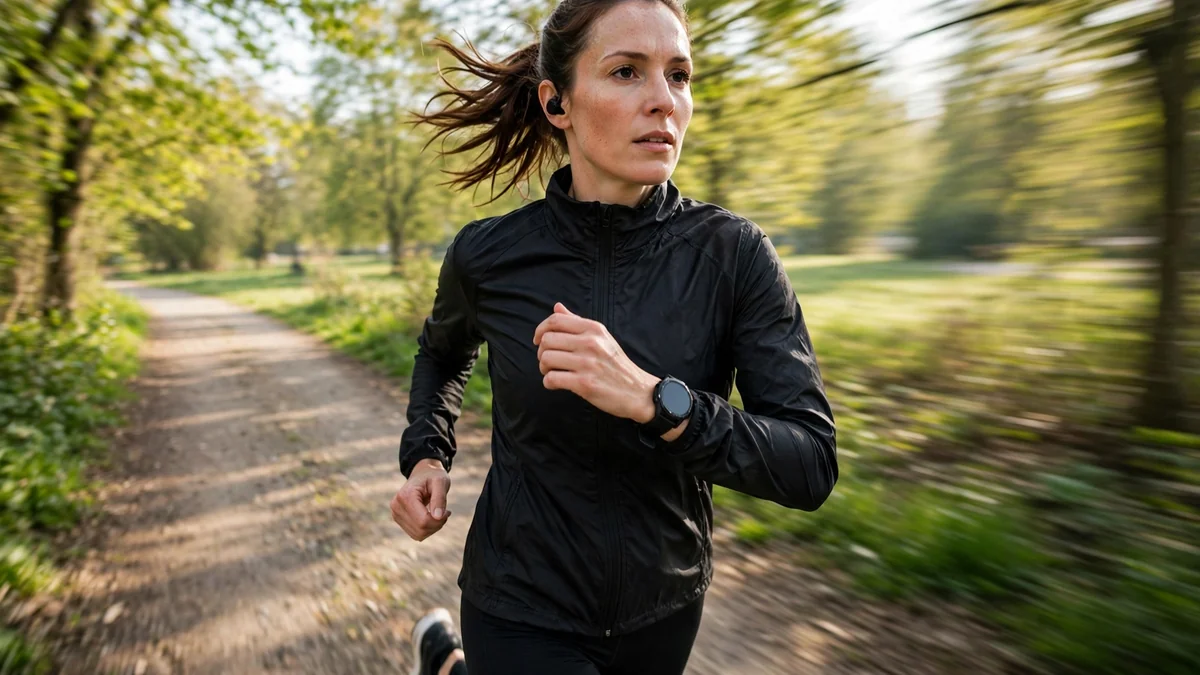
The best smartwatches for runners are judged by one thing above all: how accurately they track a run. A running watch that measures distance, pace, and heart rate precisely is worth more than one with a thousand apps, because training decisions depend on the numbers. GPS accuracy, heart rate accuracy, and battery life matter more than style or smart features.
GPS is the first filter. Dual-band GPS, found on the Garmin Forerunner 265 and the Coros Pace 3, tracks accurately even under trees and between buildings, while single-band GPS can drift by tens of metres. The second filter is battery: a watch that dies on a long run is useless, so look for at least 20 hours of GPS battery life.
This guide compares seven smartwatches that work well for runners, from the Garmin Forerunner 265 to the budget Coros Pace 3, with honest starting prices and the limits that matter. Prices are approximate starting prices — check current pricing before buying.
Key takeaways
- Best overall: the Garmin Forerunner 265, for its accurate dual-band GPS and bright AMOLED display.
- Best value: the Garmin Forerunner 165, with most of the 265’s features for less.
- Best budget pick: the Coros Pace 3, with dual-band GPS from around $229.
- Best for iPhone runners: the Apple Watch SE 2, with seamless iPhone integration.
- Avoid watches with under 20 hours of GPS battery if you run long distances.
At a glance: the shortlist
| Product | Best for | Starting price | Standout limit |
|---|---|---|---|
| Garmin Forerunner 265 | Best overall | From $449 | Expensive |
| Garmin Forerunner 165 | Best value | From $249 | No dual-band GPS |
| Apple Watch SE 2 | Best for iPhone | From $249 | Short battery life |
| Apple Watch Series 10 | Best Apple | From $399 | Needs daily charging |
| Samsung Galaxy Watch 7 | Best for Samsung | From $299 | Short GPS battery |
| Coros Pace 3 | Budget GPS | From $229 | Fewer smart features |
| Polar Vantage M3 | Best for training data | From $399 | Heavier than rivals |
Garmin Forerunner 265 — Best overall
The Garmin Forerunner 265 is the best running watch for most runners. It has dual-band GPS that tracks accurately under trees and between buildings, a bright AMOLED display that stays readable in full sun, and a heart rate sensor that is among the most accurate in this guide. Battery life is 13 days in smartwatch mode and 20 hours with GPS on.
Garmin’s training features are the best here, with suggested workouts, recovery time, and race predictions that actually help. The watch is light at 47 grams and comfortable for all-day wear. At around $449 it is expensive, but for a serious runner it is the obvious pick.
For general fitness, our best smartwatches for fitness covers all-rounders.
Pros: Accurate dual-band GPS; bright AMOLED display; 20-hour GPS battery; best training features.
Cons: Expensive; no touchscreen keyboard; smart features trail Apple and Samsung.
Garmin Forerunner 165 — Best value
The Garmin Forerunner 165 brings most of the Forerunner 265’s features for around $249. It has the same bright AMOLED display, the same heart rate sensor, and the same Garmin training features, including suggested workouts and recovery advice.
The main gap is GPS: the 165 uses single-band GPS, which is less accurate under trees and in cities. Battery life is 11 days in smartwatch mode and 19 hours with GPS on. For road runners who train in open areas, the 165 is the better value.
Pros: Low price; bright AMOLED display; same training features as the 265; 19-hour GPS battery.
Cons: No dual-band GPS; no barometric altimeter; plastic build feels cheaper.
Apple Watch SE 2 — Best for iPhone runners
The Apple Watch SE 2 is the best running watch for iPhone owners who want a smartwatch first and a running watch second. It pairs seamlessly with an iPhone, supports Apple Pay and Siri, and tracks runs accurately with GPS and a good heart rate sensor.
Battery life is the weakness: around 18 hours in normal use and 7 hours with GPS on, so it needs charging every night and cannot handle an ultramarathon. For daily runs up to two hours, though, the SE 2 is the most convenient watch here.
Pros: Seamless iPhone integration; bright display; accurate tracking; low price for an Apple Watch.
Cons: Short battery life; 7-hour GPS battery; no always-on display.
Apple Watch Series 10 — Best Apple watch
The Apple Watch Series 10 is the best Apple Watch for runners, with a larger, brighter display, a thinner body, and faster charging. It tracks runs accurately, supports offline maps, and includes depth and temperature sensors for open-water swimming.
Battery life is still the limitation: around 18 hours in normal use and 7 hours with GPS on, though a 30-minute charge adds 80 percent. At around $399 it is expensive for a running watch, but for an iPhone owner who wants the best smartwatch experience, it is the pick.
Pros: Largest brightest Apple Watch display; fast charging; offline maps; excellent app support.
Cons: Needs daily charging; 7-hour GPS battery; expensive.
Samsung Galaxy Watch 7 — Best for Samsung runners
The Galaxy Watch 7 is the best running watch for Samsung phone owners, with dual-band GPS, a bright display, and deep integration with Samsung Health. It tracks runs accurately, monitors sleep and body composition, and supports Samsung Pay.
Battery life is around 24 hours in normal use and 15 hours with GPS on, which is shorter than Garmin’s but enough for daily runs. The watch is light and comfortable, and the rotating bezel is gone, replaced by touch controls.
Pros: Dual-band GPS; bright display; deep Samsung Health integration; light and comfortable.
Cons: Short battery life; 15-hour GPS battery; best features need a Samsung phone.
Coros Pace 3 — Best budget GPS pick
The Coros Pace 3 is the cheapest dual-band GPS watch in this guide at around $229, and it is a remarkable value. It tracks as accurately as the Garmin Forerunner 265, weighs just 30 grams, and lasts 24 days in smartwatch mode and 38 hours with GPS on — the longest battery here by far.
The display is not AMOLED, so it is less vivid than Garmin’s, and the smart features are basic. For a runner who cares about tracking accuracy and battery above all, the Pace 3 is the best value in this guide.
Pros: Dual-band GPS; extremely light at 30 g; 38-hour GPS battery; low price.
Cons: No AMOLED display; basic smart features; smaller app selection.
Polar Vantage M3 — Best for training data
The Polar Vantage M3 is the best watch here for runners who live by their training data. It has dual-band GPS, an accurate heart rate sensor, and Polar’s excellent recovery and training load analysis, which many coaches prefer to Garmin’s.
Battery life is 30 hours with GPS on, and the AMOLED display is bright and sharp. At 53 grams it is heavier than the Coros and Garmin picks, and the smart features are basic. For data-driven runners, though, the Vantage M3 is the most insightful watch here.
Pros: Excellent training and recovery data; dual-band GPS; 30-hour GPS battery; bright AMOLED display.
Cons: Heavier at 53 g; basic smart features; expensive.
How to choose
Start with GPS accuracy. Dual-band GPS, found on the Garmin Forerunner 265, Coros Pace 3, and Polar Vantage M3, tracks accurately under trees and between buildings. If you run in a city or a forest, dual-band matters. If you run on open roads, single-band is fine.
Then check battery life against your longest run. A marathon needs at least 6 hours of GPS battery with a margin, and an ultramarathon needs 20 hours or more. The Coros Pace 3 leads here at 38 hours, while the Apple Watch trails at 7 hours.
Finally, consider your phone. Apple Watch works best with an iPhone, Galaxy Watch with a Samsung phone, and Garmin and Coros work well with any phone. A watch that pairs well with your phone syncs runs faster and shows notifications reliably.
Track your training with the best wearable fitness trackers for runners guide.
Common mistakes to avoid
- Buying a watch with a short GPS battery — an Apple Watch cannot handle an ultramarathon on one charge.
- Ignoring GPS type — single-band GPS drifts under trees and between buildings.
- Choosing style over tracking accuracy — a pretty watch with poor GPS gives you numbers you cannot trust.
- Forgetting to test heart rate accuracy — wrist sensors vary by person, and a loose fit ruins readings.
- Buying without checking phone compatibility — Galaxy Watch features need a Samsung phone, and Apple Watch needs an iPhone.
- Choosing a heavy watch for long runs — anything over 50 grams becomes noticeable by mile ten.
Checklist: before you buy
- Check GPS type; dual-band is worth it for city and forest running.
- Look for at least 20 hours of GPS battery if you run long distances.
- Test the heart rate sensor on a run; wrist accuracy varies by person.
- Make sure the display is readable in bright sunlight.
- Check the weight; under 50 grams is comfortable for long runs.
- Confirm the watch syncs with your phone and your running app.
Frequently asked questions
Do I need a running watch, or is a phone enough?
A phone tracks runs well, but a watch is more convenient: it shows pace on your wrist, works without carrying a phone, and lasts longer on GPS. A watch is worth it if you run three or more times a week.
Is dual-band GPS worth it?
Yes, if you run in cities, forests, or canyons, where single-band GPS can drift by tens of metres. On open roads, the difference is small. Dual-band watches cost more, but the accuracy is noticeable where it matters.
How accurate are wrist heart rate sensors?
Good wrist sensors are accurate within a few beats per minute during steady running, but they lag during intervals and can struggle with tattoos, cold skin, or a loose fit. A chest strap is more accurate for interval training.
For a luxury option, see the best luxury smartwatches roundup.
How long should a running watch battery last?
For daily runs, a week of smartwatch battery is enough. For marathon training, look for at least 20 hours of GPS battery. For ultramarathons, the Coros Pace 3 at 38 hours is the safest choice here.
Can I swim with a running watch?
Yes. All the watches in this guide are water resistant to at least 5 ATM, which covers swimming and rain. The Apple Watch Series 10 and Galaxy Watch 7 also track open-water swims.
Do running watches work without a phone?
Yes. All the watches here have built-in GPS and can track a run without a phone nearby. Music needs either onboard storage or a phone, depending on the model — Garmin and Apple Watch support offline music, while Coros does not.
The bottom line
For most runners, the Garmin Forerunner 265 is the best smartwatch in 2027: it has accurate dual-band GPS, a bright display, and the best training features. If money is tight, the Garmin Forerunner 165 covers most of the same ground for around $249, and the Coros Pace 3 is the best value for battery and accuracy at around $229.
If you own an iPhone and want a smartwatch first, the Apple Watch SE 2 is the most convenient choice, but charge it every night. Whatever you choose, check GPS accuracy on your usual route — that is the number that matters most.