Black Friday spending jumped in 2026, and electronics led the surge. Shoppers in the United States spent a record $13.1 billion online on Black Friday, up 11.1 percent from a year earlier, according to Adobe Analytics data reported by Reuters. The total beat Adobe’s own forecast of about $12.9 billion, with gaming and electronics the strongest categories of the day.
The online record was only part of the story. Mastercard SpendingPulse, which tracks in-store and online retail sales across all payment types, reported that total United States retail sales excluding gas and autos rose 5.8 percent year over year on Black Friday. E-commerce spending climbed 13.4 percent, while in-store spending grew 3.8 percent.
What makes the jump notable is the context. Shoppers arrived at the biggest shopping day of the year weighed down by inflation and high gas prices, and retailers answered with deep discounts. Yet instead of pulling back, consumers spent more, spent earlier, and spent heavily on technology.
Key takeaways
- Online Black Friday spending hit a record $13.1 billion, up 11.1 percent year over year, beating Adobe’s $12.9 billion forecast.
- Mastercard SpendingPulse put total retail sales excluding gas and autos up 5.8 percent, with e-commerce up 13.4 percent and in-store sales up 3.8 percent.
- Electronics and software spending rose 7.9 percent year over year, with a sharp early-month spike tied to the launch week of Grand Theft Auto VI.
- Shoppers used AI tools to compare prices and discover products, and leaned on buy now, pay later plans to stretch their budgets.
- Adobe expects the full holiday season to reach $275.1 billion online, with Cyber Monday still the biggest single day at $15.1 billion.
| Measure | Figure | Change vs 2025 |
|---|---|---|
| Online spending, Black Friday | $13.1 billion | Up 11.1% |
| Total retail sales ex gas and autos | Mastercard SpendingPulse | Up 5.8% |
| E-commerce spending | Mastercard SpendingPulse | Up 13.4% |
| In-store spending | Mastercard SpendingPulse | Up 3.8% |
| Electronics and software spending | Mastercard SpendingPulse | Up 7.9% |
| Cyber Monday forecast | $15.1 billion online | Up 6.2% |
The numbers behind the jump
Two independent measurements tell the same story from different angles. Adobe Analytics counts online transactions at United States retail websites, while Mastercard SpendingPulse measures in-store and online retail sales across all payment types, without adjusting for inflation. When both point the same way, the signal is hard to dismiss.
Adobe’s figure is the headline: $13.1 billion spent online on Black Friday, 11.1 percent more than last year and ahead of the $12.9 billion Adobe had forecast in September. Adobe had expected 9.2 percent growth, the fastest of any day this season, and the actual result cleared even that bar. Last year’s online total was $11.8 billion.
Mastercard’s read adds the offline half of the picture. Total retail sales excluding gas and autos rose 5.8 percent, with e-commerce up 13.4 percent and in-store sales up 3.8 percent. Michelle Meyer, chief economist at the Mastercard Economics Institute, described the consumer behind the numbers as adaptable — willing to spend while being thoughtful about where, when, and how.
Electronics did the heavy lifting
If one category explains the jump, it is electronics. Mastercard reported electronics and software spending up 7.9 percent year over year on Black Friday, and Adobe named gaming and electronics the standout categories of the day online. Toys joined them at the top of the online list, but the technology story ran deeper than a single day of deals.
The surge started more than a week before Black Friday. Mastercard recorded electronics and software spending jumping 37.9 percent on November 18 and 43.5 percent on November 19, the week Grand Theft Auto VI and other video games launched. Gamers did not wait for Friday. Thanksgiving Day gave an early warning, with electronics and software growing 19.2 percent on early promotions.
Adobe’s seasonal forecast puts the category in perspective. Electronics are expected to generate $63.3 billion of online spending across the full November-to-December season, up 5.9 percent year over year. Discounts explain part of the pull: Adobe expected electronics discounts to peak at 30 percent off list price during Cyber Week, the deepest of any category, with televisions reaching about 23 percent off.
There is also a supply-side twist. A shortage of memory chips has pushed up prices for phones, laptops, consoles, and other electronics this year. The fact that spending still jumped suggests buyers treated the discounts as a window: pay less now, before prices drift higher. Much of the current market is built around AI features — our guide to the best AI wearables of 2027 shows how deeply AI is now woven into everyday devices.
Why shoppers spent anyway
The spending jump arrived against a backdrop that, on paper, should have discouraged it. Inflation remained a drag on household budgets, gas prices were high, and retailers described an effort to win over Americans who were watching every dollar. The Reuters report on Adobe’s data noted that retailers leaned on discounts for apparel and appliances to draw people in.
Three forces helped shoppers stretch their budgets. The first was discounting itself: Adobe expected discounts of up to 30 percent off list price during Cyber Week, on par with the 2025 season, with the deepest cuts landing on Black Friday for televisions, toys, apparel, and appliances.
The second force was financing. Buy now, pay later continued to grow as a way to spread the cost of bigger purchases: Adobe forecast $807 million of it on Black Friday itself, and $1.09 billion on Cyber Monday, up 5.3 percent from a year ago. The third force was information: shoppers increasingly used AI tools to compare prices and discover products, according to both Mastercard and the Reuters account of Adobe’s data.
Online led, stores held their ground
The split between channels is one of the clearest signals in the data. E-commerce grew 13.4 percent on Black Friday, more than three times the 3.8 percent growth of in-store spending. Online also set the records: $13.1 billion in a single day, with mobile devices accounting for a record share. Adobe forecast a record 63 percent of Thanksgiving online spending would come through mobile devices.
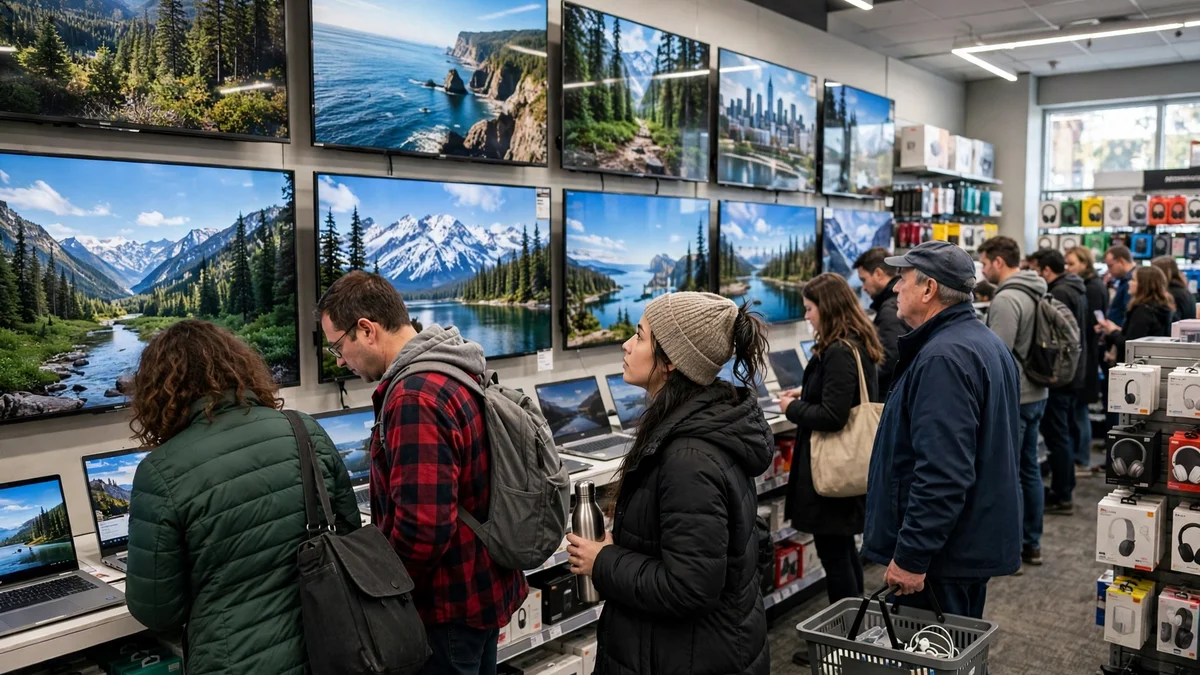
Yet the in-store number deserves more attention than it usually gets. A 3.8 percent rise in physical retail on a day when online grew by double digits means stores are not fading; they are settling into a different role. Shoppers went to stores to see televisions in person and pick up items the same day, then went online for the things they had already decided to buy.
The mix also varied by category. Alongside gaming and electronics, Adobe reported that shoppers used Black Friday deals to stock up on essentials: household cleaning products, pet care items, and personal hygiene products.
What the jump means for the rest of the season
Black Friday is one day, and the season is two months long, so the real question is what the jump predicts. Adobe’s forecast for the full season is $275.1 billion online, up 6.7 percent year over year, with Cyber Week — the five days from Thanksgiving to Cyber Monday — expected to drive $47.5 billion, up 7.4 percent. Cyber Monday is still forecast as the biggest single online day at $15.1 billion, up 6.2 percent.
If Black Friday’s beat over its forecast repeats, the season could finish ahead of expectations. The broader retail outlook points the same way: the National Retail Federation expects November and December retail sales to reach $1.013 trillion, up 4.2 percent, taking total holiday spending past the trillion-dollar mark.
There are risks worth naming. The memory-chip shortage could tighten supply on the most popular devices as the season goes on, and discounts may thin out once the deepest Cyber Week deals pass. Shoppers who wait for a better price may find the model they want out of stock rather than cheaper.
How to shop the rest of the season smartly
The rest of the season rewards the same habits that made Black Friday work for careful shoppers. Start with the item, not the discount: decide what you actually need, set a price you are willing to pay, and then watch for that price rather than browsing for something to buy. The deepest electronics discounts are expected on Cyber Monday, while the best television deals land on Black Friday itself.
Compare before you commit. Check the same product at two or three retailers, and remember that a 30 percent discount on an inflated list price is not always a bargain. Small electronics are a good place to practise this — our roundup of the best wireless earbuds of 2027 shows how to weigh sound, battery, and price side by side.
Think about the total cost, not just the sticker price. Buy now, pay later can make a large purchase manageable, but only if the installments fit your budget after the holidays. Check the terms and count the payments. And if you are buying technology that will be used for years, consider the ecosystem around it, as explained in our look at the chip war and who is building what.
Black Friday 2026 checklist
- Set a budget for the rest of the season before Cyber Monday, and stick to it.
- Compare the same product at three retailers before buying, and check the price history.
- Prioritise the items with the deepest real discounts, such as televisions and electronics.
- Read buy now, pay later terms carefully and count every installment before committing.
- Buy popular electronics early if the price is right, since chip shortages can limit stock.
- Keep receipts and check return windows, in case a better deal appears later.
Frequently asked questions
How much did shoppers spend online on Black Friday 2026?
Shoppers spent $13.1 billion online on Black Friday, according to Adobe Analytics data reported by Reuters — up 11.1 percent from last year and ahead of Adobe’s forecast of about $12.9 billion.
How much did total retail sales rise on Black Friday?
Mastercard SpendingPulse reported that United States retail sales excluding gas and autos rose 5.8 percent year over year. E-commerce spending rose 13.4 percent, while in-store spending grew 3.8 percent.
Which categories sold best on Black Friday 2026?
Gaming and electronics were the standout categories online, according to Adobe, and Mastercard reported electronics and software spending up 7.9 percent. Shoppers also stocked up on essentials such as cleaning products, pet care items, and personal hygiene products.
Why did electronics demand jump so much?
Deep discounts peaking at 30 percent off, the launch week of Grand Theft Auto VI in mid-November, early promotions on Thanksgiving Day, and shoppers using AI tools to compare prices all played a part.
What is expected for Cyber Monday 2026?
Adobe forecast Cyber Monday as the biggest online shopping day of the season, with $15.1 billion in online spending, up 6.2 percent year over year. Buy now, pay later spending is expected to reach $1.09 billion, up 5.3 percent.
How big is the full 2026 holiday season expected to be?
Adobe expects United States online sales to reach $275.1 billion for the November-to-December season, up 6.7 percent, with electronics accounting for $63.3 billion. The National Retail Federation expects total retail sales to reach $1.013 trillion, up 4.2 percent.
The bottom line
Black Friday 2026 delivered a clear result: spending jumped, electronics led, and shoppers proved willing to spend when the value was real. The $13.1 billion online record and the 5.8 percent rise in total retail sales both beat expectations, in a year when household budgets were under genuine pressure.
The season is far from over, and Cyber Monday will be the next test. If it follows Black Friday’s pattern, the holiday season will finish strong, with electronics still at the centre of the story. For shoppers, the lesson is simple: know what you want, compare the price, and buy when the deal is genuinely good.