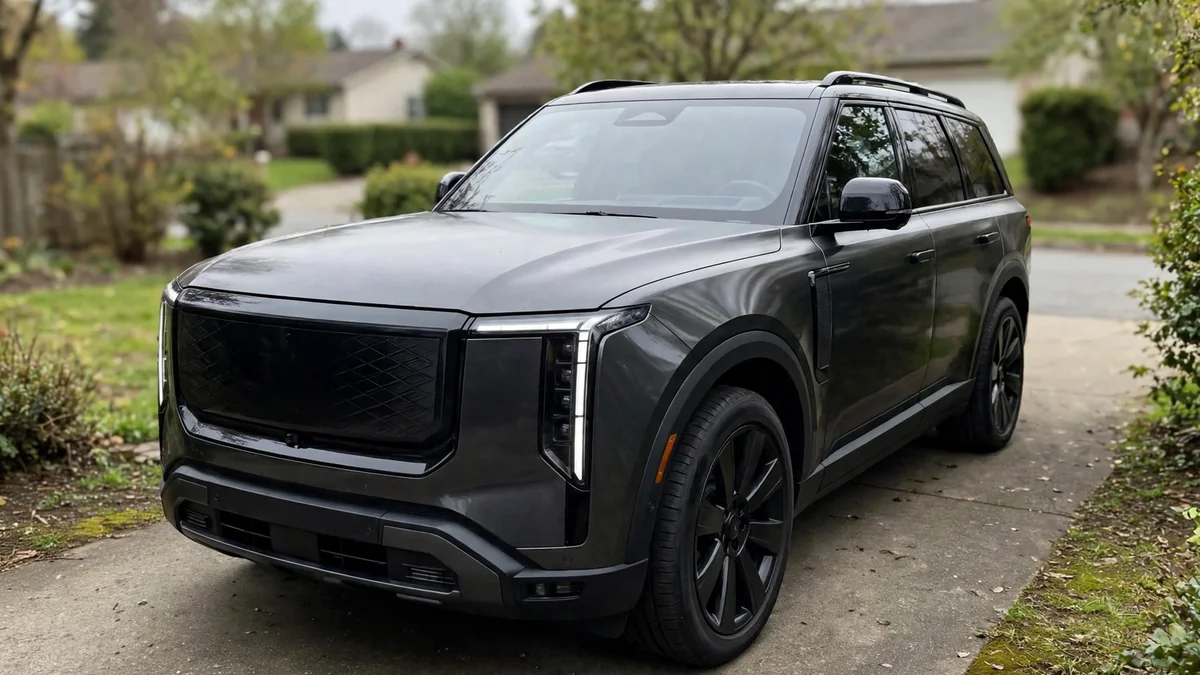
The Cadillac Vistiq is a leather-lined, 17-foot, roughly 6,000-pound luxury SUV with three rows of seats, and it is the first car of its kind that has ever made a seasoned reviewer call it a good deal. That verdict comes from TechCrunch, where Tim De Chant spent two weeks with a 2027 Vistiq Sport earlier this fall and wrote, in a report published on 29 November 2026, that he had never before described a vehicle of this size and plushness as a bargain — until now.
The test car he drove retails for $83,256, including the destination charge and options such as second-row captain’s chairs and a 19.2-kilowatt onboard charger. That is real money, and the Vistiq is not a cheap car pretending to be one. But the case TechCrunch makes is relative: sit in this cabin, feel the materials, listen to the sound system, then look at what rivals charge for less, and the price starts to look like the deal of the luxury electric segment.
There is a catch, and it is in the headline. The Vistiq’s advantage may not last long, because the platform underneath it is ageing, General Motors has reportedly paused updates to it while it rethinks its electric strategy, and rivals are arriving with faster-charging architectures. This article lays out the car, the value case, and why the window may be closing — with prices as reported in late November 2026, and a note to check current pricing before buying.
Key takeaways
- The 2027 Cadillac Vistiq Sport tested by TechCrunch retails for $83,256 including destination charge and options such as second-row captain’s chairs and a 19.2-kilowatt onboard charger.
- The Vistiq is a three-row electric luxury SUV with 615 horsepower, a 102-kilowatt-hour battery, a 33-inch dashboard display, massaging front seats, and a cabin TechCrunch describes as genuinely luxurious even in the base model.
- Against the Kia EV9 GT-Line at $74,580, the Vistiq costs $8,676 more and is, in TechCrunch’s judgement, far and away the nicer vehicle; against the Escalade IQ, which starts above $127,000, it looks like a steal.
- Charging is the weak spot: the 400-volt platform peaked at 165 kilowatts at a Tesla Supercharger, taking 36 minutes to go from 18% to 80%, and the reviewer averaged 2.9 miles per kilowatt-hour in cool weather.
- GM has reportedly put updates to the platform on ice while it reconfigures its EV strategy, and newer rivals such as BMW’s iX5 charge far faster — which is why the value case may not last.
| Detail | What is known |
|---|---|
| Test car | 2027 Vistiq Sport, as tested by TechCrunch, $83,256 including destination charge and options |
| Starting price (2026) | $77,395 before destination; $79,390 including destination, per Edmunds and Autoblog |
| Powertrain | Dual-motor all-wheel drive, 615 horsepower and 650 pound-feet of torque |
| Battery and charging | 102-kilowatt-hour battery, 400-volt platform, NACS port standard on the 2027 model |
| Efficiency in testing | 2.9 miles per kilowatt-hour in 40 to 60 degree Fahrenheit mixed driving, per TechCrunch |
| Key rivals and prices | Kia EV9 GT-Line $74,580; Escalade IQ from above $127,000 |
| Pricing note | Prices as reported in November 2026; check current pricing with a dealer before buying |
What the Vistiq actually is
The Vistiq is Cadillac’s three-row electric SUV, slotted between the two-row Lyriq and the enormous Escalade IQ. It is an all-new model for 2026, and the first three-row battery-electric crossover the brand has ever built. Four trims make up the range — Luxury, Sport, Premium Luxury and Platinum — and every one uses the same dual-motor all-wheel-drive powertrain, producing 615 horsepower and 650 pound-feet of torque, according to Autoblog and Edmunds. Our report on why Tesla still rules the US electric vehicle market shows how much of the EV contest now turns on ecosystems and charging networks rather than on any single car.
Inside: where the money shows

The cabin is where the Vistiq makes its case. A massive 33-inch display dominates the dashboard. Plush leather and finely grained wood are everywhere. The AKG sound system is, in the reviewer’s words, really quite good if you stream a high-quality recording. The finishes, he writes, are very luxurious even in the base model — the detail that turns a nice car into a value argument, because you do not have to climb to the top trim to get the luxury.
The week without the internet
Not everything was perfect, and the biggest problem in TechCrunch’s two weeks with the car had nothing to do with its engineering. When the reviewer picked the Vistiq up in Manhattan, it would not connect to the internet. The setup process for OnStar, GM’s connectivity suite, had not been properly completed, though neither he nor the fleet managers knew that at the time. He ultimately spent a full week with a car that would not connect at all.
That might sound minor, but in 2026 connectivity is load-bearing in a car like this. GM’s Super Cruise driver-assistance system works on roads the automaker has mapped in detail, and on those it performs well — but in many cases it appears to need an internet connection. No internet meant no Super Cruise, at least some of the time, and the reviewer drove four hours home without it, glancing at an iPhone perched in a cupholder for directions. The hybrid world is moving in a different direction, as our look at the Nissan Rogue hybrid and its e-Power driving experience shows, but for a pure electric car the connection is part of the product.
Charging and efficiency: the honest numbers
The numbers from the test are concrete. At a Tesla Supercharger, which mates nicely with the standard NACS port fitted to the 2027 model, the reviewer topped out at 165 kilowatts after about five minutes of preconditioning and an initial state of charge of 18%. It took 36 minutes to reach 80%. The Lucid Gravity, TechCrunch notes, seems to do better at Superchargers, and its 926-volt architecture means it can go even faster at more powerful stalls. In practice, most Vistiq owners will charge at home nearly all the time, which levels the playing field somewhat. But for road trips, the difference is real.
The price case, rival by rival
So is the Cadillac actually a good deal at $83,256? TechCrunch’s answer is built on comparisons, and the comparisons are flattering. The reviewer’s own garage holds a Kia EV9 GT-Line, and he notes that the EV9 sells today for $74,580 including destination charge. With two exceptions — faster charging and a roomier third row — he judges the Vistiq to be far and away the nicer vehicle, and one that feels worth far more than the $8,676 price difference.
The other comparison is even more dramatic. The Escalade IQ, the Vistiq’s bigger electric sibling, starts above $127,000. Against that figure, the Vistiq feels like a steal: three rows, a full luxury experience, and a cabin that would not look out of place in a car costing half as much again. Edmunds reaches a similar conclusion, scoring the Vistiq 8.4 out of 10 for value and writing that it feels incredibly well equipped for the price. The wider EV market has already been through a brutal year — the $7,500 federal tax credit is gone and sales have shrunk — and even the market leader has had to lean on its ecosystem to hold share, as our report on Norway’s wealth fund and the Tesla pay debate reflects in the way investors now judge the whole sector.
Why the deal may not last
The warning in the TechCrunch headline is not about the car getting worse. It is about the world around it getting better, faster. GM has reportedly put updates to the platform on ice while it reconfigures its EV strategy, according to Automotive News reporting cited by TechCrunch. If the platform underneath the Vistiq is frozen while rivals move on, the gap that makes the Vistiq look like a deal today will narrow, and then reverse.
Checklist: deciding on the Vistiq
- Check current pricing and incentives with a dealer — the figures here are as reported in November 2026, and Cadillac has already raised Vistiq prices twice since launch.
- Sit in the third row yourself, with the second row set for your own driving position, before deciding the EV9’s roomier back seats do not matter to you.
- Confirm OnStar and connectivity are fully set up before you drive away, so Super Cruise, navigation and streaming work from day one.
- Test the charging reality on your own routes: find your nearest NACS-compatible fast chargers and work out what a 36-minute stop means for your road trips.
- Price the trim you actually want, not the base car — a loaded Vistiq can pass $112,000, and the Premium Luxury trim is widely judged the best value.
- Ask what GM’s EV platform plans mean for software and hardware updates over the years you will own the car.
Frequently asked questions
How much does the Cadillac Vistiq cost?
The 2026 Vistiq starts at $77,395 before destination, or $79,390 including the $1,995 destination charge. The 2027 model starts at $80,395 including destination. The 2027 Vistiq Sport tested by TechCrunch retails for $83,256 including destination and options. Prices are as reported in November 2026, so check current pricing before buying.
Is the Cadillac Vistiq a good deal?
TechCrunch argues that it is, for now: it costs $8,676 more than a Kia EV9 GT-Line and is judged far and away the nicer vehicle, and roughly $44,000 less than the Escalade IQ. The caveat is slower charging than newer rivals and GM’s reported pause on platform updates.
How fast does the Vistiq charge?
On a 400-volt platform with a 102-kilowatt-hour battery, it is not a charging leader. TechCrunch recorded a peak of 165 kilowatts at a Tesla Supercharger, taking 36 minutes to go from 18% to 80%. The 2027 model comes standard with a NACS port. Most owners will charge at home most of the time.
How efficient is the Vistiq?
TechCrunch averaged 2.9 miles per kilowatt-hour over a week of mixed city and highway driving in temperatures of 40 to 60 degrees Fahrenheit. That is respectable for a vehicle of this size and weight, and roughly in line with the Lucid Gravity, but cold weather and sustained highway driving will reduce it.
Does the Vistiq support CarPlay or Android Auto?
No. GM does not support CarPlay or Android Auto in its electric vehicles, and the Vistiq relies on its built-in Android Automotive system with Google services. That makes a working internet connection important, because without it there is no phone-mirroring fallback for maps, navigation or streaming audio.
What is Super Cruise, and does it work well on the Vistiq?
Super Cruise is GM’s hands-free driver-assistance system for roads the automaker has mapped in detail. TechCrunch found it capable if imperfect, with occasional random disengagements, but mostly assured on freeway travel. It can need an internet connection.
The bottom line
The Cadillac Vistiq is a luxuriously good deal in the most literal sense TechCrunch intends: a car that feels like it should cost $100,000, priced at $83,256 in the tested specification, and starting under $80,000 before destination in its cheapest form. The leather, the wood, the 33-inch display, the massaging seats and the sheer presence of the thing all argue that Cadillac has underpriced the experience, at least relative to the Escalade IQ above it and the Kia EV9 beside it.
But a good deal is a snapshot, not a promise. The platform is ageing, its updates are reportedly on ice, and rivals already charge two or three times faster. If you want a big, plush, three-row electric luxury SUV and you charge at home, the Vistiq is hard to beat at this price — just buy it with your eyes open and check current pricing.