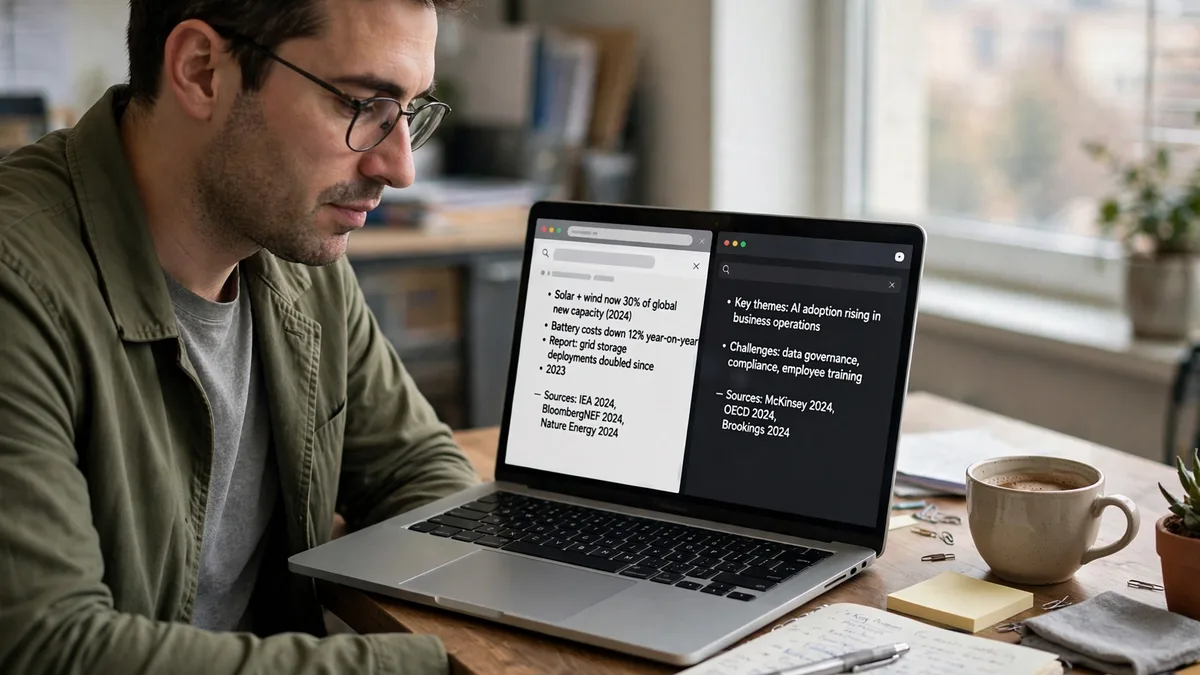
ChatGPT-5 vs Perplexity for Business Research
ChatGPT-5 vs Perplexity for business research is the comparison most research-heavy teams reach in 2027, because the two tools answer the same question in opposite ways. ChatGPT-5 is a general reasoning assistant that can plan, draft, and analyse, and it searches the web when it needs to. Perplexity is a search-first answer engine that starts from live sources and shows its citations up front. Both can research a market, a competitor, or a supplier, but they fail in different places, and picking the wrong one costs hours rather than minutes.
The difference matters most when the answer has to be right. A market-size estimate, a competitor’s pricing change, or a regulation date that is wrong by a year can send a business decision in the wrong direction, and a confident-sounding answer is no protection. In 2027 the practical question is not which tool is smarter in general but which one gives you a checkable answer for the specific research task in front of you, and how much verification work is left for the human after the AI finishes.
This comparison tests both tools on the same six business research jobs: finding current facts, comparing competitors, sizing a market, checking a regulation, summarising a long document, and producing a briefing a manager can act on. Prices are the standard plans as listed in 2027, and every verdict below is by use case, because neither tool wins everywhere.
Key takeaways
- Perplexity wins for fast, sourced fact-finding, because citations are built into every answer.
- ChatGPT-5 wins for turning research into a plan, a model, or a written briefing.
- For competitor pricing and news, Perplexity’s live search is usually more current.
- For long documents and spreadsheets, ChatGPT-5 handles the analysis better.
- Neither tool should be trusted for a decision without checking at least one cited source directly.
At a glance: the shortlist
| Detail | ChatGPT-5 | Perplexity |
|---|---|---|
| Core strength | Reasoning, drafting, analysis | Live search with citations |
| Starting price | Free tier; Plus from $20 a month | Free tier; Pro from $20 a month |
| Citations | Shown when web search runs | Shown in every answer |
| Long documents | Strong; uploads and analysis built in | Good; weaker on deep analysis |
| Current news | Good when search is used | Excellent; search is the default |
| Best for | Briefings, models, plans | Fact checks, competitor scans |
| Biggest risk | Confident answers without sources | Thin synthesis on complex questions |
| Team plans | Team and business tiers available | Pro and Enterprise tiers available |
ChatGPT-5 for business research
ChatGPT-5 is at its best when research is a process, not a single question. Give it a messy brief — a competitor’s annual report, three news articles, and a spreadsheet of prices — and it will pull out the themes, build a comparison table, and draft the briefing in a structure a manager can read in five minutes. That ability to hold a long thread, remember what you asked for, and revise a draft across several rounds is what makes it a research partner rather than a search box.

Its web search is capable but optional, and that is the catch. ChatGPT-5 will answer from its training when it can, and it only searches when the question clearly needs fresh information or when you ask it to. The answers read smoothly and confidently either way, which means a wrong date or an outdated price can slip past a tired reader. The fix is a habit, not a setting: ask it to search, ask it to cite, and then open at least one source yourself. Used that way, it is the stronger tool for synthesis, and our comparison of Perplexity vs ChatGPT-5 for research reaches a similar conclusion on the general research question, with the same warning about checking sources.
Pros: Strong reasoning and drafting, handles long documents and files, flexible across research jobs.
Cons: Search is not the default, and confident answers can hide weak or missing sources.
Perplexity for business research
Perplexity starts from the opposite end. Every question is treated as a search task: it fetches live pages, summarises what they say, and puts numbered citations beside each claim. For a business researcher, that structure changes the work. Instead of wondering whether an answer is current, you can see the source, its date, and whether it is a company page, a news report, or a forum post. A competitor pricing check that takes ten minutes of tab-hopping takes one prompt here, with the sources listed for a second look.
The weakness shows on questions that need judgement rather than facts. Ask Perplexity to weigh two market-entry strategies or to explain why a competitor’s numbers do not add up, and the answer is usually a tidy summary of what sources say, not a reasoned view of its own. It is also less comfortable with large file uploads and multi-step analysis, so a researcher who lives in spreadsheets will keep reaching for ChatGPT-5. For the daily work of checking facts, tracking competitors, and answering “is this still true” questions, it is faster and easier to verify.
Pros: Live search by default, clear citations, fast for fact checks and competitor scans.
Cons: Thinner synthesis on complex questions, and weaker on long-document analysis.
Head-to-head: the six tests that matter
On current facts, such as a regulation date or a product launch, Perplexity wins. Its search-first design pulls fresh pages and dates them, while ChatGPT-5 needs to be told to search and sometimes answers from older knowledge. On competitor comparisons, Perplexity also leads for the same reason: live pricing and feature pages are its home ground, and the citations let you confirm a change in seconds.
On market sizing, the result is closer and neither tool is safe alone. Both will produce a plausible-sounding number, and both can mix up definitions of a market or quote a figure from an old report. ChatGPT-5 is better at showing its working and breaking a market into segments, but the number still needs a check against the original report. On regulation checks, Perplexity’s citations win again, because the exact wording and date of a rule matter more than a smooth summary.
On long documents, ChatGPT-5 wins clearly. Upload a fifty-page report and ask for the three risks that matter to a small business, and it will produce a structured answer with page-level references. Perplexity can summarise documents, but its analysis is shallower. On the final briefing, ChatGPT-5 wins too: it turns findings into a readable document with a recommendation, while Perplexity gives you the ingredients and leaves the writing to you.
One more test matters for teams: how each tool behaves when the answer is uncertain. Perplexity usually shows thin or conflicting sources, which is an honest signal that more digging is needed. ChatGPT-5 is more likely to fill the gap with a smooth, plausible sentence, which reads better and is more dangerous. A researcher who spots that difference quickly will save the team from citing a guess as a fact in a client-facing document.
How to choose
Choose by the job you do most often. If your day is fact checks, competitor tracking, and answering questions from colleagues with a source attached, Perplexity should be your first stop and it will save you the most time. If your day is reading long documents, building comparisons, and writing briefings that a manager acts on, ChatGPT-5 is the better home base, with Perplexity as the checker for anything current.
Many teams end up using both, and that is a reasonable answer rather than a failure to decide. The split is simple: Perplexity finds and verifies, ChatGPT-5 thinks and writes. Budget is not the deciding factor, since both start at $20 a month for their main paid plans, so the choice is about workflow, not price. The same logic applies to document work more broadly, and our guide to Claude vs Gemini for business documents covers a similar two-tool split for teams that handle contracts and reports all day.
Checklist: before you pay
Run both free tiers on your real research tasks for a week before choosing a paid plan.
- Test each tool on a fact you already know, and see which one cites a source you can open.
- Check a competitor price on both, and note which answer is current and which is stale.
- Upload a real report and compare the quality of each summary against your own reading.
- Confirm the paid plan’s limits on searches, file uploads, and team seats.
- Check what happens to your history and files if you cancel, and whether export is included.
- Agree a team rule: no decision-grade claim goes into a document without one opened source.
Frequently asked questions
Can I replace Google with Perplexity for business research?
For many quick research questions, yes, because Perplexity searches, reads, and summarises in one step with citations. For deep digging, unusual sources, or checking a specific site directly, a traditional search engine still has a place, and the two work best together.
Does ChatGPT-5 browse the web automatically?
It searches when a question clearly needs current information, and you can ask it to search and cite sources on any question. It does not search by default for every question, so for news, prices, and regulation dates, say so explicitly in the prompt.
Which tool is better for competitor research?
Perplexity, in most cases. Its live search and citations make it faster to confirm a competitor’s current pricing, features, and announcements, and you can trace every claim to its source page in seconds.
Which tool is better for writing a market research report?
ChatGPT-5. It handles long documents, builds structured comparisons, and drafts a report with an executive summary and a recommendation. Use Perplexity alongside it to verify the current facts inside the draft before the report goes out.
Are the free tiers enough for a small business?
Often yes, for light use. The free tiers cover occasional fact checks and short documents, while the $20-a-month plans add more searches, larger file handling, and faster replies. Start free, and upgrade only when you hit a limit in real work.
How do I stop AI research tools from inventing facts?
Ask for citations on every factual claim, open at least one source per important number, and treat any figure without a source as unverified. Keep a short list of trusted sources for your industry and check new claims against them. The same caution applies to any AI assistant handling business information, and our guide on how to secure AI agents in your business covers the wider habits that keep business data and AI output under control.
The bottom line
Perplexity is the better researcher for finding and checking facts, and ChatGPT-5 is the better researcher for thinking through what those facts mean and writing them up. For a business that needs both, the practical answer in 2027 is to use Perplexity first for anything current and ChatGPT-5 second for anything that needs analysis or a briefing, and to verify the numbers that matter either way.
If you can only pay for one, pick the tool that matches your most common task: Perplexity for competitor scans and fact checks, ChatGPT-5 for reports, models, and plans. Whichever you choose, the tool is the assistant, not the decision-maker, and the habit of opening one source before acting is worth more than either subscription.