
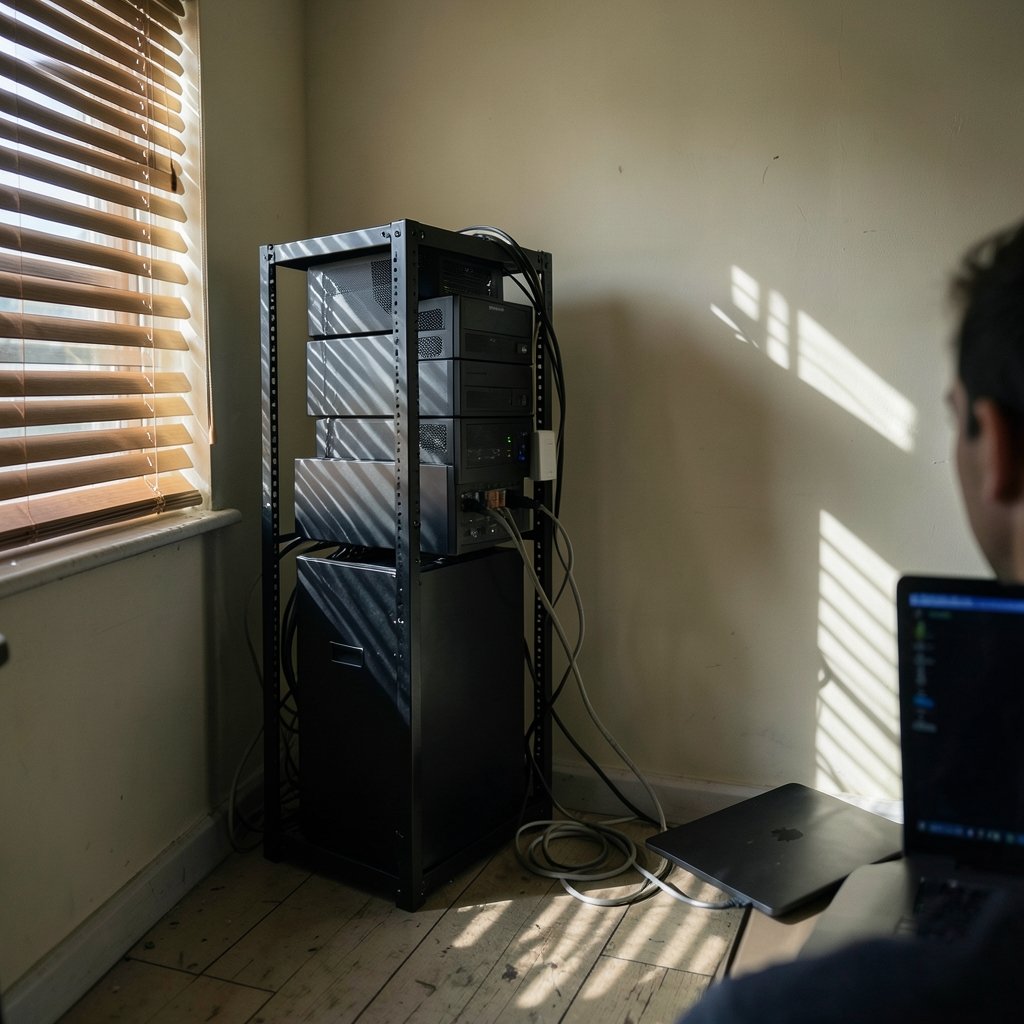
Around 93% of companies that lose their data center for more than ten days file for bankruptcy within a year, according to widely cited industry figures. That number explains why cloud backup has become standard practice. But here’s the catch: signing up for a backup service is not the same as having a backup architecture. Plenty of teams store terabytes in the cloud and still discover, at the worst possible moment, that their recovery plan falls apart.
This article breaks down how cloud backup architecture actually works, from the client agent on a laptop to the cold storage tier holding last year’s archives. It covers the design trade-offs that matter, the mistakes people make over and over, and what a sane setup looks like in practice.
What cloud backup architecture actually means
Cloud backup architecture is the full set of components, data flows, and policies that move copies of data from where it lives to cloud storage, keep it recoverable, and bring it back when needed. It is not one product. It is a system with several layers that must fit together.
At minimum, a working architecture answers five questions:
- What data gets backed up, and how often?
- Where do the copies live, and in how many places?
- How is the data protected in transit and at rest?
- How fast can it be restored, and at what cost?
- Who can delete or change backups, and under what conditions?
Most backup failures trace back to a team that answered the first two questions and skipped the last three.
The core components of a cloud backup system

The backup agent or client
This is the software running on servers, endpoints, or virtual machines. It reads data, deduplicates it, compresses it, encrypts it, and ships it to the cloud. The agent’s design matters more than vendors admit. A poorly written agent can hammer production disks during business hours or choke on millions of small files.
Change block tracking is the workhorse here. Instead of re-uploading a 500 GB database every night, the agent sends only the blocks that changed since the last run. This is why incremental and differential backups dominate modern designs.
The on-premises cache or direct-to-cloud path
Some architectures route traffic through an on-premises backup appliance that caches recent backups locally and streams older ones to the cloud. Others send data directly from the agent to object storage. The appliance adds a local restore route but requires another device to maintain. Direct-to-cloud is simpler but depends entirely on internet bandwidth.
Object storage as the backend
Nearly every cloud backup product sits on top of object storage with an S3-style API. Objects are written once, addressed by key, and organized into buckets. Lifecycle policies automatically move older objects into colder, cheaper tiers. If you want the underlying mechanics, this explainer on what cloud storage is and how it works covers the fundamentals well.
A quick comparison of how the main storage layers behave:
| Layer | Typical role in backup | Restore speed | Relative cost |
|---|---|---|---|
| Local disk or NAS cache | Hot recent backups | Minutes | High per GB |
| Standard object storage | Active backup repository | Minutes to hours | Medium |
| Infrequent access tier | Weekly or monthly copies | Hours | Low |
| Archive tier | Compliance and long-term retention | Hours to a day | Very low |
The classic beginner mistake is archiving everything to save money, then discovering that restoring 20 TB from a cold tier takes longer than the business can survive.
The metadata catalog
The catalog is the index that maps every backup job, file version, and retention rule. It is the most underappreciated piece of the whole system. If the catalog is lost, the data in storage becomes an unlabeled pile of blocks. Catalogs should be backed up separately, replicated, and tested for integrity on a schedule.
Erasure coding, replication, and the durability conversation
Cloud providers love to advertise durability in “nines.” Eleven nines of durability sounds like magic, but it is a modeled estimate, not a contractual promise. The engineering underneath is what matters, and it comes down to two approaches.
Replication keeps multiple full copies of each object across disks or availability zones. It is simple, fast to rebuild, and expensive, because you pay for every extra copy.
Erasure coding splits an object into fragments, adds parity fragments, and spreads them across many disks. It reaches similar durability with far less storage overhead. The trade-off is that rebuilding a failed disk requires reading and recomputing across many fragments, which burns CPU and network bandwidth.
Neither approach replaces a second copy in a different region or a different provider. Durability protects against disk failure. It does nothing for a deleted bucket, a compromised account, or a provider-wide outage.
Security layers that separate serious designs from casual ones
Encryption and key ownership
The single most important security question is: who holds the keys? With provider-side encryption, the cloud vendor can technically read your data. With client-side encryption, keys never leave your control, and the provider stores ciphertext it cannot open.
Client-side encryption is the right default for regulated data, but it has a real operational cost. Lose the key and the backup is gone forever. Key management deserves its own runbook, separate from the backup system itself. (Best Home Generators: Top Picks for Reliable Backup Power) (Backup)
Immutability and object lock
Ransomware crews now hunt backup repositories first, because deleting backups removes the victim’s options. Immutable backups, often implemented with object lock or WORM (write once, read many) policies, make objects undeletable for a fixed retention window, even by an administrator. This is one of the highest-value controls in modern backup design and costs almost nothing to enable.
Least privilege and separation of duties
The account that runs nightly backups should not be the account that can delete repositories. Separate roles, require multi-factor authentication, and alert on any policy change to retention settings.
The 3-2-1 rule, updated for cloud
The long-standing 3-2-1 rule calls for three copies of data, on two different media types, with one copy offsite. It still works, but cloud changes the math. A practical modern version looks like this:
- Copy one: production data on primary storage.
- Copy two: local backup appliance or snapshot for fast restores.
- Copy three: cloud object storage in a separate region.
- Optional copy four: a second provider or an offline copy for the most critical systems.
The 3-2-1 principle has been a fixture of data protection writing for years; the Wikipedia entry on backup traces its evolution and the related 3-2-1-1-0 variant that adds one offline copy and zero errors after verification.
Restore time is the metric that actually matters
Backup speed gets all the attention. Restore speed decides whether the business survives. Two numbers frame every design decision:
RTO (recovery time objective) is how long recovery may take. RPO (recovery point objective) is how much data loss is tolerable, measured in time.
A team with a four-hour RTO cannot rely on a cold archive tier with a twelve-hour retrieval window. A team with a 24-hour RPO does not need continuous replication. Getting these numbers agreed before choosing tools prevents most architecture regret.
Egress fees also matter. Pulling large volumes out of cloud storage often costs money, sometimes more than the storage itself. Model the restore bill as well as the monthly storage bill. (NIST Cybersecurity Framework)
Common mistakes that quietly break backup systems
Backing up without testing restores. The most common failure by far. A backup that has never been restored is a hypothesis, not a backup. Schedule quarterly restore drills and time them.
Treating sync as backup. File sync services mirror deletions. If a user deletes a folder, the cloud copy follows within seconds. Sync is not versioned backup unless the tool explicitly keeps history. This distinction shows up constantly in discussions of cloud storage versus local storage.
Ignoring the catalog. Teams replicate data buckets and forget the metadata that makes them readable.
One region, one account. A single compromised credential should never be able to erase every copy.
Skipping retention tuning. Keeping daily backups for five years multiplies cost for no recovery benefit. Tier them instead.
Forgetting SaaS data. Email, collaboration suites, and CRM systems often need third-party backup because the vendor’s retention is not a backup service.
A practical reference design
For a mid-sized organization, a sound starting architecture looks like this:
- Deploy agents with change block tracking on all servers and endpoints.
- Keep a local repository for 14 to 30 days of fast restores.
- Replicate to cloud object storage in a second region, encrypted client-side.
- Enable object lock on the cloud repository with a 30-day minimum retention.
- Apply lifecycle rules: standard tier for 30 days, infrequent access to 90 days, archive beyond that.
- Run automated restore verification weekly and full drills quarterly.
- Store encryption keys and catalog backups in a separate trust domain.
That design is not exotic. It is simply complete. For teams comparing infrastructure options, a broader look at cloud storage and how it works helps clarify where backup fits in the wider storage picture.
Where the architecture is heading
Two trends are reshaping designs. First, air-gapped and immutable-by-default repositories are becoming standard rather than premium features, driven by ransomware economics. Second, backup platforms are adding anomaly detection that flags unusual data change rates before a full encryption event completes.
The underlying principles, though, have not moved in twenty years. Copies in separate places, verified restores, controlled access, and honest recovery targets. Tools change. Those four rules do not.
Conclusion
Cloud backup architecture is less about picking a vendor and more about designing a system that survives realistic failure modes: a deleted bucket, a stolen credential, a failed disk, a regional outage. The components are well understood. Agents capture change, object storage holds copies, erasure coding or replication provides durability, encryption and immutability provide security, and lifecycle policies control cost.
What separates a working architecture from a hopeful one is discipline in three places: defining recovery targets before buying tools, testing restores on a schedule, and separating the ability to delete backups from the ability to create them. Get those right and the rest is configuration. Skip them and the most durable storage in the world will not save you.
Frequently asked questions
What is the difference between cloud backup and cloud storage?
Cloud storage is a place to keep files. Cloud backup is a process that copies data on a schedule, versions it, and keeps it recoverable. A synced folder in cloud storage is not a backup, because deletions and ransomware changes propagate to the cloud copy almost immediately.
How many copies of data should a cloud backup architecture keep?
Three copies is the long-standing baseline: production data, a local backup, and an offsite cloud copy. For critical systems, add a fourth copy on a second provider or an offline medium. The point is independence, meaning no single failure, credential, or vendor can remove every copy.
Is erasure coding better than replication for backups?
Neither is universally better. Erasure coding uses less storage overhead for the same durability but costs more CPU and network during rebuilds. Replication is simpler and faster to repair but stores full duplicate copies. Many providers mix both, and the choice is usually invisible to the customer.
How often should backups be tested?
Restore verification should run automatically at least weekly for critical systems, with full recovery drills quarterly. The drill should be timed against the stated RTO. An untested backup is an assumption, and assumptions tend to fail exactly when they are needed most.
Does client-side encryption break cloud backup?
No, but it shifts responsibility. With client-side encryption the provider cannot read the data, which is the point. The trade-off is that losing the encryption key means permanent data loss, so key management needs its own backup and recovery procedure, stored separately from the backup system.
How do I protect backups from ransomware?
Three controls do most of the work: immutable storage with object lock so backups cannot be deleted during a retention window, separate credentials so the backup account cannot alter retention policies, and anomaly monitoring that flags sudden spikes in data change rates. Together they turn backups from a target into a lifeline.



