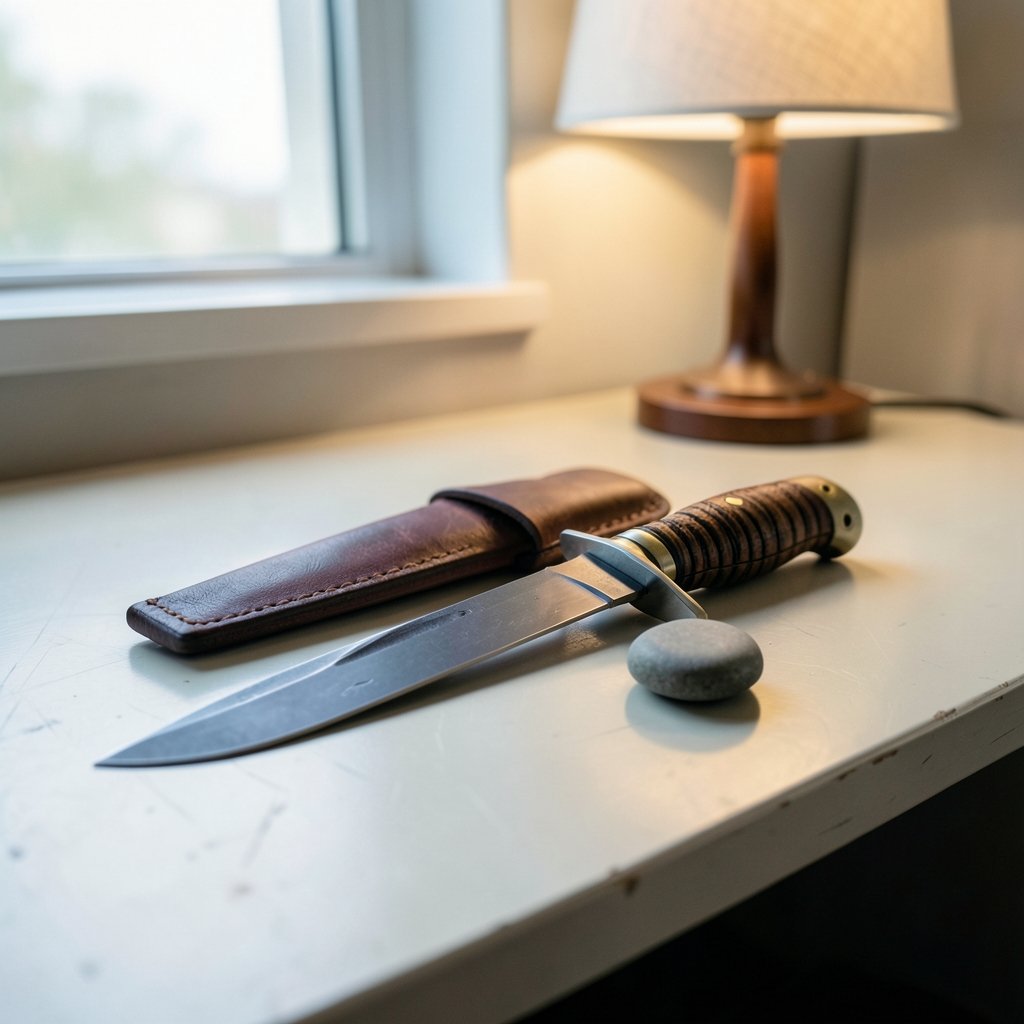
What makes a knife a “combat knife” rather than just a knife? Is it the blade shape, the black finish, the military stamp on the sheath, or something else entirely? The honest answer is messier than most product listings suggest. The term gets thrown around by collectors, soldiers, survivalists, and marketers, and each group means something slightly different. This article sorts out what the label actually covers, where the famous designs came from, how modern militaries treat knives today, and the practical mistakes people make when buying one.
What “Combat Knife” Actually Means
There is no single, standardized definition of a combat knife that every military or government agrees on. In general use, the term describes a knife designed or issued for military purposes, whether for fighting, utility work, or both. The U.S. Army tends to favor terms like “fighting knife” or “combat/utility knife,” which hints at the real story: most military knives spend far more time opening crates than in hand-to-hand combat.
That loose definition matters. Historians and knife writers have long noted that “combat” is a marketing word as much as a technical one. It overlaps heavily with trench knife, fighting knife, and survival knife, and manufacturers often use it to signal toughness rather than to describe a specific design standard. A knife sold as a “combat knife” might be a faithful copy of a 1940s military pattern, or it might be a generic fixed blade with a dark coating.
For practical purposes, most knives called combat knives share a few traits:
- A fixed blade, usually between 6 and 7 inches
- A full tang running through the handle for strength
- A guard or lower hilt to keep the hand from sliding forward
- A sheath designed for belt or gear mounting
- A finish that resists corrosion and glare
None of these are rules. They are patterns that show up again and again because they work.
The Fairbairn-Sykes Knife and the Birth of a Template

The design most often credited as the foundation of the modern combat knife is the Fairbairn-Sykes Fighting Knife, produced from 1941 for British Commandos and Special Operations Executive personnel. William E. Fairbairn and Eric A. Sykes designed it as a double-edged dagger with a blade of roughly 7 inches, built for silent, close-quarters use rather than camp chores.
Its influence came from the shape and from the thinking behind it. The Fairbairn-Sykes was purpose-built for a specific job, with a slim profile and a balanced feel that emphasized speed. It became a template that later designs reacted to, either by copying its dagger layout or by deliberately moving toward a more versatile utility blade.
A practical note for modern buyers: original wartime Fairbairn-Sykes knives are collectibles with significant value, and the market contains many reproductions of varying quality. Anyone shopping for one should look at blade markings, handle construction, and provenance rather than trusting a “commando” label.
The American Classics: M3, Ka-Bar, and the Shift to Utility
Across the Atlantic, the U.S. military developed its own answers. The M3 Trench Knife entered service in 1943 as a replacement for the earlier M1918 trench knife, with a blade of about 6.75 inches. It was both a fighting knife and a utility tool, and it was itself eventually superseded by the M4 bayonet-knife.
Then there is the most famous name of all. The Ka-Bar, officially the USN Mark 2 utility knife, entered service in 1942 and remains in limited ceremonial and utility use today. Sources disagree on exact adoption dates, with some placing full adoption in 1942 and others in 1943, so it is safer to describe the early 1940s as the window rather than pin down a single year.
| Knife | Era | Blade Length | Primary Role | Legacy |
|---|---|---|---|---|
| Fairbairn-Sykes | From 1941 | About 7 inches | Close-quarters fighting | Set the dagger template |
| USN Mark 2 (Ka-Bar) | From 1942 | About 7 inches | Utility and fighting | Most recognized military knife |
| M3 Trench Knife | From 1943 | About 6.75 inches | Utility and fighting | Bridge to bayonet-knives |
| M9 Bayonet-Knife | From the 1980s | About 7 inches | Bayonet, wire cutting, utility | Blurred the category |
That last row is the key shift. Modern militaries increasingly issue multi-purpose bayonet-knives that combine bayonet mounting, wire-cutting capability, and general utility. Once a knife has to do three jobs, the line between “combat knife” and “field tool” gets very blurry.
Do Soldiers Actually Fight With Knives?
Rarely, and that is worth saying plainly. Hand-to-hand knife combat is a minor part of modern military training. U.S. Army combatives doctrine, including the 2002 field manual on combatives and the later Modern Army Combatives Program, emphasizes grappling and striking far more than knife fighting. The knife on a soldier’s kit is primarily a tool.
This is not revisionism; it reflects how conflicts actually work. A blade is quiet, always available, and useful for cutting cord, opening packaging, prying, and preparing food. Those tasks come up constantly. A knife duel does not.
The practical takeaway for anyone buying a combat knife is to think about the tool jobs first. A blade that cuts rope cleanly, holds an edge through cardboard and webbing, and sits comfortably in the hand for twenty minutes of work will serve better than a dagger optimized for a scenario that almost never happens.
Design Features That Actually Matter
Marketing copy loves to talk about “battle-ready” steel. Here is what genuinely affects how a combat-style knife performs.
Steel type. Carbon steels take a keen edge easily and sharpen quickly but need care to avoid rust. Stainless steels resist corrosion but can be tougher to sharpen. Neither is universally better; the right choice depends on climate and maintenance habits.
Tang construction. A full tang, where the steel runs the length of the handle, adds strength and balance. Most military-pattern knives use one, and it is a reasonable baseline expectation.
Handle material. Synthetic handles resist moisture and blood-borne grime better than leather, though leather offers grip and tradition. Check for a secure fit with no gaps where the handle meets the blade.
Sheath design. This is the most overlooked part. A knife is only as good as its carry system. Look for retention that holds the blade during movement, a drainage path for water, and mounting options that match how the knife will be carried.
Guard and grip shape. A lower guard protects the hand during thrusting. A handle that is too smooth or too aggressively textured can both cause problems; the first slips, the second tears up the palm during extended use.
Common Buying Mistakes
First-hand experience with knife buyers turns up a handful of recurring errors.
Buying the look instead of the job. A double-edged dagger with a black coating looks formidable, but it is a poor choice for a camp knife or a general utility blade. Match the design to the actual tasks.
Ignoring local law. This is the big one. In the UK, section 139 of the Criminal Justice Act 1988 generally prohibits carrying a blade or sharply pointed article in public without good reason, and “combat knife” is not a separate legal category. In the U.S., federal law restricts switchblades in interstate commerce, while state laws govern most carry rules. Rules change, so check current local text before buying or carrying anything.
Skipping the sheath. Many buyers spend their whole budget on the blade and accept whatever sheath comes in the box. A loose sheath is a safety hazard, not an accessory.
Assuming “military surplus” means authentic. Surplus markets contain genuine issue items, reproductions, and outright fakes. Ask about markings and history.
Neglecting maintenance. Carbon steel left in a damp sheath will pit. A thin coat of oil and a dry storage spot prevent most problems.
Collecting, Regulation, and Realistic Expectations
Combat knives occupy an odd space. They are tools, historical artifacts, and in some places regulated items all at once. In many countries, “combat knives” fall under import, export, and possession restrictions, and the rules vary widely by jurisdiction. The UK’s Offensive Weapons Act 2019 and various EU weapons directives are examples of frameworks that can affect what can be sold and shipped, though the specifics differ from place to place.
For collectors, condition and provenance drive value. A documented wartime piece with original finish and sheath is worth far more than a cleaned-up example, and aggressive restoration often destroys value rather than adding it. For users, the calculation is simpler: buy a knife that fits the work, learn to sharpen it, and store it properly.
It also helps to keep perspective. Public-health bodies study knife injuries as a violence and injury-prevention issue, not as a weapons category, and official crime statistics treat knives as injury mechanisms. That framing is a useful reminder that the “combat” label is about design heritage, not about everyday purpose.
How to Evaluate a Combat Knife in Person
A short, practical routine beats any spec sheet. Follow these steps when handling a knife before purchase.
- Grip the handle and check that your hand sits naturally without crowding the guard.
- Rock the blade gently in the handle to check for any movement.
- Sight down the edge for straightness and check for chips or rolls.
- Test the sheath: invert it and confirm the knife stays put.
- Check the balance point; a blade-heavy knife chops better, a handle-heavy one feels quicker.
- Ask about steel type and heat treatment, and walk away if the seller cannot say.
None of this requires expertise. It requires ten minutes and a little skepticism.
Conclusion
The combat knife is less a single product than a family of designs shaped by wartime needs and peacetime marketing. The Fairbairn-Sykes set a template in 1941, the Ka-Bar and M3 carried it into mass issue, and modern bayonet-knives have blurred the line between weapon and tool. What has not changed is the practical reality: most knives labeled “combat” will spend their lives cutting rope, opening boxes, and sitting in a sheath. Buy for the work, respect local law, and treat the label as history rather than a promise. For more practical guides on blades, gear, and how to choose equipment that holds up, visit
Frequently Asked Questions
What is the difference between a combat knife and a survival knife?
A combat knife is designed or issued with military fighting and utility use in mind, often with a guard and a slim fighting profile. A survival knife is built around camp and field tasks like wood processing, food preparation, and fire-making. The categories overlap heavily, and many modern knives are marketed as both.
Was the Ka-Bar used in World War II?
Yes. The Ka-Bar, officially the USN Mark 2 utility knife, entered service in the early 1940s and was widely issued during World War II. Sources differ on whether full adoption came in 1942 or 1943, so the early 1940s is the safest description.
Are combat knives legal to own?
It depends entirely on where you live. Ownership, carry, and shipping rules vary by country and, in the U.S., by state. In the UK, carrying a blade in public without good reason is generally prohibited under section 139 of the Criminal Justice Act 1988. Always check current local law before buying or carrying.
Why do combat knives usually have fixed blades?
Fixed blades are stronger and simpler than folding mechanisms, with no hinge to fail under stress. They also clean more easily, which matters for a tool used in wet, dirty conditions. Most military-pattern knives use a full tang for added strength.
Do soldiers still learn knife fighting?
Hand-to-hand knife combat is a minor part of modern military training. Combatives doctrine emphasizes grappling and striking, and the issued knife is primarily a utility tool for cutting, prying, and opening. Knife-fighting skills exist but are not the main purpose of the blade.
How should a combat knife be maintained?
Keep the blade clean and dry, apply a thin coat of oil to carbon steel, and store the knife outside a damp sheath for long periods. Sharpen at a consistent angle and avoid aggressive power tools that can overheat the edge. A little routine care prevents most rust and edge damage.