
What Is AI Risk Assessment?
AI risk assessment is the structured process of finding, measuring, and reducing the harm an artificial intelligence system could cause before it is put into use, and while it keeps running. It covers obvious technical failures, such as a model giving wrong answers, and less obvious ones, such as a hiring tool that quietly favours one group of applicants, a chatbot that leaks private data, or a recommendation system that pushes people toward poor decisions.
The idea is not new: banks, hospitals, and factories have assessed risk for decades. What is new is the speed and scale at which AI systems make decisions, and how hard it can be to explain why a model produced a particular result. A single AI tool can affect thousands of people in a day, so a small flaw can become a large problem. Risk assessment catches those flaws early.
In 2027, AI risk assessment is becoming a normal part of buying, building, and running AI tools, driven by new regulation, harder questions from customers, and public failures. This guide explains what it is, how it works, the main types of risk it covers, and how a small organisation can run one without a large compliance team.
Key takeaways
- AI risk assessment finds and measures the harm an AI system could cause, before and during its use.
- It covers technical failures, unfair outcomes, privacy leaks, security attacks, and misuse.
- A good assessment looks at the data, the model, the people affected, and how the system is used.
- Risk is scored by likelihood and impact, so the most serious risks get fixed first.
- Assessment is ongoing: models change, data changes, and new risks appear after launch.
What AI risk assessment means
At its simplest, an AI risk assessment answers three questions: what could go wrong with this system, how likely is it, and how bad would it be? The answers are gathered in a structured way, so nothing important is missed. The result is usually a risk register: a list of risks, each with a score, an owner, and a plan to reduce it.
The scope is wider than most people expect. A risk assessment looks at the training data and where it came from, the model and what it can and cannot do, the decisions the system influences, and the people affected by them. It also looks at the organisation around the system: who is responsible when it fails, how complaints are handled, and what happens if the system has to be switched off quickly.
Risk assessment is not the same as testing for accuracy. A model can be highly accurate on average and still be risky, for example if it is consistently wrong for one group, or accurate in testing but failing on the messy data of real life. Assessment asks whether the system is safe, fair, and lawful in its real context, not only whether it scores well on a benchmark.
How AI risk assessment works
A typical assessment starts by describing the system plainly: what it does, who uses it, and what decisions it influences. Many risks only become visible when the system is written down in ordinary language; a vague description hides them. The description should include what the system is not supposed to do, since misuse is a common source of harm.
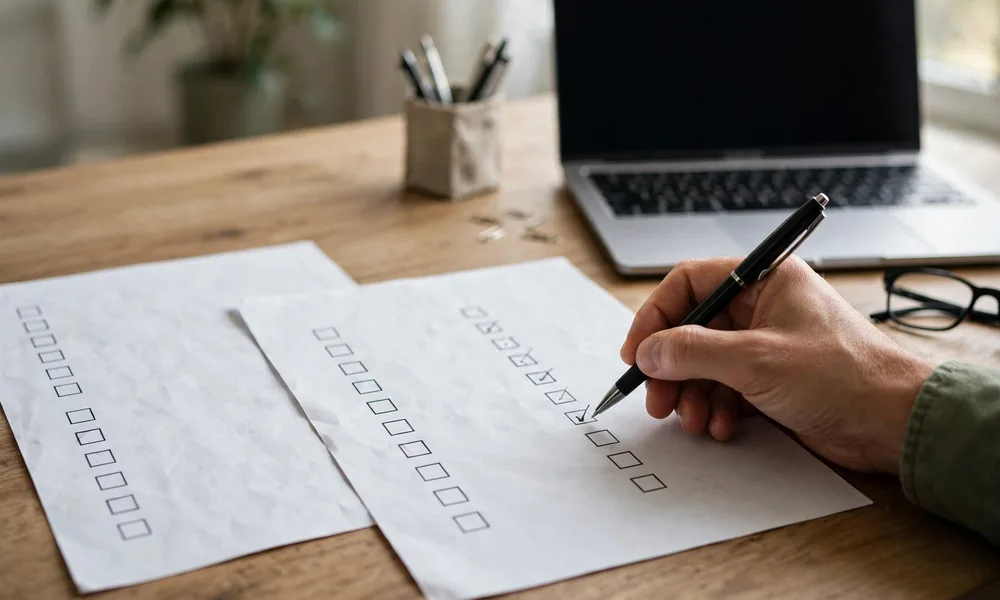
The next stage is identifying risks, usually in a workshop with the people who build, use, and are affected by it. The team works through a checklist of risk types, asks what could go wrong at each stage of the system’s life, and records every plausible harm. Common techniques include reviewing past incidents, testing with difficult inputs, and asking the people affected what worries them.
Each risk is then scored by likelihood and impact, on a simple scale such as low, medium, or high. A risk that is both likely and severe goes to the top of the list. For each high-priority risk, the team agrees a treatment: fix it, reduce it, transfer it, or accept it with a written reason. Finally, the assessment is documented, signed off, and scheduled for review.
Types of AI risk
Technical risks are the most familiar. A model can produce wrong or invented outputs, fail on unfamiliar inputs, or degrade quietly as the world changes. These failures are dangerous when people trust the system without checking, which is why assessments look at how much human oversight actually happens.
Fairness risks arise when a system treats some groups worse than others. This can come from biased training data, a feature that acts as a proxy for a protected characteristic, or a system that works well for the majority and poorly for a minority. A fair assessment tests the system separately for different groups, rather than looking only at the average result.
Privacy, security, and misuse risks complete the picture. A model can memorise personal data from its training set, an attacker can manipulate its inputs, and a legitimate tool can be repurposed for spam, fraud, or surveillance. These risks are easy to overlook when the focus is on accuracy. The international standard for managing AI risks is described in our guide to what ISO 42001 is, and it gives a useful structure for organising them.
Benefits and risks of running an assessment
The main benefit is that problems are found while they are still cheap to fix. A biased hiring screen caught in testing costs a redesign; the same bias discovered after a year of use costs a lawsuit, a public apology, and the trust of applicants. An assessment also records what the organisation knew and did, which matters when regulators or customers ask questions.
Assessment also improves the system itself. The process forces teams to write down what the system is for, who it affects, and how success will be measured, and that clarity usually improves design decisions. Teams often find gaps in data, documentation, or responsibility that would have caused trouble later.
The risks of the process itself are real too. A long, box-ticking assessment can slow a small team down and produce unread paperwork. The fix is to keep the assessment proportionate: a simple internal tool needs a short one, while a system that decides who gets a loan needs a thorough one. The other danger is false confidence, where a completed assessment is treated as proof the system is safe, when it only shows the known risks were considered at one point in time.
Real-world uses of AI risk assessment
In hiring, risk assessments examine whether a screening tool ranks candidates fairly, uses data it should not, and lets rejected applicants understand and challenge the decision. Several hiring tools were withdrawn after assessments showed they disadvantaged women or older applicants. Assessment is now a standard step before such tools are bought or deployed.
In finance, assessments cover credit scoring, fraud detection, and automated advice. Regulators expect lenders to explain why a model declined an applicant, test for unfair outcomes, and keep a human in the loop for important decisions. In healthcare, assessments focus on diagnostic tools: whether the model was tested on the patients it will serve, what happens when it is wrong, and who is accountable.
Smaller organisations use lighter versions of the process. A marketing team assessing an AI chatbot asks whether it could give wrong prices, repeat customer data, or damage the brand. A school assessing an AI marking tool asks whether it is fair to students who write differently and whether teachers can overrule it. The questions change with the context, but the method stays the same. For businesses in Europe, our guide to what the EU AI Act means for small business explains which assessments the law now expects.
AI risk assessment versus other checks
Risk assessment is often confused with other checks, but each does a different job. Security testing finds vulnerabilities an attacker could exploit; risk assessment asks what harm follows if they do. Accuracy testing measures how often the model is right; risk assessment asks who is hurt when it is wrong. A compliance check asks whether the system meets a rule; risk assessment asks whether it is safe even where no rule exists yet.
Audits are related but different in timing and independence. An assessment is done by the team responsible for the system, before and during deployment, while an audit is an independent review after the fact. A good assessment makes an audit easier, because the evidence already exists.
The most useful comparison is a product safety check. Nobody would sell a car without crash tests, and nobody should deploy an AI system that affects people’s livelihoods without asking what could go wrong. The difference is that AI systems keep learning and changing, so the check cannot be a one-off event. Our explainer on what an AI maturity model is shows how organisations build ongoing checking into the way they work.
AI risk assessment at a glance
The table below sums up the main risk types, an example of each, and the usual first step.
| Risk type | Example | First step to reduce it |
|---|---|---|
| Wrong or invented outputs | A chatbot gives a wrong price | Human review of high-stakes answers |
| Unfair outcomes | A screening tool ranks one group lower | Test results separately by group |
| Privacy leaks | A model repeats personal data | Remove personal data before training |
| Security attacks | Crafted inputs make it misbehave | Adversarial testing before launch |
| Misuse | A writing tool is used for spam | Usage limits and abuse monitoring |
| Over-reliance | Staff stop checking outputs | Regular spot-checks and training |
| Lack of accountability | Nobody owns the decision | Name a responsible owner |
Frequently asked questions
What is AI risk assessment in simple terms?
It is a structured way of asking what could go wrong with an AI system, how likely each problem is, and how serious it would be, then writing down a plan to reduce the biggest risks before the system causes harm.
Who should carry out an AI risk assessment?
The team that builds or buys the system should lead it, with input from its users and the people it affects. For high-stakes systems, an independent reviewer should check the result and a senior manager should sign it off.
How is AI risk different from ordinary software risk?
AI systems make judgements from data rather than following fixed rules, so their behaviour is harder to predict. They can also affect thousands of people at once, and their performance can change as data changes.
How often should an AI risk assessment be repeated?
Do one before launch, review it when the system changes or an incident occurs, and repeat a full review yearly for high-stakes systems.
Do small businesses need AI risk assessment?
Yes, in proportion to the stakes. A small business using an AI chatbot needs a short assessment covering wrong answers, privacy, and brand damage. Only systems that decide people’s jobs, money, or healthcare need the full process.
What happens if a risk assessment finds a serious problem?
The system should not launch, or should be paused, until the risk is reduced or a senior decision-maker accepts it in writing. Launching with a known serious risk and no plan turns small problems into public failures.
The bottom line
AI risk assessment is not paperwork for its own sake. It is the habit of asking, before an AI system affects real people, what could go wrong and what will be done. The organisations that do it well catch problems while they are cheap to fix and earn the trust of customers and regulators.
Start with one system, describe it plainly, list the risks with the people who know it best, and fix the biggest ones first. Repeat the process when things change. That simple cycle, done honestly and regularly, is what separates a responsible AI user from one waiting for a failure.