

What actually keeps one workload from reading another’s memory: a shared kernel with namespaces, or a hypervisor boundary that pretends to be a separate machine? That question drives every container security debate, and the answer changes depending on what you are defending against. Teams that treat containers as “lightweight VMs” tend to learn the difference the hard way, usually during an incident review.
This comparison looks at container security against its main alternatives, including virtual machines, sandboxed runtimes, and microVMs. It also covers the practical controls that matter more than the isolation model itself.
What container security actually protects
A container is a process on the host, wrapped in namespaces for visibility and cgroups for resource limits. The kernel is shared. That design is why containers start in milliseconds and why a kernel flaw can, in theory, become a cross-tenant problem.
Container security therefore rests on several layers stacked together:
- Image integrity: signed images, pinned digests, and scanning for known vulnerabilities before deployment.
- Runtime configuration: non-root users, read-only filesystems, dropped Linux capabilities, and seccomp profiles.
- Orchestrator policy: admission controllers, network policies, and role-based access control in Kubernetes.
- Host hardening: patched kernels, minimal host operating systems, and restricted access to the container runtime socket.
The NIST Special Publication 800-190, the Application Container Security Guide, is the reference document most security teams cite for this threat taxonomy. It organizes risk by the container lifecycle, from image creation through runtime and orchestration. The takeaway is blunt: most container breaches trace back to misconfiguration and weak image hygiene, not to the isolation primitive itself.
That matters for the comparison. If your images run as root with the Docker socket mounted, switching to a heavier isolation model will not save you.
How virtual machines compare
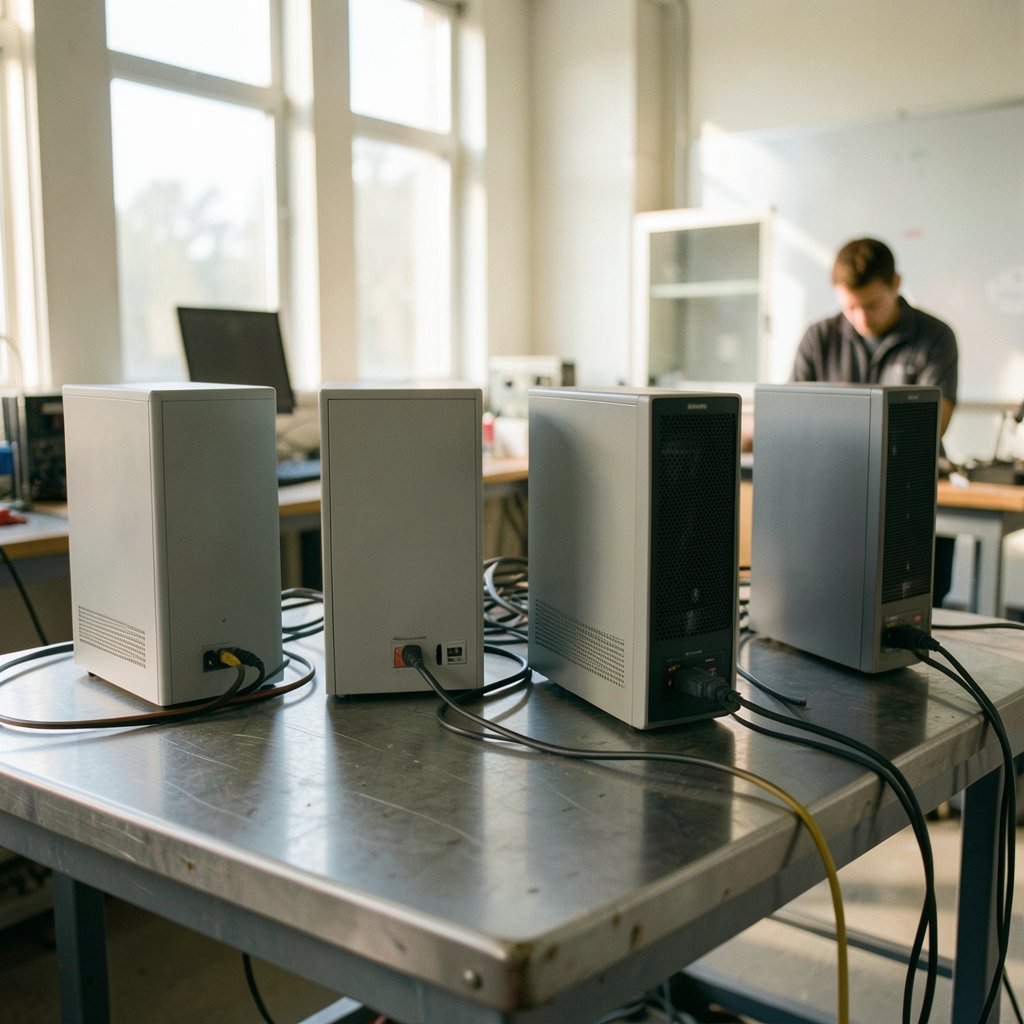
Virtual machines replace the shared kernel with a hypervisor, which emulates hardware and gives each guest its own kernel. The attack surface between tenants shrinks to the hypervisor and the hardware virtualization extensions.
| Dimension | Containers | Virtual machines |
|---|---|---|
| Isolation boundary | Namespaces, cgroups, seccomp | Hypervisor and separate kernel |
| Startup time | Milliseconds to seconds | Seconds to a minute or more |
| Density per host | High | Lower |
| Patch responsibility | Host kernel shared by all | Each guest kernel patched separately |
| Typical use | Microservices, CI jobs, stateless APIs | Legacy apps, mixed-trust tenants, compliance scopes |
The trade-off is not subtle. VMs buy a stronger boundary and pay for it in memory overhead and operational sprawl. Containers buy speed and density and push the burden onto configuration discipline. Neither is “more secure” in the abstract; each is more secure against specific threats.
A useful mental model: containers assume everything on the host is cooperating. VMs assume nothing is.
Sandboxed runtimes: gVisor and Kata Containers
Between the two extremes sit sandboxed container runtimes, which keep the container workflow but change what sits underneath.
gVisor intercepts system calls in user space through a compatibility layer it calls the Sentry. The workload’s syscalls never reach the host kernel directly, which shrinks the kernel attack surface dramatically. The cost is compatibility: some syscalls behave differently, and I/O-heavy workloads can slow down measurably.
Kata Containers takes the opposite approach. Each pod or container runs inside a lightweight VM with its own kernel, but the interface stays OCI-compatible, so Kubernetes users barely notice the swap. Boot overhead is higher than runc but far below a full VM.
In practice, the migration mistake people make is flipping the runtime switch and assuming the job is done. Sandboxed runtimes change the isolation boundary; they do not fix an image that ships a vulnerable dependency, nor do they replace network policy. Teams that adopt gVisor or Kata without first tightening their admission controls usually see cost go up and risk stay flat.
The second common mistake is benchmarking only startup latency. What matters more is tail latency under real traffic and whether your observability stack still works when the runtime changes how syscalls are handled.
MicroVMs and hardware-level isolation
MicroVMs such as Firecracker strip a virtual machine down to the minimum device model needed to run a workload. Boot times land in the low hundreds of milliseconds, and the isolation boundary is a real hypervisor. This is the model behind several large serverless platforms, which is a strong signal about its fitness for multi-tenant workloads.
For teams weighing this against containers, the decision usually comes down to trust boundaries. If all workloads belong to one team and one trust level, plain containers with hardened configuration are defensible. If you run customer code, third-party plugins, or AI-generated workloads, a hardware-level boundary is easier to justify to auditors.
The same logic applies in consumer-adjacent security contexts, where trust boundaries are explicit by design. Reviews of home security systems make a similar point: layered controls beat a single strong lock, because the failure modes are different at each layer. Container architecture rewards the same thinking. (Kubernetes Documentation: Security)
The controls that matter more than the runtime
Here is the uncomfortable truth from years of incident write-ups: isolation model choice rarely appears in post-mortems. Misconfiguration does.
Image and supply chain discipline
Pin images by digest, not by tag. Enforce signature verification at admission. Rebuild base images on a schedule rather than patching running containers. The CIS Benchmarks for Docker and Kubernetes, maintained by the Center for Internet Security, give concrete configuration checks that catch a large share of real-world weaknesses.
Least privilege at runtime
Run as non-root. Drop all capabilities and add back only what is needed. Use read-only root filesystems. Apply seccomp profiles. These four steps eliminate a wide band of container escape techniques that rely on privileged operations.
Network segmentation
Default-deny network policies in Kubernetes are still not universal, which is surprising given how cheap they are to implement. Segmentation limits blast radius regardless of whether the runtime is runc, gVisor, or Kata.
Secrets and identity
Workload identity has become its own discipline. Non-human identities, service accounts, and machine credentials now outnumber human ones in most clusters, and the tooling market reflects that. Comparisons such as this look at Astrix vs Oasis vs Entro for non-human identity security and show how differently vendors approach discovery and least-privilege enforcement for machine credentials. The lesson transfers: a stolen token bypasses every isolation layer you built.
Practical migration guidance
For teams deciding whether to move off standard containers, a staged approach works better than a wholesale switch.
- Baseline your current posture. Run the CIS benchmark against a representative cluster and record findings. Most teams find dozens of fixable issues before any runtime change.
- Classify workloads by trust level. Separate first-party services from anything executing untrusted code. Only the latter needs a stronger boundary.
- Pilot one sandboxed runtime on a non-critical service with realistic traffic. Measure tail latency alongside averages.
- Verify observability. Confirm that tracing, profiling, and debugging still function under the new runtime before expanding.
- Expand by trust tier, keeping the hardened container configuration as the default for everything else.
The teams that skip step one usually end up running an expensive isolation layer on top of an unhardened cluster, which is the worst of both worlds.
Where the alternatives genuinely win
It is worth being specific about when the heavier options earn their overhead.
- Multi-tenant platforms running arbitrary customer code should default to microVMs or Kata. The boundary is the product.
- Regulated environments often require demonstrable separation between workloads, and a hypervisor boundary is easier to document than a namespace policy.
- Legacy applications with unusual kernel dependencies frequently fit VMs better than containers, and forcing them into containers creates more risk than it removes.
- CI/CD runners executing untrusted pull requests are a classic case for sandboxed runtimes, since the code is adversarial by definition.
Conversely, internal microservices with a single owner, strong admission control, and mature observability rarely justify the migration cost. The isolation gain is real but small relative to the operational complexity.
Cost and performance considerations
Isolation has a price, and it shows up in three places: memory overhead per workload, cold-start latency, and engineering time.
Sandboxed runtimes typically add tens of megabytes per instance and some syscall overhead. MicroVMs add boot time and require a different approach to image management. VMs add all of the above plus a guest operating system to patch.
The engineering time is the line item teams underestimate. Every runtime change touches debugging workflows, monitoring agents, and incident runbooks. Budget for that before committing.
For readers tracking hardware and tooling availability alongside security decisions, notes on Steam Deck out of stock alternatives in 2026 illustrate the same pattern: the fallback option is rarely a drop-in replacement, and the real cost is in the adaptation work.
Conclusion
Container security is not a binary choice between containers and everything else. It is a stack of decisions, and the isolation boundary is only one layer. Standard containers with disciplined configuration, signed images, least privilege, and default-deny networking handle most internal workloads well. Sandboxed runtimes and microVMs earn their overhead when the code is untrusted, the tenants are external, or a regulator wants a boundary they can point to.
The practical sequence is unglamorous: harden first, classify trust levels second, and adopt stronger isolation only where the threat model demands it. Teams that invert that order pay more and sleep worse.
FAQ
Are containers less secure than virtual machines?
Not inherently. They have a different threat model. Containers share the host kernel, so a kernel vulnerability can affect multiple workloads. VMs isolate at the hypervisor level but add patching burden and operational complexity. For well-configured single-tenant workloads, containers are often perfectly adequate.
When should a team adopt gVisor or Kata Containers?
When workloads execute untrusted or third-party code, when tenants are external, or when compliance requires demonstrable separation. Start with a pilot on a non-critical service and measure tail latency before expanding across the cluster.
Does a sandboxed runtime replace the need for image scanning?
No. Sandboxed runtimes change the isolation boundary, not the contents of your images. A vulnerable dependency inside a gVisor sandbox is still a vulnerable dependency. Image scanning, signature verification, and rebuild schedules remain necessary regardless of runtime.
What are the most common container security mistakes?
Running as root, mounting the container runtime socket into containers, using mutable image tags, skipping network policies, and leaving default capabilities enabled. These configuration issues account for a large share of real-world container compromises, and each has a straightforward fix.
How much performance overhead do sandboxed runtimes add?
It depends heavily on workload shape. Syscall-heavy and I/O-intensive applications see the largest impact, while compute-bound services notice little. Measure with realistic traffic and watch tail latency rather than averages, since the overhead is rarely uniform.
Do microVMs make sense for internal microservices?
Usually not. MicroVMs shine in multi-tenant and serverless contexts where the isolation boundary is the product. For internal services with a single owner and mature admission controls, the added complexity rarely pays for itself. Reserve them for workloads where trust genuinely varies.
The final consideration is lifecycle. Isolation choices age: a runtime that felt excessive in 2026 may become the default baseline by 2028, and the reverse is also true as tooling matures or stalls. Revisit the decision annually against your actual incident data and threat model rather than treating it as a one-time architecture vote. Document why each trust tier uses the runtime it does, so future maintainers inherit the reasoning along with the configuration. That written record is often the cheapest security control available, and the one most frequently skipped.



