
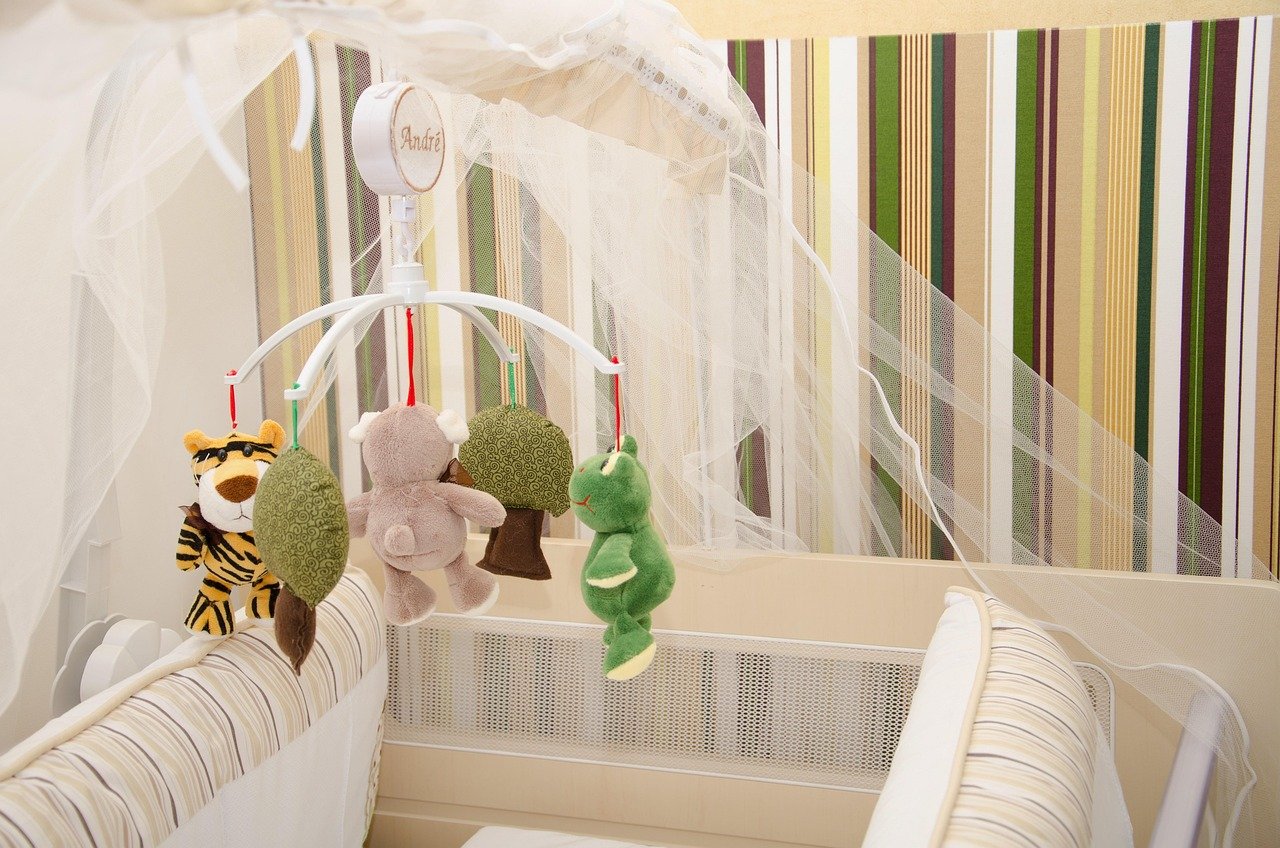
What is the first thing most parents hang above a newborn’s crib? A mobile. It is one of the most common baby gifts, one of the most photographed nursery decorations, and one of the most misunderstood pieces of baby gear. Parents hang mobiles to soothe, to entertain, and to give a baby something to look at. But safety guidance on crib attachments has shifted a lot over the past two decades, and much of the advice floating around online is out of date.
This guide walks through what the current safety rules actually say, what the research does and does not support about developmental benefits, how mobiles compare with other visual stimulation options, and the practical mistakes that turn a harmless decoration into a hazard.
What a crib mobile actually is, and why the category is trickier than it looks
A crib mobile is a suspended structure that attaches to a crib rail, a stand, or a wall, with dangling shapes that move. Some play music. Some rotate. Some are simple black-and-white cards on a plastic arm. A few are handheld toys waved in front of a baby’s face, which is a different product with different risks.
The confusion matters because the same word covers objects with very different hazard profiles. A wall-mounted mobile across the room is not the same as a clamp-on mobile hanging eight inches above a sleeping baby’s face. When parents search for advice, they often get a single answer applied to all of these, and that answer is usually either “totally fine” or “never do it,” neither of which is accurate.
The honest position sits in the middle. Mobiles have a legitimate use as short-supervised visual stimulation for young infants. They have no legitimate use as a permanent fixture over a sleeping baby, and they should come down earlier than most parents expect.
The safety rules that actually matter

Cord and string length
The single biggest hazard with crib-attached toys is strangulation. Cords, strings, ribbons, and elastic loops attached to a crib can wrap around a baby’s neck. Regulators and safety bodies have repeatedly flagged crib attachments with long cords as a serious risk, and cord-length thresholds in guidance typically sit around 7 inches (18 cm). Treat that number as a ceiling, not a target. Anything dangling near a baby’s reach deserves a hard look.
The removal trigger most parents miss
Safety guidance advises removing crib gyms and mobiles once a baby can push up on hands and knees, which typically happens around five months. That is much earlier than the “baby is bored of it” milestone most parents use. The logic is simple: a baby who can push up can also grab, pull, and become entangled. Many manufacturers label mobiles for roughly 0 to 5 months for exactly this reason.
If you take one thing from this article, take this: the mobile comes down when your baby starts getting mobile, not when your baby stops looking at it.
Small parts and choking
US toy rules treat any component that fits entirely inside a small-parts cylinder (roughly 1.25 inches by 2.25 inches) as a choking hazard for children under three. Mobiles usually hang out of reach, so the risk is not the mobile in use. The risk is the mobile after a toddler yanks it down, or a decorative piece that works loose over months of vibration and rotation. Give the hanging pieces a firm tug every few weeks. If anything rattles loose, retire the mobile.
The bare-crib principle
Federal rules now ban crib bumpers and inclined sleepers outright, and pediatric safe-sleep guidance is unambiguous: a bare crib, with no soft objects, loose bedding, or toys, is the goal for sleep. Mobiles are not banned and are not classified as sleep products, but the same logic applies. A mobile is a waking-hours, supervised object. It does not belong over a sleeping baby, and it does not belong in a crib that a baby sleeps in overnight.
There is a genuine tension here that parenting sources rarely acknowledge. Some encourage mobiles as visual stimulation while safe-sleep guidance pushes toward an empty crib. Both can be true at once if you treat the mobile as equipment you attach for a play session and remove afterward, rather than as permanent nursery decor.
Regional rules differ
In the United States, ASTM F963 is the main toy safety standard and has been mandatory under consumer product safety law since 2009. In the European Union, mobiles count as toys under the Toy Safety Directive 2009/48/EC and must carry CE marking and meet EN 71 standards, including EN 71-1 for mechanical and physical properties. If you are buying across borders or accepting hand-me-downs from abroad, check which framework the product was certified under. A mobile that meets one standard has not automatically been tested against the other.
Do mobiles actually help development?
This is where marketing outruns evidence.
Newborns see best at roughly 8 to 12 inches (20 to 30 cm), which is about the distance from a caregiver’s face to a baby’s face during feeding. High-contrast black-and-white patterns are widely described as more engaging in the first months, with color discrimination developing over the following months. That is a reasonable basis for hanging something visually interesting within that range.
What is missing is strong evidence that mobiles produce measurable developmental gains. There is no robust body of randomized trials showing that babies with mobiles hit visual or cognitive milestones faster than babies without them. The claims are largely theoretical, extrapolated from what we know about infant vision, not from studies of mobiles specifically. That does not make mobiles useless. It makes them optional enrichment, not intervention.
A fair summary: a mobile gives a baby something to track and focus on during a supervised waking period. A caregiver’s face, a window with moving trees, a contrast card held up close, and a ceiling fan all do similar work. None of them is a developmental shortcut.
Mobiles versus other visual stimulation options
| Option | What it offers | Supervision needed | Practical notes |
|---|---|---|---|
| Crib mobile | Movement, contrast, sound | Yes, and removal by ~5 months | Best for short sessions; check cords and loose parts |
| Contrast cards | High-contrast patterns at close range | Yes, brief | Cheap, portable, easy to rotate |
| Caregiver’s face | The most engaging stimulus available | Not applicable | Free, responsive, adapts to the baby |
| Play gym on the floor | Reaching, batting, tummy time | Yes | Supports motor practice as well as looking |
| Ceiling fan or window | Movement and light contrast | Yes | Surprisingly effective, costs nothing |
The pattern is clear. A mobile earns its place if it is well made, securely attached, and used briefly. It does not earn a permanent spot bolted above the crib.
Practical setup: what actually works
- Mount it securely and out of reach. Clamp or wall-mount according to the manufacturer’s instructions. Never improvise with tape, string, or a hook that was not designed for the weight.
- Position it at the right distance. Roughly 8 to 12 inches from the baby’s face during floor or crib play, angled so the baby can see it without straining.
- Keep sessions short. Ten to fifteen minutes of supervised looking is plenty. Watch for the cues that say “enough”: turning away, fussing, arching.
- Remove it for sleep, every time. No exceptions, no “just this once.”
- Take it down at the mobility milestone. Pushing up on hands and knees means the mobile is finished, regardless of what the box says.
- Inspect monthly. Tug the hanging pieces, check the clamp, look for fraying on any fabric or cord.
The most common mistakes are all variations on one theme: leaving the mobile up too long. Parents keep it because it looks nice, because the nursery feels emptier without it, or because the baby still seems to enjoy it. Aesthetics are a bad reason to keep a hazard within reach.
If you are the type who likes to solve problems systematically rather than guess, the same instinct applies here. The article on how baiting beats spraying every time makes the point that the right method beats the aggressive method. Baby gear works the same way. A modest mobile used correctly beats an elaborate one left hanging for a year.
Buying checklist
Before you buy or accept a mobile, run through this list:
- Does it carry a certification mark for the market you live in, such as CE marking in the EU?
- Is the attachment mechanism a proper clamp or bracket, not a suction cup or a loop of string?
- Are the hanging pieces firmly sewn or molded on, with no small detachable parts?
- Is there any cord, ribbon, or elastic longer than about 7 inches anywhere on the product?
- Does the packaging state an age range, and does it align with the push-up milestone?
- Can you remove it in under a minute? If not, you will not remove it as often as you should.
Hand-me-downs deserve extra scrutiny. A mobile that sat in an attic for a decade may have brittle plastic, weakened clamps, or faded safety labeling. Recalls also happen, and older products are more likely to be affected. If you cannot confirm a secondhand mobile’s history, skip it.
What about handheld and stroller mobiles?
The same principles scale down. A handheld mobile waved in front of a baby is fine during supervised play, and it is a genuinely useful distraction during diaper changes. A stroller mobile needs a secure attachment that will not come loose on a bumpy sidewalk, and it should never have a cord that could reach a baby’s neck.
For parents who like gear that does one job well, the logic is familiar from other categories. A tool that works when it is worth using, and gets set aside when it is not, is better than one that stays deployed out of habit. The same reasoning shows up in the guide to when a mobile hotspot is worth using, which is really a lesson about matching a tool to a moment rather than leaving everything switched on. (Common mobile hotspot problems fix them fast)
Conclusion
Crib mobiles are not dangerous by definition, and they are not developmental magic either. They are a modest, optional tool for supervised visual stimulation in the first few months, and their value depends almost entirely on how they are used. Mount them securely. Keep them within the 8 to 12 inch viewing range. Remove them for every sleep. Take them down permanently once your baby can push up on hands and knees, which usually arrives around five months, whether or not the box says so.
The parents who get this right are not the ones who buy the most expensive mobile. They are the ones who treat it as temporary equipment with a clear expiration date, and who check the clamp and the hanging pieces as routinely as they check the diaper bag. Everything else is decoration.
Frequently Asked Questions
How long should a mobile stay over a crib?
Only during supervised waking time. Safety guidance advises removing crib mobiles and crib gyms once a baby can push up on hands and knees, typically around five months. Many manufacturers label mobiles for roughly 0 to 5 months for the same reason. Between sessions, take it off entirely rather than leaving it hanging.
Are black-and-white mobiles better than colorful ones?
Not proven to be better, but they match what we know about early vision. Newborns see best at about 8 to 12 inches, and high-contrast patterns are widely described as more engaging in the first months, with color discrimination developing afterward. A high-contrast mobile is a reasonable choice, but a caregiver’s face at the same distance is just as effective.
Do mobiles make babies smarter?
There is no strong evidence for that. The developmental claims are largely theoretical, extrapolated from infant vision research rather than from studies of mobiles themselves. A mobile gives a baby something to track and focus on, which is pleasant and mildly stimulating. It is not an intervention, and it will not substitute for interaction, tummy time, or floor play.
What is the strangulation risk with crib mobiles?
Cords, strings, ribbons, and elastic loops attached to a crib are a recognized strangulation hazard, and guidance typically flags anything longer than about 7 inches (18 cm) as a concern. The risk grows once a baby can reach and grab. Check every attachment point, remove any cord you did not expect, and retire the mobile at the mobility milestone.
Can I use a mobile if my baby sleeps in the same room?
Use it during waking hours only, and remove it before sleep. Safe-sleep guidance calls for a bare crib with no soft objects, loose bedding, or toys. Mobiles are not classified as sleep products and are not banned, but the bare-crib principle applies to anything hanging within a baby’s reach overnight.
Are hand-me-down mobiles safe?
Only if you can confirm their history. Older mobiles may have brittle plastic, weakened clamps, or faded labels, and recalls do happen. Before using one, check that the clamp is solid, that no hanging piece detaches, that no cord exceeds the length guidance, and that the product was certified for the market you live in. If you cannot verify any of that, it is not worth the risk.



